Archive | Greekish RSS feed for this section

Daily Frappe Introduces Me to Its Readers

3 Feb

Yesterday I was featured on Daily Frappe!  They published a new article I wrote on best-selling author Eric Metaxas and linked to yesterday’s post here on the young Egyptians protecting the Library of Alexandria.

A few years ago Daily Frappe published an article I wrote on the 76th Annual Greek Independence Day Parade a few years, and it is an honor to be collaborating with them again.

Daily Frappe was founded over Easter Weekend 2005 as “a community for the millions of people of Greek decent that are scattered by geography but united by heritage,” according to the website.  A quick scan through the message boards and you’ll discover Greeks from the United States to Australia.

The articles Daily Frappe publish cover the full spectrum of the Greek diaspora.  There are articles about restaurant chains, films, and even Facebook.  The articles tie heritage to current events in a relevant way.

Mmmm… now I could really go for a frappeMetrios, please.

Youth Guard Library of Alexandria During Egyptian Protests

2 Feb

While protests rage in Egypt, the country’s youth have banded together to protect the Bibliotheca Alexandrina, according to The Guardian.  Imagine a country where people want to loot a library and it’s the young people who organize themselves to protect this historic building and its millions of books.  It says a lot about the value they place on knowledge and literature.

The Bibliotheca Alexandrina—which can shelve 8 million books and holds, and among other facilities holds a planetarium, four museums, and a manuscript-restoration laboratory—was inaugurated on October 16, 2002.  However, this expansive cultural center stems from the rich legacy of the Royal Library of Alexandra, also called the Ancient Library of Alexandria.

In 331 BC, the Greek king Alexander the Great founded the small town of Alexandria along the shores of the Mediterranean.  It became an incredibly important city, and for almost a thousand years Alexandria was Egypt’s capitol.  The library was founded by Demetrius of Phaleron in 3rd century BC, during the Ptolemiac dynasty.  Demetrius of Phaleron was an Athenian who was forced to flee to Alexandria because the citizens viewed him as a pro-Macedonian pawn and then Demetrius I of Macedon came to power and, ironically, forced him out.  When he had lived in Athens, Demetrius of Phaleron was friends with the dramatist Menander and when he moved to Alexandria,  Demetrius himself began to write prolifically.  Among his writing subjects was literary criticism.  Alexandria at that time was run by the Macedonian general Ptolemy I Soter.  This Greek rule of Alexandria perhaps allowed Demetrius of Phaleron to establish the Ancient Library of Alexandria, which he built in the style of the Greek philosopher Aristotle’s educational institution The Lyceum.

Demetrius of Phaleron’ Ancient Library of Alexandria did more to further world knowledge and cultural understanding than any other library in the world, according to research, because, unlike most libraries, the Ancient Library of Alexandria specifically sought out books from other parts of the world.  Book publishers today are always talking paper availability and price, but back in ancient times Egypt was one of the few countries that could easily reproduce documents because of its access to papyrus.  The Library pulled books off of boats that docked along the Mediterranean and made copies of their manuscripts.  Furthermore, the libraries attended book fairs in Greece and collected new books.  Ptolemy III Euergetes paid a huge sum of money for The Library to “borrow” (he never actually returned them) from Greece the original manuscripts of Aeschylus, Euripides, and Sophocles.

Unfortunately, Julius Caesar burned the library down in 48 BC.  It wasn’t until 2002 that Alexandria finally opened Bibliotheca Alexandrina to stand in for the Ancient Library of Alexandria.  Today, in the wake of violent conflict in Egypt, Bibliotheca Alexandrina stands another day because the youth of the country want it to.

Ismail Serageldin, director of the Bibliotheca Alexandria, posted this statement on January 30, 2011, to the main page of the library’s website:

Events deteriorated as lawless bands of thugs, and maybe agents provocateurs, appeared and looting began.  The young people organized themselves into groups that directed traffic, protected neighborhoods and guarded public buildings of value such as the Egyptian Museum and the Library of Alexandria…. The library is safe thanks to Egypt’s youth, whether they be the staff of the Library or the representatives of the demonstrators, who are joining us in guarding the building from potential vandals and looters.

It is said that the following words were carved into a wall at the Ancient Library of Alexandria:

The place of cure for the soul.

Gripster: The Greek Michael Scott

1 Feb

Did you catch The Office last Thursday??  Not only did Ricky Gervais finally make a guest appearance–for anyone who doesn’t know, long before Gervais offended everyone at this year’s Golden Globe Awards, he wrote, directed, and starred in the show that inspired NBC’s The Office–but Michael Scott (Steve Carell) played a Greek character.

We’ve seen Michael take on a lot of different personalities over the years.  Who can forget Date Mike?  The persona he puts on for dates is decidedly less cool than his normal self.  There was Caleb Crawdad, a personality he took on for a murder-mystery game.  He once even put on a fat suit and called himself Michael Klump, after the Klumps from the Nutty Professor.  And there is Ping, his offensive portrayal of a Chinese food delivery man, mentioned again in last week’s episode.

In last week’s episode, “The Seminar,” he dresses up as a Greek character named Mykonos to help Andy with a seminar.  “Mykonos is loosely based on another Greek character I do, Spyros, who is more about the ladies,” Michael explains to the camera.

He unbottons the top few buttons of his dress shirt.  The pointy collar sits over the outside of his jacket.  He slicks his hair back.  Essentially, he’s the Greek version of a “Guido.”

As with most of Michael’s characters, though, Mykonos doesn’t sound Greek at all.  At one point he utters German, and then later on he gets called out for seeming more Italian than Greek.  Of course, there’s also the fact that Mykonos is not a Greek name but rather the name of a Greek island.

Endearing Holly saves the day.  She gives him a character background that explains his mixed-up portrayal, and even joins in, with a pretty good Greek accent, as his wife.

* * *

No word yet on a Greek version, but, as a Greek-Swedish-American (Greekish-American), I’m happy to report that a Swedish version of The Office is scheduled to air this fall.

Penelope: NYC Restaurant Review and Mini Mythology Lesson

31 Jan

My sister treated me to lunch at Penelope on Friday, which was the perfect antidote to the snowy day.  The shabby chic look of the décor, in white and powder blue, reminded me of my Victorian dollhouse.  There were antique-looking light fixtures, salvaged wall art, and even a picket fence at the hostess desk.  Located in the Curry Hill area of New York, Penelope (159 Lexington Avenue, at 30th Street) is one of the cuter little restaurants in a neighborhood dominated by Indian buffets and grab-and-go bagel shops.

If you’re in the mood for a sophisticated take on comfort food, head over to Penelope.  The menu offered up so many vegetarian options, though there were also plenty of meat dishes.  There was Ellie’s Spinach Pie, which is described as “yia yia’s greek country recipe” [sic]; The John-Oliver, a goat cheese and olive tapenade sandwich on cranberry-pecan bread; and Grilled Three Cheese, which for a buck more you can add artichoke hearts to.

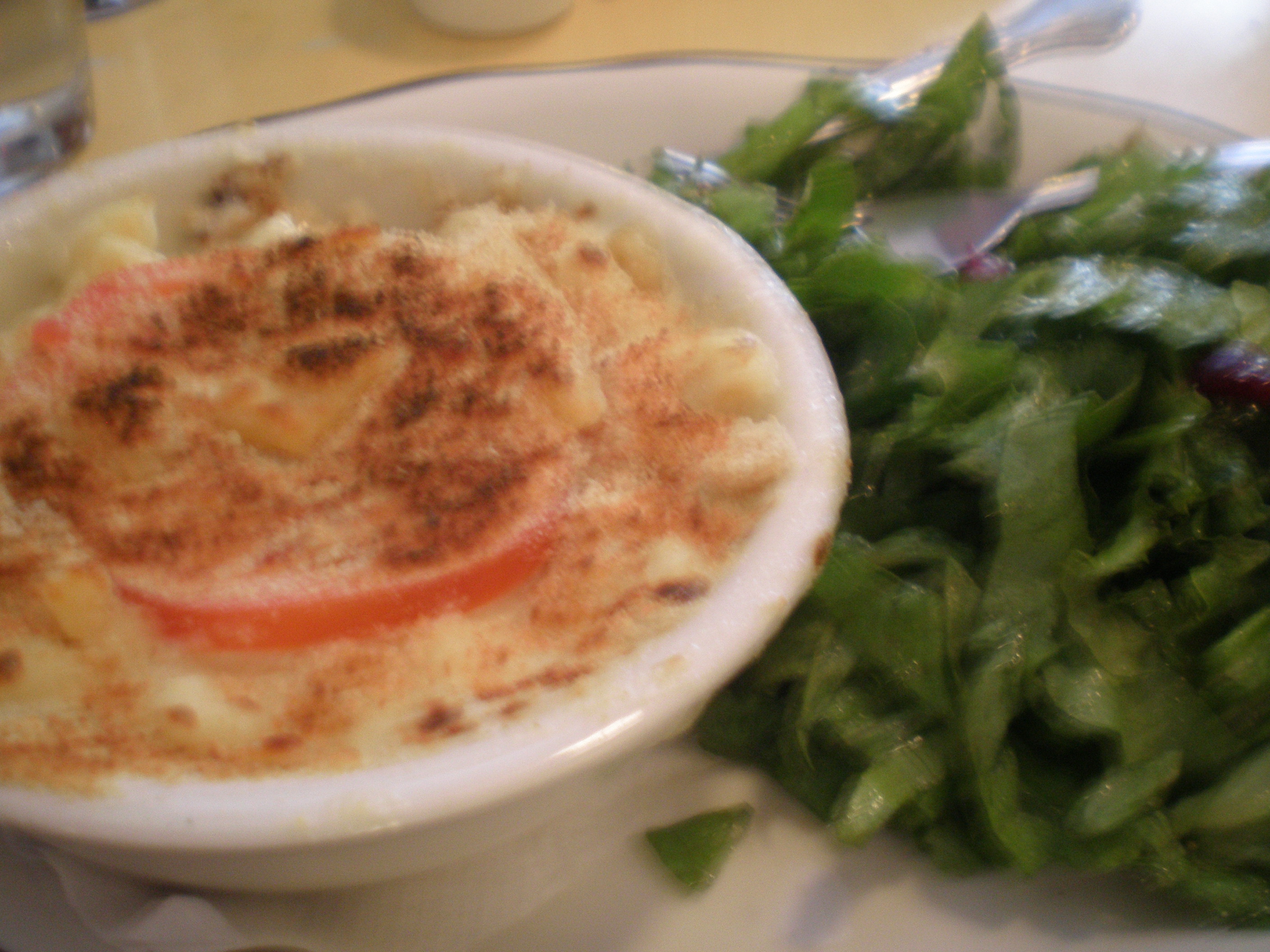
I ended up getting the Mac & Cheese.  It wasn’t quite as good as the one made at Chat’n’Chew, but I loved that they put tomato on it—just the way my mom serves it.

For dessert, my sister and I split a Peanut Butter Blondie, and I had a latte.  So good!

Next time, I’d like to come for brunch.  Their Nutella French Toast sounds amazing.

When Jennifer Potenza opened the restaurant in 2003, she named it after her pet turtle.

Fans of Greek literature, though, may remember that Penelope is also the name of Odysseus’ faithful wife in The Odyssey.  While much of the action in Homer’s epic poem revolves around the adventures of cunning Odysseus, who fends off the Cyclops and the sexy Sirens, it is also a story of profound love.  There’s no reason for Penelope to believe that her husband has survived when, days turn into years and still Odysseus has not returned from the Trojan War, and yet Penelope remains faithful to Odysseus by refusing to accept offers from any of the one hundred (108 to be exact) suitors that come into her life.

Twenty years later, Odysseus returns.  Penelope doesn’t believe it’s him at first, and it’s only after he tells the secret that only he and she knew about how part of their bed is made from an olive tree that she believes it is truly him.

One can pick out Penelope in artwork because artists depict her at a loom and with her legs crossed.

Gripster: Can Greeks and Hipsters Coexist?

28 Jan

All that talk about Portlandia made me wonder what the Greek population in Portland is like.

According to census data from, oh, about a decade ago, .5% of the population in Portland is Greek.  The Pacific Northwest city has its fair share of Greek restaurants and holds one of the biggest Greek festivals in the country.  Still, Zest reports that the hipster movement is pushing out at least one Greek diner.

Can Greeks and hipsters coexist in Portland?

Well, he predates the aughts’ hipster culture, but Art Alexakis is at least one example of a Greek-American—and a Christian—who came out of the alternative arts culture of Portland.  Although he’s originally from Los Angeles, it wasn’t until Alexakis moved to Portland that he formed the 90s band Everclear.

The Quotable Greek: I Know Nothing

24 Jan

One thing I know, that I know nothing.

This is the source of my wisdom.

~Socrates

Gripster: Portlandia, Hipsters, and Greek Myth

21 Jan

The new IFC series Portlandia has been getting major press.  My eyes have been rattling around in my head, they rolled back so far.  Are hipsters still in?

But, after seeing this clip about how in Portland the dream of the nineties is still alive, I’m amused.  Plus, I love Fred Armisen.

Portlandia is also the name of a sculpture located at the entrance of the Portland Building (1120 SW 5th Avenue, in Portland, Oregon).  Sculpted by Raymond Kaskey, it’s based on Portland’s city seal, which features a woman, the Queen of Commerce, in Classical garb, brandishing a trident.  Wikipedia quotes The Morning Oregonian as stating on March 22, 1878, that the lower portion of the seal contains a wreath of myrtle.

Sound familiar?

The Greek muse Erato was often portrayed wearing a wreath of myrtle and roses.  Interesting, since Portland is none other than the City of Roses.  Erato, the muse of lyric poetry, is often depicted carrying a lyre; however, Portlandia carries a trident, which is the traditional symbol of the Greek god Poseidon.  The irony here is that with its sheaf of grain, the city seal was supposed to recognize Portland’s agrarian, which a pitchfork would have symbolized.  The similar-looking trident symbolizes fishing, and Poseidon used it to wreck havoc on the land by creating earthquakes.  Of course, the Queen of Commerce is standing by a body of water so perhaps she is also Queen of the lower Columbia River.

Another possibility is that Portlandia is based on the Greek goddess of love and beauty Aphrodite.  Aphrodite is often depicted with myrtle and roses.  She is often positioned by the sea, but she holds a scepter instead of a trident.  Aphrodite is the Greek incarnation of the Phoenician goddess Astarte, whose symbol is the star.  In the seal of Portland, a star hovers above the Queen of Commerce.

It’s interesting the way Greek mythology resurges, insinuating itself in pop culture.  Does this mean we might be seeing Greek hipsters—Gripsters—in Portlandia?

Portlandia airs tonight at 10:30 on IFC.

Vasilopita Cutting at the FOS Kick Off

18 Jan

I recently wrote an essay that involved an experience I once had at a vasilopita cutting.  I look forward to sharing it with you sometime in the future.  In the meantime, I want to encourage you to come out to the vasilopita cutting at the FOS kick-off party Thursday night, January 20, 7-9 PM, at Kellari Parea.

In addition to the vasilopita cutting, there will be savory appetizers and a cash bar.  Admission is $25 in advance and $30 at the door.  $100 makes you an event sponsor.  Kellari Parea is located at 36 E. 20th Street in Manhattan.

The kick-off event will present Faithbook: The Orthodox Church as the Ultimate Spiritual Network as the next series topic for FOS, a Greek Orthodox fellowship led by Father Frank Marangos at Holy Trinity Cathedral.

You can listen to an interview about FOS at Radio NEO.

Throwing Crosses in the Hudson River

12 Jan

I once saw a priest in Brooklyn throw a cross into the muddy waters of the Hudson.  It was a frigid January day, yet a bunch of boys jumped into the river to save the cross.

What would possess a priest to throw a cross into the river?

Theophany; or, as most westerners call it, Epiphany.

The word “Theophany” comes from the Greek “τα Θεοφάνια,” which means “appearance of God,” and January 6 is the feast day that commemorates the incarnation of Jesus.  It celebrates His birth and baptism.

When St. John the Baptist baptized Jesus in the Jordan River, the heavens opened up and the Holy Spirit descended like a dove.  God spoke from the heavens, saying, “This is my Son, whom I love; with him I am well pleased” (Matt 3:17, NIV).  It marked one of the very few times that all three characters of the Trinity—Jesus, the Holy Spirit, and God—revealed themselves at the same time to man.

Jesus’ baptism marks His first step toward Crucifixion, according to Orthodox theology.

And so, on January 6, Orthodox priests throughout the world throw crosses, symbolic of Jesus’ crucifixion, into bodies of water, symbolic of His baptism.  This is called the Blessing of the Waters.  Volunteers jump into the water to retrieve the cross.  The priest, according to tradition, prays a blessing on the person who gets to the cross first and brings it back to him.

Happy New Year! Happy New Blog!

4 Jan

Happy New Year!  Καλή χρονιά!  I suppose it’s rather cliche to start a blog in the new year, but I’ve been talking about doing this for a while and a new year seems to have given me the impetus I needed.  Let me tell you a little about why I’m blogging and what you’ll find here.

I’m looking forward to sharing my journey as a writer and editor with you.  I’m currently working on a few different projects.  One of the ones I’m most excited about sharing with you is my memoir about growing up Greek-American.  Whether you’re Greek, Greek-American, a hellenophile, or interested in cross-cultural exchange of any sort, you’ll hopefully find my upcoming project interesting and informative.  As this blog gets underway, I’ll collect inspiring quotes by Greek writers and philosophers, let you know about upcoming Greek events and news, and share some memories with you that might just fall under the category of embarrassing.

Having worked as a professional writer and editor for over ten years now, I also have a multitude of other interesting projects I’m involved with.  Feel free to check out the clips section to sample previous articles on such obsessions as the Beat Generation, The Hold Steady, traveling, and visual arts.  Whenever I publish something new, I’ll be sure to share the news with you in the blog.

I also hope this blog will be encouraging and useful for fellow writers and those interested in the writing process.  You’ll get a behind-the-scenes look at what I’m thinking about as I write.  Some of the entries will deal with the practical issues of style and substance and other entries will mean to inspire, support, and create a community of writers and readers.

Please feel free to leave your thoughts and questions for me, about what I’m writing, and about the writing life in the comments section.  I’d love to hear what you’re writing and reading too!

Looking forward experiencing 2011 with you!

Luv ya heaps,

Stephanie