A Collage of Art and Literature at the Guggenheim
14 AugPictures from Allen Ginsberg’s Birthday Party at Poet House
18 JunVideo from David Amram & Co.’s Inspiring Show at Cornelia Street Cafe
15 Jun“Every day is an experience. Every day is an adventure.”
“Pay attention to anybody and everybody, and you’ll be amazed at what you can learn.”
It’s Walt Whitman’s 196th Birthday! …Or a Post that Includes References to President Lincoln and Bon Jovi
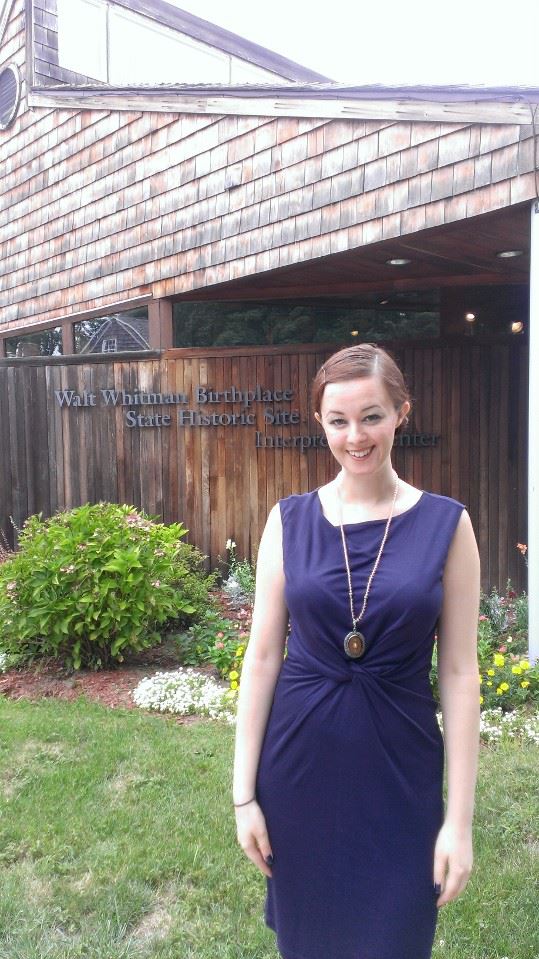
31 MayHere I am in 2013 standing outside Walt Whitman’s Birthplace State Historic Site and Interpretive Center in Long Island.
Walt Whitman was born on May 31, 1819, in Huntington, Long Island. He’s best known for Leaves of Grass. American schoolchildren are probably most familiar with the poem “O Captain! My Captain!” from the poetry collection. Written in 1865 and not included in Leaves of Grass until the fourth edition, the poem is about the death of President Abraham Lincoln.
There’s so much more to Whitman than that, though.
Walt Whitman is a complex and endlessly fascinating figure of the American poetry scene. He is regarded as the father of free verse poetry. He was also a reporter. He wrote a temperance novel: Franklin Evans (1842). He didn’t believe that all the works attributed to Shakespeare were actually Shakespeare’s. (Hm… what would Miguel Algarin say?) He at first called for the abolition of slavery … and then later thought the movement was a threat to democracy. He’s been inducted into the Legacy Walk, which celebrates LGBT history and people. He passed away in Camden, and the Garden State claimed him in the New Jersey Hall of Fame; that same year (2009), fellow literary luminaries William Carlos Williams and F. Scott Fitzgerald were inducted in the category of “general” while Whitman was inducted in the category of “historical.” (Jon Bon Jovi was one of the inductees honored in the category “arts and entertainment.) Andrew Carnegie said Whitman was “the great poet of America so far.”
“So far.”
Has any other “great poet of America” come along who has taken Whtiman’s place? It’s difficult to say, but this week we’ll be honoring the Good Gray Poet and talking about the poets that have been inspired by him.
Yep! You guessed it. The Beats.
Christina Rossetti and Jack Kerouac Describe the Sound of the Sea
30 AprAs April closes out, I dream of warmer days spent reading poetry by the sea. I think of Jack Kerouac captivated by the sound of the Pacific Ocean in Big Sur, the poem “Sea” he wrote about it and how his friend and fellow poet Lawrence Ferlinghetti influenced the poem.
Years earlier, Gothic poet Christina Rossetti had written that the sea sounds like moaning.
Christina Rossetti’s “By the Sea”
Why does the sea moan evermore?
Shut out from heaven it makes its moan.
It frets against the boundary shore;
All earth’s full rivers cannot fill
The sea, that drinking thirsteth still.Sheer miracles of loveliness
Lie hid in its unlooked-on bed:
Anemones, salt, passionless,
Blow flower-like; just enough alive
To blow and multiply and thrive.Shells quaint with curve, or spot, or spike,
Encrusted live things argus-eyed,
All fair alike, yet all unlike,
Are born without a pang, and die
Without a pang, – and so pass by.
What does the sea sound like to you?
Robert Frost, Jack Kerouac, Gregory Corso, and the Road Not Taken
16 AprIn honor of National Poetry Month, I wanted to share some poems.
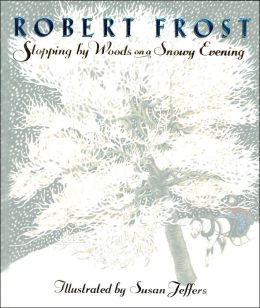
I write a lot about the road. I write about Jack Kerouac’s On the Road and even wrote a whole book about it called Burning Furiously Beautiful. When I was much younger, though, all the way back in elementary school, I encountered Robert Frost’s “The Road Not Taken.” Here it is for your reading pleasure.
Robert Frost’s “The Road Not Taken”
Two roads diverged in a yellow wood,
And sorry I could not travel both
And be one traveler, long I stood
And looked down one as far as I could
To where it bent in the undergrowth;
Then took the other, as just as fair,
And having perhaps the better claim,
Because it was grassy and wanted wear;
Though as for that the passing there
Had worn them really about the same,
And both that morning equally lay
In leaves no step had trodden black.
Oh, I kept the first for another day!
Yet knowing how way leads on to way,
I doubted if I should ever come back.
I shall be telling this with a sigh
Somewhere ages and ages hence:
Two roads diverged in a wood, and I—
I took the one less traveled by,
And that has made all the difference.
Frost begins his poem, “Two roads diverged in a yellow wood, / And sorry I could not travel both.” It reminds me of the Gregory Corso quote: “If you have a choice of two things and can’t decide, take both.” It’s not always that easy, though, is it? You can’t always choose to go both left and right at the same time. You can’t always choose to stay and to go. Sometimes you have to make a choice.
Robert Frost says, “I took the one less traveled by.” And that’s certainly what Jack Kerouac, Gregory Corso, and the many other poets and writers associated with the Beat Generation did. They choose the road less traveled.
Choosing the road less traveled is not an easy choice, though. It is an unfamiliar one. It is one without precedent. It comes with risk.
Sometimes, though, it’s worth it. It can’t be a reckless risk. It must be, as my father would say, a calculated risk.
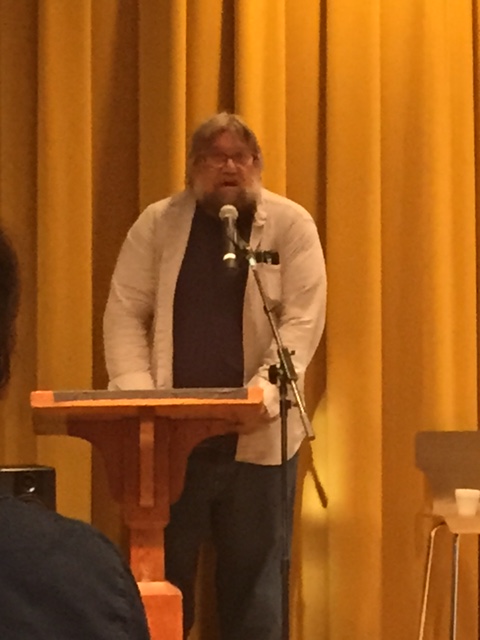
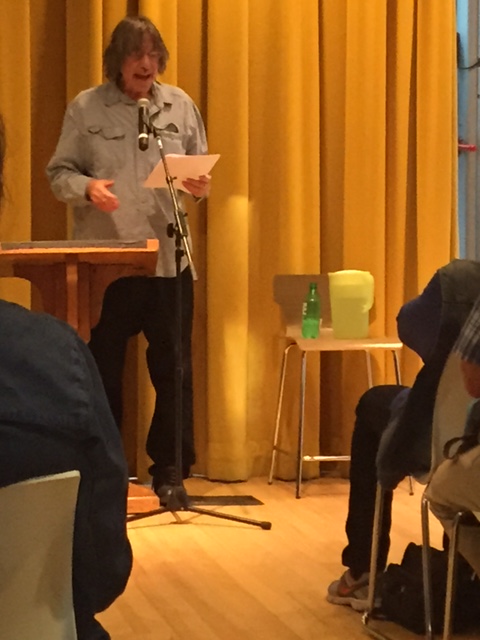
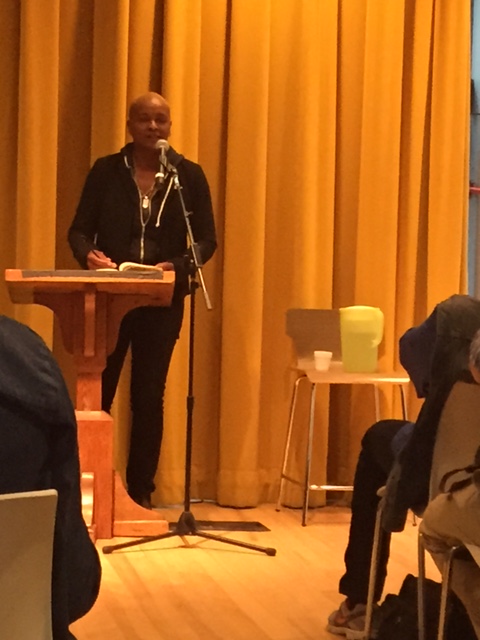
Anne Waldman, Penny Arcade, Jan Herman, Steve Dalachinsky & Aimee Herman Read Burroughs 101!
15 MarAttending Three Rooms Press’ Burroughs 101 celebration at Cornelia Street Cafe has become an annual event for my friend and me. Last year’s phenomenal readings culminating in an epic communal reading brought the spirit of Burroughs and the Beat Generation to life, and it was no surprise that this year there were even more people in the audience than at the centennial event.
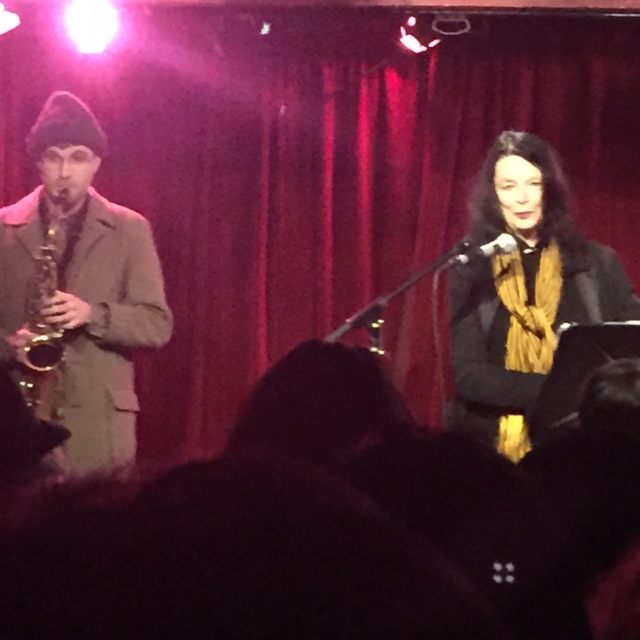
Anne Waldman is captivating. I cannot keep my eyes off her when she recites her poetry. I can’t even call what she does “reading.” She sings, chants, tells stories. It’s deeper than performance. It’s like she becomes the poem. I heard her read at the First Blues event honoring Allen Ginsberg’s work at Housing Works. With Ginsberg, she founded the Jack Kerouac School of Disembodied Poetics at the Naropa Institute in Boulder, Colorado. She was also friends with William S. Burroughs so it felt special to hear her read her friend’s work. Her son, Ambrose Bye, accompanied her at the Burroughs 101 event, weaving jazz music throughout her poetry. I definitely want to see them perform together again.
Any time I get a chance to hear Steve Dalachinsky read I jump at the opportunity. The first time I ever heard the New York poet read was actually the first time I ever attended Lowell Celebrates Kerouac. After that, I ran into him at various other readings, but I am naturally shy and hate to appear fan-girlish so I was nervous about introducing myself. Fortunately, David Amram introduced me to Steve and his wife, poet Yuko Otomo, on my second trip to Lowell Celebrates Kerouac, so now I always enjoy catching up with Steve and Yuko when I see them. Steve does amazing jazz-poetry, and I tend to prefer hearing him read his own work, but he has such a reverence for Beat poetry that he gives reverence to Beat events that could otherwise come out cultish or immature.
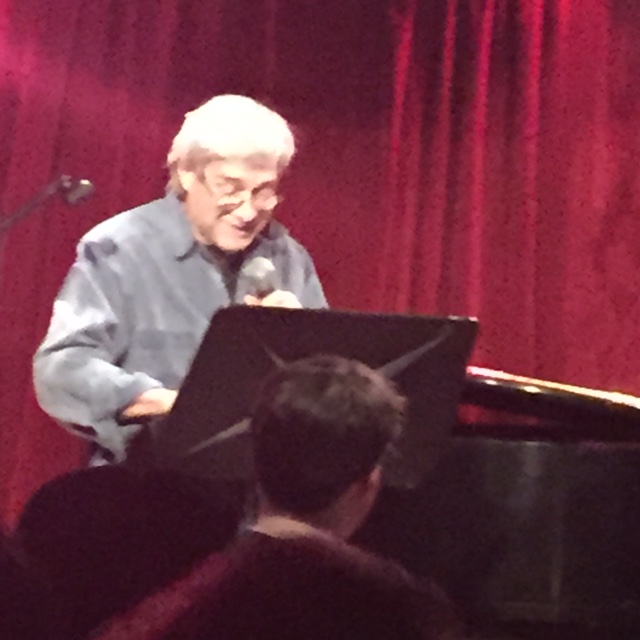
Jan Herman is a scholar. He’s someone I’d like to just sit down in a coffee shop with and listen to him talk and tell stories. And that’s what he did at the Burroughs 101 reading. In a conversational approach, he told stories about Burroughs.
Aimee Herman kicked the evening off, bringing Burroughs’ rebellious and experimental spirit to life at Cornelia Street Cafe as she ripped up poems as she read. Burroughs, as most know, cut up his writing and rearranged it to form his work. Aimee Herman’s reading succinctly captured Burroughs’ literary methodology in that simplistic and stunning gesture.
Penny Arcade is an authentic poet on the scene since I was old enough experience the contemporary New York poetry world. She closed the evening by reading Burroughs’ aphorisms. It was the perfect ending to a perfect reading.
The Burroughs 101 celebration was hosted by Three Rooms Press’ very own Peter Carlaftes.
Happy 99th Birthday, Robert Lax!
30 NovRobert Lax was born on this day in 1915 in Olean, in the Southern Tier region of New York.
Lax studied poetry with Mark Van Doren at Columbia University and graduated in 1938, right before Jack Kerouac arrived on campus. Similarly, they both took on a life of wandering. Lax worked for some prestigious magazines — The New Yorker and Time — and then joined the circus as a juggler.
Eventually, he found his way to the Greek island of Patmos. The island is known as a place of pilgrimage, as the apostle John had lived there. Lax himself went on to live here for more than thirty years, living the life of a hermit and writing beautiful poetry.
Kerouac indeed did end up getting in contact with his fellow alum. You can read his letter to him in Jack Kerouac: Selected Letters, 1940-1956.
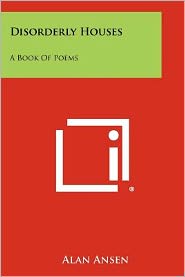
Remembering Alan Ansen
12 NovOn this day in 2006 we lost Alan Ansen.
Today we celebrate his life and work. Ansen, a graduate of Harvard, was secretary to none other than the great W. H. Auden, who had come to New York City in 1939. He hung out with Jack Kerouac, William S. Burroughs, Allen Ginsberg, and Gregory Corso, and is even written into their works. By the 1960s, he had moved to Greece, where he lived on Alopekis Street in Athens, and hung out with other expatriate poets such as James Merrill (who went on to get the Pulitzer Prize in Poetry in 1977), Chester Kallman (one of Auden’s lovers), and Rachel Hadas (who went on to receive the Guggenheim Fellowship).
Ansen passed away in Athens at the age of eight-four, but leaves behind his poetry and prose. Check out:
I think reading someone’s work is one of the best way to celebrate their life. Do you have a favorite poem by Ansen?