Archive | April, 2011

Is the Greek Flag More Prominently Displayed than Other Country Flags in the US?

5 Apr

Since we’ve been chatting about how the revolutionary flag was raised at Agia Lavra, I thought it would only be appropriate for us to talk next about the Greek flag itself.

When I was a kid, there used to be a house in Paramus that had a giant Greek flag painted on its garage.  Greeks love to show off their flag.  I don’t think I’ve ever seen another country flag so readily displayed in America.  I’ve seen the United States flag, the Confederate flag, and the flag of California (mainly on t-shirts), but I’ve rarely seen a non-US flag in America as often as I’ve seen the Greek flag.  We like our flag.

But how many of us actually know the meaning behind the Greek flag?

Galanolefki, “blue-white,” is the name of Greece’s flag.  Although no documents exist that explicitly state the reason for the chosen colors, most people agree that the blue is for the color of the Mediterranean Sea and the white is the waves.  Some have also suggested the blue and white are for the Greek sky.

In the upper left of the Greek flag is a white Greek cross on a blue background.  The Greek cross, also known as crux immissa quadrata, is perfectly parallel: all four arms are equal length.  Kind of like the symbol of the Red Cross.  The cross is, of course, representative of Greece’s Greek Orthodox faith.

In addition to the cross, the Greek flag hosts nine alternating blue and white horizontal stripes.  The top and the bottom stripes are both blue.

Remember how the Greeks shouted “Ελευθερία ή θάνατος” at the start of the revolution?  Well, popular theory has it that the nine stripes of the flag correspond to the nine symbols of the phrase: ” E-lef-the-ri-a i Tha-na-tos.”

Another theory is that the nine stripes stand for the nine letters in “Έλευθερία,” the Greek word for “freedom.”

It’s really quite beautiful when you understand the significance of each part of the Greek flag.

*  *  *

Ever wonder what it would be like to design your own flag??

April Books by Greek-American Authors

4 Apr

When you think Greek literature, what do you think?  Homer’s The Odyssey? Plato’s Republic?

I often worry that the world at large does not recognize contemporary Hellenic literature.  This month, though, we see two books by famous Greek-American comedians turned Greek-American authors.


Bossypants by Tina Fey

A few years ago, when Christopher Hitchens said that women aren’t funny, he said it with the caveat, “there are some impressive ladies out there. Most of them, though, when you come to review the situation, are hefty or dykey or Jewish, or some combo of the three.”  That was in 2007.  By then, Tina Fey had already showed the world her comedic chops by following up her “Weekend Update” skit on Saturday Night Live with another hit: 30 Rock.  Last year she became the youngest person ever to win the Mark Twain Prize for American Humor.

In a recent interview, Fey actually said that it was only after she lost weight that she was able to move from comedy writer to comedy actress.

Tina Fey is a Greek-American by birth.  Her given name is Elizabeth Stamatina Fey.  Her 2001 wedding to Jeff Richmond was held in a Greek Orthodox Church.

She—and a lot of other women—proved Hitchens wrong on all three counts.  And now she has a memoir coming out that lets you step into the life of this very funny Greek-American woman.


Look for it: April 5


This Is a Book by Demetri Martin

Books by comedians usually go one of two ways: either really funny or really sad. Demetri Martin goes funny in his first book, a collection of short stories.  Martin, known for his work on “The Daily Show” and Comedy Central’s “Important Things with Demetri Martin,” was born in New York City and grew up in Toms River, New Jersey.  His dad, Dean C. Martin, is a Greek Orthodox priest.  Martin’s Greek heritage plays into his comedy and writing.

Kirkus Review notes that in “Socrates’s Publicist,” one of the short stories in Martin’s upcoming book, “imagines the deadly consequences of the Greek philosopher acquiring a chirpy PR rep eager to brand him and bring his “question thing” to a wider audience.”

Look for it: April 11

A Chat with My Editor Brings Exciting News

1 Apr

Had a great chat with my former editor last week.  He told me about some great events at Cornelia Street Café;  I told him about a reading by a political prisoner I attended at The New School.

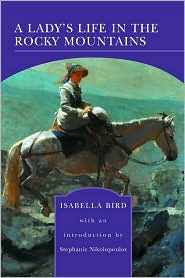
He also let me in on some exciting news::: the ebook edition of A Lady’s Life in the Rocky Mountains—letters by Isabella Bird, introduction by yours truly—is currently one of his bestsellers!


Obviously, I’m happy on a personal and professional level, but I’m also happy because Isabella Bird’s story is so beautiful and inspiring and it deserves a wider audience.  The short of it is that Bird left the comforts of home in Victorian England to travel by herself through the rough terrain of America’s Rocky Mountains.  As I wrote in my introduction to the book, “Whether you’re interested in nature, the history of the Rocky Mountain region, travel writing, Christianity, or women’s studies, Bird’s simple yet provocative letters will entertain your imagination.”

I’d say that’s worth the $1.99 for the nook book!