Archive | Beat Generation RSS feed for this section

Blogiversary: Greeks Beat Kerouac in 2012

10 Jan

greek-greece-flag_pink

January 1 marked the anniversary of my blog! Thank you all for your support and encouragement of my writing and blogging. It means so much to me that you take the time to read and comment on my blog entries.

I just reviewed a report of my year in blogging, and it’s been a good year!

Here’s a recap of my most viewed posts of 2012:

Notice anything interesting? They all have to do with Greece, and four out of five of them have to do with Greek beauty and fashion. Despite the fact that most of my blogging efforts this past year were about Jack Kerouac, not a single Kerouac-related entry made it into the top 5.

Two out of the above-mentioned blog posts didn’t receive any comments, despite being popular views. My most commented on post of the year was:

That just goes to show you that comments and views aren’t necessarily correlated.

What were your favorite posts from 2012?

The Light Holds Harvey Shapiro

8 Jan

9780819560964_p0_v1_s260x420

I have just learned that Harvey Shapiro passed away yesterday.

Shapiro, whose first language was the endangered language of Yiddish, is the person who suggested Martin Luther King, Jr., compose a letter while he was in jail. The result was “Letters From Birmingham Jail,” which Shapiro wasn’t able to get published at The Times Magazine, where he was editor, but which was published by The Christian Century, among others.

Shapiro was a poet in his own right, crafting poems both witty and profound and oftentimes reflecting on life in New York City. Born in 1924 and obtaining his master’s degree in American literature from Columbia University in 1948, he was a contemporary of the Beats. He served in World War II and edited the volume Poets of World War II.

I had the good fortunate of hearing him speak at McNally Jackson Books two years ago. One of the big takeaways I had was that one must persevere in writing. Here was someone who even in his eighties was still engaged in the literary community and encouraging writers.

Sneak Peek of Burning Furiously Beautiful: Early Version of “On the Road” Tells Kerouac’s Mom’s Story

8 Jan

528764_288645227899680_240973182_n

From chapter 1 of Burning Furiously Beautiful: The True Story of Jack Kerouac’s “On the Road,” the book I’m coauthoring with Paul Maher Jr.:

In an unpublished prose fragment, Jack Kerouac incorporated his mother and father’s French-Canadian heritage into one version of his road novel. It was centered on his mother’s birth using the pseudonym of Gaby L’Heureux. Gaby’s pregnant mother unwisely took a long journey by train to visit relatives in St. Pacome in the Quebec province of Canada. Gaby’s mother, though poor, was pure at heart, according to Kerouac. She gave birth to a set of twins before dying in her bed. Gaby survived but her twin did not. Gaby’s widowed father, Louis L’Heureux, who stayed home in Nashua, tended a gloomy bar. Outside, staring at the canopy of stars reeling over him, he adjusted his collar, securing himself unwittingly for one more cruel “blow” to his life.

The mother’s body was brought back to Nashua accompanied by her Aunt Alice and the infant Gaby. Kerouac captured in this bit of wrtiting how the train moved through the New England countryside, and how the Merrimack River wended its way through New Hampshire, a land once inhabited by Algonquin Indians waiting for “life.”

Gaby’s piercing cries irritated the travelers, and she was unaware of the life all around her. At the train station, her father took her in his arms, and he looked down to her adoringly. Alice predicted that they would never be without troubles: “Life is sad, O my love….”

This was first posted on the book’s Facebook page. For the latest, check out our page!

Happy 169th Birthday, Saint Bernadette!

7 Jan

Saint Marie-Bernarde Soubirous was born on this day in 1844 in Lourdes, France.  She saw a vision of Mother Mary, who spoke to her in Gascon, which is now an endangered language.  The visions inspired the Grotto of Our Lady of Lourdes in Lowell that Jack Kerouac writes about.  You can read about this famous landmark, where Bob Dylan, Jackie O., and Allen Ginsberg also visited in my Church Hopping column on Burnside Writers Collective.


New Year’s Eve with Jack Kerouac

1 Jan

9781101201572_p0_v1_s260x420

“The parties were enormous; there were at least a hundred people at Herb Benjamin’s basement apartment in the west nineties. People overflowed into the cellar compartments near the furnace. Something was gong on in every corner, on every bed and couch, not an orgy, but just a New Year’s party with frantic screaming and wild radio music.”

You can read the whole story beginning with Neal Cassady driving Jack Kerouac’s mom back to New York for New Year’s Eve, on page 225 of On the Road: The Original Scroll, published by Penguin Books in 2008.

The recent film adaptation of On the Road does a splendid job capturing the energy at the New Year’s Eve party. Burning Furiously Beautiful: The True Story of Jack Kerouac’s “On the Road,” the book I’m coauthoring with Paul Maher Jr., tells the true-life events that inspired this story.

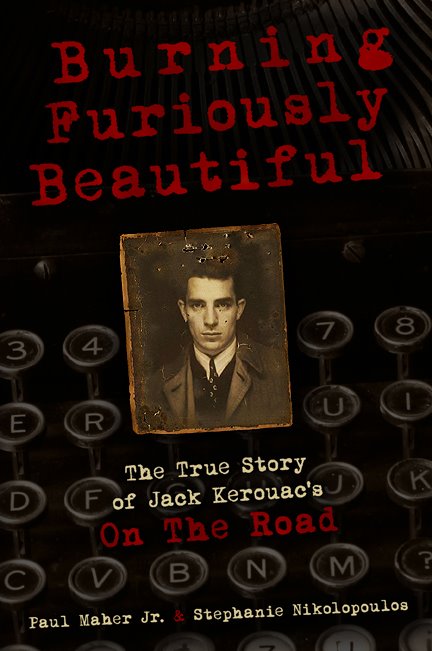
Proof Copy of “Burning Furiously Beautiful: The True Story of Jack Kerouac’s ‘On the Road'”

26 Dec

312640_349018201862382_1931916268_n

Paul took this photo of our book Burning Furiously Beautiful: The True Story of Jack Kerouac’s “On the Road.”  As you can see, it’s all laid out now! It was really important to me that the book not only contain great content but that it also was visually appealing. I love that typewriter font!

The book will be out soon! In the meantime, we’re posting lots of fun content on the book’s facebook page.

Christmas with Jack Kerouac

24 Dec

OLYMPUS DIGITAL CAMERA


I spotted this festive train outside the National Streetcar Museum when I was in Jack Kerouac’s hometown of Lowell, Mass., earlier this month.

Looking for a Kerouac-related Christmas story? Here’s a snippet from the scroll version of On the Road in which Kerouac describes his Christmas:

“At Christmas 1948 my mother and I went down to visit my sister in the South laden with presents. I had been writing to Neal and he said he was coming East again; and I told him if so he would fine me in Rocky Mount, North Carolina, between Xmas and New Year. One day when all our Southern relatives were sitting around the parlor in Rocky Mount, gaunt men and women with the old southern soil in their eyes talking in low whining voicss about the weather, the crops and the general weary recapitulations of who had a baby, who got a new house and so on, a mud spattered ’49 Hudson drew up in front off the house on the dirt road….”

You can read the whole story beginning on page 212 of On the Road: The Original Scroll, published by Penguin Books in 2008.


Jack Kerouac’s Angry Postcard to His Editor

24 Dec

In 1956, Viking Press expressed an interest in Jack Kerouac’s On the Road.  The author had been writing and rewriting his novel for years, and Kerouac was growing impatient as it languished in the publishing house.  He was working with an editorial consultant named Malcolm Cowley, who had first gained renown for his 1929 book of poetry Blue Juniata before writing one of the first books about the Lost Generation.  Having been associated with the Lost Generation, it in many ways made sense that he was attracted to the Beat Generation.

By the 1940s he was editing Viking Portable editions.  He championed the work of William Faulkner, F. Scott Fitzgerald, Walt Whitman, Ernest Hemingway, and John Cheever.  His interest in Kerouac’s On the Road is important to literary history.  What many people forget is that Kerouac was already an established novelist before On the Road.  He’d written a semi-autobiographical novel entitled The Town and the City that got respectable reviews with comparisons to Thomas Wolfe but which tanked when it came to sales.  Kerouac had literary contacts, but selling On the Road still wasn’t easy.  Cowley was interested but took his sweet time getting back to Kerouac.

On July 9, 1956, Kerouac sent him a postcard depicting the Lower Falls in Yellowstone National Park threatening to sell On the Road elsewhere if he didn’t receive his contract and advance from Viking.  You can read Kerouac’s postcard to Malcolm Cowley (as well as 14 other postcards from authors) at Flavorwire.

Titles Impact Sales: The Many Titles of On the Road

20 Dec

At the premiere reading of Burning Furiously Beautiful: The True Story of Jack Kerouac’s On the Road, I read a section from a chapter that mentioned that Kerouac titled an early draft of his road trip novel Gone on the Road.  Isn’t it amazing how one word can completely change the perception of a work?

What I didn’t mention at the reading is that this wasn’t the only incarnation of the title.  At another point, Kerouac considered changing the title so that it reflected the rock music that was emerging at the time.  Considering how influential jazz music was on his writing style and on the content of the book, it’s better that the title wasn’t changed just to capture a certain market.  It’s always better to remain true to your voice and vision.

The title On the Road is perfect.  And yet in another way it’s just so … obvious.  So literal.  I wonder if his work were being published for the first time today, if an editor would change the title to something flashier.

List of Reviews of “On the Road”

19 Dec

OTRstill

[official film still from On the Road]

Yesterday, I posted my review of the On the Road film adaptation. As LeVar Burton used to say on Reading Rainbow, “But you don’t have to take my word for it.” Here are some other reviews of the film On the Road:

The Beat Museum: “Everyone knows a  book is not a movie and a movie is not a book.  The genius of Jack’ Kerouac’s novels is his prose. It’s not the story, it’s not even the relationships, it’s the prose with the language that he uses to sketch the scene to move the story and to describe the relationships.”

Buzz Sugar: “The plot at times drags, but there is so much energy in the production that I didn’t mind. … This is the role Sam Riley has been waiting for — he’s talented and looks great on screen.”

The Film Pilgrim: “Where Salles really shines is the party/drug scenes, capturing the beatnik life style beautifully.”

Film School Rejects: “For a tale which so obviously values hedonism and free expression, On The Road is ultimately joyless and unengaging, and for a self-discovering road movie to fudge the journey so much and lose almost all lasting meaning is downright criminal.”
The Guardian: “The film is stiflingly reverent towards its source material, and indeed towards itself. It’s good-looking and handsomely produced, but directionless and self-adoring, richly furnished but at the same time weirdly empty, bathed in an elegiac sunset glow of male adoration.”
Hollywood.com: “Incorporating more of Kerouac’s writing as voice-overs or something similar would have given it more life, the kind of vivacity Kerouac sought out in spades, which is why he tolerated Dean’s vagaries for so long. More than most movies, it feels like On the Road could have gone in any direction, expanding or reducing characters, shortening the trips to concentrate on the characters more, emphasizing the effects of their missing fathers or not, and it’s this wishy-washiness that undermines the movie.”
The Hollywood News: “Visually, Salles’ ON THE ROAD is a thing of beauty. Eric Gautier’s cinematography is a wonder to behold: the colouring, the tracking of the characters, and the close quarters filming take the audience to Denver, New York and San Francisco like never before. The images conjured by Kerouac’s words come to life in a way never thought possible. But whilst it looks ravishing the film is full of problems, the first of which is a glaring problem: Hedlund is not Dean Moriarty.”
The Hollywood Reporter: “A beautiful and respectful adaptation of Jack Kerouac’s landmark novel that intermittently leaves the ground to take flight.”
Honi Soit: “Too often unnecessary scenes were included while others were not given the time to become poignant, such as Moriarty’s very brief search for his vagrant father in Denver. I’m happy to concede that part of the frenzy is intentional, to replicate the experience of its addled protagonists, but some tighter editing would not have gone astray.”
The Independent: “Walter Salles takes an orthodox approach to Jack Kerouac’s classic text. As with his adaptation of Che Guevara’s Motorcycle Diaries, Salles seems as preoccupied with the mundane as he is with the tales of threesomes, drugs and broken friendships.”
Indiewire: “The atmosphere of his travels comes first, establishing the book’s searching nature ahead of its loose plot. From that early point, “On the Road” adopts a serious, low-key approach to establishing Sal’s world that keeps the characters grounded.”

LitKicks: “Jack Kerouac would have loved this film version of On The Road.”

Movie News: “As a work of narrative semi-fiction, Salles’ version of Kerouac’s book is appropriately graceful, dirty, and enigmatic. He’s a sensitive director and a good storyteller. What doesn’t come across, though, is why the story matters. Who are these Beatniks?”

The NewStatesman: “Once the beats’ credo of philosophy and pharmaceuticals is established, the film starts noticing those people exasperated or excluded by the party. Sal and Dean may be kings of the road behind their scratched windscreen, but Salles is meticulous in balancing the ledger. There is no liberation in the film without suffering, no beat generation without its beaten-down counterpart (usually female).”

The New Yorker: “I found Garrett Hedlund’s teen-idol depiction of Dean Moriarty particularly unsatisfying. … Hedlund’s performance neuters the book’s animating Mephistophelian spirit.”
The New York Times: “The cinematographer Eric Gautier has done brilliant work elsewhere and doesn’t seem capable of taking a bad shot. But everything tends to look too pretty here — the scenery, sets and costumes included, especially for the rougher byways and more perilous interludes, like the Benzedrine nights that feel more opiated than hopped up.”
NPR: “In fact, any film in which all the characters seem utterly convinced of their own importance and coolness from the outset has the same battle. … There is the Ginsberg-like Carlo (Tom Sturridge), a character drawn here as so self-consciously writer-like that his every appearance inspires twitches. He actually says at one point, while pondering how to describe his feelings, ‘Melancholy’s too languorous!'”
Ropes of Silicon: “The tedious result of this adaptation of Jack Kerouac’s famed novel is, however, unfortunate considering Eric Gautier’s rich, smoke-filled cinematography, Walter Salles’s direction and stand-out performances from most of the cast.”
The Telegraph: “Despite its pretty cast and sun-ripened colours, the film quickly settles into a tedious looping rhythm of Sal Paradise (Sam Riley) experiencing some kind of beatnik debauchery with co-wanderers Dean Moriarty (Garrett Hedlund) and Marylou (Kristen Stewart), before retiring to a shady corner and scribbling wildly in a notebook.”
Time Out London: “Freewheeling spontaneity is tough to convey on screen, and the drink- and drug-fuelled carousing lacks Danny Boyle-style zing. But the bull-nosed cars, jazz soundtrack and soft light of a bygone era are a joy.”
Total Film: “Even if the film has a patchwork quality, Rivera’s script mines some much-needed humour from events – from Stewart giving new meaning to the phrase ‘two-hander’ to the priceless scene where Dean drives Sal’s mother back to New York.”
Variety: “Yet despite the high level of craft here, it’s an inadequate substitute for the thrilling, sustaining intelligence of Kerouac’s voice. Admittedly, any definitive adaptation would have to adopt a radically avant-garde approach to approximate the galvanic impact Kerouac’s novel had on literary form. But even audiences content with an easy-listening version may be put off by the weak conception of Sal’s inner life.”