Archive | Greekish RSS feed for this section

Feast of the Flowers

2 May

Greece’s Feast of the Flowers is not a literal feasting on flowers.  It’s a celebration of springtime, the hearth’s rebirth.  If you are interested in actually dining on flowers, though, there are a surprising number of options.

Gardenias, hibiscuses, jasmines, lavender, pansies, roses, and violets are among popular flowers that can be eaten and enjoyed.  Some may be an acquired taste, but the ones just mentioned tend to be the least offensive varieties.  About.com’s home cooking site offers some great introductory descriptions of edible flowers.  Please, please, please keep in mind though that some flowers don’t just taste bad—they’re toxic.  So be careful what you not only put in your mouth, but what you use to garnish your plates.

Edible flowers can be used in teas, liquors, and punches as well as in salads and on cakes and other pastries.

Diana Henry talks about the ancient uses of flowers and the contemporary use of cooking with flowers in Middle Eastern cooking in her article “Heaven scent: cooking with flowers” for the Telegraph.

You might be interested to know that many Greek pastries, such as kourabiedes, call for orange flower water.

Protomayia

1 May

We all know that April showers bring May flowers, but Greeks celebrate May 1 (also known as May Day, Labor Day, and Protomayia) with the enchanting Feast of the Flowers.

Revelers flee to the countryside on this national labor holiday to herald spring.  By May 1, most of the Greek islands are warm with gentle breezes and the mainland can even get hot.  It’s a marvelous day of picnicking and flying kites and enjoying nature.

People spend the day collecting flowers and turning them into wreathes.  There are even several flower festivals throughout Greece.

Light of the World

18 Apr

I think there’s probably a law against carrying an open flame in the subway.  I’m not sure.  But it’s a pretty safe bet.  This threw my Easter celebrations into flux last year.

Usually I spend Easter with my family in Baltimore.  Last year, though, Greek Orthodox Easter fell on the same Sunday as “American” (i.e., Protestant and Catholic) Easter, so I decided to stay in New York rather than deal with holiday traffic.

At the Cathedral, we lit candles to signify that now that Jesus is sitting at the right hand of God in heaven, we, the believers, are to be to the light to the world.  We carry our lit candles out of the church with us at the midnight Easter service, and shine them for all the world to see on our way home.  Up until last year, that had always meant carrying our lit candles into my uncle’s van.

Last year, though, I took the subway to the Easter service.  When I left the Cathedral, lit candle in hand, I realized I was more than twenty blocks from my apartment.  How could I get home with my candle still lit?

Surely, I’d get stopped if I tried to go in the subway.

What cabbie wouldn’t object?

I can never figure out the bus system, and it certainly wouldn’t be the solution anyway.

So, I hoofed it.  I got a lot of stares from passersby on my walk home.  At first, the masses coming from the Cathedral looked like we’d attended a vigil.  Or, maybe we were part of a weird cult.  As the crowd dispersed—east, west, uptown, downtown—we began to look like solitary candle holders.  Who were we?  Why were we carrying candles across city sidewalks in the middle of the night?

I’m glad you asked.

Spring Break ’11 Recap: I Got Sick

7 Apr

It’s been go, go, go for the past few months.  When spring break came around, I was so excited for the opportunity relax and have some fun.  I imagined I’d read in the Egyptian room at the Met.  I’d buy fresh veggies at the Union Square greenmarket.  I’d invite friends over for dinner.

Instead, I got sick.  I guess my body knew it could finally take a rest from the manic pace I normally put it through.

Before I got sick, though, I did have some fun.

I went with my sister and my friends Rachel and Fred to the FXB Speed-Networking for a Good Cause event at Sidebar, where I met some really cool people.  FXB, which has been around for twenty years, works to support children affected by poverty and AIDS.  They organize a lot of fun fundraising events for young professionals.

Afterward we met up with our photographer friend Annie and Carly, who was visiting from out of town.  We went to an amazing Japanese restaurant.  I seriously could not get enough of the green beans and corn.

The next day I spring cleaned my apartment. Woot!  Then my friend came over and we ate pizza and chocolate and watched Paper Heart and The Virgin Suicides (which is of course based on the book by Greek-American author Jeffrey Eugenides).

That kick-off weekend I also hopped on the bus and headed over to New Jersey, to have lunch with a friend.  I hadn’t seen her for a few months so we had one of those really good, drawn-out lunches and talked about everything.  So therapeutic.

Monday I met up with a friend and fellow Scripps alumna who works at MoMA.  We had lunch and then she gave me a tour of the Pictures by Women: A History of Modern Photography exhibit.  I learned so much more from what she told me than if I had been there by myself.  It was such an inspiring and monumental exhibit.

Then I went to the New York Society for Ethical Culture to hear what all the hoopla was about over Rob Bell and his new book.

By Tuesday I was sick and spent the rest of the time watching films like The Runaways on Netflix and reading Lydia DavisThe End of the Story.

Writing Wednesday: Greek Stereotypes — If You Can’t Beat ‘Em, Join ‘Em … Or Something Like That

6 Apr


“Stereotype” is a dirty word.  Stereotypes of ethnicities and races come with all sorts of negative connotations—the types of assumptions that are too dangerous to even give examples of, but you all know what I’m talking about.

I remember years ago learning that even “positive” stereotypes are negative.

Really?  How can that be?

I’ve been stereotyped.  Because of my last name, people make all sorts of assumptions about the literature I read and the language I speak.

“Did you read the new translation of The Odyssey?”

“Can you tell the class how to pronounce this Greek word?”

“I can’t remember who the god of wine is.  Stephanie, who was it again?”

If it happened once in a blue moon, it wouldn’t be a big deal.  But it happens often enough that it’s at times made me insecure in my identity.  Should I know that there’s a new translation of Homer’s epic poem?  What does it say about me that I don’t know?

Sometimes it works to my advantage, though.  I’ve received opportunities to write about Greek things by virtue of my ethnicity.  That is a positive, but it is also a negative.  Is that the only reason I was selected?, I can’t help but wonder….

“Why do you write about Greek things?” my mom, who is not Greek by blood, asked me.

My lit teacher has a theory that literature is reparative.  We write to rectify, to make ourselves whole.  She may be right.  I write about Greek things because I don’t feel as Greek as others seem to think I should—which makes me think I need to feel more Greek—and my writing seeks to explain, to justify, even to rectify.

Also, I figure if I can’t beat ‘em, join ‘em.  People have been making stereotypes about my interests and knowledge of Greece for decades.  That’s not likely to change.  The stereotyping comes from a good place: people love Hellenic history and Greek culture.  Why not give the people what they want?  After all, I like Greek culture too, even if I don’t always know as much about it as some people assume I do.

Is the Greek Flag More Prominently Displayed than Other Country Flags in the US?

5 Apr

Since we’ve been chatting about how the revolutionary flag was raised at Agia Lavra, I thought it would only be appropriate for us to talk next about the Greek flag itself.

When I was a kid, there used to be a house in Paramus that had a giant Greek flag painted on its garage.  Greeks love to show off their flag.  I don’t think I’ve ever seen another country flag so readily displayed in America.  I’ve seen the United States flag, the Confederate flag, and the flag of California (mainly on t-shirts), but I’ve rarely seen a non-US flag in America as often as I’ve seen the Greek flag.  We like our flag.

But how many of us actually know the meaning behind the Greek flag?

Galanolefki, “blue-white,” is the name of Greece’s flag.  Although no documents exist that explicitly state the reason for the chosen colors, most people agree that the blue is for the color of the Mediterranean Sea and the white is the waves.  Some have also suggested the blue and white are for the Greek sky.

In the upper left of the Greek flag is a white Greek cross on a blue background.  The Greek cross, also known as crux immissa quadrata, is perfectly parallel: all four arms are equal length.  Kind of like the symbol of the Red Cross.  The cross is, of course, representative of Greece’s Greek Orthodox faith.

In addition to the cross, the Greek flag hosts nine alternating blue and white horizontal stripes.  The top and the bottom stripes are both blue.

Remember how the Greeks shouted “Ελευθερία ή θάνατος” at the start of the revolution?  Well, popular theory has it that the nine stripes of the flag correspond to the nine symbols of the phrase: ” E-lef-the-ri-a i Tha-na-tos.”

Another theory is that the nine stripes stand for the nine letters in “Έλευθερία,” the Greek word for “freedom.”

It’s really quite beautiful when you understand the significance of each part of the Greek flag.

*  *  *

Ever wonder what it would be like to design your own flag??

April Books by Greek-American Authors

4 Apr

When you think Greek literature, what do you think?  Homer’s The Odyssey? Plato’s Republic?

I often worry that the world at large does not recognize contemporary Hellenic literature.  This month, though, we see two books by famous Greek-American comedians turned Greek-American authors.


Bossypants by Tina Fey

A few years ago, when Christopher Hitchens said that women aren’t funny, he said it with the caveat, “there are some impressive ladies out there. Most of them, though, when you come to review the situation, are hefty or dykey or Jewish, or some combo of the three.”  That was in 2007.  By then, Tina Fey had already showed the world her comedic chops by following up her “Weekend Update” skit on Saturday Night Live with another hit: 30 Rock.  Last year she became the youngest person ever to win the Mark Twain Prize for American Humor.

In a recent interview, Fey actually said that it was only after she lost weight that she was able to move from comedy writer to comedy actress.

Tina Fey is a Greek-American by birth.  Her given name is Elizabeth Stamatina Fey.  Her 2001 wedding to Jeff Richmond was held in a Greek Orthodox Church.

She—and a lot of other women—proved Hitchens wrong on all three counts.  And now she has a memoir coming out that lets you step into the life of this very funny Greek-American woman.


Look for it: April 5


This Is a Book by Demetri Martin

Books by comedians usually go one of two ways: either really funny or really sad. Demetri Martin goes funny in his first book, a collection of short stories.  Martin, known for his work on “The Daily Show” and Comedy Central’s “Important Things with Demetri Martin,” was born in New York City and grew up in Toms River, New Jersey.  His dad, Dean C. Martin, is a Greek Orthodox priest.  Martin’s Greek heritage plays into his comedy and writing.

Kirkus Review notes that in “Socrates’s Publicist,” one of the short stories in Martin’s upcoming book, “imagines the deadly consequences of the Greek philosopher acquiring a chirpy PR rep eager to brand him and bring his “question thing” to a wider audience.”

Look for it: April 11

Church Hopping: Agia Lavra

30 Mar

In case you missed it, here’s the link to my most recent Church Hopping entry on Burnside Writers Collective.  In this adventure, I bring you to Agia Lavra, the little church where the Greek revolution began.  Long before Facebook organized citizens, the Church was a place of social change.

2011 Greek Independence Day Parade

29 Mar

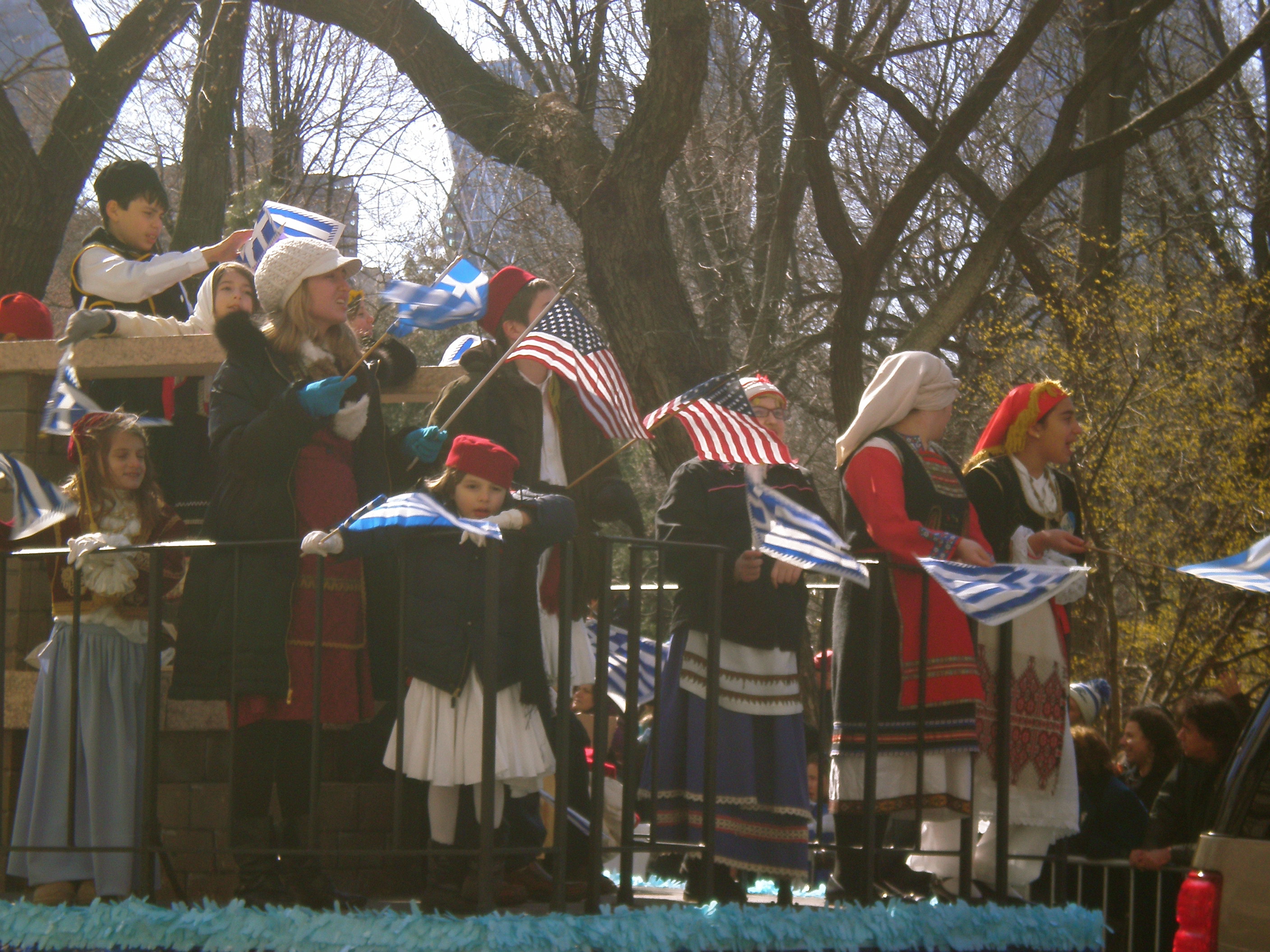
Who made it out to the parade on Sunday to celebrate Greek Independence Day?  My sister and I went after brunch.  It was a great day for a parade.  The sky was a bright, bright blue and the sun was shining.  It was a bit brisk to be standing on the sidelines, but I’m sure those marching in the parade enjoyed that it wasn’t hot out.

Our favorite part was seeing the little kids all dressed up in their Greek costumes.  Seriously adorable!

I also rather enjoyed seeing the Greek-American women who insisted on marching in high heels.  It was quite a few blocks up Fifth Avenue to be clomping around in heels, but they remained stoic.

Greek men and women of all ages layered blue and white clothes on, wore Hellas t-shirts they probably picked up in Plaka, and draped the Greek flag over their shoulders. Super-hero style!

Here are a few pics.


Victory Hellas!

25 Mar

Happy Independence Day!  I fully realize in this chilly weather that today is not July 4.  March 25, however, marks the 190th anniversary of Greek Independence from the Ottoman Empire.

Greece was a strong empire, impacting language and culture around the world for much of ancient history.  Even after Greece fell to Roman rule, Greek thought and influence remained strong.  However, in 1453 the Byzantine Empire fell to the Ottoman Empire.

On March 25, 1821, Metropolitan Germanos of Patras raised a revolutionary flag under a tree outside of Agia Lavra, a monastery in the Peloponnese.  This wasn’t the first clash between the Greeks and the Ottoman Empire in those 400 years.  The Turks had burned monastery, which was built in AD 961, to the ground in 1585.  The Greeks rebuilt it in 1600 but then the Ottoman Empire armies of Ibrahim Pasha of Egypt destroyed the church in 1715.  The Greeks rebuilt it again, and in 1821 Germanos gave an oath to the Greek fighters and raised the flag.  Pasha’s army destroyed Agia Lavra again in 1826.

The War for Independence lasted nine years.  Finally, on 1829, a small part of Greece was liberated.  Slowly, other parts of Greece were liberated.  On July 21, 1832, the Treaty of Constantinople, which put the Greek borders in writing, was signed, and on August 30, 1832, it was ratified.  Still, it wasn’t until after World War II that other Greek lands were returned to Greece.

You can read my full article on the church where the revolution began in my Church Hopping column on Burnside Writers Collective.

*  *  *

Get out your blue and white… in New York, the Greek Independence Day Parade will be taking place this Sunday, March 27, beginning at 1:30.  The parade goes up Fifth Avenue, starting at 64th Street until it reaches 79th Street.

If you can’t get there, you can watch it on WWOR TV Channel 9.  It will be anchored by Greek-Americans Ernie Anastos, Nick Gregory, and Nicole Petallides.

I’ve attended the parade many years, and when I was a kid I even got to ride on one of the floats!

Read my write up on the 76th Annual Greek Independence Day Parade in New York that took place a few years ago on Daily Frappe for more insight on the history of the parade and Greeks life in America.