“Flophouse Budget Lifestyle”

27 Feb

Remember the other day when I waxed poetic about my submission spreadsheet? Well, I just stumbled upon Aaron Gilbreath’s article “The Business of Tracking Lit Mag Submissions” on Tin House‘s blog. I loved his old-fashioned pen-and-paper advice. This paragraph punched me in the gut:

Accepting contributor copies as payment for something that took six to twelve months to write; subsisting off microwavable Trader Joes food in order to keep your expenses low enough that you can afford time to write; working temp and odd jobs while publishing in magazines that writers respect but non-writers have never heard of – that’s monkey business. To have an adult’s business mindset and the flophouse budget lifestyle of a twenty year old musician seem antithetical, but I think of those things as part of the business of writing: few poets or essayists make enough money to support themselves by writing, but if you’re willing to live frugally and without popular recognition, you can enjoy a gratifying creative freedom by writing for literary magazines.

It’s so important to protect your creative freedom. There was a time when I didn’t. When I’d take little writing jobs here or there just for the few extra pennies in my pocket and the thrill of seeing my name in print. It took a breakup for me to realize I’d been squandering my time and my creative energy. I don’t publish as much these days, but the writing I’m doing is better, more thoughtful, more “me.” It’s worth more, to me.

And yet it’s so difficult to explain what Gilbreath phrases as “To have an adult’s business mindset and the flophouse budget lifestyle of a twenty year old musician” to someone who isn’t an artist.

Especially when you live in New York City, where the first question someone asks you is “What do you do for a living?” and where you’re judged by which neighborhood you live in. Here, a box of pasta costs double of what it costs over the bridge in New Jersey. Being middle class in New York City isn’t really the same as being middle class in other parts of the country.

Take this quote from The New York Times’ article “What Is Middle Class in Manhattan?“:

By one measure, in cities like Houston or Phoenix — places considered by statisticians to be more typical of average United States incomes than New York — a solidly middle-class life can be had for wages that fall between $33,000 and $100,000 a year.

By the same formula — measuring by who sits in the middle of the income spectrum — Manhattan’s middle class exists somewhere between $45,000 and $134,000.

But if you are defining middle class by lifestyle, to accommodate the cost of living in Manhattan, that salary would have to fall between $80,000 and $235,000. This means someone making $70,000 a year in other parts of the country would need to make $166,000 in Manhattan to enjoy the same purchasing power.

Or this one from NY Daily News‘ “N.Y.C. so costly you need to earn six figures to make middle class“:

In Manhattan, a $60,000 salary is equivalent to someone making $26,092 in Atlanta.

And of course, there’s this one from The Huffington Post’s “New York City’s Middle Class Is Facing An ‘Affordability Crisis,’ Says Christine Quinn“:

City Council defines “middle class” as those with a household income within 100 to 300 percent of the area median income (AMI). In New York City, that means an income ranging from $66,400 to $199,200.

I personally don’t have a “flophouse budget lifestyle.” I have a Career. Yes, capital “C.” I enjoy the work I do, and it also affords me the creative space I need to work on my writing without having to make a living off my writing, though I do earn money for my writing.

But, what does “lifestyle” really even mean? Reading and writing, and even being part of the literary community, do not require much money. There was some talk a while back about bookstores considering charging for readings, however most readings in New York City are free. Libraries lend out books for free. Museums have pay-what-you-wish days. There are more literary opportunities for writers in New York City than in many other places in the country, so in some ways it evens out. But maybe that’s just wishful thinking.

I did think this Onion article was funny, though.
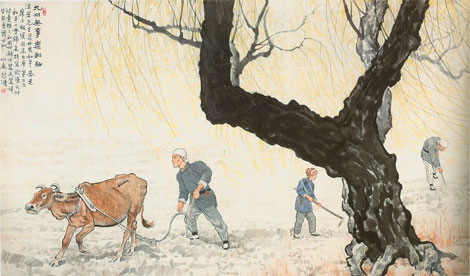
Clip on Xu Beihong Plus Thoughts on Calligraphy, the Beats, and the Abstract Expressionists

19 Feb

plant2

Burnside published my art post “A Time to Plant and a Time to Uproot” today.

It only occurred to me as I was posting this clip how interesting it is that Xu Beihong’s painting is from 1951. Doesn’t the seemingly traditional shuimohua painting seem much older? Xu is actually known for his Western sensibilities and is considered a forerunner in modern Chinese art.

Xu studied calligraphy with his father before attending the famous École Nationale Supérieure des Beaux-Arts — you know, that Parisian school where Degas, Matisse, Monet, and Renoir studied at. In 1917, Xu Beihong went to Japan to study art. During World War II, he sold his paintings in exhibitions throughout Asia, giving the proceeds to the Chinese whose lives had been upturned because of the war. As a teacher and artist, Xu’s policies greatly influenced the way both colleges and the government respond to art in Communist China. He died in 1953.

Meanwhile, over in Oregon at Reed College in the early 1950s, Gary Snyder, Philip Whalen (who served Stateside during World War II), and Lew Welch–who are associated with the Beat Generation–were studying with calligrapher Lloyd Reynolds. Snyder and Whalen later spent time in Japan, where they studied zen. The US State Department initially denied Snyder a passport, alleging he was a Communist.

Asian influences can also be seen in the art of the time period, most notably the abstract expressionist art of Franz Kline, Adolph Gottlieb, and Theodoros Stamos. Note this opening paragraph from the Guggenheim’s article “Abstract Art, Calligraphy, and Metaphysics“:

Following World War II New York City became the center of the avant-garde art world. Artists were working in new ways, and some were exploring the energy of the gesture with loose brushwork that reflected the impact of the artist’s bold movements. The calligraphic brushstroke was an approach to abstract painting that focused on the spontaneous gesture of the artist’s hand and was informed by the East Asian art of calligraphy and popular writings on Zen and its principles of direct action.

The article goes on to say:

In Chinese and Japanese calligraphy the brush becomes an extension of the writer’s arm, indeed, his or her entire body. The artist’s stroke not only suggests the movement of the body, but also inner qualities. Abstract as it appears, calligraphy also conveys something about the essence of the individual artist. It is therefore not surprising that 20th-century American Abstract Expressionists who sought to convey emotion through paint were drawn to it.

Because so many soldiers were stationed in the East during World War II, both the West and the East were influenced by each other.

What I personally find fascinating with calligraphy is the collision of art and literature, the visual and the literal, words becoming art, and art becoming words.

Modern Love

14 Feb
by William Hilton

by William Hilton

When I was still just a teenager, I fell for John Keats. He was a Romantic, prone to fits of passion and depression, the highs and lows most teenagers can relate to. He had studied and gotten his apothecary license, but who wants to be a doctor when they could be a poet? Both fix the heart, do they not? He sat under a plum tree and wrote an ode to a nightingale. Swoon. He wasn’t stuffy. He infused humor into his poetry and broke traditional rules, using false rhymes. He went on “road trips,” walking tours of the Lake District, Ireland, and Scotland. There’s a beautiful scene in the film Bright Star, about Keats’ romance with Fanny, in which a million butterflies flutter though a bedroom. And isn’t that just like love? Whimsical. Animated. Delicate. Fleeting. Memorable.

Gregory Corso, the poet associated with the Beat Generation, was a fan of John Keats’ poetry. It’s easy to see their resemblance to each other—the way they both referenced their hero poets in their poetry, the cheeky humor, their admiration for the Classics, the way they strayed from conformity, their struggling to make ends meet.

In honor of Valentine’s Day, here’s Keats’ thoughts on modern love.


Fragment: Modern Love

And what is love? It is a doll dress’d up

For idleness to cosset, nurse, and dandle;

A thing of soft misnomers, so divine

That silly youth doth think to make itself

Divine by loving, and so goes on

Yawning and doting a whole summer long,

Till Miss’s comb is made a pearl tiara,

And common Wellingtons turn Romeo boots;

Then Cleopatra lives at number seven,

And Antony resides in Brunswick Square.

Fools! if some passions high have warm’d the world,

If Queens and Soldiers have play’d deep for hearts,

It is no reason why such agonies

Should be more common than the growth of weeds.

Fools! make me whole again that weighty pearl

The Queen of Egypt melted, and I’ll say

That ye may love in spite of beaver hats.


Writing Wednesday: Writing from a Brothel

6 Feb

Dear Mom and Dad,

I’m going to go live in a brothel now. Don’t worry — just as the landlord. William Faulkner told me to.

PS: Sorry for robbing you and drinking all your whiskey. I’m just trying to be a good writer.

xoxo.


Note: This is completely fictional. But, Faulkner’s 1956 interview poses an interesting question: What is the best type of job for a writer to hold to earn some income while working on a book?

Clip: A Time to Plant and a Time to Uproot ~ van Gogh’s “Farmers Planting Potatoes”

5 Feb

plant1

On Burnside Writers Collective.

Clip: A Time to Be Born

1 Feb

birth4

“Nativity at Night” by Geergen tot Sint Jans, 1490

As the visual arts editor for Burnside Writers Collective, I curated artwork having to do with the theme “a time to be born.”

…And yes, the Byrds are now stuck in my head!

You can view the post here.


Happy Friday!!

Writing Wednesday: Publication Therapy

30 Jan

The other day I was updating my submissions spreadsheet. Yes, I’m that big of a nerd. The spreadsheet tracks the articles, essays, and other creative works I’ve written, so at a quick glance I can tell what I have to pitch, where I’ve submitted it, and when—if at all—I’ve heard back from a publication.

There are a lot of blank rectangles on the spreadsheet.

In the past, the blank rectangles used to indicate that I had yet to submit my work. Rejections seemed scary so I wouldn’t even submit to journals because I was so worried the editors wouldn’t be interested in my work. This meant my work had zero chance of getting published. When I became an editor myself I realized how much editors depend on writers. It’s not this terrible power struggle I’d imagined. Editors really want to like writers’ work. They want to publish us. Getting a rejection doesn’t mean they hate us. If you want to have your work published, you have to send it out.

After a while, though, it was the “accepted” column that had the blank rectangles. I carefully sent queries or unsolicited manuscripts out and then suffered to hear from someone—anyone! Opening my mailbox and refreshing my inbox became subtle forms of self-torture, as I never knew when I’d hear back from a publication and what the news would be.

But more frequently I’ve been getting rejections. This is not a bad thing! I’ve come to realize that the greatest writers have gotten rejections. Jack Kerouac couldn’t get On the Road published for years. Stephen King nailed all his rejection letters to the wall, the stack growing larger and larger before he found fame.

I just read an article in Bloomsberg Businessweek about a guy named Jia Jiang who is doing a project called 100 Days of Rejection Therapy, in which he opens himself up to rejection at least once a day in order to desensitize himself to the pain of rejection so that he can go after his dream. The concept is attention-grabbing, and I think there are some valuable lessons to learn from it about courage and perseverance. There are also fundamental flaws to this approach, though. It’s easier to not get hung up on a rejection when you’re not invested, and in this case the rejections Jiang is receiving have nothing to do with his real dream. Furthermore, the project title itself suggests and attracts self-defeat. Although Jiang hasn’t gotten rejected from everything he’s tried, he believes he will be rejected. Although his rejection therapy is supposed to give him the courage to not let fear of rejection keep him from pursuing his dream, it essentially is saying that he thinks he will get rejected. Otherwise, why not call it Achievement Therapy? Or Success Therapy? Or Acceptance Therapy?

Also, as the article itself points out, there are valid reasons for rejection and we can learn from them:

But career coach Nemko suggests Jiang focus on what made the initial investor balk. “I have clients who apply for a number of jobs [and] who get rejected a bunch. They like to brush it off, like, ‘Oh, it’s the economy,’ but I say: ‘Take a look at yourself. Do you need more skills? What’s your employment track record? Are you obnoxious?’”

Back in 2011, I blogged about how Kathryn Stockett’s The Help was rejected sixty times. Here was someone who was truly invested in her work, and yet she didn’t start asking donut makers to do strange things to her donuts in an effort to build her confidence in her writing abilities and achieve success. She actually took a good long look at why she was getting rejected and revised her work accordingly.

Sometimes you need criticism, even if it comes in the form of a rejection, to improve your work. Other times, there may be nothing wrong with your work, but it’s just not the right fit for that publication at that time. It happens. It’s worth being part of a writing group and getting honest feedback on your work from more than one person who is not your mom.

Lately, the rejections I’ve been getting have come with personalized notes that say things like “great story but it’s not timely enough” or “great writing but it’s not for us. Feel free to submit again in the future.” I don’t like getting rejections, but I have learned from them. I’ve taken the comments I’ve received from editors and revised my works. I’ve grown as a writer, and even when my work isn’t what the editor wants, I know it’s getting closer to hitting the mark.

The other day when I was updating my spreadsheet, I smirked at the callousness with which I treated my rejections. There was a time when I would’ve taken them so personally, but now I realize that rejections come with the territory.

This applies to life too. No one ever did anything great in life without taking a risk.

Anne Waldman Speaks on How Beat Poets Selling Out Helped Naropa

28 Jan

If you have about an hour to spare, this interview with poet Anne Waldman at the University of Texas at Austin touches on Jack Kerouac’s awareness of the arts world at the time, the New York School poets and Black Mountain poets, Beatnik-inspired clothing and selling out, how the Jack Kerouac School of Disembodied Poetics at Naropa got its name and why it’s not named after Gertrude Stein, the passing of Gregory Corso and Allen Ginsberg, William S. Burroughs’ cut-up techniques, women of the Beat Generation, the Bowery Poetry Club, and her mother’s time in Greece. It’s a thoughtful interview that’s well worth listening to.

The interview was in conjunction with the Harry Ransom Center’s 2008 exhibit On the Road with the Beats.


Jack Kerouac Dropped Out of College. So What?

27 Jan

Is genius born or created?  By now everyone has read, or at least heard, about how Steve Jobs dropped out of Reed College and went on to become the cofounder of Apple and one of the most important entrepreneurs of our time.  Perhaps less known is the fact that Jobs continued to audit classes at Reed.  He actually credited a calligraphy course he took as having a major impact on the Mac.  When I was taking a shuttle from the San Francisco airport to my hotel out in Walnut Creek, I had a midnight conversation with a businessman who had read the biography on Jobs and told me about how the computer genius’ interest in art was fundamental to his vision for building a successful brand.

Back in September, Flavorwire posted an article called “10 Famous Authors Who Dropped Out of School.”  This is what they wrote about Jack Kerouac:

In high school, Beat hero Jack Kerouac was no poet — he was a jock, star of the football team. His athletic skills won him a scholarship to Columbia University, but he and the coach didn’t get along. The two argued constantly and Kerouac was benched for most of his freshman year. Then, he cracked his tibia and, his already tenuous football career over, dropped out of school.

I love Flavorwire, and I understand that the writer was trying to keep the text short and irreverent, but I think it’s worth dissecting the often repeated line that Kerouac dropped out of Columbia University.  Implicit in remarks about his football scholarship and dropping out is the suggestion that Kerouac was neither intelligent nor studious—the same way that many critics like to point to how quickly he supposedly wrote his novels.  If he were a computer genius, like Steve Jobs, perhaps his craft would not be questioned, but because the arts are subjective, Kerouac’s dropping out of college is often reported more as a jab than as evidence toward his natural gifts.

To say that Kerouac was a jock and not a poet in high school undermines his academic achievements.  In reality, Kerouac, who didn’t even feel completely comfortable speaking English when he went off to school (he spoke his parents’ French Canadian dialect), did so well in school that he skipped a grade.  He spent a lot of time at the public library in his hometown of Lowell, Massachusetts, voraciously reading the classics.  When he was not on the football field, Kerouac was part of a roundtable discussion group on philosophy and literature.  His father was a printer, and so even at a young age, Kerouac produced his own writing.  Like Jobs, Kerouac did not come from money, and the scholarship he earned helped him attend the university, where he studied English under the tuition of great professors.

Kerouac left Columbia, then he returned to resume his studies, and then dropped out for good.  However, like Steve Jobs, Kerouac continued his studies even after he dropped out of college.  He enrolled at The New School, where he studied literature.


After Kerouac moved to Ozone Park, Queens, and holed himself up writing, his friends jokingly referred to him as “The Wizard of Ozone Park.”  Do you know “The Wizard of Menlo Park” (New Jersey) was?  Thomas Edison, who after only three months of formal schooling, dropped out.


***

This post has been updated. I wrote “college” when I meant to write “school,” when referring to Kerouac’s ease with English.


92-Year-Old Greek Diner Shut Its Doors in Literary Neighborhood

24 Jan

Ninety-two-year-old Greek diner St. Clair has closed down, reports Grub Street, after learning the news from Brownstoner.

Owned by five Cypriot brothers, according to New York magazine, offered various Greek dishes such as the Greek Delight Platter, Corfu Salad, and Greek Moussaka alongside classic American dishes like The Best Baked Meatloaf and 14 Oz. new York Cut Sirloin Steak Sandwich. Brooklyn Daily provided a little history that when the diner was revamped in 1967 it was opened up as the New St. Clair by the Costa family. In 2007, they sold it to Spiro Katehis, who also owns the Carroll Gardens Classic Diner. The Greek diner was at the corner of Smith and Atlantic in the Boerum Hill neighborhood of Brooklyn.

In The Town and the City, Jack Kerouac housed the parents of his main character in Brooklyn and mentioned the Boerum Hill neighborhood. Of course back then, the neighborhood hadn’t gone through its yuppie gentrification—Kerri Russell and Michelle Williams have called it home—and was known as South Brooklyn or North Gowanus.

Considering the establishment had already opened in 1920 and Kerouac was in the area in the 1940s and ‘50s, it’s possible—though not proven—that he could have stopped in the St. Clair Diner.

The neighborhood is famously home to another writer: Jonathan Lethem, who told the New York Sun,  “’My image of the writer came from people like Henry Miller and Jack Kerouac.’” When he was younger, Letham hitchhiked to California and worked at used bookstores. In 2011, he was the Roy E. Disney Professor in Creative Writing at Pomona College, where I studied literature and Classical Greek.