Church Hopping at the Festival of Faith & Writing: Calvin College Chapel

17 Apr

I’m getting excited for the Festival of Faith & Writing!!  I’m so looking forward to catching up with all my friends from the Burnside Writers Collective, some of whom I haven’t seen in years and others whom I’ve never met before.  We’ll have a booth so please do stop by and say hello!  I’m the visual arts editor for Burnside, and I’m always looking for new writers and cool artists whose work we can feature on the site.  If you’re interested, let’s chat at the Festival.

If you’re going — or just want to live vicariously through this blog — you might be interested in the Church Hopping column I wrote up after our last trip to the Festival.  Some of the panels and Q&As are held in the Pizza Hut Chapel, as Diane called it.


Burnside commentary:

Kim Gottschild:  “I liked the chapel’s architecture. What I found particularly interesting was the pergola type structure that lined the inside of the sanctuary like an overhang. Together with the beautiful view of the budding trees, it made me feel like I was sitting in a garden setting, the outside having been brought in. I also loved the light feel of the wooden interior. Overall, the interior atmosphere felt natural, light and airy, and I felt like I could breathe. And Mary Karr’s interview only enhanced that, as listening to her always gives me permission to be human.”

Penny Carothers: “I liked the chapel, too. I liked the inclusive feel, the feeling of being surrounded by others, not just staring at the dais. I also appreciated how the dais was almost in the center of the room. I liked how light it was.”

Cary Campbell Umhau:  “Well, I hate to be a naysayer but I found it cold. I wanted a cozy corner, not an exposed openness. I’m sure that says something antisocial and awful about me, but I wanted to flee!  I have to say I was swayed a little by Diane saying that it’s sometimes referred to as the Pizza Hut Chapel (Diane, am I misquoting you?).  Is it bizarre that I preferred the ‘Undercroft’ of cinderblock (and the bathrooms were nearby too; handy with all the coffee I was downing), and I loved hearing Lisa Samson down there.”

Diane Nienhuis:  “Cary, you quoted correctly!”


You can read the rest of Church Hopping: Calvin College Chapel here.

Memoir Outtake: Albanian Greeks at the Greek Consulate

16 Apr

All the endangered language research I’ve been doing seeped its way into the rough draft of my memoir.  Below is a scene in which I encounter two darker-skinned boys at the Greek Consulate in New York City.  From the looks of them, I gather that they must be Albanians.  As I’m dealing with my own language issues at the Consulate, I begin to think about theirs.  This section turned out to be too Wikipedia-ish in comparison to the lighter, humorous tone of that chapter in my memoir, so I was advised to take it out.  Still, I found the subject matter fascinating, and so I’m posting it here as an outtake.

Two dark-skinned boys in their teens or twenties—it was hard to tell—filled out paperwork at the long table.  They wore motorcycle-style jackets that made them look tough but in more of a poor than badass look.  I wondered if they were perhaps Albanian refugees.  Cham Albanians began migrating to Greece during the Middle Ages.  They speak the Cham Albanian language, a type of Tosk Albanian that was the language of the most well-known bejtexhinj, Muhamet Kyçyku, first poet of the Albanian National Renaissance.  Bejtexhinj is the oftentimes religious poetry written in Albanian with Arabic alphabet and Persian, Turkish, and Arabic words, that began in the eighteenth-century to rebel against the influence of the Ottoman Empire.  During that time and also in the early twentieth century, Albanians known as  Arvanites came to Greece as well.  The Tosk Albanian dialect they speak, known as Arvanitika, is now an endangered language, as they assimilate into Greek culture.  Though sometimes Arvanitika is used interchangeably, the Orthodox Albanians who in the 1920s came to northeastern Greece, namely to the areas of Western Thrace and Greek Macedonia, are called Shqiptars.  They speak the Northern Tosk Albanian.  Although many Arvanitika fought against the Ottomans in the Greek War for Independence from 1821 to 1832, by World War II the Cham Albanians had sided with Italy and Germany and had to flee from Greece to Albania, Turkey, and the United States.  After the fall of Communism in 1991, another group of Albanians came over to Greece to escape economic depravity.  Today, most Albanians living in Greece self-identify as Greek; they have converted to Greek Orthodox Christianity and speak the Greek language.  Now, listening in on the two boys consulting each other for their paperwork, I couldn’t tell whether they spoke an Albanian dialect or Greek.

On the Bro’d: A Parody of Jack Kerouac’s On the Road​​

15 Apr


The only bros for me are the mad awesome ones, the ones who are mad to chug, mad to party, mad to bone, mad to get hammered, desirous of all the chicks at Buffalo Wild Wings, the ones who never turn down a Natty Light, but chug, chug, chug like f*cking awesome players exploding like spiders across an Ed Hardy shirt and in the middle you see the silver skull pop and everybody goes, “Awww, sh*t!”

So goes On the Bro’d: A Parody of Jack Kerouac’s On the Road, by Mike Lacher, published today.  The book reimagines Jack Kerouac’s On the Road as if it were told by someone like How I Met Your Mother‘s Barney–a bro.

Contrary to the popular myth of the scroll, Kerouac spent years trying to get the voice right for On the Road.  Yes, he did pound the keys of the typewriter and turn out the novel in a matter of days, but that was only after he had spent years on the road and wrote and rewrote the novel multiple times, with different characters and different narration.  Neal Cassady’s famous letters spurred Kerouac on to write in a more confessional and conversational approach.  He worked hard to capture the feeling of a real talk, using words like “beat” and “hipster.”  However, Kerouac was well educated.  He did go to Columbia, after all, and while it may have been on a football scholarship that might make him seem a bit more like a bro, even as a child he used to ditch school so he could go read in the library.  While his work may appeal to a guy’s guy because he’s often with his “bro” Neal, recklessly driving, picking up chicks, and smoking pot, the diction and syntax in On the Road reveal that underneath it all he was a sensitive poet who saw the beauty in the color of grapes. After all, this is how the famous quote from Jack Kerouac’s On the Road paraphrased above actually read:

“The only people for me are the mad ones, the ones who are mad to live, mad to talk, mad to be saved, desirous of everything at the same time, the ones who never yawn or say a commonplace thing, but burn, burn, burn, like fabulous yellow roman candles exploding like spiders across the stars and in the middle you see the blue centerlight pop and everybody goes “Awww!”

On the Bro’d is just a parody. It says so right in the subtitle.  It’s not meant to be taken seriously, and the idea is actually clever.  Still, it points toward a common misconception people have of Jack Kerouac and the Beat Generation, whom critics pejoratively referred to as “beatniks,” meaning the Beats were as “far out” as Sputnik.  Keep in mind, Sputnik was launched by the Soviets during the Cold War.  Beatnik was not a compliment. Even today, many scholars don’t take Kerouac’s writing seriously because it is so accessible.  But his prose is poignant, his message spiritual.  He was not saying, the only people for him were the ones who wanted to get drunk.  He was saying the only people for him were the ones who want to truly live life to the fullest.  He didn’t like the type of brain-zapped people who said commonplace things and wore Ed Hardy t-shirts.  He said, “Great things are not accomplished by those who yield to trends and fads and popular opinion.”

I’m curious if you think On the Bro’d is a successful parody?  It seems like something that would sell well at Urban Outfitters, yes?

Clip: Light of the World

13 Apr

I expanded a post that started out here on this blog, and it’s up on Burnside now!  It’s about the first Greek Easter I spent in New York….


I think there’s probably a law against carrying an open flame in the subway.  I’m not sure.  But it’s a pretty safe bet.  This turns Easter in New York City into a midnight marathon.

Writing Wednesday: The Art of Discovering What You Believe

11 Apr

The art of writing is the art of discovering what you believe.

— Gustave Flaubert

I love this quote on so many levels. As I struggle with writing my book(s), I realize that sometimes you have to write a whole lot in order to figure out what it is you’re really trying to say, because sometimes the idea you go in to write about isn’t really the true heart of your story. It’s there. You’re onto it. It’s just buried deep inside your original idea. Sometimes, as you write, you learn something about yourself, about who you are and what you believe.

I think this is true even for those who don’t write for a living, but who enjoy keeping a diary or blogging. There have been many times I’ve scribbled into my journal and come to some revelation or at least clarity on something that had been on my heart.

Bravo for Writing a Greek-American Memoir

9 Apr

On my lunch break one afternoon I met a man from Greece at a coffee shop.  He had been born in Greece, but currently resides in New York.  He didn’t have the thick Greek accent that would’ve indicated a recent move, and yet like so many Greek people I’ve met, he was still very much hung up on Greece.

After some rather dull conversation he perked up when I told him the memoir I’m writing is about growing up Greek American.  It made me kind of hate him.  I know that’s a terrible, overdramatic reaction, but his reaction gave me the distinct sense that in his eyes my ethnic heritage played a role in my worth.

The Greek American community is incredibly proud of its Greek heritage.  As we should be.  We have a beautiful culture with a rich and fascinating history.  I often feel I don’t live up to Greek ideals.  I know the reason I inwardly cringed when the man expressed interest in my heritage above all else is because I feel like I fall short of the standards of Greek American identity.  I don’t speak the Greek language, I don’t look particularly Greek, and I’m not 100% Greek.  Culturally, I’m not very Greek.

In fact, those who know me well are surprised when I say I’m writing a memoir about growing up Greek American.  Spoiler alert!  The memoir isn’t really about being Greek.  It’s about being American.  It’s about growing up American but going through an experience as an adult that ties me back to Greece.

Life is too complex for anyone to be categorized or valued based on just one aspect of their identity.

Clip: Separation Sunday

7 Apr

“Father, can I tell your congregation how a resurrection really feels?”

Sin and salvation.

Death and resurrection.

Hoodrats and comeback kids.

Parties and confession booths.

The Hold Steady’s Separation Sunday: indie rock’s Easter music.

Clip: Paintings of the Crucifixion

6 Apr


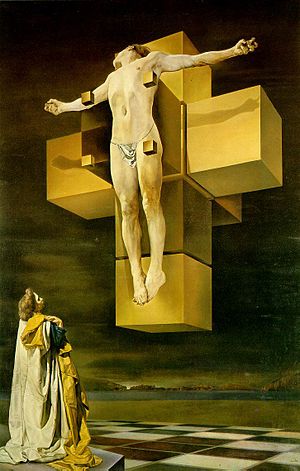
In light of Good Friday, I’m reposting “Paintings of the Crucifixion,” originally published on Burnside last year.


A couple years ago there was an exhibit called Spanish Painting from El Greco to Picasso: Time, Truth, and History at The Solomon R. Guggenheim Museum in New York City.  The exhibit paired old masters with modern painters, according to theme: knights, ghosts, ladies, bodegones, landscapes of fire, and so forth.  It was an impressive collection of artwork that spoke to how Truth transcends time.
Frank Lloyd Wright designed the museum in such a way that museum-goers wind their way up through exhibits as opposed to being sectioned off, floor by floor, and consequently there are heightened feelings of momentum and progress as one climbs closer to the top of the museum.  At the pinnacle of the museum during the Spanish Painting exhibit there was a section devoted entirely to paintings of the Crucifixion.
It is probably the most intense and haunting collection of artwork I have ever witnessed.  I have seen many paintings of the Crucifixion over the years, but standing in an entire room of them is overwhelming.  I felt uncomfortable.  I felt sick.  I left trying to push it out of my mind.
You can read the rest and see visuals here.

Writing Wednesday: Punctuate Your Point with Punctuation

4 Apr

I’ve heard a lot of strange comments in my writing workshops.  Someone once told me they thought from my writing that I wished I was a boy.  Someone else questioned why I write more about Greek identity than Swedish identity.  I expect all sorts of reactions to the content of my essays and that I’ll get criticism in regard to structure.  It comes with the territory.

What I never suspected was that I’d get feedback on my punctuation.

I don’t recall ever hearing anyone else in a workshop receive comments on their lack of use of the oxford comma or their split infinitives.  Actually, that’s not entirely true.  I criticized someone’s use of parentheses.  If it’s unimportant enough to place in a parenthetical, it’s not important enough to keep in your book.  Edit it out!  Of course there are exceptions: for example, definitions of foreign words.  The other instance of a workshop debate being generated from punctuation had to do with the use of David-Foster-Wallace-like footnotes.  For the most part, though, comments about punctuation—errors in punctuation, that is—are kept to written edits on the writer’s page.

That’s why I found it so curious that at least once a semester, someone raised comments praising my grammar and punctuation.  As an editor by profession, punctuation is important to a fault for me.  I live by Oscar Wilde’s quote:

I was working on the proof of one of my poems all the morning, and took out a comma.  In the afternoon I put it back again.

It just never occurred to me that someone might actually notice my punctuation.  After all, correct punctuation should be a given.  And when punctuation is correct, it generally doesn’t stand out to the reader.

I figured readers maybe noticed my punctuation because I use crazy marks like the semicolon.  Who uses the semicolon nowadays?

I’m playing a bit coy, though.  I do believe there’s more to punctuation than it just being correct.  I don’t intend my punctuation to stand out and grab the reader’s attention.  I’m not trying to be a punctuation renegade, experimenting and breaking the rules for purposeful affect.  That said, every comma, every em-dash, and yes, every parenthesis conveys subtle meaning.

Think about it.  When em-dashes (those long dashes between words) appear in a text, doesn’t it make the work feel more modern and fast-paced than a commonplace comma?  And don’t endnotes seem more scholarly than parentheses?

I think punctuation frightens most people.  It brings back all this childhood trauma associated with teachers yelling about sentence fragments and marking papers up with green pen.  Green is the new red.  Green is supposed to be less scary than red, but it isn’t.  It means the exact same thing: you made an error.

Don’t let punctuation poison your prose.  Get a grip on it and use punctuation just as you use diction as one of your writer’s tools to convey your story to your reader.


Helpful resources for proper punctuation:

Grammar Girl 

The Copyeditor’s Handbook

Grammar class at New York University


Huckleberry Finn Grows Up to Be Dean Moriarty

2 Apr

Flavorwire recently had a fun post on kid literary characters and their grown-up counterparts.  They said that Huckleberry Finn would grow up to be Dean Moriarty, the character based on Neal Cassady in On the Road:


Huckleberry Finn and Dean Moriarty

Mark Twain’s original American boy vagabond in search of adventure would inevitably grow up to figure as the care-free rover in Kerouac’s semi-autobiographical novel. Moriarty is described as “a side-burned hero of the snowy West” and a “holy con-man,” which seem to us to be pretty accurate descriptions of how the lawless, fanciful Huck might have turned out. And after all, even though Moriarty and Sal never set off down the river on a raft, you can bet they would have if they could’ve — and we think Huck would be itching to try that ’37 Ford sedan.

Find out all the other great counterparts here, and feel free to add your in the comments section.  I’d add:

Harold (of Harold and the Purple Crayon) grows up to be Chip Kidd in Cheese Monkeys.

Who would you add?