Tag Archives: Allen Ginsberg

Recap — with Photos! — of David Amram Reading

10 Sep


When musician David Amram introduced me before I read with him at Cornelia Street Cafe on September 3, 2012, he very generously said people should pay attention because one day they’d see me on television.  To me, though, reading with David Amram was a much bigger deal than being on television.  There are countless television shows, but there is only one David Amram.  While there are many fantastic musicians and writers out there whom I’d be honored to read with, there are few who hold such a special place in forming my creative identity as Amram does.

I first became acquainted with Amram through studying Jack Kerouac when I was just a teenager.  I was enamored with his improvised performance as Mezz McGillicuddy in the 1957 Robert Frank and Alfred Leslie film Pull My Daisy.  In fact, this photograph, featuring Larry Rivers, Jack Kerouac, David Amram, Allen Ginsberg, and Gregory Corso, who all collaborated on the film, is probably my all-time favorite photograph of the poets, writers, and artists associated with the Beat Generation.  It seems to so purely capture their friendship: just a couple of people hanging out at a cafe, maybe talking about the arts, or maybe just drinking coffee late into the night and enjoying each other’s company.

Although it was literature that introduced me to Amram, his music fascinated me.  Here was a musician who was more than just skillful.  Amram is an innovator.  He’s someone who experiments, improvises, blends genres, captivates.  He is, quite simply, mesmerizing to watch and listen to.

Through reading biographies on Kerouac and also reading Amram’s own biographies, I came to discover the jazz-poetry readings Amram and Kerouac began doing in the Village in 1957.  These were improvised sets, requiring each to masterfully foresee and adapt to changing tempos and moods in each other’s works.  These jazz-poetry collaborations captured my imagination, challenging my view of art and the way in which it’s created, the musicality of words, and the role of collaboration, improvisation, and performance in literature.  As I read about the collaborations in musty library books, forty-some-odd years after they’d taken place, I envisioned what it must’ve been like to be in the crowd at a painter’s loft or at the Circle in the Square.  Did the people there realize they were part of history?

In 2001, I had the opportunity to ask Amram just that when I interviewed him for some research I was doing at the time.  I sat enthralled, clinging to his every word, as he told me about all the places he used to hang out at in New York, about collaborating with Kerouac, and about how the term “Beat Generation” is just a marketing term that people later attached to the individual artists who each create unique works.  As he talked, answering all of my questions and never rushing me, and later as I read another biography of  his, I realized that Amram is the real deal — a creative genius and also a beatific individual, an artist who inspires and encourages.

Amram has been someone whom I’ve long admired, both on an artistic and a personal level.  Reading about those 1957 jazz-poetry readings he did with Jack Kerouac, I never imagined that one day I would have the opportunity to read the book I’m writing on Jack Kerouac with him.  When my former editor suggested we attend Amram’s show at Cornelia Street Cafe in the Village, I excitedly said yes.  A few days later, I had to email him back to say Amram had invited me to read with him.  It was completely surreal.

The September 3, 2012, show was completely sold out.  I had some friends who were turned away at the door.  Special thanks to Cornelia Street Cafe’s Robin Hirsch and the staff for hosting the reading and for doing such an excellent job in organizing the event.  I read a short selection about Kerouac’s time in Mexico from Burning Furiously Beautiful: The True Story of Jack Kerouac’s On the Road, the book I’m co-authoring with Paul Maher, Jr.  It was really exciting because author Larry Closs and painter Jonathan Collins, both of whom I met through the Burning Furiously Beautiful Facebook page, were in the audience.  Poet and producer RA Araya, who has been hugely supportive of my work and whose birthday bash was the premiere reading from Burning Furiously Beautiful, was also there, and graciously provided the photography you see here.  I had some other family and friends there as well and am so appreciative of their support.  It means more to me than most people realize.

As soon as my videographer, Liz Koenig, sends the video, I’ll post it so you can hear me reading with David Amram and his band.  The band, consisting of Amram, Kevin Twigg, and John de Witt played so beautifully — even more of a feat, considering Twigg had hurt his hand before the show.  The music was haunting and fit the piece that I read so perfectly.  I wanted to remain present in the moment, to really hear what they were playing, and savor the moment.  It was one of those times in life that I wanted to tuck into my heart and cherish.
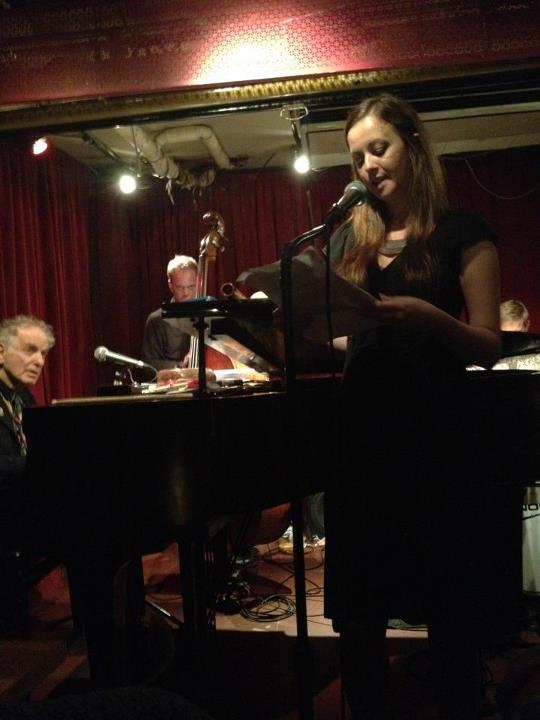


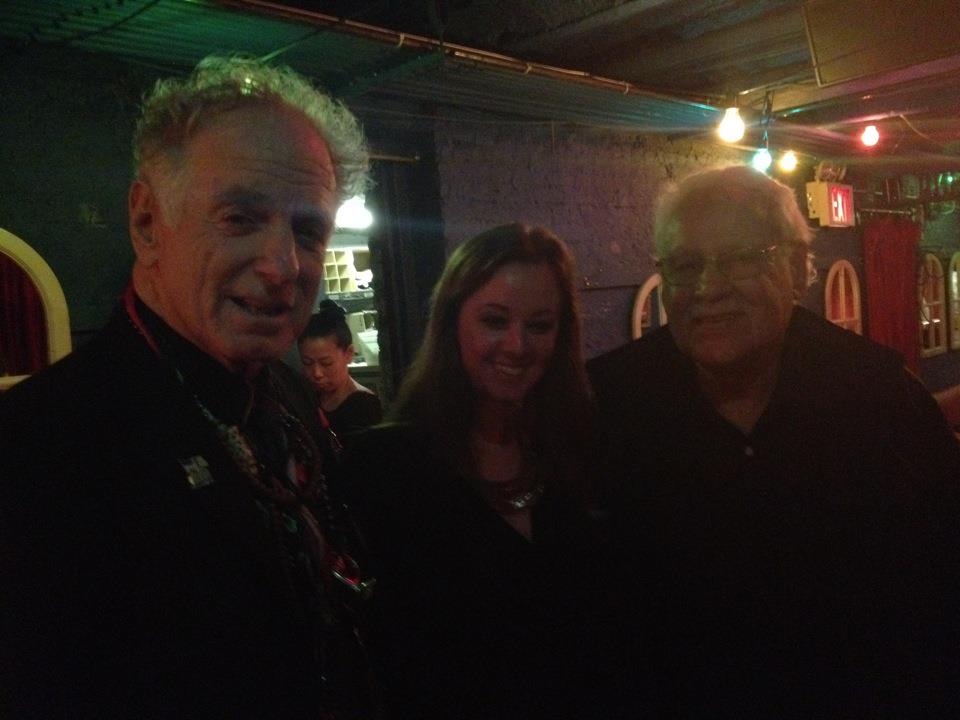
David Amram, Stephanie Nikolopoulos, Joe Pacheco

Stephanie Nikolopoulos, David Amram, RA Araya

From the Lost Generation to the Beat Generation: Hollywood’s Obsession

12 Jul


With Hemingway and Gellhorn currently on HBO and a remake of The Great Gatsby heading to theatres this Christmas, The Observer’s Daniel D’Addario ponders if we’re experiencing a “Lost Generation Boom.”

The Lost Generation refers to the writers during the World War I era, many of whom became expatriates.  The Lost Generation writers include F. Scott Fitzgerald, T. S. Eliot, Gertrude Stein, Ernest Hemingway, and John Dos Passos, among others.  Hemingway popularized the term in A Moveable Feast, in which he quoted Stein as telling him a story about a man who said, “That’s what you all are … all of you young people who served in the war. You are a lost generation.”

D’Addario also references last summer’s Midnight in Paris, but in some regard, we’ve been experiencing the “boom” for quite some time now … at least in the cocktail scene.  A few years ago, speakeasy-type bars became all the rage here in New York.  Dimly lit lounges served up spiked punches in tea cups.  There are also Jazz Age parties on Governor’s Island, where everyone gets all dolled up in fantastic flapper dresses and Sacque suits.  And the Oak Room—which in the ‘20s was Algonquin’s Pergola Room—just reopened.

However, Hollywood isn’t only obsessed with the Lost Generation.  The Beat Generation, which wasn’t popular for a long time, is beginning to see a revival.  On the Road, based on Beat writer Jack Kerouac’s novel, just premiered at Cannes Film Festival in May and will be released Stateside sometime later this year.  Next year, Kill Your Darlings, about a murder involving Kerouac, William S. Burroughs, and others associated with the Beat Generation, will be released.  In 2010, Howl, based on Allen Ginsberg’s poem and the trial that followed its publication, came out.  These aren’t small movies by any means.  Howl starred it-boy James Franco, Kill Your Darlings will star Daniel Radcliffe, and much has been made of On the Road starring Kristen Stewart.

Perhaps we’re trying to figure out our own generation by looking at those in the past.

Your Home Can Smell Like Big Sur

9 Jul

Busy poet Lawrence Ferlinghetti, who is still active at ninety-three years old, moved out to San Francisco and founded City Lights in 1953.  More than just the independent bookstore of Beat pilgrimages, City Lights is a book publisher, and in 1956, Ferlinghetti was arrested on obscenity charges because he had published and sold Allen Ginsberg’s Howl.  He was later found not guilty of a crime.

The year after Ginsberg and Ferlinghetti made the papers, Jack Kerouac finally found fame with On the Road.  The fame was overwhelming, though.  Talk-show hosts invited the naturally shy author on their show.  Wanderlust kids, winos, and dogged readers showed up unannounced at his home.  Fame took a toll on his mind, body, soul.

Ferlinghetti had a cabin, a refuge, out in the wilderness of Big Sur.  He could escape the hustle and bustle of San Francisco for respite along the coast of central California.  After the fame wore him down, Kerouac escaped there too, living for a brief time in Ferlinghetti’s cabin in the woods.  The result of this experience is the 1962 novel Big Sur.

Juniper Ridge now has a room spray called Big Sur.  According to their website, it smells of “wild ginger, burnt honey, salt, damp ground.”  The ingredients are plucked from the deserts and mountains of the West, and 10% of the $20 spray bottle goes back to protecting western wilderness.  They also have a Big Sur soap, essential oil, and sachet.  For $50 you can give the gift of Big Sur, which includes the items already mentioned, plus wild huckleberry jam (perhaps reminiscent of Neal Cassady, whom some have said is Huckleberry Finn incarnate).  The gift comes gift wrapped with real pine cones!  And, like the others, 10% of the profit goes to protecting wilderness.

Happy 86th Birthday, Allen Ginsberg!

3 Jun


“Poetry is not an expression of the party line.

It’s that time of night, lying in bed, thinking what you really think, making the private world public, that’s what the poet does.”

~Allen Ginsberg


Today would’ve been Allen Ginsberg’s 86th birthday.  In celebration, here are a couple of links:::

2012 Howl Festival

Howl (the film starring James Franco); clip of the section on how to write poetry

Allen Ginsberg reading part 1 of Howl

The flowering dogwood at St. Mark’s is blooming for Ginsberg’s birthday

“when did you forget you were a flower?” ~ Sunflower Sutra (one of my favorite poems — It’s beautiful. It’s true. It makes me tear up.)

Ginsberg’s Karma (documentary on Ginsberg’s time in India; produced by Ram Devineni and hosted by Bob Holman)

Ginsberg’s photography

Vomit Express (Allen Ginsberg and Bob Dylan)

Howl on the list of banned books

Ginsberg’s hometown of Paterson, NJ

Sneak Peek of the Burning Furiously Beautiful Cover

31 May

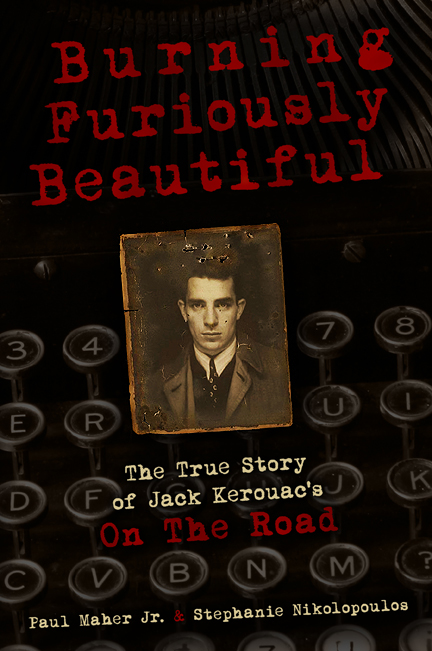
Here’s a sneak peek of the cover design for Burning Furiously Beautiful: The True Story of Jack Kerouac’s On the Road, which I am co-authoring with critically acclaimed Kerouac scholar Paul Maher Jr.

Award-winning designer Igor Satanovsky created the cover.  Igor also happens to be a poet in his own right and studied poetry under Allen Ginsberg at City University of New York-Brooklyn College.

Can’t wait to share more with you!

The Beat Hotel

27 Mar

A couple of years ago, I was ravaging the shelves at the New York Public Library, when I came across Barry Miles’ The Beat Hotel: Ginsberg, Burroughs and Corso in Paris, 1957-1963.  It was around Memorial Day, and I remember sitting by the fountain in the East Harlem section of Central Park, marveling at the ingenious writing methods of my favorite writers and their fascinating lives.  While Burroughs was making his cut-ups and Ginsberg was writing poetry at night and typing them up in the morning, Corso was off wooing girls into buying him dinner.

Here’s what the overview of the book says:

Called “a vivid picture of literary life along the Left Bank in the late 1950s and early 1960s … [and] fun reading” by Library Journal, The Beat Hotel is a delightful history of a remarkable moment in American literary history. From the Howl obscenity trial to the invention of the Cut-up technique, Barry Miles’s extraordinary narrative chronicles the feast of ideas that was Paris, where the Beats took awestruck audiences with Duchamp and Celine, and where some of their most important work came to fruition — Ginsberg’s “Kaddish” and “To Aunt Rose”; Corso’s The Happy Birthday of Death; and Burroughs’s Naked Lunch. Based on firsthand accounts from diaries, letters, and many original interviews, The Beat Hotel is an intimate look at a place that “gave the spirit of Dean Moriarty and the genius of Genet and Duchamp a place to dream together of new worlds over a glass of vin ordinaire” (San Francisco Chronicle).

Wikipedia gives a little background on the Beat Hotel:

The Beat Hotel was a small, run-down hotel of 42 rooms at 9 Rue Gît-le-Cœur in the Latin Quarter of Paris, notable chiefly as a residence for members of the Beat poetry movement of the mid-20th century.

It was a “class 13” hotel, meaning bottom line, a place that was required by law to meet only minimum health and safety standards. It never had any proper name – “the Beat Hotel” was a nickname given by Gregory Corso, which stuck on [2][3]. The rooms had windows facing the interior stairwell and not much light. Hot water was available Thursdays, Fridays and Saturdays. The hotel offered the opportunity for a bath – in the only bathtub, situated on the ground floor – provided the guest reserved time in beforehand and paid the surcharge for hot water. Curtains and bedspreads were changed and washed every spring. The linen was (sometimes and in principle) changed every month.

The Beat Hotel was managed by a married couple, Monsieur and Madame Rachou, from 1933. After the death of Monsieur Rachou in a traffic accident in 1957, Madame was the sole manager until the early months of 1963, when the hotel was closed. Besides letting rooms, the establishment had a small bistro on the ground floor. Due to early experiences with working at an inn frequented by Monet and Pissarro, Madame Rachou would encourage artists and writers to stay at the hotel and even at times permit them to pay the rent with paintings or manuscripts. One unusual thing that appealed to a clientele of bohemian artists was the permission to paint and decorate the rooms rented in whichever way they wanted.

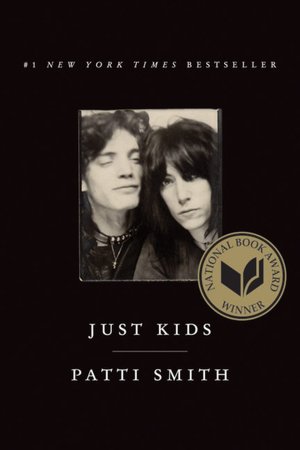
The Chelsea Hotel is kind of like New York’s answer to Paris’ Beat Hotel.  Patti Smith brings the Chelsea Hotel to life in Just Kids, where she also talks about meeting Burroughs, Corso, and Ginsberg and about the idea of improvising in writing.  But I digress….

If you follow me on Twitter, you may remember my recent post lamenting Barney Rosset’s death.  Rosset didn’t shy away from experimental work, publishing the revolutionary works of the Beats at Grove Press. Upon his death, Regina Weinreich wrote an article about his involvement with the Beat Hotel.

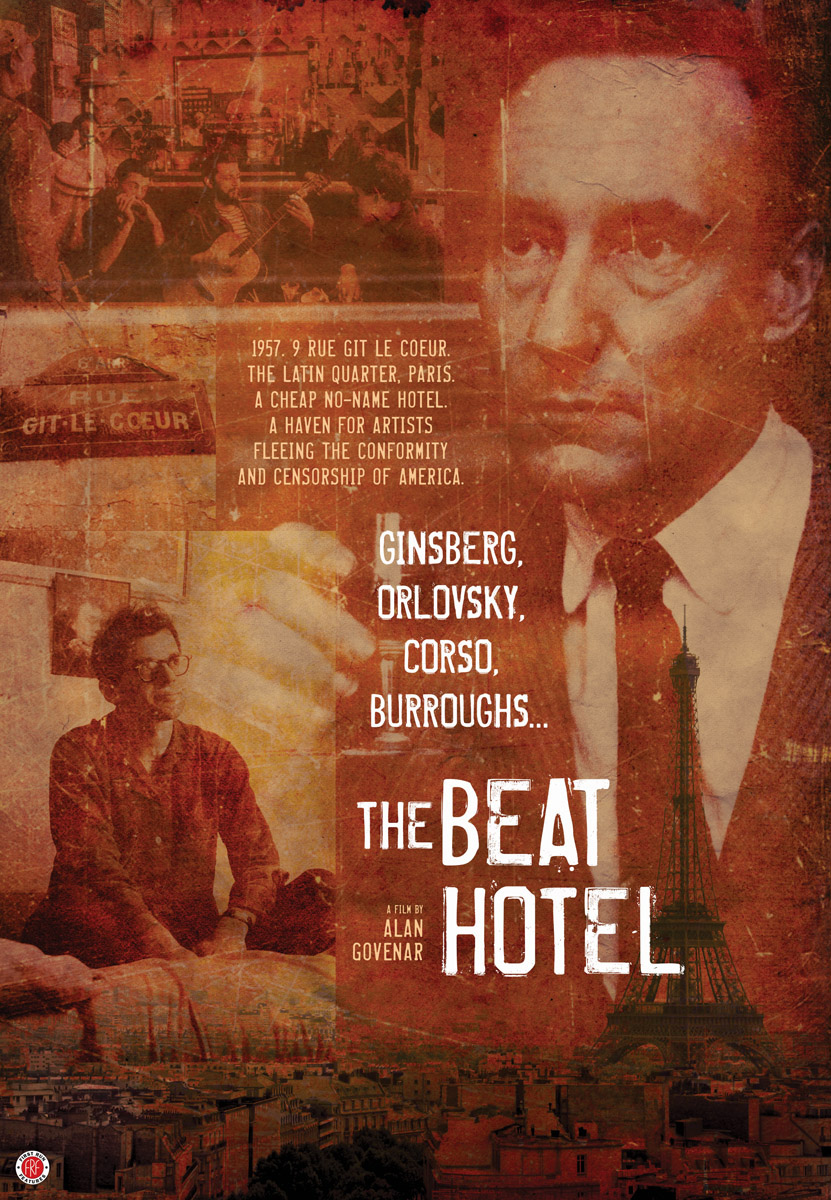
Alan Govenar is directing a new 82-minute documentary, with First Run Features and produced by Documentary Arts,  called The Beat Hotel.  Here’s the press release:

1957. The Latin Quarter, Paris. A cheap no-name hotel at 9 rue Git le Coeur became a haven for a new breed of artists fleeing the conformity and censorship of America. The hotel soon turned into an epicenter of Beat writing that produced some of the most important works of the Beat generation. It came to be known as the Beat Hotel. Opening March 30 in New York City, to be followed by a rollout to other cities across the country, Alan Govenar’s feature documentary THE BEAT HOTEL explores this amazing place and time.

Fleeing the obscenity trials surrounding the publication of his seminal poem Howl, Allen Ginsberg, along with Peter Orlovsky and Gregory Corso, happened upon the hotel on rue Git le Coeur and were soon joined by William Burroughs, Ian Somerville, and Brion Gysin. Run by the indefatigable Madame Rachou, the Beat Hotel was a hotbed of creativity and permissiveness, where Burroughs and Gysin developed the cut-up writing method; Burroughs finished his controversial book Naked Lunch; Ginsberg began his poem Kaddish; Somerville and Gysin invented the Dream Machine; Corso wrote some of his greatest poems; and Harold Norse, in his own cut-up experiments, wrote a novella, aptly called The Beat Hotel.

British photographer Harold Chapman‘s iconic photos and Scottish artist Elliot Rudie‘s animated drawings capturing Ginsberg, Orlovsky, Corso, Burroughs, Gysin, Somerville and Norse just as they were beginning to establish themselves on the international scene bring THE BEAT HOTEL to life on the screen. The memories of Chapman and Rudie interweave with the first-hand accounts of French artist Jean-Jacques Lebel, British book dealer Cyclops Lester, and 95 year old George Whitman. Together with the insights of authors Barry Miles, Oliver Harris, Regina Weinreich, and Eddie Woods, among others, they evoke a time and place where Chapman, mentored by Cartier-Bresson, roamed around Paris photographing nuns, bums, and the idiosyncrasies of street life; Corso took scissors to Marcel Duchamp’s tie in a Dadaist statement while Ginsberg kissed his knees; and Burroughs, with the help of Somerville’s lighting, learned to disappear before an audience’s eyes.

Director Alan Govenar is a writer, folklorist, photographer, and filmmaker. He is president of Documentary Arts and has a Ph.D. in Arts and Humanities from the University of Texas at Dallas. He is the author of 23 books, including Osceola: Memories of a Sharecropper’s Daughter, which won first place in the New York Book Festival (Children’s Non-Fiction), among other prizes. The off-Broadway premiere of his musical “Blind Lemon Blues,” co-created with Akin Babatunde, received rave reviews in The New York Times and Variety. Govenar’s film Stoney Knows How, based on his book by the same title about Old School tattoo artist Leonard St. Clair, was shown at the Museum of Modern Art in New York and the Centre Georges Pompidou in Paris, and was selected as an Outstanding Film of the Year by the London Film Festival. Govenar also has produced and directed numerous films in association with NOVA, La Sept/ARTE, and PBS for broadcast and educational distribution, including The Voyage of Doom, Le Naufrage de la Belle, The Devil’s Swing, Texas Style, Everything But the Squeak, The Human Volcano, The Hard Ride, Dreams of Conquest, and Little Willie Eason and His Talking Gospel Guitar.

Judging from the trailer, The Beat Hotel looks like it will be a documentary not to be missed by any fans of the Beats.

Writing Wednesday: “I Just Give Myself Permission to Suck”

21 Mar

I don’t really I get writers’ block.  I always have an idea of what I want to put on the page, or else I just start writing and something new and unexpected finds its way onto the page.  The problem I have is in getting it out onto the page in the first place.  I know that sounds an awful lot like the same thing as writers’ block, but hear my out because I feel there’s a bit of a distinction.

I’m a self-editor.  I can’t get a sentence out without questioning its validity, its beauty, or its coherence.  I blame my career choice for that: I’m an editor by profession.  I obsess over syntax and punctuation, as if they’re more important than the story itself.

Once I’ve gotten a few paragraphs on the page, I begin to worry.  Was that a good place to start the story?  Should I open with dialogue?  Did I provide enough background information?  Too much background information?  Is this story even worth telling???

I move paragraphs around.  I delete sentences.  I go back and reread what I wrote and decide I hate it all.  I feel like giving up, and I haven’t even written the middle of the story yet.

While writing workshops are extremely beneficial to raising issues a writer may have never thought about in their own work, the flipside is it’s easy to get so wrapped up in the criticism that it negatively affects the writing process.  As I write, there’s a cacophony of “create scenes,” “give us more,” and “show, don’t tell” in my head.  These are important elements to keep in mind, no doubt, but the first draft doesn’t always have all those elements in perfect harmony.  The first draft sometimes comes out like a rambling outline of thoughts.  (Not unlike this blog.)

And that’s okay.

I’m a firm believer in Allen Ginsberg’s writing philosophy of “first thought best thought.”  I think the core of writing comes from the pacing and passion of spontaneity.  But that doesn’t mean it always works out that way.  Sometimes the first draft is like a car revving its engine.  Maybe you’re just spinning your wheels and not actually getting to your destination, but you’re gearing up for it.

I felt so encouraged when I read that John Green deletes “about 90%” of his first drafts:

Q. How do you deal with writers’ block?
A. I just give myself permission to suck. I delete about 90% of my first drafts (the only exception to this rule so far has been Will Grayson, Will Grayson) so it doesn’t really matter much if on a particular day I write beautiful and brilliant prose that will stick in the minds of my readers forever, because there’s a 90% chance I’m just gonna delete whatever I write anyway. I find this hugely liberating.

I also like to remind myself of something my dad said to me once in re. writers’ block: “Coal miners don’t get coal miners’ block.”

If the name John Green sounds familiar that’s because he’s the guy who decided with his brother to stop corresponding to each other via textual communication and talk primarily through vlogs on youtube.  “The videos spawned a community of people called nerdfighters who fight for intellectualism and to decrease the overall worldwide level of suck,” as his website points out.


John Green’s also the enviable author whose manuscript reached the #1 position on Amazon this past summer even before it was published.  His new book is called The Fault in Our Stars; he previously wrote Looking for Alaska, An Abundance of Katherines, Paper Towns, and Will Grayson, Will Grayson.

Not being able to get words out onto the page and deleting 90% of them, it’s amazing writers ever publish anything at all!

Writing Wednesday: If You Miss a Beat, You Create Another

14 Mar

I had the great privilege of hearing Patti Smith read from Just Kids at The New School a while back.  She read from the priceless scene in which she meets Allen Ginsberg at an automat.  I’m quite fond of kitsch automat culture, and used to frequent the one down on Saint Marks when it was still around.  Basically, an automat is fast fast food: you don’t even have to stand in line to order a burger and fries; you just slip a few quarters into a vending machine and out comes surprisingly delicious warm food.  Whenever I ate at the Automat, I felt like I was a character straight out of The Jetsons.  I was hooked on their mac-and-cheese egg rolls.  The resurgence of The Automat only stuck around for a few years, but as a whole they were big a few decades ago.  When Patti Smith was in her early twenties, scraping by to survive, she fed a few quarters into an automat to get some quick, cheap food.  When she turned the knob she discovered the price had gone up.  The machine had sucked up her meager coins and she was about to go hungry when Allen Ginsberg offered her the additional cents and even paid for a cup of coffee.  They get to talking, she knowing perfectly well he is the great poet, and he thinking the whole time she is a handsome boy!

I knew for a long time that I wanted to read Just Kids.  It had all the makings of a book I knew I’d love—New York City, Beat poets, artists, The Hotel Chelsea, Andy Warhol, music, and memoir.  The only problem was that I was inundated with reading assignments for classes and bills to pay for tuition and books for said classes.  Just Kids wasn’t constantly checked out of the library, which was probably for the best because I didn’t have the time to read it anyway.  But!  I have at last read it—savored it.  I so greatly enjoyed Smith’s poetic voice and her obsession over Rimbaud.  I liked reading about Patti Smith and Robert Mapplethorpe’s relationship, their strivings toward art, their fashion!  And I was so happy to discover that in addition to the Allen Ginsberg connection, Smith also befriended poet Gregory Corso, whose poetry I revere.

Patti Smith also began a relationship with Sam Shepard, and they end up collaborating on a play together.  I find great reassurance in reading their exchange.  Smith was nervous about the prospect of improvising during the play, and on page 185 of the first edition (HarperCollins, 2010), Smith asked, “What if I mess it up?  What if I screw up the rhythm?”  Shepard replied:

“You can’t,” he said.  “It’s like drumming.  If you miss a beat, you create another.”

From Just Kids I learned a lot about being part of the “scene,” which comes across as important to the evolution and success of one’s career.  However, this little line spoken by Sam Shepard is a solid reminder that in writing and in life the beat goes on.  If you miss a beat, you improvise and create another.

Captain America and Harry Potter Will Kill Your Darlings

12 Dec

I can picture Captain America as Jack Kerouac.  On the Road pretty much defines the phrase “great American novel” so we might as well call Kerouac Captain America.  And there’s also the matter that Kerouac was a rugged athlete type.

I’m not sure what to make of Harry Potter as Allen Ginsberg, though.  I mean, I kind of get the similarity between the two in the sense that of the nerdy boy with the glasses and books.  And maybe there’s some sort of correlation between Harry Potter’s incantations and Allen Ginsberg’s manic howling.

It’s just that James Franco did such an amazing job as Allen Ginsberg in Howl.  He completely exceeded my expectations.  And Daniel Radcliffe just seems so … young.  But he does like The Hold Steady, who’ve been known to quote Kerouac.  Maybe he can pull it off.

In case you haven’t figured it out by now, Chris Evans was cast as Jack Kerouac and Daniel Radcliffe was cast as Allen Ginsberg in Kill Your Darlings.

Follow Friday: Beat Generation Edition

22 Jul

Saw James Franco in Howl at the Angelika: amazing.  Now you can watch it for free on Hulu.

Replace “Moloch” with “Murdoch” in Allen Ginsberg’s Howl and this is what you get

John Allen Cassady reveals why even though he’s named after Jack Kerouac (and Allen Ginsberg) he’s named John

The Bowery Poetry Club is hosting a Diane Di Prima film screening on August 7

The Beat Museum is blogging for HuffPo

Anyone get the Penguin On the Road app for iPad?  Company loyalty means I have a Nook.

Wishing I was still living in LA County so I could see the Ed Ruscha and Jack Kerouac exhibit at the Hammer Museum