Tag Archives: feminism

NY Chapter of Scripps Book Club Reads “Burning Furiously Beautiful”!

10 Feb

bookclub1

The New York chapter of the Scripps College alumni book club selected Burning Furiously Beautiful: The True Story of Jack Kerouac’s “On the Road” as their January read and invited me to talk about the book. I had such a great time talking with all these brilliant women about Jack Kerouac, the Beat Generation and Millennials, feminism, and traveling your own path to pursue your dreams.

I’m actually a Scripps alum and wrote my thesis on the Beat Generation, which is when I first came in contact with David Amram. I feel like my life is coming full circle!

I hope I’ll get to participate in more Scripps book clubs and other book clubs in general. If you’re interested in having me speak at your book club, email me at snikolop {@} alumna.scrippscollege.edu.

Find Burning Furiously Beautiful on Amazon and Goodreads. Join the discussion on Facebook!

6 Best Books of 2013, According to Me

26 Dec

It’s that time of year when everyone’s doing their Best of 2013 lists, so I figured I’d add mine!

I know most people pick 5 or 10, but I picked 6. Why 6, you ask? For arbitrary reasons. Yes, I read more than 6 books this year. No, they weren’t all from 2013. And no, not every book that I read that was published in 2013 made this list. These just happen to be the very best of the books that I read that were published in 2013.

This isn’t a ranking, but rather a listing in a way that one theme flows into the next.


paradise

This Is Paradise by Kristiana Kahakauwila

I saw this face-out on a shelf at Barnes & Noble, picked it up, and read the first few lines. The prose was exquisite. I’d nearly given up on fiction, frustrated at how it can be so overwritten yet simple at the same time. This was the type of writing I’d been missing in my life. The language is just gorgeous. I want to reread it already.


interestings

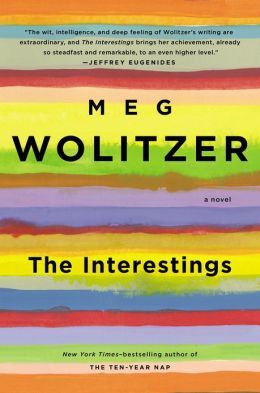
The Interestings by Meg Wolitzer

I had read Wolitzer’s The Wife in grad school and felt it was too heavy-handed, so I cautiously picked this one up after hearing the high praise for it, which almost always dooms a book for me. The Interestings deserves to be on every best of 2013 list. Not only are the story and the themes (the nature of love, the nature of friendships, family, jealousy, career, money, art, New York) thought-provoking on many levels, but the writing strikes that perfect balance of appearing both deliberate and breezy, literary yet conversationally authentic. It’s the type of book I want to now read reviews of and discuss with others, especially women artists.


LeanIn

Lean In: Women, Work, and the Will to Lead by Sheryl Sandberg

I read this for my Scripps College book club, which is composed of alumni from a wide range of class years from the women’s college. We’re all at various stages of our careers, including stay-at-home moms, working moms with infants, moms whose children have flown the nest, recent grads who have just entered the workforce, and mid-career-level women in relationships and not. Some have Ph.D.s, others want to be yoga instructors. The resulting conversation we had about this book is that, in the end, you have to find out what works for you and that may change depending on where you are in your life.

I also happened to finally get around to reading a book a colleague had given to me a few years ago: Patty Azzarello’s Rise: How to be Really Successful at Work AND Like Your Life, which came out in 2010. While Sandberg’s book is chock-full of important statistics and food for thought, Azzarello’s, though perhaps not as carefully edited, offers tips that are actually practical for people in the workforce.


Print

A House in the Sky by Amanda Lindhout and Sara Corbett

This book, the true story about a Canadian journalist and her Australian ex-boyfriend photographer who are kidnapped in Somalia, gave me nightmares. Literally. I became obsessed with the story, reading articles,  watching interviews with the people involved, and following them on Twitter. It got me thinking a lot about perceptions of the West, feminism, and ambition.


Manana

Manana Means Heaven by Tim Z. Hernandez

The publisher sent me this book, and I was a bit leery going into it that it would come off as fan fiction, but Hernandez’s Manana Means Heaven is an incredibly important book to the Beat canon. Through poetic diction, this novel tells the moving story of one of the little-known people who crossed paths with Jack Kerouac. It gives voice to a woman who didn’t even know she’d been written about decades earlier in On the Road.

You can read my interview with Tim here.


heart

My Heart Is an Idiot by Davy Rothbart

I’ve written about Davy Rothbart before, having encountered one of the stories in this book in The Paris Review and comparing him to Jack Kerouac and then going to see him read in Brooklyn, where I met his dad and pulled a sword out of his cohort. This book technically came out last year, but the paperback came out this year, and it is brilliant. I had to stifle my laughter quite a few times on the subway to keep people from staring at me as I read this book. The thing is, though, there’s a lot of heart in this book too. It’s more than just a bunch of stories that make your eyes bug with incredulity over the antics Rothbart gets himself in. It shows the tenderness and beauty and wonder of humanity in all its forms, from an aspiring DJ to a con-artist.


Tell me your favorite books of 2013 below in the comments section. I’m looking for some new reads, and I figure if you read my blog we probably have similar taste! …And by similar taste, that probably means all over the board.


* * *

Burning Furiously Beautiful: The True Story of Jack Kerouac’s “On the Road” is now available as an ebook and paperback!


Friday Links: Aristophanes Edition

13 Dec

swellfoot

Happy Friday! I’m wrapping up Aristophanes week with some link love devoted to this funny dramatist.

Lysistrata is a name featured on the Heritage Floor at The Dinner Party, at the Elizabeth A. Sackler Center for Feminist Art at the Brooklyn Museum

Pablo Picasso was so inspired by Aristophanes’ Lysistrata that he made several prints related to it, on view at the Met

Artist Aubrey Beardsley, who is often inspired by literature, also created a print inspired by Aristophanes

Obviously, there’s Radiohead’s Cloud Cuckoo Land

Lisa Borders titled her book about a young female busker’s search for home Cloud Cuckoo Land

On Fernhill Farm in Somerset, there’s a festival called Cloud Cuckoo Land

Festivals may seem very post-Woodstock, but Aristophanes was part of a festival back in Ancient Athens, called Lenaia, where he actually won first prize for his play The Knights

There’s an international architecture journal called Cloud-Cuckoo-Land

In London there’s a delightful period-clothing shop called Cloud Cuckoo Land

Percy Bysshe Shelley (Gregory Corso’s favorite poet) imitated Aristophanes’ The Frogs in the comic drama Oedipus Tyrannus: Or, Swellfoot the Tyrrant

“Aristophanes is ridiculous!” shouted Oscar on an episode of The Odd Couple in which he and Felix are contestants on the game-show Password


* * *

Burning Furiously Beautiful: The True Story of Jack Kerouac’s “On the Road” is now available as an ebook and paperback!

The Longest Word in Literature Is, Of Course, Greek

10 Dec

Ari

I always take a deep breath before I spell out my name for someone, a nonverbal warning to the person asking for it to prepare themselves. “N as in ‘Nancy,’” I say, then pause. “I-K.” Another pause, just like I heard my mother spelling it out so many times to credit card companies over the phone when I was growing up. The spelling out proceeded like that for some time, til all twelve letters were given.

Most of our friends get used to our long last name over time, so when I recently had to spell out the address of where my parents live in Greece for a family friend, I warned her to make sure she had enough room on the paper. This place name was long even for us.

I was not at all surprised, therefore, to learn via The Huffington Post, run by a Greek woman, that literature’s longest word can be found in a Greek play. Aristophanes’ Assemblywomen, an ancient comedy about the upheaval that occurs when women insert themselves in politics (things like: men must sleep with an ugly women before they sleep with a beautiful woman), contains a word that is 171 letters.

From Oliver Tearle:

Since you’re doubtless itching to know what this word is, I’ll give Aristophanes the final word: Lopado­­temacho­­selacho­­galeo­­kranio­­leipsano­­drim­­hypo­­trimmato­­silphio­­parao­­melito­­katakechy­­meno­­kichl­­epi­­kossypho­­phatto­­perister­­alektryon­­opte­­kephallio­­kigklo­­peleio­­lagoio­­siraio­­baphe­­tragano­­pterygon.

And if you’re curious what that looks like in Greek, I found it on Wikipedia:

λοπαδοτεμαχοσελαχογαλεοκρανιολειψανοδριμυποτριμματοσιλφιοκαραβομελιτοκατακεχυμενοκιχλεπικοσσυφοφαττοπεριστεραλεκτρυονοπτοκεφα-λλιοκιγκλοπελειολαγῳοσιραιοβαφητραγανοπτερύγων.

It’s the name of a dish that has about that many ingredients in it (okay, maybe only 16 or so but that’s still too many ingredients, and it sounds disgusting).


* * *

Burning Furiously Beautiful: The True Story of Jack Kerouac’s “On the Road” is now available as an ebook and paperback!

Extraordinary Women of the Fifties: The Beat Women

30 Oct

“Moreover, I was puzzled to read in her introduction how ‘our idea’ of the Fifties is one of a decade reviled for being full of dull and docile women. This does a disservice to so much writing on the “other” Fifties, from Elizabeth Wilson on lesbianism and Angela McRobbie on girls’ subcultures to Deborah Philips and Alison Light on women and fiction,” writes Sheila Rowbotham in “Her Brilliant Career: Ten Extraordinary Women Of The Fifties, by Rachel Cooke, review” for The Telegraph.

Missing from both lists were the women associated with the Beat Generation. Here were women who defied the stereotype of being “dull and docile.” They were renting apartments on their own at a time when women generally lived with their parents until they got married. They were pursuing higher education. They were creating their own innovative, beautiful works.

Much of modern discourse surrounding the Beat Generation has to do with its masculinity and misogyny. Those are important discussions to have. However, I think it does a great disservice to the many talented female writers who were associated with this literary grouping. These weren’t just muses in black stockings. They were and continue to be powerful writers.

* * *

Burning Furiously Beautiful: The True Story of Jack Kerouac’s “On the Road” is now available as an ebook and paperback!

Kalo Mina! October 2013!

1 Oct


OLYMPUS DIGITAL CAMERA

“Life starts all over again when it gets crisp in the fall.”

~ F. Scott Fitzgerald

Kalo mina! Happy October 1st! The first day of fall was September 22, but the weather today feels more like late spring. The sky is a bright, bright blue, the color of parakeet feathers. I walked down to Union Square at lunch today and was tempted to play hookey just so I could sit in the grass and look up at the sky and dream.

September brought routine back to the city, and it was a busy month. A few highlights:

  • Attending Greek American Fashion Week and seeing the latest collections by Tatiana Raftis, Angelo Lambrou, Nikki Poulos, and Stratton, with hair by Christo Curlisto
  • Seeing Jonathan Collins’ Beat Traveller art exhibit in Paterson with Larry Closs
  • Conducting a live interview with Tim Z. Hernandez about his book Manana Means Heaven at the Spanish Harlem bookstore La Casa Azul and getting to meet all the great people who work at the bookstore as well as Tim’s insightful agent
  • Reading one of my personal essays about road trips, homelessness, and God as Jason Harrod softly strummed guitar at his album release party
  • Retreating to Connecticut for the Scripps TriState alumni book club
  • Attending the Brooklyn Book Festival with friends whom I co-lead a monthly writing workshop with and getting to hear Justin Torres read from We the Animals again. He’s brilliant. I’m obsessed
  • Watching Into the Wild. I know I’m late to the game on this one, but at least I had read the book by Jon Krakauer before. The film devastated me. It was beautiful and painful and haunting and true, and I couldn’t stop thinking about it for days….
  • Brunching with author Isobella Jade
  • Hearing Davy Rothbart read from My Heart Is an Idiot. I once wrote that a story of his made me “wonder if Rothbart might be my generation’s Jack Kerouac.” Yep, he’s that good. I was too shy to talk to Davy, but I met his dad and, despite my efforts to become invisible at the mere mention of audience participation, Brett Loudermilk selected me out of the audience to pull a sword out of him. Yes, you read that right
  • Reading Kristiana Kahakauwila’s story collection This Is Paradise — this is Literature. I am savoring it
  • Discovering H&M Home — whoops! There went all my money!
  • Finally getting Internet set up at my new place
  • Talked to my sister for the first time since she moved out of New York City
  • Imbibing my first pumpkin spice latte of the fall
  • Attending A Global Conversation: Why the UN Must Focus on Women’s Leadership
  • Oh and launching the e-book edition of Burning Furiously Beautiful: The True Story of Jack Kerouac’s “On the Road” with Paul Maher Jr!!!

So yeah, that was my September. What about you? Did you read any good books? See any movies that moved you?

Tonite: I’m Talking with Tim Z. Hernandez

19 Sep

New Image

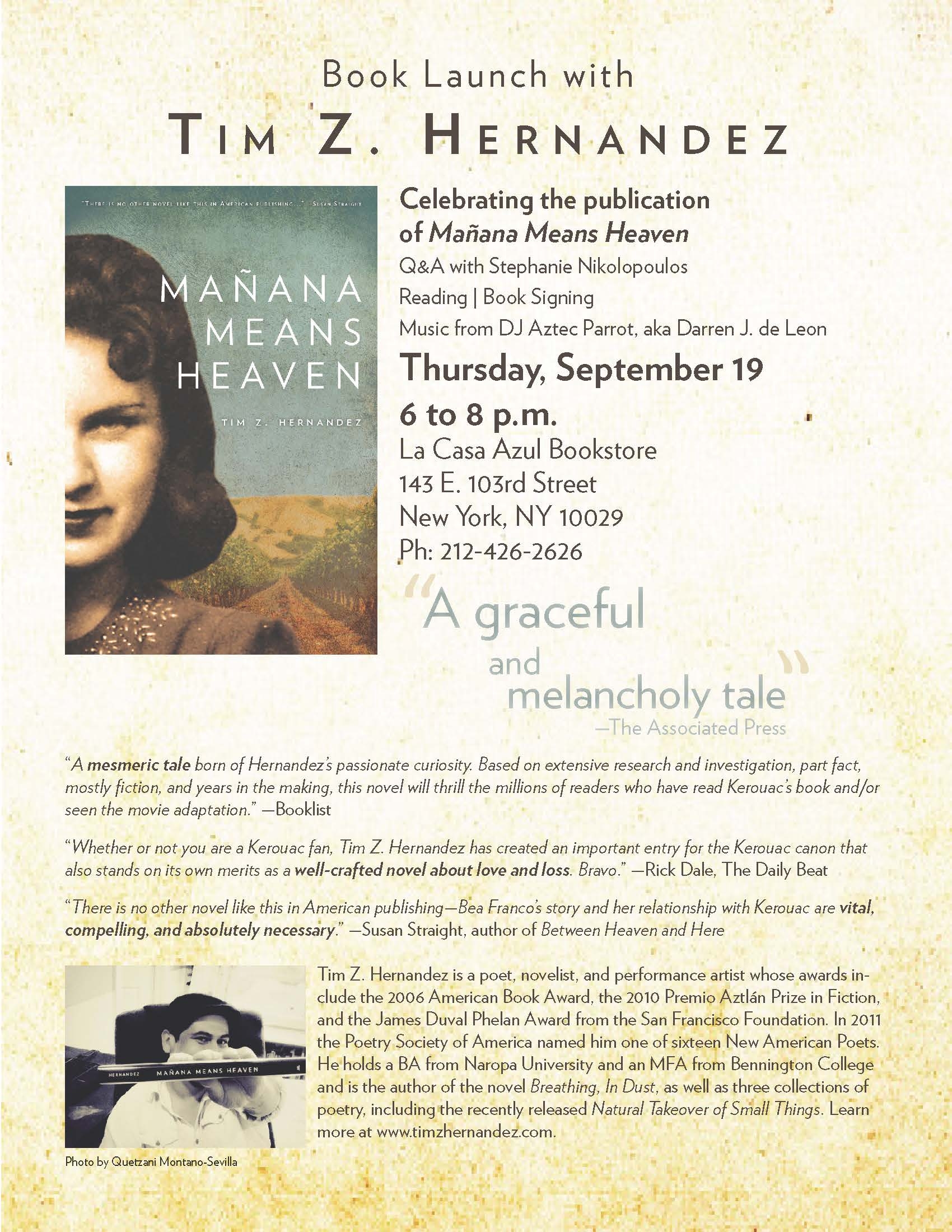
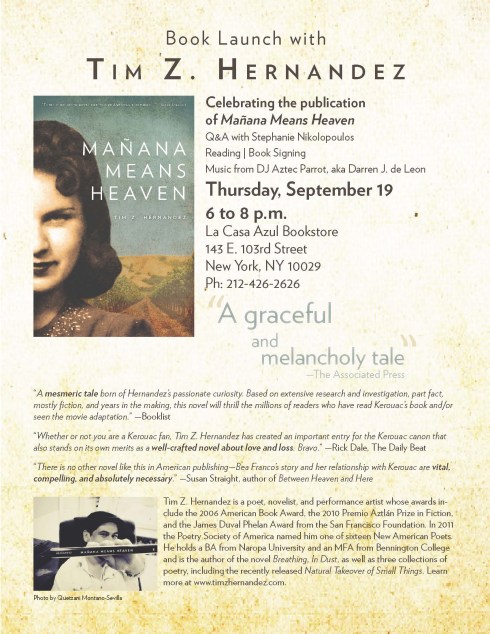
Just a quick reminder that I’ll be expanding upon my interview with award-winning poet Tim Z. Hernandez at La Casa Azul (143 E. 103rd, NYC) tonight at 6:00. We’ll be talking about his new book Manana Means Heaven, whether Jack Kerouac was a womanizer, what it’s like to write sex scenes about someone’s grandmother, the difference between fiction and creative nonfiction, and a whole lot more.

Tim will give a reading and will sign books — and DJ Aztec Parrot will be spinning music from the 1940s and ’50s.

I’m super excited! Hope to see you there!!

Mediabistro posted about the event here.

* * *

In the meantime, check out the awesome photos of Bea Franco and Tim’s guest post over on Rick Dale’s blog The Daily Beat, read an excerpt of Manana Means Heaven on La Bloga, and stop by to see Tim on The Big Idea. Then, follow along on the rest of Tim’s blog hop:

Friday, September 20 | The Dan O’Brien Project http://thedanobrienproject.blogspot.com/

Saturday, September 21 | Impressions of a Reader http://www.impressionsofareader.com/

If you happen to be in the New York area, Tim Hernandez will also be on a panel at the Brooklyn Book Festival this Sunday:

The Poet & the Poem: Natalie Diaz (When My Brother Was an Aztec), Alex Dimitrov (Begging For It), Lynn Melnick (If I Should Say I Have Hope) and Tim Hernandez (Mañana Means Heaven) will examine politics and identity in poetry, and the complex ways in which a poet’s work can become intertwined with the poets’ personal narrative. Moderated by Hafizah Geter, Cave Canem Foundation.


I’m Talking with Tim Z. Hernandez; Join Us!

16 Sep


New Image


This Thursday I’m going to be in conversation with Tim Z. Hernandez, author of Manana Means Heaven, at the Spanish Harlem bookstore La Casa Azul. DJ Darren de Leon will be spinning music from the 1940s and ’50s. It’s going to be such a fun event. I’m really excited.

Tim’s novel Manana Means Heaven is about the real-life person who inspired Jack Kerouac to write one of the most poignant parts of Jack Kerouac’s On the Road: Bea Franco, “the Mexican Girl.” Tim tracked her down and interviewed her for the book, and she got to see it right before she passed away last month.

An award-winning poet, Tim pays close attention to words and imagery in his novel. We’ve been writing back and forth for a while now, and I have so many questions I want to ask him at the bookstore. There’s going to be a Q&A too so come with questions!

Here’s the essential info:

Thursday, September 19

6pm

La Casa Azul

143 E. 103rd Street, NYC

See you there!

*Please excuse the lack of the proper Spanish “n” with a tilde in “Manana”; I’m not tech-savvy enough to get my blog to use it.


Tim Z. Hernandez Gives a Behind-the-Scenes Look at Manana Means Heaven

16 Sep

TimTim Z. Hernandez photo courtesy of the University of Arizona Press

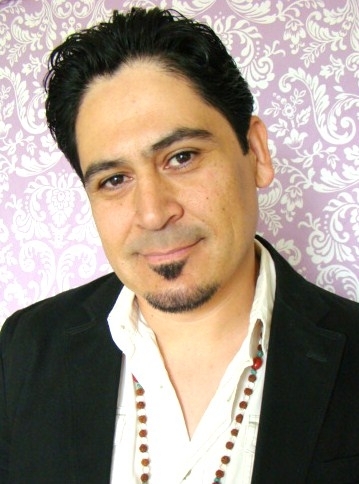
I’ve often thought that poets make the best prose writers, and I was reminded of this once again as I read award-winning poet Tim Z. Hernandez’s novel Mañana Means Heaven. The story is about Bea Franco, the real-life woman who inspired Jack Kerouac to write one of the most poignant passages in On the Road—the story of “the Mexican girl,” Terry. Mañana Means Heaven is by no means a work of fan fiction. It is beautifully crafted and painstakingly researched, and stands on its own. Even as I got caught swept up in the story, I kept wondering how Hernandez did it—how was he able to write such a captivating story about a real person, one he’d met and interviewed, one whose children he’d met, who for so long seemed mythical herself yet was perhaps overshadowed by Beat mythmaking?

When the University of Arizona Press asked me if I’d be interested in participating in a blog hop with Tim Hernandez, I jumped on the opportunity. Special thanks to the University of Arizona Press for arranging this interview and for being great to work with. And, of course, a big thanks to Tim for so thoughtfully answering all my questions.

* * *

TimCover

How did you first come across Jack Kerouac’s On the Road and how old were you?

I first read it when I was around 17. I believe a friend of mine from Sweden, Jonas Berglund, turned me onto it. He was the poet back then, while I was mostly into painting. He was trying to get me to go backpacking with him in Europe, and he kept telling me how cool it would be. He told me I should read “On the Road,” so I did. That summer I split with him to Europe.

What did you think of it at the time and how has your perspective on the novel changed over time?

I’ve read OTR three times now. At age 17, and then in my early twenties, and then later at around 30. At age 17 I identified with the desire to break free, to adventure and take risks, to get away from the place I called home. In my early twenties I began questioning whether or not these guys, Kerouac and his crew (The Beats), were just completely insane. Also, the idea of a threshold appeared. I related more with the underlying question Sal Paradise was seeking to answer, that is, do I continue on this path of wild abandon, this path as perpetual seeker of truths, by whatever means, OR, do I fall in line with the rest of the world and live a “normal” life clocking in day to day and having a family? It was a matter of maturation. Not that I decided to let go of that desire “to seek” but just that I would go about it differently, in my own way. And then by age thirty, I was reading the book less for its subject and more for the writing itself, the technique and process, and also the idea of lineage. This is what sparked the initial seed for Mañana Means Heaven.

In the introduction to Manana Means Heaven, you say that you became interested in the story of “the Mexican girl” Terry/Bea Franco because it was the part of Kerouac’s novel that you could relate to. I understand that your parents were migrant workers near where Bea’s family worked as migrant workers. I know you also worked for the California Council for the Humanities interviewing immigrants about their lives and struggles. Were your parents immigrants? Can you talk a little about your relationship to and interest in the migrant worker experience and how it relates to your writing?

Yes, all of this was very influential to my wanting to write about Bea Franco. My work with CCH, and even the Colorado Humanities today, has been very instrumental in the research and process for the making of this book. It’s the experience of working for them that has emboldened me to walk up porches and knock on the front doors of total strangers, for the sake of stories. Not to mention, having these two entities as a resource throughout my research has been invaluable. As for the other part of your question, my parents were migrant farmworkers, but they were born in Los Angeles and Texas, so they weren’t immigrants. I’m the third generation in my family to be born here in the United States, and I think this is also why I related to Bea so much once I finally met her. My first question to her was, “What do you think about being called the Mexican Girl?” She laughed and replied, “I’m not from Mexico, I was born in L.A..” So she was very conscious of her own identity in this way too. She was not an immigrant by any means, and I believe that it’s possible this assumption about her is what kept Kerouac biographers from finding her, or even looking. In any case, having come from the same background as Bea Franco, the farmworker experience, living among the labor camps of the San Joaquin Valley, this was all part of my growing up. My parents and grandparents used to travel all over picking crops, grapes, hoeing sugar beets, so I knew the people from this place very well. When Sal Paradise entered the San Joaquin Valley in “On the Road” I felt he was now entering my world, a distinct place that is in every fiber of who I am, and I knew I could write about this with some authority.

Similar to your experience with Bea Franco, part of what continues to draw me to Kerouac is his ethnic experience and how he writes about feeling a duality within him. I was born here in New York City, but my father is an immigrant. He moved here from Greece when he was in his thirties, and he felt embarrassed because sometimes people couldn’t understand him because of his accent. Kerouac’s parents were immigrants from Quebec, and although he spoke English as a child he really didn’t feel comfortable with the language until he was a teenager. I think our immigrant experience was much different, though, because of our skin color. Kerouac is seen as a quintessential American novelist while Bea got pegged as “the Mexican girl” even though they were both born here in the States. Was Kerouac’s portrayal of the immigrant experience something you were interested in or were you mainly interested in telling Bea’s story?

Yes, all valid points here. Bea too was in that strange purgatory of “immigrant born in the U.S.,” and she too was very light skinned with green eyes, and because of it was sort of an insider-outsider, similar to Kerouac’s and your own situation. In some of our conversations she talked about how she was treated differently, sometimes cruelly, while growing up because of her complexion. In many ways, hers was a real “Chicana” experience, before the term was popular. She was balancing between two cultures at once, was educated in Los Angeles public schools, spoke fluent English and Spanish. She loved both the Mexican classic songs, and the big bands of her time. In 2010 she still had stacks of records by Tommy Dorsey and Glenn Miller, folks like that. When I first met her she had a portrait of Ronald Reagan in her dining room. It took my aback for a moment, until I asked her about it. I was afraid she’d say something like, “He was our greatest President.” But instead, she said, “He was a great actor and I loved his movies,” and then she chuckled. Bea loved being American, and even though her father was from Mexico she clearly identified with aspects from both sides of the border. In regards to the last part of your question, yes, I was mostly after Bea’s story, about who she was/ is. As a fan of Kerouac’s writing, in the beginning it was tough for me to distance the two, but it was necessary to do so. If I was to write about Bea’s life, to fill in that “missing link” about who “The Mexican Girl” was, I had to start from scratch. That is, I had to, in some ways, reject what other biographers had written about her, and even reject what Kerouac himself had written about her, and go straight to the source—Bea and her family—and start there. So then the question of what she remembered of her time with Jack was no longer significant. Instead I would ask her, Tell me who you are? Where were you born? Who did you love? Approaching it this way would allow readers to enter the book on her terms, not based on anything else written about her previously. This is what I was after.

The Beats have often been criticized for the way they treated and portrayed women. In fact, I have been criticized in the media for being a woman who likes Beat writing. You’ve given voice to one of the most influential women connected to the Beats. The story of “The Mexican Girl” was the first part of On the Road Kerouac got published in a lit magazine. Some might argue that Kerouac used her for her body or for gaining experience for his book. Your depiction of their relationship was quite tender and sympathetic toward both of them. It reads like a beautiful love story. What was your thought process in writing about Bea striving to make a change in her life and cheating on her husband, and Jack leaving and never reconnecting with her?

Yes, my initial idea, as I started to envision the book, was that I’d somehow have the opportunity to “even the score.” That I would make Jack out to be this womanizer only after his own “kicks” or “experiences.” Of course, this was still before I had ever met Bea. Too, I think in order to write a good story, an honest or authentic story, at least in this case, one has to suspend those kind of judgments about their own characters. This occurred to me after I had met Bea and began speaking with her. She never viewed herself as the “damsel in distress,” and in fact, was a woman who took responsibility for her own decisions, in her early years and even now, yet was also very much a romantic. After speaking with her I quickly saw that she was not the naive “Mexican Girl” that Kerouac made “Terry” out to be in “On the Road.” Nothing in our conversations told me that for Bea, at least in her own mind and heart, ever doubted their relationship was a real possibility. Of course, she was aware that this could also mean a new start for her and her children. And this is the sense I get too from reading her love letters to him. In the end, the relationship had to feel like a very real possibility, for her mostly, but for Kerouac too. Because if he didn’t believe in it, then going by what I know about her, she would not have wasted her time.

You tracked down the real Bea Franco and got to know her. How did she feel about being a character in Kerouac’s novel and how open was she when answering questions for your book?

When I located her in September 2010, she nor her children had any clue about the legacy of “The Mexican Girl.” She was just about to turn 90 years old, and when I did tell her, I said something to the effect of, “Did you know you are a famous character in a famous American novel?” Her children, Albert and Patricia, laughed out loud. Bea just sort of nodded and said, “Oh really. I didn’t do nothing so special.” The next thing I did was take out a list of over 20 Kerouac biographies that mention her name. She just shrugged, like it was no big deal. Her son though, Albert Franco, who Kerouac dubbed “Little Johnny” in On the Road, he opened up his laptop and started typing stuff into the search engine. There he was now at age 70, blown away by it all. I can’t describe the feeling of it, but the word “surreal” comes to mind. I just sort of sat there praying they wouldn’t kick me out of the house. A couple of visits later, while interviewing Bea, Albert asked me, “After all these years…how can so many people mention my mother’s name in their books and never tell us about it?” I didn’t have an answer for them. But I knew right then that I had already done a couple of interviews and still had not formally asked their permission. I felt, symbolically at least, that this was necessary. So I asked her point blank, “Bea, can I write the book about your life?” She said, “Sure.” I replied to her, “What would you like the world to know about you?” She answered, “Oh, I guess that I tried hard to be a good person.” Albert was sitting with us too. At the time he looked reluctant with the idea of yet another book. I told him, “People will continue to learn about your mother from all these books, or I can write the only book with her input, her own words, from her perspective, and after that everyone will no longer guess at who she is.” I think it was after he did his research on me and saw that I was a kid from Fresno whose parents were also migrant farmworkers, did he finally begin to trust me. Of course, Albert and I are now great friends.

How did her children react? You uncovered Bea’s affair and described her and Jack’s relationship in pretty sensual terms. Did you feel any awkwardness writing about any of this or any responsibility toward her and her family for how you portrayed the events?

Patricia and Albert are both very proud of the book. As are the rest of their family and friends, many of who are the children or grandchildren of some of the background characters in my book. As for the “sensual” aspect, this is probably where I had the toughest time writing the book. Which seems weird coming from me, since both of my first two books have been called “raw,” “graphic,” “sexual,” in past reviews. But here I was dealing with someone else’s life, not purely my own imagination. My first attempts with the love-making scenes were horrible. A good friend who was a first reader told me, “You’re writing as if Bea herself is standing over your shoulder.” And this was true. I was worried about losing the trust of her and her children. I didn’t want it to come across as distasteful. But still, in order for anyone to be convinced of this romance, an affair where two adults holed up in a hotel room for several days, then the range of intimacy had to be present—everything from long talks in the wee hours of the night, to the ebb and flow of emotions, sex, regret, risk, liberation, all at once. I’ve long considered myself to be the kind of writer who doesn’t shy away from “the real,” and in fact, this is what I returned to as the book was being written.

Manana Means Heaven is categorized as a work of fiction. How much of it is true? In literature, where do you think the lines are drawn between fiction and creative nonfiction?

This is the kind of question that would require many pages to even scratch the surface, so I’ll try and give you the brief version. “Fiction” and “Creative Non-Fiction” are genres, and I treat them as such. Neither are qualified substitutes for “the actual.” Isn’t this part of what Kerouac’s own legacy is built on? The idea of writing it as he lived it? If I had to put it into a percentage I would say about 75% of Manana Means Heaven is “true” from Bea’s perspective. The other 25% is authored by me, but also rooted in truth, about the life of farmworkers in the 1940’s, about the history of that part of California and the people who worked the land. Like I told Bea herself, even though it’s called “fiction” it’s still closer to the truth about who you are than anything else out there. Which is odd when considering that most of what is out there can be found in the “Non-fiction” books shelves. Reason being is that biographers have only counted on Kerouac’s version of events. One of the first biographers I contacted when my research began was Paul Maher Jr. This was because his book, “Jack Kerouac’s American Journey” had the most unique pieces of information about Bea than any other book out there at the time. I wondered how he knew certain things, so I asked him. Turns out he had read Bea’s letters to Kerouac, which were housed in Kerouac’s archives at the New York Public Library. So Maher had dug a little deeper than most in regards to Bea. And now only recently, Joyce Johnson’s new book “The Voice is All” has echoed some of what Maher had discovered. I imagine now that my book is out we’ll start to see more accurate information about Bea Franco, which is also a big part of why I wrote this book.

You’re also an award-winning poet. I think poets often make the best writers. Can you talk a bit about how you approached this novel as a poet or how the writing process differed?

Yes, ultimately, I feel at home with poetry. For me, prose is like going to work, slinging a hammer from 6am–5pm. Poetry is like the ice cold beer you crack open when the day is done. Poetry was my focus throughout my undergrad and graduate degrees. But I do love telling stories too. Why can’t both happen? In writing I don’t begin by saying “I’m going to write a poem today.” Or, “I’m going to make this a story.” I write and allow the muse to tell me what it is. Even then I’m skeptical, or open about it. I keep writing until I get to a point where I go, okay, now I have to make a decision here. In the end, my main goal is tell a damn good story. It so happens that for me a good story is one that works on multiple levels. Not merely subject, but on the line level. For me a good story also has language that sings, that isn’t afraid to dig deep in the crates, use fresh turns of phrase, make rhythm, use imagery that evokes emotion.

Can you talk a little about the literary device you used in opening and closing the book in the same way?

Yes, there are two ends to the book, Bea’s story, and then my search for Bea. The idea of starting the book at the second ending emerged somewhat organically. I had to figure out how to let the reader know that this book is rooted in my interviews with Bea, and I had to address the one thing that I knew would be on the minds of Kerouac fans, that is, what did she remember of her time with Kerouac. And then there was one big wrench in the machine that I also had to figure out how to get around. By starting from the very end of what is considered the “non-fiction” portion I was able to set these three things up so that when the reader finally enters the “fictional” portion of Bea’s story, they have suspended their idea of “fiction.” The book went through something like twelve drafts before I could figure this part out. There was a lot of shuffling chapters around and reconfiguring the whole thing…in fact, there were times when I thought to myself, who am I kidding? It’ll never work. But I finally found a combination that did work.

* * *

Tim and I will be continuing this conversation this Thursday night at La Casa Azul.
New Image

* * *

Meanwhile, join Tim Z. Hernandez on the rest of his blog-hop!

Tim Z. Hernandez Blog Tour:

Tuesday, September 17 | The Daily Beat http://thedailybeatblog.blogspot.com/

Wednesday, September 18 | La Bloga http://labloga.blogspot.com/

Thursday, September 19 | The Big Idea http://www.jasonfmcdaniel.com/

Friday, September 20 | The Dan O’Brien Project http://thedanobrienproject.blogspot.com/

Saturday, September 21 | Impressions of a Reader http://www.impressionsofareader.com/

Should Women Dismiss Beat Literature?

18 Jul


funnyfacebookstorewdsdsdsdsdsImage via Dangerous Minds
Google+ was all the talk at BEA this year and last. I’ve been on the social media platform for a while now, but just the other day decided to see how it compares with Facebook for finding the latest conversations on the Beat Generation. I did a keyword search and immediately found an article that was right up my alley: “The Feminist Backlash Against the Beat Generation.”
Kimberly J. Bright writes for Dangerous Minds about her experience viewing the now legendary scroll of Jack Kerouac’s On the Road and having another person there remark in surprise that she was there of her own volition. Bright writes:
Their teacher asked me a question about the scroll, obviously assuming that I was a museum employee. When I explained that I was just a visitor, she apologized and said, “But I didn’t think women read Kerouac.”
That was news to me.
The backlash against the Beats in general, and Kerouac in particular, is becoming more evident and is mostly coming from Feminists.
Oh, how I could relate—which Bright noted, referencing my apparently controversial Millions article. Just like Bright, I never knew some works of literature were supposedly for men and others were for women. How silly of me to not realize there was an entire list of writers whom I should ban without reading them to decide for myself or that I should dismiss the literary and cultural merits of a highly innovative and influential body of literature just because certain aspects of it might offend my sensibilities.
I attended a women’s college, where we read a wide breadth of literature and learned to think critically about works—literature that included Allen Ginsberg, Ernest Hemingway, Michel Foucault, Karl Marx, Isaac Asimov, Kathy Acker, comic books, Sigmund Freud, Jean-Jacques Rousseau, Samuel Richardson, and Jane Austen. In my MFA program, we specifically discussed the distinction between the author and the work as well as the literary merit versus our individual preferences.
Bright went on to write:
Personally if I purged my bookshelves, real and virtual, of all the alcoholics and misanthropes – let alone all the manic-depressives, opium addicts, suicides, eccentric asexuals, adulterers and misogynists – I would hardly have any books left.
It seems a bit hypocritical, to me, for people to lambast the Beats while still reading other authors whose personal lives and even the content of their work are not any less controversial. This summer everyone rushed out to watch The Great Gatsby, read or reread the novel, and plan their weddings around the theme of F. Scott Fitzgerald’s story that placed women as secondary characters, kills off one of the women, glorifies a criminal, includes affairs, and exalts illegal substances. It should also be noted that Fitzgerald is widely known to have plagiarized his wife’s work for some of his own books. If we’re dismissing authors on so-called moral grounds, perhaps we should then also dismiss:
  • Miguel de Cervantes (prison time after the money he collected as a tax collector went missing)
  • Paul Verlaine (prison time after shooting Rimbaud)
  • O. Henry (prison time for embezzlement)
  • Jean Genet (prison time for lewd acts)
  • Leo Tolstoy (secretly abandoned his wife in the middle of the night)
Of course, choosing whose work is “worth” reading becomes problematic because whose morals must we go by? Furthermore, which attributes of a person are more or less important when deciding whether we should read their literature? Should we praise Betty Friedan’s entire body of work because she is pro-choice? Should we dismiss her entire body of work because she did not further lesbian politics? Or vice versa? Should we dismiss her altogether? What about Bill Clinton? Should we not read the former president’s books because he cheated on his wife? Because he wielded his position of power over a twenty-two-year-old intern? Should we dismiss Jack Kerouac’s work because of the way he treated his daughter? Should we praise his work because of the way he treated his mother?
I don’t mean to make light of any of these issues or to excuse anyone from anything. My point is simply that we need to take a closer look as to why we excuse some authors but not others. Why have the writers who have been marketed together as the Beat Generation been targeted while others get a free pass?
And why don’t those so-called feminists who target the so-called Beats acknowledge the many women writers associated with the generation? Here were women who faced tougher socio-political times than we do today who got their own apartments, who studied at well-known undergrads and went on to work toward their MAs, who didn’t just sit around cooking dinner for their husbands but created works of their own. Should we forget their body of work or negatively lump it into a category we don’t read because of their associations?