Tag Archives: film

Welcome to Beat Week!

12 Dec

The people behind the On the Road film are uniting a community of angel-headed hipsters. They’ve organized lots of fun activities leading up to the release of the film in the States. Welcome to Beat Week!

beat-week

Those of us who are passionate about Jack Kerouac’s literature may cringe at the use of the word “beatnik” and the commercialism of the events–the supper club event costs $95 and is a far cry from the cafeteria food Kerouac typically described in his writing; I’m not sure what haircuts have to do with the book or the film adaptation of On the Road and I’m pretty sure Kerouac wouldn’t have been able to afford the prices there–but perhaps these are simply fun events that will inspire a new generation to check out Kerouac’s book for themselves to see what the buzzzzzz is all about. And I must say, the chance to see Jose Rivera and Walter Salles in person is too good to pass up!

What do you think: Is this crass commercialism or an inspired way to engage the Millennial Generation? Is Jack Kerouac finally getting his due or are we headed into Maynard G. Krebs territory?

James Franco Reveals How He Was Introduced to the Beats

11 Dec

I was just thinking the other day that it had been a long time since I’d heard about James Franco. I’m serious! It seemed like a year or two ago James Franco was omnipresent. There’s James Franco sleeping in class at Columbia! There’s James Franco explaining it wasn’t technically class! There’s James Franco playing with a cat! There’s James Franco’s book! There’s James Franco teaching at NYU! There’s–well, you get the idea.

And then nothing.

I don’t know why, but I suddenly missed hearing about James Franco. Maybe it had something to do with the fact that we were both getting our MFAs. Or maybe it had to do with the fact that I thought his portrayal of Allen Ginsberg in Howl was authentic.

Well, wouldn’t you know it: today I stumbled upon The Los Angeles Review of Books‘ recent interview with James Franco. In the article, Franco discusses poetry, writing, and filmmaking. He talks about William Carlos Williams, Hart Crane, Allen Ginsberg, Frank Bidart, and his writer mother. He also says that even though he portrayed Allen Ginsberg in Howl it was another author who inspired his foray into Beat literature:

Kerouac came first. On the Road was my introduction to the Beats, but “Howl” was my introduction to poetry. I studied Williams in school, but I didn’t really study him as a craftsman until later, when I went to the writing program at Warren Wilson College in North Carolina.

He also reveals that he’s studying Beat literature with Amy Hungerford, who has written about Ginsberg’s supernatural language, in his PhD program at Yale.

Road Trip: Nightmare of a Trip

31 Oct

Happy Halloween!  I’ve been recounting some rather nightmarish road trip tales for you — the tour I booked not going all the way to Big Sur, the bus breaking down, not being able to stop and pick up 7 avocados for a dollar in Salinas, my road trip essentially going awry.  Oh, the horror!  I know, I know.  White girl problems.  But really it all just added up to be one semi-disastrous trip.  Here’s what I didn’t tell you:

  • my friend and I spoke on the phone about getting tix together, she sent me an email confirming the arrival time was okay, I booked my flight … and then she told me she wasn’t coming after all
  • my other friends had planned their trip in reverse of mine, arriving the day before the wedding and then staying a few days after I left, so I didn’t get to hang out with them apart from the wedding
  • the person who’s place I was supposed to crash at was sick so I had to book a last-minute hotel, which would’ve been fine except apparently there were several conferences going on that week so every hotel in the city of San Francisco was at least $400
  • my connecting flight was delayed, so then the shuttle I prebooked said it would only take me if I paid more money
  • the shuttle dropped me off at the hotel, sped away, and then I was left with the realization that the hotel had shut down for the night.  What kind of hotel shuts down??
  • I decided to take the BART on my way back to the airport at the end of my trip, drag all my luggage the 20 minutes from the hotel to the train, only to discuss mass transport doesn’t start running til 8am in SF.  I will miss my flight if I wait an hour for the BART to run.  I call the shuttle company; it won’t pick me up because I don’t have a reservation.
  • I get a cab.  The driver tells me it will cost $120 to get to the airport.  It’s that or miss my flight.
  • We get to the airport and can’t find my airline.  For some reason, it’s in the international flight section of the airport, even though I’m flying SFO to LGA.
  • I’m waiting for my flight to leave, when I get a call from my bank that they’re shutting my card down due to strange charges.

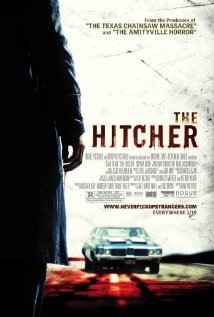
Okay, so my trip wasn’t the stuff of B horror movies.  It wasn’t the opening of I Know What You Did Last Summer, when a driver hits someone on the road and dumps their body in the ocean.  It wasn’t The Hitcher, where a young couple gives a ride to a hitchhiker and horror ensues.  It wasn’t The Texas Chainsaw Massacre, where a group picks up a stranger on their way to gravesite and then are stalked by, well, a guy with a chainsaw and his cannibal family.  And it wasn’t Urban Legends, where a college coed is driving along and suddenly a guy pops up in the back seat!

See, back when Jack Kerouac was taking road trips in the 1940s and ’50s, hitchhiking was pretty commonplace.  It was never really the ideal or safest way to travel, but it wasn’t as scary as it is today.  Today, horror movies are moral tales that warn drivers to always  check the perimeter and interior of their car before getting in and to not pick up strangers.  Parents not only forbid kids to hitchhike but also have to warn them about getting too close to cars in general.  Currently in the area in which I grew up in New Jersey, there’s a man who’s been trying to lure kids into his car.  There have been at least 17 luring attempts in Bergen County recently, and some New Jersey towns are considering a Halloween curfew.

Have a happy and safe Halloween!  What’s your favorite horror movie road trip?

Road Trip: By Night

30 Oct

In honor of Cabbage Night and Halloween, I thought it would be fun to post some photos from my road trip that I took at night.  A midnight road trip is deliciously scary.  The moon taunting you from above.  Tree branches that look like claws.  Eerie silence.  On the bus, we watched the psychological thriller Vertigo, directed by Alfred Hitchcock, which was filmed in part at the 17-Mile Drive, which we traveled through on our road trip, but you could listen to an audio recording of a horror story if you have to keep your eyes on the road … and the rearview window!


“Beat Generation” Premieres during Lowell Celebrates Kerouac

10 Oct


Kerouac’s play “Beat Generation,” written the same year that On the Road was published, will also have its premiere tonight.  The event stage production is taking place during Lowell Celebrates Kerouac, the week-long literary where fans from across the country make their pilgrimage to Kerouac’s hometown in Massachusetts.

As The Guardian reports, until around 2005, Kerouac’s play “The Beat Generation” sat unpublished in a New Jersey warehouse. In 2006 Da Capo Press published the play, with an introduction by A. M. Holmes.  Kerouac, who had a great interest in film, never got to see his own play put on or his novels made into a film.

Merrimack Repertory Theatre (MRT) raised funds through Kickstarter to stage the play in Lowell and is presented with UMass Lowell.  It was made with “the support and collaboration of Kerouac Literary Estate representative John Sampas,” according to MRT.

The play centers around the same group of New York City friends Kerouac often wrote about, as they pass around a bottle of wine.  Perhaps even more so than his novels, which are rich in poetry, the emphasis in “Beat Generation” is on dialogue.  Kerouac had a great ear for the unique syncopation of everyday language and the lingua franca of the working class.  As Kerouac himself said:

One thing is sure: It is now a real play, an original play, a comedy but with overtones of sadness and with some pretty fine spontaneous speeches that are as good as Clifford Odets.

Odets (1906-1963) was a playwright raised in Philly and the Bronx who wrote such plays as Waiting for Lefty and Golden Boy.  Born to Russian- and Romanian-Jewish immigrant parents, Odets used ethnic language and street talk in his plays.  Arthur Miller said of Odets’ work,  ″For the very first time in America, language itself . . . marked a playwright as unique.″  Kerouac himself was the son of immigrant French-Canadian parents and made use of both ethnic language–his own joual dialect as well as Greek and Spanish–and street talk.

For information on the special events surrounding the play as well as tickets, visit MRT.

Lowell Celebrates Kerouac: The Typewriter

9 Oct


One evening, a student came into our writing workshop at The New School and announced he’d bought a typewriter.  We were all very impressed.

“What kind?” we asked.

“Where did you get it?”

Most of us were in our twenties or thirties and had grown up using computers.  Many of us had entire mini computers—smart phones—jammed into our pockets and purses at that very moment.  We’d attended readings in bars across Manhattan, where authors had read poetry off their iphones.

But a typewriter!  Now that sounded really literary.  The click-clack of the keys echoing in a bare-bulb room.  Allen Ginsberg’s first-thought-best-thought mantra forced upon a generation accustomed to the “backspace” button on our keyboards.  Facebook procrastination less accessible.

And the history!  Continuing the beautiful tradition of authors attached to specific models of typewriters.

This evening, the documentary The Typewriter will screen at the Lowell National Historical Park Visitor Center Theater (245 Market St.) as part of the Lowell Film Collaborative with Lowell Celebrates Kerouac.  Here’s a little bit about the film from its website:

Three typewriter repairmen the filmmakers have interviewed all agree that their business is better than it has been in years.

Perhaps it is a reaction to the plugged in existence of today’s 24/7 communications world. Perhaps it is mere nostalgia and kitsch. Perhaps it is an admiration for the elegance of design and the value of time-tested workmanship. And for some, like typewriter collector Steve Soboroff, it is the appeal of owning machines on which American writers like Ernest Hemingway, Tennessee Williams, Ray Bradbury, John Updike and Jack London typed some of their finest work. (He also owns typewriters once owned by George Bernard Shaw and John Lennon)

The film is directed by Christopher Lockett and produced by Gary Nicholson.  You can read fascinating typewriter stories here.

As for Jack Kerouac, he owned several typewriters throughout his lifetime but most famously used a 1930s Underwood typewriter.  His father was a printer, so even from a very young age, Kerouac was in a world full of language, literacy, typography, and printing presses.  Not surprisingly, he had a reputation for being a speed typist.  myTypewriter.com offers some background information on Kerouac’s—as well as other literary figures’—use of typewriters.  Burning Furiously Beautiful: The True Story of Jack Kerouac’s On the Road will also include information about Kerouac’s typewriter.  Larry Closs‘ novel Beatitude also includes a plot involving Kerouac and typewriters.

Here’s a tip for those of you attending Lowell Celebrates Kerouac or if you happen to find yourself in Lowell any other time: you can see one of Kerouac’s Underwood typewriters, and other memorabilia firsthand at the Mill Girls and Immigrants Exhibit at the Morgan Cultural Center.  It may sound like an unlikely place to view some of Kerouac’s possessions, and it’s not really well advertised, so it’s easy to miss if you don’t know about it, but the exhibit is open 1:30-5:00pm except on major holidays.  It’s free, but even if it weren’t the entire exhibit is fascinating.  The case display for Jack Kerouac is very small, but literary pilgrims will appreciate it nevertheless, since it’s rare to have opportunities to view his personal travel gear and typewriter in person.  The exhibit is engaging in retelling the story of immigration to Lowell.  Many of the immigrants were from Greece so the exhibit gives insight into the influence of Greek culture on Lowell.

Recap — with Photos! — of David Amram Reading

10 Sep


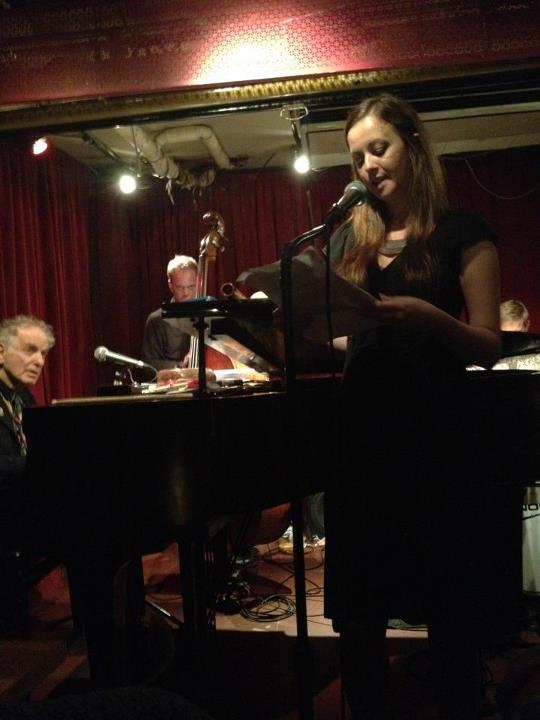
When musician David Amram introduced me before I read with him at Cornelia Street Cafe on September 3, 2012, he very generously said people should pay attention because one day they’d see me on television.  To me, though, reading with David Amram was a much bigger deal than being on television.  There are countless television shows, but there is only one David Amram.  While there are many fantastic musicians and writers out there whom I’d be honored to read with, there are few who hold such a special place in forming my creative identity as Amram does.

I first became acquainted with Amram through studying Jack Kerouac when I was just a teenager.  I was enamored with his improvised performance as Mezz McGillicuddy in the 1957 Robert Frank and Alfred Leslie film Pull My Daisy.  In fact, this photograph, featuring Larry Rivers, Jack Kerouac, David Amram, Allen Ginsberg, and Gregory Corso, who all collaborated on the film, is probably my all-time favorite photograph of the poets, writers, and artists associated with the Beat Generation.  It seems to so purely capture their friendship: just a couple of people hanging out at a cafe, maybe talking about the arts, or maybe just drinking coffee late into the night and enjoying each other’s company.

Although it was literature that introduced me to Amram, his music fascinated me.  Here was a musician who was more than just skillful.  Amram is an innovator.  He’s someone who experiments, improvises, blends genres, captivates.  He is, quite simply, mesmerizing to watch and listen to.

Through reading biographies on Kerouac and also reading Amram’s own biographies, I came to discover the jazz-poetry readings Amram and Kerouac began doing in the Village in 1957.  These were improvised sets, requiring each to masterfully foresee and adapt to changing tempos and moods in each other’s works.  These jazz-poetry collaborations captured my imagination, challenging my view of art and the way in which it’s created, the musicality of words, and the role of collaboration, improvisation, and performance in literature.  As I read about the collaborations in musty library books, forty-some-odd years after they’d taken place, I envisioned what it must’ve been like to be in the crowd at a painter’s loft or at the Circle in the Square.  Did the people there realize they were part of history?

In 2001, I had the opportunity to ask Amram just that when I interviewed him for some research I was doing at the time.  I sat enthralled, clinging to his every word, as he told me about all the places he used to hang out at in New York, about collaborating with Kerouac, and about how the term “Beat Generation” is just a marketing term that people later attached to the individual artists who each create unique works.  As he talked, answering all of my questions and never rushing me, and later as I read another biography of  his, I realized that Amram is the real deal — a creative genius and also a beatific individual, an artist who inspires and encourages.

Amram has been someone whom I’ve long admired, both on an artistic and a personal level.  Reading about those 1957 jazz-poetry readings he did with Jack Kerouac, I never imagined that one day I would have the opportunity to read the book I’m writing on Jack Kerouac with him.  When my former editor suggested we attend Amram’s show at Cornelia Street Cafe in the Village, I excitedly said yes.  A few days later, I had to email him back to say Amram had invited me to read with him.  It was completely surreal.

The September 3, 2012, show was completely sold out.  I had some friends who were turned away at the door.  Special thanks to Cornelia Street Cafe’s Robin Hirsch and the staff for hosting the reading and for doing such an excellent job in organizing the event.  I read a short selection about Kerouac’s time in Mexico from Burning Furiously Beautiful: The True Story of Jack Kerouac’s On the Road, the book I’m co-authoring with Paul Maher, Jr.  It was really exciting because author Larry Closs and painter Jonathan Collins, both of whom I met through the Burning Furiously Beautiful Facebook page, were in the audience.  Poet and producer RA Araya, who has been hugely supportive of my work and whose birthday bash was the premiere reading from Burning Furiously Beautiful, was also there, and graciously provided the photography you see here.  I had some other family and friends there as well and am so appreciative of their support.  It means more to me than most people realize.

As soon as my videographer, Liz Koenig, sends the video, I’ll post it so you can hear me reading with David Amram and his band.  The band, consisting of Amram, Kevin Twigg, and John de Witt played so beautifully — even more of a feat, considering Twigg had hurt his hand before the show.  The music was haunting and fit the piece that I read so perfectly.  I wanted to remain present in the moment, to really hear what they were playing, and savor the moment.  It was one of those times in life that I wanted to tuck into my heart and cherish.


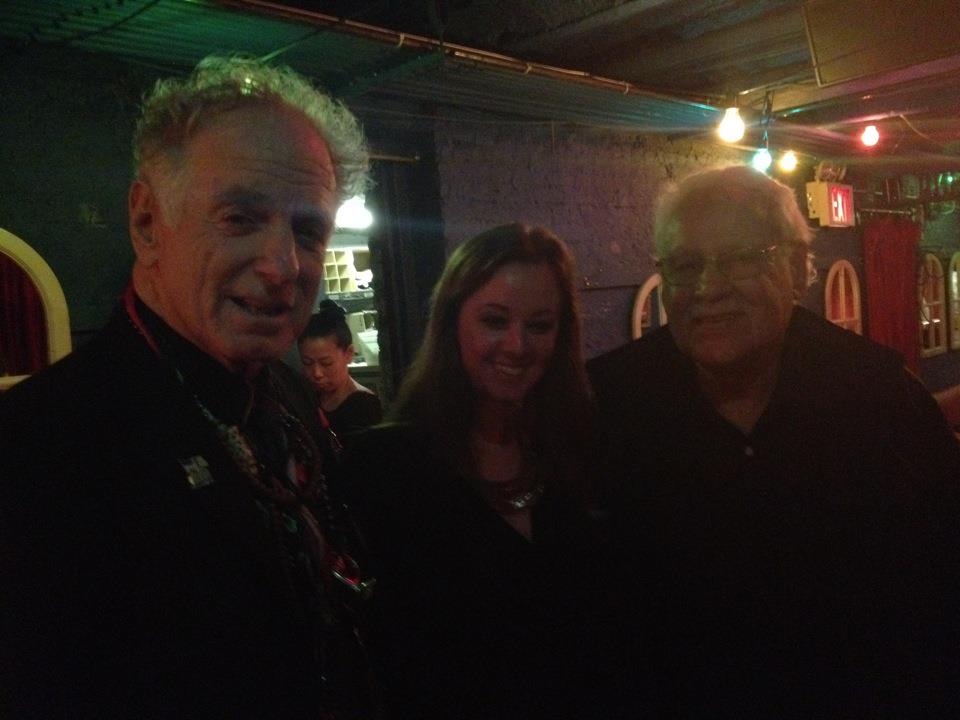
David Amram, Stephanie Nikolopoulos, Joe Pacheco

Stephanie Nikolopoulos, David Amram, RA Araya

Exclusive Interview with Author Paul Maher Jr.

7 Sep

I am so excited to share my interview with Paul Maher, Jr.  He has such incredible insight on Kerouac and the writing process in general.  I think you’ll see why I enjoy working with him so much on Burning Furiously Beautiful: The True Story of Jack Kerouac’s On the Road.

How did you first become interested in Jack Kerouac?

I remember one of the first books I ever picked up of Kerouac’s, it was Dr. Sax. I didn’t buy it at the time, I just looked at the back cover and read its blurb: “In this haunting novel of intensely felt adolescence, Jack Kerouac tells the story of Jack Duluoz, a French-Canadian boy growing up, as Kerouac himself did, in the dingy factory town of Lowell, Massachusetts.” That was the exact same sentiment of myself at the time, I must have been about 18 or 19, and my adolescence too was “intensely felt” as well as growing up in Lowell. I also grew up in Centralville in a French  Canadian enclave for about the same time period as Jackie Duluoz. Soon afterwards, when I did buy Dr. Sax, I related to Kerouac’s capturing of the whole scene, the sense of hauntingness; the dialects, the sensibilities, and the mystery of Catholicism. I attended Saint Louis de France school like Jack did, and attended masses there. My last time in the basement of that church, it was for my father’s funeral. I remember sitting in those little wooden pews, smelling the burning candles, and the hushed yet amplified sounds of murmurings, sneezes and the priest standing before us all. It brought me right back to my boyhood when I used to walk there every day. Except, of course, the cycle was complete for my father who had also attended that church as a boy, as well as his parents.

So, dipping into Kerouac was easy for me. That was my introduction, not, like many, On the Road. After reading Dr. Sax and Visions of Cody, my first Kerouac books, On the Road seemed a bit tame. A disappointment really, and it still ranks lower than those aforementioned visionary masterpieces. It is no wonder Dr. Sax was a novel that he was really proud of.

You grew up in Kerouac’s hometown of Lowell, MA.  What was that like and how does it inform your understanding of Kerouac and his work?

I can’t objectively say what it was like, it just was. There was also a lot not to like about Lowell, like any other town or city. Growing up in Lowell was as natural as anything else. My home address was less than a quarter-mile from three of his Centralville addresses. His house in Dr. Sax was next to the Hildreth Street cemetery, and walking by that cemetery, as a child, the stone wall was high and there were iron gates surrounding it. It was padlocked with a chain. We never got in, so we wondered what was in there, and so that naturally retained a mystery for us. Adjacent to that house was a funeral home, and my father and grandfather were waked there (among others). There was a mystery to all of it, and I easily made those associtations captured so perfectly in his Lowell writings. However, I didn’t feel it so much with Maggie Cassidy or Vanity of Duluoz, because I didn’t grow up in Pawtucketville or attend Lowell High School. Those two books do more to capture an era than a certain mystical reverence for childhood.

I have a high regard for Visions of Gerard as well, because it captures more of the Franco-American sensibility of Centralville, and that sort of insular vibe common to the city. Like Kerouac, I was friends with kids named Plourde and Beaulieu, for all I know they were grandsons of his friends.

Which is your favorite of Kerouac’s books?

In no particular order, any of those books written between 1952 and 1954, especially those that have more of a mystical nature. I love The Subterraneans and Tristessa. The Lowell novels, Visions of Gerard and Dr. Sax; Book of Sketches and Some of the Dharma. I always carry Visions of Cody with me, though I am no admirer of Neal Cassady, I am fond of how Kerouac transmuted that person into his artistic sensibility to create a portrait of bygone America.

One of your greatest skills as a biographer is the thoroughness of your research.  Do you have any tips for aspiring biographers on how to track down hard-to-find material and incorporate the information into a work without it sounding like a Wikipedia entry?

I’m not a trained researcher. I took courses for my degrees on how to conduct research and much of it was rote, based on archaic practices and for the most part, teaching us to dispense with the piecemeal detective work of newspapers and archives, and instead operate backwards by working through secondary sources. For my Kerouac biography, I made it a point not to use the existing biographies as a resource. On the other hand, I had already retained much of what was written and having that knowledge, I could work on another level.

I also operate out of a sixth sense, almost intuiting where material might be, or something that may exist and is worth pursuing by surmising that it might be there. It may be as simple as spelling a name wrong, and then doing searches for it. The Internet has made it awfully easy to do much of it, especially in regards to newspapers and magazines. However, there is also room to abuse it, so that it does sound like a Wikipedia entry.

Per incorporating it, that can be tricky. You always want to use it where it adds to the narrative and doesn’t seem like filler material. I could have easily added anecdotal information on every town Kerouac passed through when he traveled across America. However, the emphasis is on Kerouac, not the town. However, if it was a documentary on the Travel channel, then it works.

I feel like you and I have worked really well together on Burning Furiously Beautiful, but collaboration is not desirable to many people or can be intimidating for those interested in it, particularly artists who want to leave their personal imprint on a work.  However, there is a grand tradition of collaboration; Kerouac himself collaborated with Burroughs on And the Hippos Were Boiled in Their Tanks.  What would you say to someone who is contemplating collaboration?

You just have to operate on blind trust and intuition. I like collaborating, but I can certainly understand the desire to want to have your own book, with just your name beneath the title. I am past that; it doesn’t matter to me if my name is on there at all. Films are created in collaboration with others, books are no exception.

In addition to various biographies on Kerouac, you’ve written Tom Waits on Tom Waits, Miles on Miles, and One Big Soul: An Oral History of Terrence Malick.  You’ve recently started writing your first novel and are documenting the process through your blog Scrivener Notes.  Why are you documenting the writing process?  What do you think are the positive and negative effects of lifting the curtain to expose the work that goes into writing, especially this early on when the work is still at its nascent stage?

I have always been very open about my work, sometimes to my detriment. To write inside a vacuum, to sit on your idea and let it gestate in isolation doesn’t seem like fun at all. I feel with this little adventure, that the book can just as well bloom when it is fostered by a like-minded community. I think there is something perilous and reckless yet strangely beautiful in throwing your ego out the window and letting the world watch you try to invent something out of nothing.

I have finally arrived to the point in my life that I don’t care about how any book of mine is received, because they are written out of a pure volition of wanting to do it, not having to, and in wanting to do it, once it is done, the act of creating has already been accomplished. The rest is just grist for the mill.

Documenting it just seemed right to do. I always wanted to see someone else do it, and I haven’t found it done to my satisfaction. I could write an entry how thrilled and elated I am to finish a chapter, and the next day write how much I suck. There is a reality television vibe to it. I do understand that it will only appeal to maybe 1% of the people out there, if anyone at all, but since I am doing it for myself, it doesn’t matter to me who reads it in the end. At the very least I will eventually get a novel out of it for better or for worse.

In happenstance, I could say the negative thing is that someone can lift your ideas and run with it. This has already happened with a reputable person in Kerouac studies. However, I think once the writing on the blog is exposed enough, it is more or less on public record so if someone does lift from it, then they are pretty much hurling themselves and their work into disrepute.

You write a little on your blog about why you wanted to make the leap from biography to novel.  What I want to know is how, if at all, do you think your biography work will influence your fiction?

I’m not sure that it will. The work ethic is already ingrained in me. I wanted to free myself from the world of facts and I have started resenting having to prove myself to publishers any longer. I have come to recognize that it isn’t an art form, it is a business, and I do not have a business mindset.

Also, a recent incident when my research and ideas were stolen from me has totally killed the spirit of writing biography, though I do admire others that are more honest in their profession. Operating out of my own intelligence and imagination keeps my ideas and impulses sacred and pure. I guess that’s it.

You also are a photographer and a filmmaker.  While these are notable in their own right, as a writer I am curious if you see any correlation between those art forms and the literary arts?  You and I have spoken before about how the narrative of film has influenced your scene-setting in your books.  Can you talk a little more about this?

The only correlation for it is personal, in that I am creating out of my own impulses to satisfy me. Taking a photo is immediate gratification, writing keeps me constantly busy, and it keeps my depression at bay. It keeps me in books and it serves to keep my mind occupied and focused since it is always burning at both ends.

Through chance and not design, I have a natural tendency to see things cinematically. That takes in imagery, dialogue, and creating a setting. This is how our collective minds are trained, and to bombard a reader with minutiae just for the sake of being all-encompassing with the facts is just an exercise of indulgence. We live in new times, where the facts are available if we want them, within a few keystrokes. I think pointing to the heart of the matter, isolating a biographical scenario like it was a storyboarded scene adds to the appeal of the book tremendously. I think Kerouac also had that in mind with his “bookmovies.”

How do you find time to do everything?  How do you balance all these various projects?

If I had to itemize my time, I couldn’t do it. I live this stuff. I breathe it. If we were taught at the beginning of our lives that we had to make sure we breathe at least eighteen times per minute, and it wasn’t automatic, that we had to go about our daily lives having to count, then we would crumble, sooner or later, under the pressure of it all. It would be too stressful. Instead, it comes to us automatically; we don’t have to make room for it. I just do it because it is all I think about. If I don’t do it, then I feel like shit. My mind turns to mud. I get lethargic. Unbalanced. So, like I said, it has become a survival mechanism for me, whether it is a book, a blog entry, an email or a photograph, all of it is tied into the daily phenomena of my being.

I never have considered how it is all balanced other than I keep my own schedule. When I need a break from one project to let it breathe, I move to another. Eventually I return to all of them.

Actually, managing writing projects is a lot easier than trying to manage a practical everyday life for me. To that end I am a colossal failure.


***

9/7/12, 10:28am: Several minor edits were made to this interview.

14 Road Trip Movies for Every Personality

17 Aug

When I was an arts & entertainment editor for an indie paper in LA county, I used to work a lot with the big Hollywood studios to promote their films.  At the time, the American Pie franchise was all the rage, and the PR execs in Hollywood contacted me about coordinating a free screening for my readers of the similarly raunchy teen comedy Road Trip.  Not exactly the highest form of entertainment, but it just went to prove that there’s a road trip movie for everyone.

As I’ve been working with Paul Maher Jr. on Burning Furiously Beautiful: The True Story of Jack Kerouac’s On the Road, I’ve been thinking about the upcoming film of On the Road and wondering who it will appeal to.  Will it be the die-hard Beat fans that pilgrimage out to Lowell Celebrates Kerouac?  Will it be a new crop of hipsters in the making?  Will it be a bunch of fanged teenyboppers brought in by Twilight’sKristen Stewart, who’s playing LuAnne?  Will it be the social justice league brought in by Walter Salles, of The Motorcycle Diaries?

For the wine lover: Sideways

For the BFFs (emphasis on the last F): Thelma & Louise

For the quirky, dysfunctional family: Little Miss Sunshine

For remembering your own family road trips gone awry: National Lampoon’s Vacation

For brothers: The Darjeeling Limited

For the beer-lovin’, truck-drivin’, betting type: Smokey and the Bandit

For the hippie: Easy Rider

rc=”http://www.youtube.com/embed/UjlxqANj68U&#8221; frameborder=”0″ allowfullscreen></iframe>

For the revolutionary: The Motorcycle Diaries

For the reader who shuns conventional life and his family: Into the Wild

For the scamming father-daughter team: Paper Moon

For fashionable gangsters in love: Bonnie and Clyde

For bored, hormonal teens whose girlfriends are on vacation: Y Tu Mama Tambien

For quirky con artists and an heiress who like their trips European: The Brothers Bloom

For the spoiled heiress and the desperate journalist: It Happened One Night

There are so many other road trip movies.  Which are your favorites?

Road Trip Writing: On the Road and “Human Snowball”

26 Jul

Many summers ago, a couple of poets and I dragged some rickety chairs outside of the Bowery Poetry Club and sat in a circle, chatting about our writing, our day jobs, and life, as people passed by, sometimes stopping to talk to us. One of the girls in the group worked at a publishing house, like I did, and she offered to send us some of the books everyone in her office was buzzing about. About a week later, the package arrived, and I excitedly opened it. It’s been too many years to recall all that was in it, but I do remember it contained a book by Philipppa Gregory, which I in turn gave to another coworker because I have little patience for historical novels about the Tudor period—although I later saw her The Other Boleyn Girl on an airplane and enjoyed it—and Found.

Found started as a magazine that showcased notes, lists, drawings, and other miscellanea that readers found and sent in to the editors. In April 2004, they compiled the best of the best from the magazine and published the book Found: The Best Lost, Tossed, and Forgotten Items from Around the World. Having the book upped my coolness factor among the skinny hipster set I was hanging with at the time, and I began dating one of the guys. When Found’s founder, Davy Rothbart, published a short story collection called The Lone Surfer of Montana, Kansas, in 2005, I gave it to the guy I was dating.

I never read the book myself, but recently I read one of Rothbart’s short stories in the summer 2012 issue of The Paris Review, and it made me wonder if Rothbart might be my generation’s Jack Kerouac. While Rothbart lacks Kerouac’s poetry, they share an ear for dialogue, a captivating retelling of riding in buses and cars, an obsession with music, and an awkwardness with girls. In the short nonfiction story “Human Snowball,” Rothbart takes a Greyhound from Detroit to Buffalo to see a girl who isn’t quite his girlfriend yet or maybe ever and ends up in a carful of eccentric characters, including an ancient black man and a Neal Cassady-esque car thief. It may not have the sensory details that On the Road has, but “Human Snowball” captures characters with such honest and real details and dialogue that you feel like you know them. They’re beat characters. A little rough-around-the-edges, but sensitive and full of life.

In a bit of a Kerouac connection, actor Steve Buscemi, who stars in the film adaptation of On the Road, optioned the rights for Rothbart’s The Lone Surfer of Montana, Kansas. Rothbart himself is a chronic roadtripper. He’s traveled the country and toured with the punk rock band Rise Against, creating the documentary How We Survive for the dvd Generation Lost as well as the documetnary Another Station: Another Mile.