Tag Archives: hipster

Road Trip with Kevin Russ

23 Aug

I stumbled down the rabbit hole of the Internet into some incredible road-trip photography by Kevin Russ, via Miss Moss. Looking at his photographs of grazing buffalo and wild horses that can’t be broken is like looking into the great American West of the past—and yet his photographs were taken with an iphone.

Kevin Russ’ photographs, wild and natural, rustic and warm, capture a moment that could be any moment in time. Massive mountains and deep gorges speak to the untamed beauty of the American landscape—the type of view that makes you pull over on the side of the road, speechless. You feel small. Not insignificant, but no longer the center of the universe. Your perch in the corner office becomes a little less important. Your eyes readjust. You begin to see.

The photographs have such a timeless quality to them even though there are signs of modern-day life in some of them. There are no people in the photographs that Miss Moss featured, and yet the contemporary traveler is present. There’s the lone yellow school bus traveling in the distance. Mundane-looking cars parked by a corral. The camper on the side of the road. A pastoral home, with what appears to be a kerosene lamp. Teepees. Yellow stripes dashing down grey pavement.

What’s interesting about the absence of people in the photographs is that Russ is actually an amazing portrait photographer. I liked his road-trip work so much that I did a bit of digging around on the Internet and found more of his photos on CameraLuv. He shoots hipsters with envy-inducing haircuts in front of abandoned tires, layers of newspapers, beat-up vans, and industrial fences. Is it any surprise he’s based in Portland?

So then I found his Flickr page and discovered he’s done photography for Radiant, a publication that has published my writing.

I want to languish all day on his Tumblr.

Seeing Kevin Russ’ photography makes me kind of wonder what it would’ve been like if iphones were around when the poets and writers of the Beat Generation were crisscrossing the United States. Allen Ginsberg was the itinerant photographer of the group, capturing hipster friends Jack Kerouac, William S. Burroughs, Gregory Corso, Peter Orlovsky, and the like on their travels.

Hipsters Hate Driving

3 Jul

I knew I was getting old the day I saw a car commercial where the driver was clearly younger than I am.

So here’s an interesting bit of news: Generation Y doesn’t like to drive. According to Reuter’s “America’s Generation Y not driven to drive,” the Millennials think driving is more of a hassle than it’s worth.  A California think tank analyst, Tony Dudzik says instead of a driver’s license, a cell phone is the new rite of passage for young adults.

The article points to a few different reasons why Generation Y may be less interested in driving:

  • Smart phones make it easier to know public transportation schedules
  • More Gen-Yers are riding bikes
  • People are more concerned about saving the planet
  • Car-sharing services are making it easier not to have to own a car

From a cultural perspective, this makes total sense.  Gen Y is the hipster culture.  The kids in Williamsburg who listen to low-fi indie music on their hi-tech iphone, knit water-bottle cozies that they sell on etsy, ride their bicycles to work, buy their clothes from Buffalo Exchange, spend their weekends at the food coop, brew their own craft beer, and vlog on YouTube. If they drive, they drive hybrids. Because they’re all about the i-this and the i-that, they seek out community more intentionally. Who needs a car, if your friend or parents (they also happen to be the Peter Pan Generation, living at home after college) have one?

I personally fall somewhere between Gen X and Gen Y, making me part of Generation Flux.  Generation X refers to people born between the early 1960s and 1980s, while Generation Y refers those born between the late 1970s and the 2000s.  I know when I was growing up, there were a lot of cultural arts programs in the school about saving the rainforest and saving the whales, we studied acid rain and the ozone layer, and we joined KAP: Kids Against Pollution.  In drivers ed, they pretty much terrified you with statistics, photos, and videos that suggested it was likely you were going to die if you got behind the wheel. The shows that were popular when I was a teen were Mad About You, Seinfeld, Friends, Will & Grace, and Sex and the City, all of which were set in New York City.  Other popular shows like Ally McBeal, Frasier, and ER were also set in cities. Our stars didn’t drive.  They took cabs and rode the subway. Is it any surprise that we moved into the city and followed suit?

So will a generation who grew up watching Paris Hilton, Lindsey Lohan, and Snooki getting arrested for driving under the influence and/or crashing their cars, a generation coming of age during the Great Recession, a generation who doesn’t care about driving, embrace the 1950s road trip adventure of On the Road when the movie comes out and the novel by Jack Kerouac it is based on?  Well, here’s another interesting twist: Jack Kerouac didn’t like driving either. If you read his novel, you’ll see that most of the time, the character based on him in the novel is on the bus or in the passenger seat.

How do you feel like the era you grew up in influenced you?

Now you can “like” Burning Furiously Beautiful on Facebook!

On the Bro’d: A Parody of Jack Kerouac’s On the Road​​

15 Apr


The only bros for me are the mad awesome ones, the ones who are mad to chug, mad to party, mad to bone, mad to get hammered, desirous of all the chicks at Buffalo Wild Wings, the ones who never turn down a Natty Light, but chug, chug, chug like f*cking awesome players exploding like spiders across an Ed Hardy shirt and in the middle you see the silver skull pop and everybody goes, “Awww, sh*t!”

So goes On the Bro’d: A Parody of Jack Kerouac’s On the Road, by Mike Lacher, published today.  The book reimagines Jack Kerouac’s On the Road as if it were told by someone like How I Met Your Mother‘s Barney–a bro.

Contrary to the popular myth of the scroll, Kerouac spent years trying to get the voice right for On the Road.  Yes, he did pound the keys of the typewriter and turn out the novel in a matter of days, but that was only after he had spent years on the road and wrote and rewrote the novel multiple times, with different characters and different narration.  Neal Cassady’s famous letters spurred Kerouac on to write in a more confessional and conversational approach.  He worked hard to capture the feeling of a real talk, using words like “beat” and “hipster.”  However, Kerouac was well educated.  He did go to Columbia, after all, and while it may have been on a football scholarship that might make him seem a bit more like a bro, even as a child he used to ditch school so he could go read in the library.  While his work may appeal to a guy’s guy because he’s often with his “bro” Neal, recklessly driving, picking up chicks, and smoking pot, the diction and syntax in On the Road reveal that underneath it all he was a sensitive poet who saw the beauty in the color of grapes. After all, this is how the famous quote from Jack Kerouac’s On the Road paraphrased above actually read:

“The only people for me are the mad ones, the ones who are mad to live, mad to talk, mad to be saved, desirous of everything at the same time, the ones who never yawn or say a commonplace thing, but burn, burn, burn, like fabulous yellow roman candles exploding like spiders across the stars and in the middle you see the blue centerlight pop and everybody goes “Awww!”

On the Bro’d is just a parody. It says so right in the subtitle.  It’s not meant to be taken seriously, and the idea is actually clever.  Still, it points toward a common misconception people have of Jack Kerouac and the Beat Generation, whom critics pejoratively referred to as “beatniks,” meaning the Beats were as “far out” as Sputnik.  Keep in mind, Sputnik was launched by the Soviets during the Cold War.  Beatnik was not a compliment. Even today, many scholars don’t take Kerouac’s writing seriously because it is so accessible.  But his prose is poignant, his message spiritual.  He was not saying, the only people for him were the ones who wanted to get drunk.  He was saying the only people for him were the ones who want to truly live life to the fullest.  He didn’t like the type of brain-zapped people who said commonplace things and wore Ed Hardy t-shirts.  He said, “Great things are not accomplished by those who yield to trends and fads and popular opinion.”

I’m curious if you think On the Bro’d is a successful parody?  It seems like something that would sell well at Urban Outfitters, yes?

Gripster: Can Greeks and Hipsters Coexist?

28 Jan

All that talk about Portlandia made me wonder what the Greek population in Portland is like.

According to census data from, oh, about a decade ago, .5% of the population in Portland is Greek.  The Pacific Northwest city has its fair share of Greek restaurants and holds one of the biggest Greek festivals in the country.  Still, Zest reports that the hipster movement is pushing out at least one Greek diner.

Can Greeks and hipsters coexist in Portland?

Well, he predates the aughts’ hipster culture, but Art Alexakis is at least one example of a Greek-American—and a Christian—who came out of the alternative arts culture of Portland.  Although he’s originally from Los Angeles, it wasn’t until Alexakis moved to Portland that he formed the 90s band Everclear.

Gripster: Portlandia, Hipsters, and Greek Myth

21 Jan

The new IFC series Portlandia has been getting major press.  My eyes have been rattling around in my head, they rolled back so far.  Are hipsters still in?

But, after seeing this clip about how in Portland the dream of the nineties is still alive, I’m amused.  Plus, I love Fred Armisen.

Portlandia is also the name of a sculpture located at the entrance of the Portland Building (1120 SW 5th Avenue, in Portland, Oregon).  Sculpted by Raymond Kaskey, it’s based on Portland’s city seal, which features a woman, the Queen of Commerce, in Classical garb, brandishing a trident.  Wikipedia quotes The Morning Oregonian as stating on March 22, 1878, that the lower portion of the seal contains a wreath of myrtle.

Sound familiar?

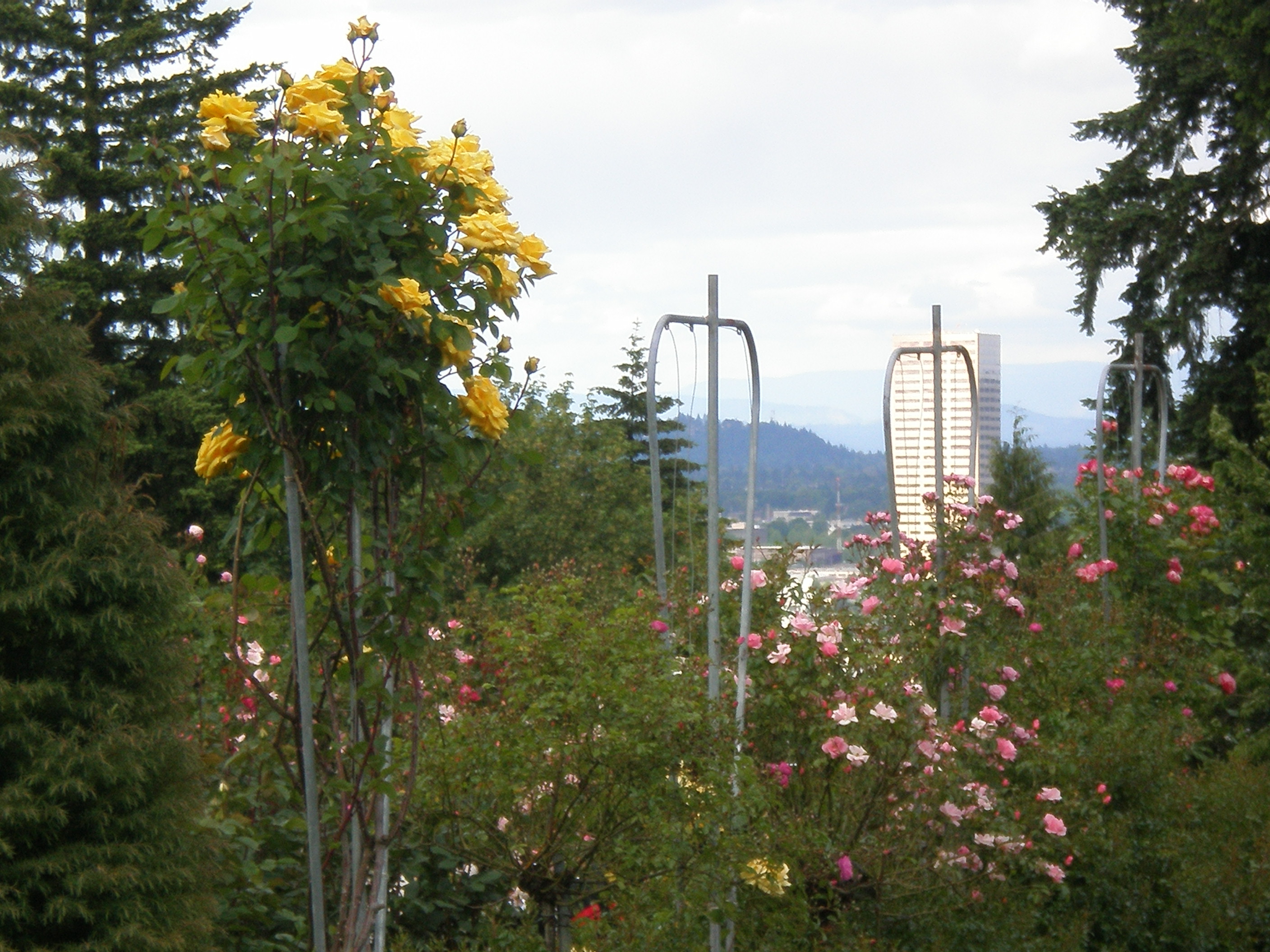
The Greek muse Erato was often portrayed wearing a wreath of myrtle and roses.  Interesting, since Portland is none other than the City of Roses.  Erato, the muse of lyric poetry, is often depicted carrying a lyre; however, Portlandia carries a trident, which is the traditional symbol of the Greek god Poseidon.  The irony here is that with its sheaf of grain, the city seal was supposed to recognize Portland’s agrarian, which a pitchfork would have symbolized.  The similar-looking trident symbolizes fishing, and Poseidon used it to wreck havoc on the land by creating earthquakes.  Of course, the Queen of Commerce is standing by a body of water so perhaps she is also Queen of the lower Columbia River.

Another possibility is that Portlandia is based on the Greek goddess of love and beauty Aphrodite.  Aphrodite is often depicted with myrtle and roses.  She is often positioned by the sea, but she holds a scepter instead of a trident.  Aphrodite is the Greek incarnation of the Phoenician goddess Astarte, whose symbol is the star.  In the seal of Portland, a star hovers above the Queen of Commerce.

It’s interesting the way Greek mythology resurges, insinuating itself in pop culture.  Does this mean we might be seeing Greek hipsters—Gripsters—in Portlandia?

Portlandia airs tonight at 10:30 on IFC.