Tag Archives: holiday

Blessed Theophany

7 Jan


I hope you had a blessed Theophany!  It’s truly a memorable site to see priests throwing crosses in the Hudson River here in New York City.

In case you missed my post from last year and have no idea what I’m talking about, here it is again:


I once saw a priest in Brooklyn throw a cross into the muddy waters of the Hudson.  It was a frigid January day, yet a bunch of boys jumped into the river to save the cross.

What would possess a priest to throw a cross into the river?

Theophany; or, as most westerners call it, Epiphany.

The word “Theophany” comes from the Greek “τα Θεοφάνια,” which means “appearance of God,” and January 6 is the feast day that commemorates the incarnation of Jesus.  It celebrates His birth and baptism.

When St. John the Baptist baptized Jesus in the Jordan River, the heavens opened up and the Holy Spirit descended like a dove.  God spoke from the heavens, saying, “This is my Son, whom I love; with him I am well pleased” (Matt 3:17, NIV).  It marked one of the very few times that all three characters of the Trinity—Jesus, the Holy Spirit, and God—revealed themselves at the same time to man.

Jesus’ baptism marks His first step toward Crucifixion, according to Orthodox theology.

And so, on January 6, Orthodox priests throughout the world throw crosses, symbolic of Jesus’ crucifixion, into bodies of water, symbolic of His baptism.  This is called the Blessing of the Waters.  Volunteers jump into the water to retrieve the cross.  The priest, according to tradition, prays a blessing on the person who gets to the cross first and brings it back to him.


Here’s the Troparion (tone 4) from the Eve and Afterfeast hymn, which has some powerful imagery:

The River Jordan receded of old by the mantle of Elisha when Elijah ascended into heaven; and the water was separated to this side and that, the wet element turning into a dry path for Him, being truly a symbol of Baptism, by which we cross the path of transient age. Christ appeared in the Jordan to sanctify its waters.


 

Explosions in the Sky

5 Jul


Hope you had a fantastic 4th of July weekend!!  Did anyone go away?  How were all the BBQs?  I want to thank one of my readers, who actually did invite me to a BBQ after reading my last post, after I begged all of you for an invite.

On Thursday night I had dinner with my sister at a Greek restaurant out in Astoria.  Afterward, we decided to walk around for a while.  We were chatting about this and that when all of a sudden from behind a leafy tree an explosion of color burst out over the black sky.  Fireworks!  We followed the glittery reds and purples and the gunshot boom of the explosions down the sidewalk.  Then we stood in the middle of the street with people who had suddenly stopped their car and gotten out to catch a glimpse of the show.

Colors lit up the sky.  Greens.  Purples.  Reds.  Whites.  Oranges.  Dots of color formed rings.  Dashes of color zoomed heavenward.  Color sizzled and dazzled.  Eyes opened wide.  Little kids put their sticky palms flush against their ears.  Others jumped up and down and pointed excitedly.  Cars honked.  We clapped.  We stood in amazement.

Sometimes, if you just look up, you’ll be amazed.

Protomayia

1 May

We all know that April showers bring May flowers, but Greeks celebrate May 1 (also known as May Day, Labor Day, and Protomayia) with the enchanting Feast of the Flowers.

Revelers flee to the countryside on this national labor holiday to herald spring.  By May 1, most of the Greek islands are warm with gentle breezes and the mainland can even get hot.  It’s a marvelous day of picnicking and flying kites and enjoying nature.

People spend the day collecting flowers and turning them into wreathes.  There are even several flower festivals throughout Greece.

2011 Greek Independence Day Parade

29 Mar

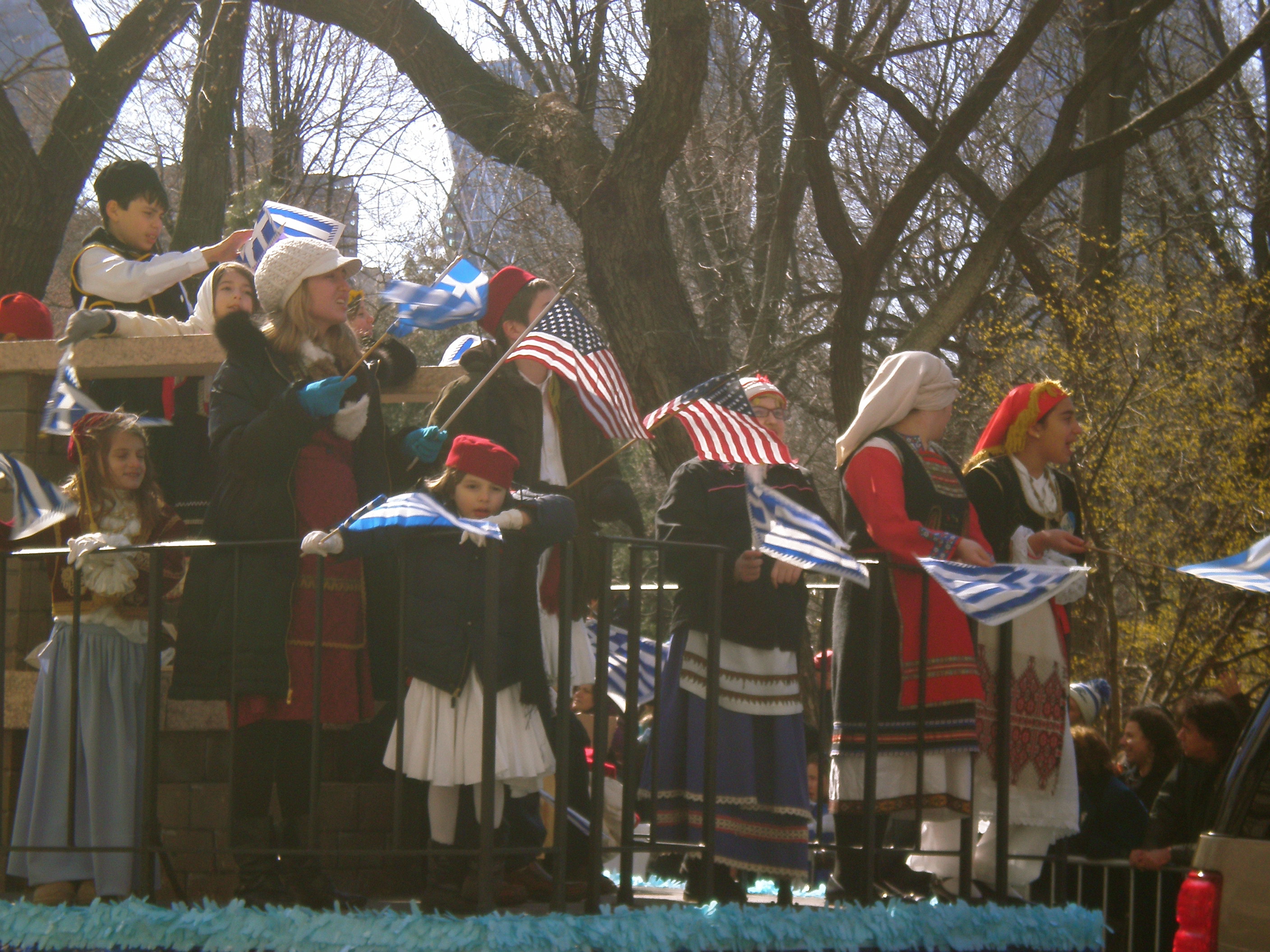
Who made it out to the parade on Sunday to celebrate Greek Independence Day?  My sister and I went after brunch.  It was a great day for a parade.  The sky was a bright, bright blue and the sun was shining.  It was a bit brisk to be standing on the sidelines, but I’m sure those marching in the parade enjoyed that it wasn’t hot out.

Our favorite part was seeing the little kids all dressed up in their Greek costumes.  Seriously adorable!

I also rather enjoyed seeing the Greek-American women who insisted on marching in high heels.  It was quite a few blocks up Fifth Avenue to be clomping around in heels, but they remained stoic.

Greek men and women of all ages layered blue and white clothes on, wore Hellas t-shirts they probably picked up in Plaka, and draped the Greek flag over their shoulders. Super-hero style!

Here are a few pics.


Victory Hellas!

25 Mar

Happy Independence Day!  I fully realize in this chilly weather that today is not July 4.  March 25, however, marks the 190th anniversary of Greek Independence from the Ottoman Empire.

Greece was a strong empire, impacting language and culture around the world for much of ancient history.  Even after Greece fell to Roman rule, Greek thought and influence remained strong.  However, in 1453 the Byzantine Empire fell to the Ottoman Empire.

On March 25, 1821, Metropolitan Germanos of Patras raised a revolutionary flag under a tree outside of Agia Lavra, a monastery in the Peloponnese.  This wasn’t the first clash between the Greeks and the Ottoman Empire in those 400 years.  The Turks had burned monastery, which was built in AD 961, to the ground in 1585.  The Greeks rebuilt it in 1600 but then the Ottoman Empire armies of Ibrahim Pasha of Egypt destroyed the church in 1715.  The Greeks rebuilt it again, and in 1821 Germanos gave an oath to the Greek fighters and raised the flag.  Pasha’s army destroyed Agia Lavra again in 1826.

The War for Independence lasted nine years.  Finally, on 1829, a small part of Greece was liberated.  Slowly, other parts of Greece were liberated.  On July 21, 1832, the Treaty of Constantinople, which put the Greek borders in writing, was signed, and on August 30, 1832, it was ratified.  Still, it wasn’t until after World War II that other Greek lands were returned to Greece.

You can read my full article on the church where the revolution began in my Church Hopping column on Burnside Writers Collective.

*  *  *

Get out your blue and white… in New York, the Greek Independence Day Parade will be taking place this Sunday, March 27, beginning at 1:30.  The parade goes up Fifth Avenue, starting at 64th Street until it reaches 79th Street.

If you can’t get there, you can watch it on WWOR TV Channel 9.  It will be anchored by Greek-Americans Ernie Anastos, Nick Gregory, and Nicole Petallides.

I’ve attended the parade many years, and when I was a kid I even got to ride on one of the floats!

Read my write up on the 76th Annual Greek Independence Day Parade in New York that took place a few years ago on Daily Frappe for more insight on the history of the parade and Greeks life in America.

Cartoon Crush

14 Feb

“You know, guys, sometimes I wish we were cartoon teenagers.”

~ Fez on That 70s Show


In honor of Valentine’s Day, I thought it would be fun to share my cartoon crushes.

Maybe back in ancient Greece, girls got all dreamy-eyed listening to myths about Hercules, but growing up in suburban New Jersey I got crushes on cartoon characters.  It wasn’t the Prince Charming type that I was into, though.  No, I liked them a bit scrappier–and wearing green tunics.

Peter Pan was one of my early cartoon crushes.  Wendy, Tinkerbell, Tiger Lily, and all the mermaids swooned over him, and I could understand why.  He was a real charmer, always flirting with one girl after the other.

My other big cartoon crush was Link from The Legend of Zelda.  On Fridays, instead of The Super Mario Bros. Super Show!, The Legend of Zelda aired on tv.  Like Peter Pan, Link was sarcastic and flirty.

That’s why I was so excited when my friend Sue sent me this link to The Legend of Zelda: The 80s Teen Movie.  If John Hughes made a film about Zelda, this is what it would look like.

Speaking of video games, if you haven’t seen Brothers Mario yet, check out Brothers Mario.

Also, Laura Vanderkam (168 Hours: You Have More Time Than You Think) wrote a telling article awhile back called “The Princess Problem.”


Who are your cartoon crushes??

Σ’αγαπώ: I love you

14 Feb

As a sea captain, traveling the world, my dad picked up words and phrases in many different languages.  “I love you” seems to have been his phrase of choice.  He can say it in practically every language.

Wouldn’t it be nice if the phrase everyone around the world wanted to learn how to say in different languages was “I love you”?

*  *  *

My dad spent some time docked in Japan when he was young, and he was always particularly proud of his ability to profess his love in Japanese.

A few years ago, I traveled to Tokyo and visited the adorable cafe in the pictures above.  The decorations were all heart-shaped and even the foam of the latte was spun into a heart.  Yum!

*  *  *

In Greek, the way you say “I love you” is: Σ’αγαπώ, pronounced s’agapo.

*  *  *

Happy Valentine’s Day!

Hello, Carnival; Good-bye Meat

7 Feb

The Carnival season won’t start until next month in Catholic countries (Mardi Gras isn’t until March 8), but the Carnival season in Greece kicks off on February 12 and will run until March 6 this year.  The dates are different but the significance is the same.

The dates differ for the Roman Catholics and Eastern Orthodox because of two things: Firstly, Catholics use the Gregorian calendar, while Orthodox use the Revised Julian calendar.  Secondly, for Catholics, Lent begins on Ash Wednesday, while for Orthodox, Lent begins on Clean Monday.

The concept behind Carnival for both denominations is the same, though.  Carnival marks a season of revelry before Lent begins.  Lent is the forty-day period before Easter when Christians prepare for the crucifixion and resurrection of Christ by fasting and other means.  Since certain foods cannot be eaten during Lent and would spoil before the forty days are up, they had to be eaten ahead of time.  According to some accounts, this resulted in gluttonous parties in the days leading up to Lent, a season we now celebrate as Carnival.

In Greece, Carnival is known as Apokriés (Αποκριές), which literally translates to “saying goodbye to meat.”  Each week there are different celebrations to say good-bye to the favorite foods we’ll be giving up.

2011’s Key Carnival Dates for Eastern Orthodox:

Triodion: Sunday, February 12th
Tsiknopempti or “Burnt Thursday”: February 24th
Tsiknopempti Weekend: Friday, February 25th – Sunday, February 27th
Main Carnival Weekend: Friday, March 4th – Sunday, March 6th
Clean Monday: Monday, March 7th

Just as in other Carnival celebrations around the world, Greeks celebrate Apokriés with parades, floats, and wild masks.

Groundhogs Agree: We Will Be Sprung from Winter Soon

3 Feb

Today is Groundhog Day.  Today is Groundhog Day.  Today is Groundhog Day. Yesterday was Groundhog Day.  Apparently both Punxsutawney Phil and Staten Island Chuck agree: spring is on the way!

With all the thundersnow and ice NYC’s been hit with, spring can’t come soon enough.  I thought it might be a nice time to share some spring images with you that I took last year at the Brooklyn Botanical Garden Cherry Blossom Festival.


Christian Resolutions

20 Jan

Part 2 of my look at New Year’s resolutions was published on Burnside Writers Collective yesterday.  In part 1, I asked “Does God Laugh at Our Resolutions?”  Now in part 2, I look at “Christian Resolutions.”  It starts:

I’m tempted to write a satire called Christian New Year’s Resolutions.  It would go something like this:

  1. Pray without ceasing.  Ever.
  2. Don’t watch secular television.
  3. Become a physically fit Proverbs 31 woman.
  4. Read the bible every day and nothing besides it.
  5. Go to church every Sunday.

Is there such a thing as Christian New Year’s Resolutions?

You can read the rest on Burnside.

I started to have some self-doubt about my writing–this piece included but writing in general–and I’m so encouraged by the comments I received on this article.

Larry Shallenberger, author of the books Divine Intention: How God’s Work in the Early Church Empowers Us Today and Lead the Way God Made You, said, “If there were a “like” button, I’d have pushed it.”

Diane Nienhuis, a Burnside writer and food blogger whom I met at the Festival of Faith & Writing at Calvin College (she picked me up at the airport, she’s so sweet!), wrote, “Well said, Stephanie! Beautiful!”  She also shared some of her own resolutions.

Michael D. Bobo, who tackles a highly controversial work of art in his thought-provoking piece “Ants on a Crucifix,” currently featured on Burnside, and as it turns out writes the Claremont Christianity Examiner, which is in the California town where I went to undergrad (small world!), said, “Thanks Steph for getting us back to the basics in 2011.”

And, my editor, Jordan Green, said, “This is tremendous, as if that would be a surprise coming from Stephanie.”  Wow.  Jordan recently cowrote the book Besides the Bible: 100 Books that Have, Should, or Will Create Christian Culture and just wrote what is probably the most thorough review of the new IFC show Portlandia there is.  Incidentally, I once met Jordan in Portland.  (We did not Kombucha tea.) (PS. Check back here tomorrow for a bit of trivia on the Greek influence on Portlandia.)

Anyway, the reason I mention all this is two-fold:::

1.  To show my appreciate for the comments I received, I wanted to promote what all these other talented writers are doing.  Check out their links.  Buy their books.  Leave nice comments for them.  They deserve it.

2.  To encourage writers who struggle with self-doubt.  As I mentioned, I was plagued by insecurity and almost deleted the article.  Sometimes my writing is bad.  That’s the way it goes some days.  But sometimes, and I suspect this is true for other writers as well, my writing isn’t as horrible as I imagine it to be.  Sometimes, it might even resonate with someone.  And that’s why I write.