
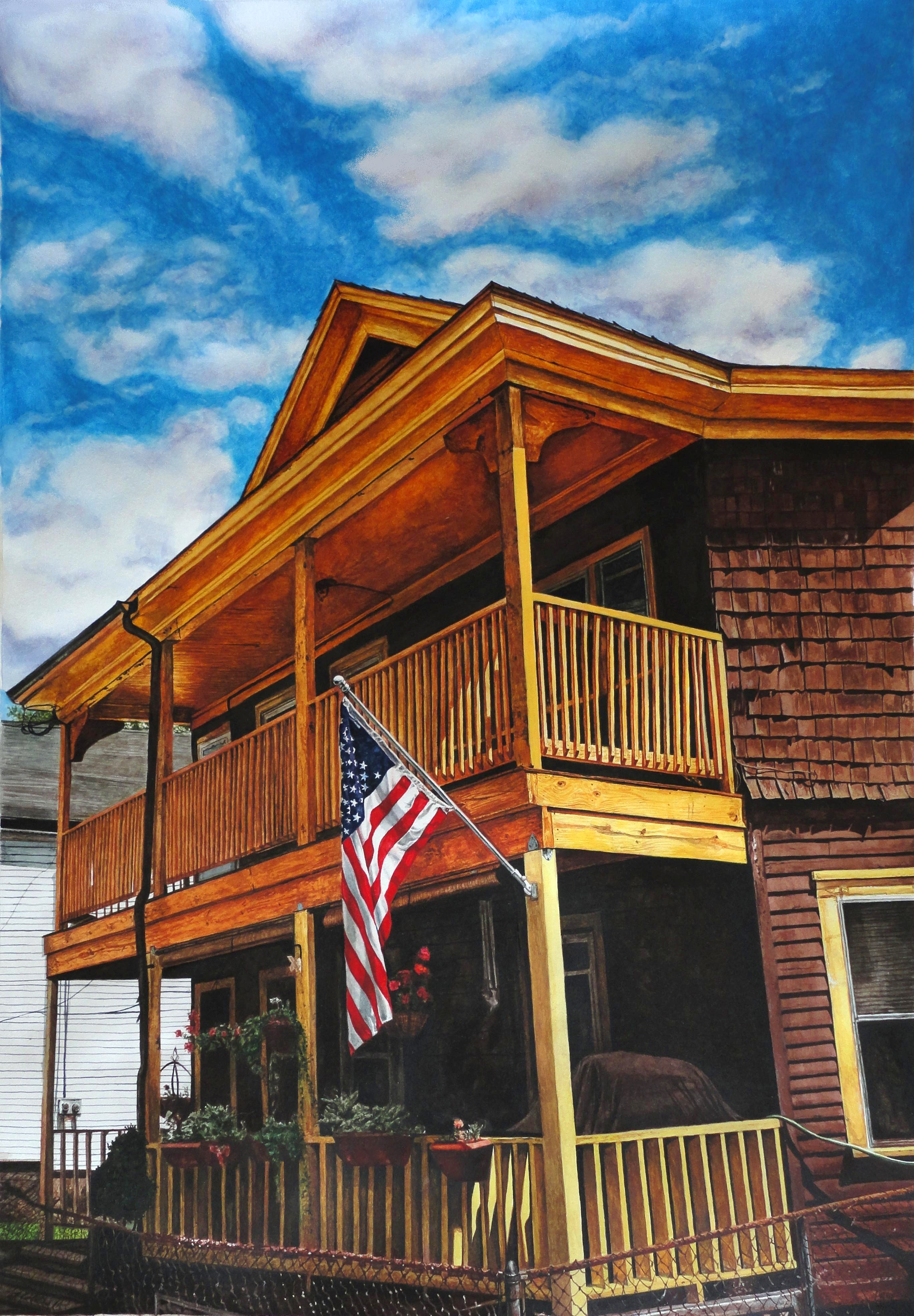
9 Lupine Road
When I first saw artist Jonathan Collin’s paintings in person, I thought they were photographs. They’re stunning. Incredibly detailed and richly saturated, his Lowell series captures with paint the Massachusetts landscape that Jack Kerouac captured with words. More than just setting and subject matter, Collins’ use of chiaroscuro resonates with Kerouac’s literature. There is light piercing the darkness.
When I asked Jonathan if he’d write a little artist statement, he sent me back an email with the below, saying he’d written it spontaneously and with no revision, according to Beat principles.

Visions of Lowell
Jack Kerouac’s Duluoz Legend has always been an important touchstone of literature and revelation of light and beauty to me. In my research of those heady days of the 40s and 50s, I found them not only to be thrilling, but all in the family.
My father, Don Collins, was also in the Navy in WWII , the Merchant Marines, and traveled the world as Kerouac did. My father came back home, worked and painted, Kerouac wrote!
I began this series of paintings of Beat Generation locales in 2010. Traveling to San Francisco first, via the California Zephyr , in 2007, I was astounded by the natural richness and depth of the American landscape. I strolled the streets of North Beach, with its glistening neons and vibrating nightlife. I recorded everything in my journal, sketchbook, and camera. Everything that rose the hairs on my neck in artistic excitement!
I had been to Lowell many times, from the mid 1990s on, but my trip in July 2011 was intended to document the birth and mystery of the seeds planted in Kerouac’s psyche. From the Lupine Road house, to downtown cobbled streets, to the glowing Grotto, I stood transfixed.
Paterson was where my mother was born, and my parents met at the bridge surrounding the Great Falls. Allen Ginsberg was raised in Paterson and grew up a mere four blocks from these sites. I found Ginsberg’s poem, “The Green Automobile” to be an exquisite inspiration, tying the mythical past to present;”From Lowell’s Merrimack to Paterson’s Passaic.”
My main focus was not only the historical context both personal and literary , but illumination, literally. Light is the essence of my paintings and a key ingredient in the tempest of Beat literature. From Rimbaud’s “Illuminations,” to Kerouac’s “Visions” series, Gregory Corso’s visionary odes, to Ginsberg’s “Howl,” his plea for understanding.
The need to shed light, to reveal hidden truths beyond words, to make sense of the beauty and sanctity of life, feeling the mystery in the shadows, was and IS, the artists’ true quest.
Just as the Paterson Falls continue to boom and crash, and the neons of Frisco glow endurably, and the spirit of Lowell pulses in the night, so will the work of the Beats continue to inspire, and illuminate generation after generation.
It is my hope that these paintings will enrich the hearts and minds of others, with a glimpse of the light surrounding us, and pray we honor and express the light within us all.

The Moon Her Majesty

Lord
 The Visitation
[The three paintings above are of the Grotto in Lowell and should be viewed from left to right in the order in which they appear.]
Tags: faith, Grotto, Jack Kerouac, Jonathan Collins, light, Lowell, Massachusetts, painting, visual art




 Stephanie Nikolopoulos