Tag Archives: Neal Cassady

“On the Road” Review

18 Dec


OLYMPUS DIGITAL CAMERA

OLYMPUS DIGITAL CAMERA

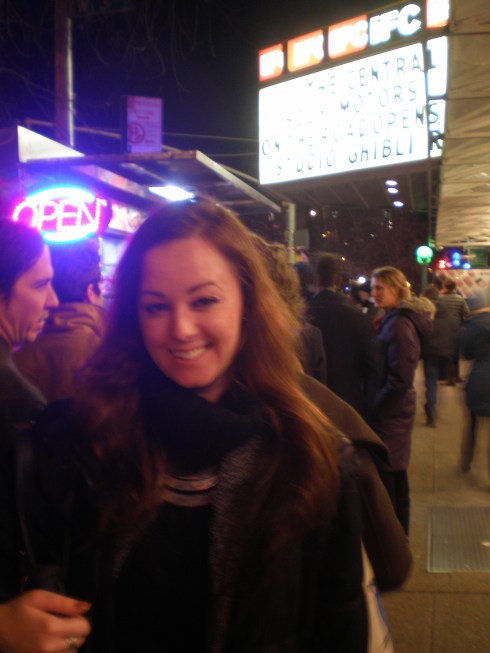
On Friday, December 14, I attended a special sneak preview of On the Road at IFC Center in Greenwich Village. It was history in the making. At long last, Jack Kerouac’s seminal road novel had made its way to the silver screen. Kerouac himself wrote a lot about going to the movies, and he wanted his novel turned into a film. In fact, he even wrote to Marlon Brando, asking him to buy it and star in it.

Francis Ford Coppola bought the film rights decades ago. I have a friend who wrote a screenplay that he showed to Coppola, and there have been numerous actors associated with the film adaptation, but the project always seemed to stall. Finally, Walter Salles came on as director and Jose Rivera as screenwriter, and soon after an impressive cast lined up, and the film looked like it would finally take off. And it did! It debuted at Cannes Film Festival in May 2012. Throughout the summer and into the fall, the film showed at theatres across Europe and South America. Those of us in the States read reviews, watched clips, argued about whether the novel could be adapted for film in a successful way, and debated the choices for the cast while we waited for the quintessential American story to come to us. At long last, when it was announced that a sneak preview of On the Road was taking place in the neighborhood Kerouac used to hang out in, people lined up on the Avenue of Americas for a chance to see it. As my good friend Elizabeth and I waited in line, an older man offered us $50 for our movie tickets. Considering we were so excited we were taking photos to commemorate the event, we probably weren’t the best people to try to scalp from. Needless to say, I watched the film, and, for whatever it’s worth, I can now give you my review of On the Road, which opens in New York and LA on December 21 and the rest of the country in January.

Let me start with a caveat: I am perhaps a bit too close to the subject matter to review On the Road objectively. After all, I am writing a book about the true story of On the Road. I have also heard and read reviews by a few other Beat scholars and fans and watched many Youtube clips from the film. I came in with lots of preconceived notions, and I watched the film more as a critic than as your average moviegoer. That said, I did not go into it as a literary snob wanting it to fail. I came into it wanting to see Kerouac’s work done justice.

***

On the Road is wonderfully nuanced. And to me, it’s the nuances in the acting, directing, and screenwriting that make On the Road a worthwhile adaptation of the novel. Everyone involved in the film understood that Kerouac’s novel is not just about some crazy kids driving at high speeds across the country, getting high, and getting laid. They understood that depicting this wild behavior — the film does not censor anything — was necessary not for shock value but because it underscores the complexity of the characters. In particular, the film does justice to the theme of the loss of fathers. Burning Furiously Beautiful, the book I’m coauthoring, delves into the personal life stories of the real-life people the characters are based on, giving further insight into their behavior and lifestyle. Understanding the characters’ back story elucidates their desires and actions, and the film adaptation neither glorifies nor critiques the characters. It gives them space to reveal themselves to the viewer.

Interestingly, the character that fell flat to me was the character of Sal Paradise, based on Jack Kerouac and played by Sam Riley. The actor, screenwriter, and director did a great job showing him to be an observer, which was true to Kerouac’s nature. However, the film itself was not seen through Sal’s eyes. He seemed like just another character. The landscape, the jazz shows, the parties were depicted through a neutral perspective. Not only did this make it difficult to understand Sal’s motivations and character — this is most evident in the scene with Terry (“the Mexican girl”), which isn’t developed enough for us to understand why it’s included — it meant we lost his voice. While critics over the years have focused on the road trip antics, for me, the strength of the novel was its insanely beautiful poetry. The film adaptation was more about the story and less about the literature.

Overall, though, the dialogue for the characters and the acting was phenomenal. Viggo Mortensen needs to star in a biopic on William S. Burroughs. Amy Adams took on the persona of Jane. Kristen Stewart brought a depth to Marylou that Kerouac himself didn’t. Kirsten Dunst showed great emotion in her scenes. Tom Sturridge played Carlo Marx with intensity but also surprising humor; his dialogue was quintessential Ginsberg: dramatic and over the top. Elisabeth Moss’ Galatea was a nice contrast to the other characters, while Danny Morgan’s Ed was a bit too goofy; these two characters are the reason the characters end up at Old Bull Lee and Janes’s place, but if it weren’t for that they could’ve been edited out for the film. Garrett Hedlund was charismatic. He lit up the screen.

My most pressing criticism of the film is that it felt a bit too much like a period piece for my personal preference.  I was impressed that the film was historically accurate, and yet I found myself distracted by those details. For example, when the focus was on the exterior of the Hudson, it made the story feel removed instead of vibrant; yet the shots within the car or from the viewpoint of the passenger were beautiful. Likewise, there were times when the wallpaper in a room jumped out at me more than it probably should have. I’m by no means suggesting the story should have been modernized, but the setting and props should not overpower the story. There were also scenes like the one at the jazz club which felt staged, almost cartoonish. I would’ve liked something a bit more raw, a bit grittier or impressionist.

In contrast, the New Year’s Eve party was sheer brilliance. Here were fast cuts and disorienting angles. Here were sweat and thrashing limbs. Here was jazz you wanted to dance to. Here was the energy that made you want to shout go, go, go! There were also beautiful quiet moments laced throughout the film. Poetic landscape. Honest heart-to-hearts. Subtle glances. Almost any time the characters were on the road, the dialogue, the filmography, and the acting were spot on.

The film adaptation of On the Road may enlighten some people’s perception of Jack Kerouac.
Jeff Bridges Interviews Garrett Hedlund, Who Plays Dean Moriarty in “On the Road”

13 Dec

I’ve been connected with so many people these days who are interested in the different writers associated with the Beat Generation. Katie, who is researching Joan Burroughs, turned me on to Interview Magazine‘s feature on Garrett Hedlund, who plays the Dean Moriarty character in the film adaptation of Jack Kerouac’s On the Road.

What initially caught my eye was photographer Robbie Fimmano‘s moody portraits of Hedlund. The black-and-white photographs are stunning. I wish I could post them here, but I don’t want to impose on his or the magazine’s copyright, so instead you can check out the online gallery here. He’s looking a bit like Johnny Depp in some of the photographs.

Actor Jeff Bridges, who apparently played his father in Tron (I say apparently because do you really think I watched Tron?), interviewed Hedlund for the magazine, and it starts off kind of cute and silly because they’re calling each other “Dad” and “Son.” Hedlund is from Minnesota and is Swedish, just like my mother, and he talks a little bit about coming from Minnesota in the interview. He also reveals that even though he played Dean Moriarty, the character based on Neal Cassady, in On the Road, he relates more to Sal Paradise. You can read the full interview here.

The film is finally opening in the States on December 21.

Video from Collaboration with Jazz Musician David Amram

19 Sep


This is the video from my collaborative reading with David Amram at Cornelia Street Cafe on Labor Day.  If you missed my full recap, you can read it here.

In the video you’ll hear me reading a section on Jack Kerouac’s time in Mexico, which gives some perspective on Kerouac’s faith, his sensitivity toward animals, and his tumultuous friendship with Neal Cassady.  The book I’m reading from is my book with Paul Maher Jr. called Burning Furiously Beautiful: The True Story of Jack Kerouac’s On the Road

Special thanks to my videographer Liz Koenig.

The event also picked up some press!

Larry Closs mentioned it in his article “Transcending Beat with David Amram.”

The Pappas Post mentioned it in “Stephanie Nikolopoulos and Jazz legend David Amram pay tribute to Jack Kerouac.”

Road Trip Writing: On the Road and “Human Snowball”

26 Jul

Many summers ago, a couple of poets and I dragged some rickety chairs outside of the Bowery Poetry Club and sat in a circle, chatting about our writing, our day jobs, and life, as people passed by, sometimes stopping to talk to us. One of the girls in the group worked at a publishing house, like I did, and she offered to send us some of the books everyone in her office was buzzing about. About a week later, the package arrived, and I excitedly opened it. It’s been too many years to recall all that was in it, but I do remember it contained a book by Philipppa Gregory, which I in turn gave to another coworker because I have little patience for historical novels about the Tudor period—although I later saw her The Other Boleyn Girl on an airplane and enjoyed it—and Found.

Found started as a magazine that showcased notes, lists, drawings, and other miscellanea that readers found and sent in to the editors. In April 2004, they compiled the best of the best from the magazine and published the book Found: The Best Lost, Tossed, and Forgotten Items from Around the World. Having the book upped my coolness factor among the skinny hipster set I was hanging with at the time, and I began dating one of the guys. When Found’s founder, Davy Rothbart, published a short story collection called The Lone Surfer of Montana, Kansas, in 2005, I gave it to the guy I was dating.

I never read the book myself, but recently I read one of Rothbart’s short stories in the summer 2012 issue of The Paris Review, and it made me wonder if Rothbart might be my generation’s Jack Kerouac. While Rothbart lacks Kerouac’s poetry, they share an ear for dialogue, a captivating retelling of riding in buses and cars, an obsession with music, and an awkwardness with girls. In the short nonfiction story “Human Snowball,” Rothbart takes a Greyhound from Detroit to Buffalo to see a girl who isn’t quite his girlfriend yet or maybe ever and ends up in a carful of eccentric characters, including an ancient black man and a Neal Cassady-esque car thief. It may not have the sensory details that On the Road has, but “Human Snowball” captures characters with such honest and real details and dialogue that you feel like you know them. They’re beat characters. A little rough-around-the-edges, but sensitive and full of life.

In a bit of a Kerouac connection, actor Steve Buscemi, who stars in the film adaptation of On the Road, optioned the rights for Rothbart’s The Lone Surfer of Montana, Kansas. Rothbart himself is a chronic roadtripper. He’s traveled the country and toured with the punk rock band Rise Against, creating the documentary How We Survive for the dvd Generation Lost as well as the documetnary Another Station: Another Mile.

On the Bro’d: A Parody of Jack Kerouac’s On the Road​​

15 Apr


The only bros for me are the mad awesome ones, the ones who are mad to chug, mad to party, mad to bone, mad to get hammered, desirous of all the chicks at Buffalo Wild Wings, the ones who never turn down a Natty Light, but chug, chug, chug like f*cking awesome players exploding like spiders across an Ed Hardy shirt and in the middle you see the silver skull pop and everybody goes, “Awww, sh*t!”

So goes On the Bro’d: A Parody of Jack Kerouac’s On the Road, by Mike Lacher, published today.  The book reimagines Jack Kerouac’s On the Road as if it were told by someone like How I Met Your Mother‘s Barney–a bro.

Contrary to the popular myth of the scroll, Kerouac spent years trying to get the voice right for On the Road.  Yes, he did pound the keys of the typewriter and turn out the novel in a matter of days, but that was only after he had spent years on the road and wrote and rewrote the novel multiple times, with different characters and different narration.  Neal Cassady’s famous letters spurred Kerouac on to write in a more confessional and conversational approach.  He worked hard to capture the feeling of a real talk, using words like “beat” and “hipster.”  However, Kerouac was well educated.  He did go to Columbia, after all, and while it may have been on a football scholarship that might make him seem a bit more like a bro, even as a child he used to ditch school so he could go read in the library.  While his work may appeal to a guy’s guy because he’s often with his “bro” Neal, recklessly driving, picking up chicks, and smoking pot, the diction and syntax in On the Road reveal that underneath it all he was a sensitive poet who saw the beauty in the color of grapes. After all, this is how the famous quote from Jack Kerouac’s On the Road paraphrased above actually read:

“The only people for me are the mad ones, the ones who are mad to live, mad to talk, mad to be saved, desirous of everything at the same time, the ones who never yawn or say a commonplace thing, but burn, burn, burn, like fabulous yellow roman candles exploding like spiders across the stars and in the middle you see the blue centerlight pop and everybody goes “Awww!”

On the Bro’d is just a parody. It says so right in the subtitle.  It’s not meant to be taken seriously, and the idea is actually clever.  Still, it points toward a common misconception people have of Jack Kerouac and the Beat Generation, whom critics pejoratively referred to as “beatniks,” meaning the Beats were as “far out” as Sputnik.  Keep in mind, Sputnik was launched by the Soviets during the Cold War.  Beatnik was not a compliment. Even today, many scholars don’t take Kerouac’s writing seriously because it is so accessible.  But his prose is poignant, his message spiritual.  He was not saying, the only people for him were the ones who wanted to get drunk.  He was saying the only people for him were the ones who want to truly live life to the fullest.  He didn’t like the type of brain-zapped people who said commonplace things and wore Ed Hardy t-shirts.  He said, “Great things are not accomplished by those who yield to trends and fads and popular opinion.”

I’m curious if you think On the Bro’d is a successful parody?  It seems like something that would sell well at Urban Outfitters, yes?

Huckleberry Finn Grows Up to Be Dean Moriarty

2 Apr

Flavorwire recently had a fun post on kid literary characters and their grown-up counterparts.  They said that Huckleberry Finn would grow up to be Dean Moriarty, the character based on Neal Cassady in On the Road:


Huckleberry Finn and Dean Moriarty

Mark Twain’s original American boy vagabond in search of adventure would inevitably grow up to figure as the care-free rover in Kerouac’s semi-autobiographical novel. Moriarty is described as “a side-burned hero of the snowy West” and a “holy con-man,” which seem to us to be pretty accurate descriptions of how the lawless, fanciful Huck might have turned out. And after all, even though Moriarty and Sal never set off down the river on a raft, you can bet they would have if they could’ve — and we think Huck would be itching to try that ’37 Ford sedan.

Find out all the other great counterparts here, and feel free to add your in the comments section.  I’d add:

Harold (of Harold and the Purple Crayon) grows up to be Chip Kidd in Cheese Monkeys.

Who would you add?