Tag Archives: New York

Happy 88th Birthday to the Quiet Beat!

12 Mar

Go

John Clellon Holmes is the friend Jack Kerouac was talking to when he coined the phrase “Beat Generation.” Holmes actually found success more quickly than Kerouac did in writing about the scene when he published Go in 1952. The writing style is vastly different than Kerouac’s, as it takes a much more traditional approach to novel writing, but it is fantastic! Go is one of my favorite books of the so-called Beat canon. Holmes does a fantastic job bringing all the familiar characters — Gene Pasternak as Kerouac, Hart Kennedy as Neal Cassady, David Stofsky as Allen Ginsberg, Will Dennison as William S. Burroughs, and so forth — to life as he explores hipsters partying it up in New York City. Dare I say his descriptions of the 1940s party scene are more memorable to me than Kerouac’s?!

Holmes was born in Holyoke, Massachusetts, on this day in 1926. Celebrate his life and work by reading Go!


Mino Cinelu Plays the Blue Note

11 Mar

Mino3

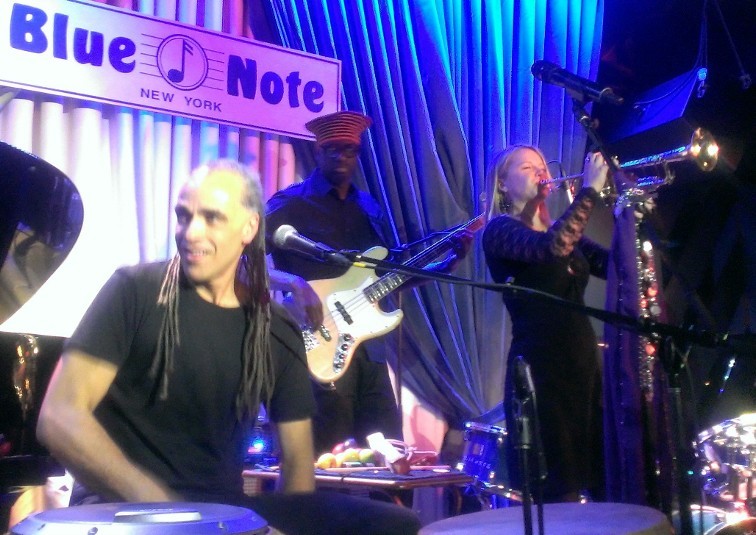
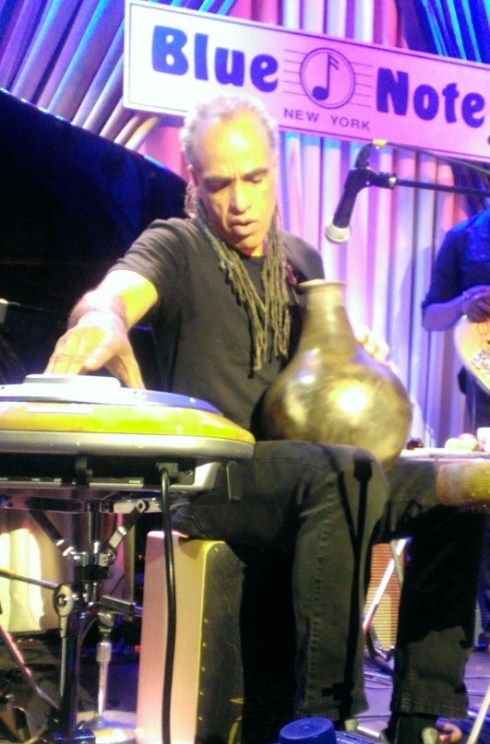
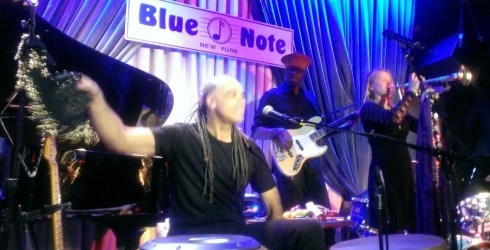
At Greenwich Village’s famed Blue Note Jazz Club on a cold Monday night in February, instruments are strewn across the stage. There’s nary a place to step, yet Brooklyn-based French musician Mino Cinelu intuitively finds each new instrument he needs amongst the pedals and wires, without missing a beat. He seamlessly switches from drums to egg shakers to water drum. He flicks a triangle like it’s hot to the touch. He stretches his hand across the stage and caresses a belly-dancing scarf, its gauzy fabric dripping with coins that stir in his fingers. His body itself becomes an instrument, as he claps his hands together and punctuates beats with forceful stomps that reverberate off the stage floor.

Mino Cinelu is a musician—and a performer. The jazz percussionist draws energy toward him and releases it back to the audience in a swell of notes and beats.
Mino4

“He’s the most sought out percussionist,” Ra Araya whispers to me, speaking of Mino Cinelu with sincere authority. “Art Blakey literally picked him up and said, ‘Now you’re coming with me.’” Araya, the poet and poetry event organizer who set up the premier reading for Burning Furiously Beautiful, had invited me to the show, asking me to review it.* It is my first time ever hearing Cinelu live or otherwise, and I sit mesmerized by the way the jazz musician embodies his music.

Cinelu’s music is simultaneously out-of-body and corporeal. The tempo echoes the pulse of the earth and his vocal cord arrangements hum like the sounds of nature, building toward an ethereal plane. Pulling from various traditions, his world-fusion jazz unites through the exchange of ideas and sounds and cultures. It makes the listener think. It makes the listener feel. It makes the listener anticipate. His lips move to the beat of the drum as he slaps it. He scrunches his face and groans. The flesh of his cheeks tremble to the beat. Sweat drips from his temple as he whips his dreadlocks around. His muscles are taut, suggesting his years of making music have built his body.

Cinelu was born in Saint-Cloud, in the western suburbs of Paris. “From a very young age I had to take care of myself. Let’s just say that,” says the musician, who grew up in a violent home. He was born into a musical family, and as a child learned to play the guitar. By sixteen, he was already a professional musician with gigs in London and New York. In the 1980s, after moving to New York, he met Miles Davis and went on tour with him. Like others who played with Davis, Cinelu then went on to be part of Weather Report, one of the earliest jazz-fusion bands, though the band dismissed that label. The ever-changing roster of musicians in Weather Report played an amalgamation of free jazz, funk, rock, R&B, Latin jazz, and other ethnic music. In the ’90s Cinelu emerged as a solo artist, releasing his self-titled album in 2000. Cinelu has played with everyone from Stevie Wonder to Herbie Hancock, and from Sting to Lou Reed.

Cinelu continues to surround himself with an impressive array of talent, and the Mino Cinelu World Jazz Ensemble seems to grow in number as more and more musicians take to the stage as the evening progresses. The band includes Jamshied Sharifi (keys & flute), Mamadou Ba (bass), and Jose Davila (tuba & percussion). A graduate of MIT, Sharifi went on to study at the esteemed Berklee College of Music. He composed the soundtracks for Muppets from Space, Harriet the Spy, The Rugrats Movie, Clockstoppers, and The Thomas Crown Affair. Ba was the musical director for Harry Belafonte’s orchestra and was one of the founding members of African Blue Note Band. Davila has played with everyone from Ray Charles to Marc Anthony, and from Tito Puente to Nora Jones.

At the Blue Note, special guest Bria Skonberg (trumpet & flugelhorn) joins the Mino Cinelu World Jazz Ensemble on stage. She covers the mouth of the brass instrument with her shiny red nails, playing along with the music, til suddenly she tilts her head back and BLOWS! Face scrunched in exertion, much like Cinelu’s, Skonberg plays powerfully, masterfully. “We’ll keep her after the gig,” Cinelu jokes in appreciation of her talent.

Mino2

By the end of the first set, Cinelu is standing on top of an amp. He thanks everyone, including the waitresses at the jazz club. Despite the snow still on the ground and despite the early day of the week, fans have poured into venue. Among them is actress Pauletta Washington, Denzel’s wife. “I stole some of her moves,” teases Cinelu.

Then, just as they arrived, one by one the musicians file off the stage into the aisles of The Blue Note, still playing their instruments. The music stays with us as they disappear in the dark.

*My ticket and minimum were comped, but these opinions are my own.

Happy 89th Birthday to Lu the Glue!

1 Mar

“Lu was the glue,” said Allen Ginsberg, talking about how integral Lucien Carr was to connecting the people who would go on to become collectively known as the Beat Generation. Carr and Ginsberg met when Ginsberg came knocking on his dorm door at Columbia (well, technically they were attending Columbia but lodged at Union Theological Seminary) to discover who was playing the delightful music of Brahms. Carr was also friends with a fun-loving student named Edie Parker who introduced him to her boyfriend Jack Kerouac. Meanwhile, around that same time, Carr’s stalker, David Kammerer, and William S. Burroughs, whose family Carr had known back in their hometown of St. Louis, arrived in New York City. A charismatic wit, Carr drew this circle together and came up with the idea of a New Vision that embodied “naked self-expression,” a “derangement of the senses,” and the doing away with conventional morality” when it came to art.

Lucien Carr was born on this day in 1925 in New York City.

Surrealist Film at Pravda: Thoughts on Breton’s Automatism and Kerouac’s Spontaneous Prose

17 Feb

surreal1

surreal2

Pravda ran a Surrealist and Experimental film night series over the summer, and although I’m terribly late in posting about it, my friend and I had such a great time that I figured better late than never. One night of Surrealism can lead to many more!

Pravda is a subterranean Russian speakeasy in Soho, near two of my favorite bookstores, Housing Works and McNally Jackson. They serve delicious food and have a fantastic vodka selection. I cannot recommend the horseradish-infused vodka enough.

Occasionally they host special events, such as Salon Dinners, Roaring Twenties Parties, and Surrealist & Experimental Cinema of the 1920s & 30s. The film nights are such a treat! The films are actually silent, and they hire a musician to play live piano music!! I was enthralled. Inspired. They showed films by Man Ray, whom I’d studied at Scripps College, as well as other artists.

A little background::: Surrealism developed out of Dada during World War I in Paris. André Breton is the key player here. Using Sigmund Freud’s psychoanalytic methods on soldiers, the French poet worked at a neurological hospital. In 1924, he wrote the Surrealist Manifesto, a work that defined the cultural revolution:

“Psychic automatism in its pure state, by which one proposes to express — verbally, by means of the written word, or in any other manner — the actual functioning of thought. Dictated by the thought, in the absence of any control exercised by reason, exempt from any aesthetic or moral concern.”

While Surrealism affected all the arts, I want to pause right here to focus on the connections between Surrealist literature and the Beat Generation. The idea of Surrealist automatism is key here. Automatism is the practice of writing without self-censorship. The Oxford University Press defines it as:

Term appropriated by the Surrealists from physiology and psychiatry and later applied to techniques of spontaneous writing, drawing and painting.

“Spontaneous writing.” Sound familiar? Jack Kerouac wrote a writing manifesto called “Essentials of Spontaneous Prose.” In it, Kerouac wrote, for example:

Not “selectivity” of expression but following free deviation (association) of mind into limitless blow-on-subject seas of thought….

I haven’t yet done any extensive research into this to see if the connections are accurate, but there is a cultural connection to Kerouac and automatism. On Wikipedia (obviously not a true source to go by, but one that can be a launching pad for actual informed research) I read:

The notion of Automatism is also rooted in the artistic movement of the same name founded by Montreal artist Paul-Emile Borduas in 1942; himself influenced by the Dadaist movement as well as André Breton. He, as well as a dozen other artists from Quebec’s artistic scene, very much under restrictive and authoritarian rule in that period, signed the Global Refusal manifesto, in which the artists called upon North American society (specifically in the culturally unique environment of Quebec), to take notice and act upon the societal evolution projected by these new cultural paradigms opened by the Automatist movement as well as other influences in the 1940s.

Remember that Kerouac’s parents were from Quebec, and he and his family used to travel back and forth to visit relatives. The Automatism of Quebec happened in 1942, when Kerouac was already an adult, having graduated from high school and moved to New York by that time. Still, it’s possible that the seeds were planted in both Kerouac and Borduas around the same time and place, in at least the small point that they spoke French, the language of Surrealism.

In “Earwitness Testimony: Sound and Sense, Word and Void in Jack Kerouac’s Old Angel Midnight” for Empty Mirror, Gregory Stephenson makes the claim:

Indeed, in method and intention, Old Angel Midnight could be said to be closer to the sound poetry of the dadaists, Hugo Ball and Kurt Schwitters, and to the automatic writing practiced by the surrealists, André Breton and Philippe Soupault, in their book-length exercise in textual autogenesis, The Magnetic Fields, originally published in 1919.

There’s much more to be said about Surrealism, Automatic Writing, Spontaneous Prose, and Surrealist Film, and the evening at Pravda whet my appetite.


Who Is Rollo Greb in “On the Road”?

6 Feb

contact

Some names are practically synonymous with Jack Kerouac’s On the Road: Dean Moriarty/Neal Cassady, Old Bull Lee/William S. Burroughs, and Carlo Marx/Allen Ginsberg, for sure.

But what about Rollo Greb? Who was he?

The character Rollo Greb in On the Road was based on Alan Ansen. Kerouac renamed him in other books. He was Irwin Swenson in Visions of Cody and Book of Dreams, Austin Bromberg in Big Sur, and Amadeus Baroque (love that name!) in Doctor Sax. Burroughs called him AJ in Naked Lunch and Port of Saints. Gregory Corso named him Dad Deform in American Express. (See Beat Book Covers’ excellent character key.)

But who was he in real life?

Born on January 23, 1922, and raised on Long Island, Ansen attended Harvard University, which incidentally was also William S. Burroughs’ alma mater.

After college and back in New York City, in 1948, Ansen became a research assistant/secretary to W. H. Auden. The English poet had come over to the US with author Christopher Isherwood (The Berlin Stories) in the first month of 1939. Auden dedicated his 1950 book of lectures The Enchafèd Flood to Ansen. Based on the notes he took while working with the poet, Ansen published Table Talk of W. H. Auden. Here’s the write up on Amazon:

In New York, between 1946 and 1948, the scholar and poet Alan Ansen made rapid notes of Auden’s inimitable conversation. This book is a record of Auden’s private, offhand and sometimes wayward remarks and opinions about art, literature, music, politics, religion and sexuality.


Sounds like a must read! I’m adding it to my Goodreads list.

By the time Ansen was working for Auden, Kerouac was already in the early stages of the work that would become On the Road. Poet Ted Joans went so far as to say:

Without Alan Ansen there would be no William Burroughs.

Ansen himself went on to become a poet and playwright, but never reached the same heights of fame that his mentor and Beat contemporaries did.

If you’re looking to read one of Ansen’s works, Contact High is a good place to start. Here’s the copy from Barnes & Noble:

“Alan Ansen’s first book,” James Merrill has noted, “Disorderly Houses (1961), dedicated to both W. H. Auden and William Burroughs, was also his last to be published commercially. Since then this prolific and unpredictable poet’s work has been available only in editions of his own devising, distributed to friends at his own caprice. As one of the happy few, I can report that his gifts remain as brightly unnerving as ever.”
Though perhaps best known as the model for some of the most flamboyant characters in Beat fiction (Rollo Greb in Kerouac’s On the Road, A. J. in Burroughs’s Naked Lunch, Dad Deform in Corso’s American Express) and as Auden’s secretary (he helped Auden with the syllabification of The Age of Anxiety), Alan Ansen is an accomplished poet in his own right. Having affinities with both the Beats and the New York school of poets, Ansen fuses Beat sensibility with formalist rigor. Contact Highs is the first comprehensive collection of his poetry, and includes a biographical introduction, an afterword by poet Rachel Hadas, and a bibliography of Ansen’s elusive works.

“Alan Ansen occupies a specialized evolutionary niche in twentieth-century letters, and his poetry has unjustly been too long obscured by its unfashionable classicism and its author’s self-effacing stance towards a poetic career. His writings achieve the scarcely possible: transmuting existence into life.” (William Burroughs)

“Ansen is the most delicate hippopotamus of poets with his monstrous classical versifications—he gets conversational fatness ‘into stricter order’ by use of weird echosyllabics, polyphony, strict rhymeless pindarics, self-annihilating sestinas, mono-amphisbaenic and echo rhyme, skeltonics, versicles & alcaics coherent Palindromes & such like master eccentricities—a hangup on Forms which interestingly pushes academic models beyond polite limits into the area of lunatic personal genius—This is an amazing book, with many sad poems.” (Allen Ginsberg)

“Whatever the styles, the cadences are powerfully relentless and informed by an intellectual complexity rare today. As witty as O’Hara, Ansen also plunges into the depths of the human condition. This may be one of the more significant poetry publications of the decade; four stars.” (Library Journal)

“[Contact Highs] careens in voice from a tone of bravado—an unwavering insistence on seeing the universe in all its mockery and injustice—to one of unabashed tenderness. And such conflict implies the poetry’s central tension: a desire to be immersed in life’s drama, rather than merely to judge it. Ansen . . . is a vivid creator of worlds with words, but never too sober in his verbal wizardry. Sly and wild in the manner of Gregory Corso or Allen Ginsberg, the poet marries exultant anarchy to traditional forms. Dismissing ‘shameless lyrists’ who ‘warble their hearts’ content,’ like an ‘eerie oddity’ Ansen ‘retails his uniqueness’ with some bitterness but more brio, and many readers will be grateful.” (Publishers Weekly 10-20-89)

“Ansen’s poetry . . . joins Apollonian reserve and formal skill to Dionysiac drug taking and homoeroticism. Between those poles, however, he creates a space of truly living poetry. Recommended.” (Booklist 10-1-89)

“Beautifully wrought formal (though outrageous) verses. . . . His poems speak for themselves, combining playfulness with astonishing erudition, in the fashion of the better poets of what was in my mind ‘the Ginsberg nucleus.'” (Carl Solomon, American Book Review Nov-Dec 90)

Just goes to show you, just because the other characters in On the Road became more notorious doesn’t mean the lesser-known characters aren’t equally as fascinating.

“That Rollo Greb is the greatest, most wonderful of all. That’s what I was trying to tell you – that’s what I want to be. I want to be like him. He’s never hung-up, he goes every direction, he lets it all out, he knows time, he has nothing to do but rock back and forth. Man, he’s the end! You see, if you go like him all the time you’ll finally get it.”

~On the Road

100 Facts on William S. Burroughs for His 100th Birthday

5 Feb

burr2

The title say it all, and I’ve got a lot of ground to cover so let’s just get on with it!

      1. Burroughs was born on February 5, 1914, which would make him 100 years old today!
      2. But he passed away on August 2, 1997
      3. The S. in William S. Burroughs stands for Seward
      4. Burroughs is actually Burroughs II
      5. Burroughs’ father’s name was Mortimer Perry Burroughs
      6. Mortimer ran a gift shop called Cobblestone Gardens
      7. The II comes from his grandfather
      8. William Seward Burroughs I was the founder of the Burroughs Adding Machine company
      9. William S. Burroughs II named his son William Seward Burroughs III
      10. Burroughs’ mother’s name was Laura Hammon Lee
      11. Burroughs’ pen name was William Lee
      12. Burroughs’ maternal grandfather was a minister
      13. In the ’60s, Burroughs joined and left the Church of Scientology
      14. In 1993 he became a member of the Illuminates of Thanateros
      15. Laura Hammon Lee’s family claimed to be related to Confederate General Robert E. Lee
      16. Burroughs’ uncle was Ivy Lee, the founder of modern PR
      17. His family was not very affectionate
      18. He was born in St. Louis, Missouri and lived on Pershing Avenue in the Central West End section of St. Louis
      19. He attended the private school John Burroughs School, named after the naturalist
      20. Burroughs was class of ’31
      21. Burroughs’ first publishing achievement was at the school when his essay “Personal Magnetism” was published in 1929 in the John Burroughs Review
      22. He didn’t graduate from John Burroughs School
      23. On its website, John Burroughs School calls William S. Burroughs a “controversial author”
      24. After John Burroughs School, he attended Los Alamos Ranch School, an elite boarding school in New Mexico
      25. Another famous author later attended Los Alamos Ranch School: Gore Vidal (born 1925)
      26. At the boys boarding school, Burroughs kept a diary about his attachment to another boy at the school
      27. Burroughs was a virgin through high school
      28. Burroughs dropped out of Los Alamos too
      29. Next up, he went to Taylor School in Clayton, Missouri
      30. From there, he went to Harvard to study art
      31. At Harvard, he was part of Adams House
      32. Back home on summer break, Burroughs became a cub reporter for the St. Louis Post-Dispatch
      33. His beat? Police docket
      34. Surprisingly, he hated the job and refused to cover gruesome stories
      35. That summer he lost his virginity
      36. He shed his virginity to a female prostitute
      37. It was back at Harvard that he was introduced to gay culture when he traveled to New York City with his wealthy Kansas City friend Richard Stern
      38. Stern was apparently a bit like Neal Cassady when it came to driving: he drove so fast that Burroughs wanted to get out of the car once
      39. Burroughs graduated from Harvard in 1936
      40. After he graduated, his parents gave him $200 a month
      41. After Harvard, Burroughs went to Vienna to study medicine
      42. There he became involved in the gay subculture
      43. He also met his first wife there, Ilse Klapper, a Jewish woman fleeing the Nazis
      44. Burroughs and Klapper were not romantically involved, but he married her in Croatia so she could move to the US
      45. After they divorced in New York, they remained friends
      46. By 1939, he had become so obsessed with a man that he severed his own finger — the last joint of his left little finger, to be exact
      47. In 1942, Burroughs enlisted in the US Army
      48. When he became depressed that he was listed as 1-A Infantry instead of officer, his mother called a family friend, a neurologist, to get him a civilian disability discharge due to mental instability
      49. It took five months for him to be discharged, and he waited at Jefferson Barracks, near his family home
      50. Afterward, he moved to Chicago
      51. In Chicago, the Harvard grad became an exterminator
      52. The Burroughs family was friends with another prominent family, the Carrs
      53. William S. Burroughs II was eleven years old when Lucien Carr was born
      54. During primary school in St. Louis, Burroughs had met David Kammerer, who was three years older than him
      55. Kammerer had been Carr’s youth group leader and become obsessed with him, following him to the University of Chicago
      56. When Carr fled to Columbia University in New York City, Kammerer followed — as did Burroughs, who moved a block away from Kammerer in the West Village
      57. Carr met Allen Ginsberg at Columbia and introduced him to Burroughs and Carr
      58. Burroughs met Joan Vollmer Adams around this time, and he moved in with her
      59. In the summer of ’44, Carr killed Kammerer with his Boy Scout knife, and then went to Burroughs — Kammerer’s friend — for help
      60. Burroughs flushed Kammerer’s bloody pack of cigarettes down the toilet and told Carr to get a lawyer and turn himself in, but instead Carr sought out help from Jack Kerouac
      61. Burroughs and Kerouac were arrested as material witnesses, but Burroughs’ father posted bail for him (Kerouac married Edie Parker to get bail money)
      62. Burroughs became involved in drugs around this time, becoming addicted to heroin
      63. When Burroughs got arrested for forging a prescription, he was released to his parents in St. Louis
      64. When he was finally allowed to leave, he went back to New York City for Joan Vollmer Adams, and together, with her daughter, moved to Texas
      65. It was Joan who gave birth to William S. Burroughs III in 1947
      66. After Texas, the family moved to New Orleans
      67. Around this time, Burroughs was arrested after police found letters at Ginsberg’s place that incriminated him
      68. Burroughs, Joan, and the kids went on the lam to Mexico
      69. In Mexico, Burroughs decided to go back to school: he studied Spanish and the Mayan language at Mexico City College
      70. He studied under R. H. Barlow, a homosexual from Kansas City who commit suicide through overdose  in January 1951
      71. He also decided to take up a game of William Tell. It didn’t go so well: he shot Joan in the head, killing her
      72. He only spent 13 days in jail, after his brother bribed authorities to let him out while he waited for trial; witnesses were also bribed so Burroughs would appear innocent. Either way, Burroughs skipped town
      73. Burroughs considers his killing of Joan to be the beginning of his life as a writer; he wrote Queer at this time
      74. Queer was not published until 1985; Burroughs’ first book was actually Junkie, published in 1953 — four years before Kerouac’s On the Road came out
      75. Burroughs III went to live with his grandparents in St. Louis; Joan’s daughter, Julie, went to live with her maternal grandmother
      76. Burroughs himself went down to South America in search of the drug yage
      77. From there, he moved to Palm Beach, Florida, with his parents
      78. His parents paid for him to travel to Rome to see Alan Ansen
      79. They didn’t hit it off romantically, so Burroughs left for Tangier, Morocco
      80. When Kerouac visited Burroughs in Tangier in 1957, he typed up his manuscript for him and edited it into Naked Lunch
      81. In 1959, Burroughs moved to the Beat Hotel in Paris; Ginsberg, Ginsberg’s lover poet Peter Orlovsky, poet Gregory Corso, and photographer Harold Chapman lived there
      82. There, he discovered the cut-up technique of Brion Gysin, which greatly influenced his work
      83. In 1966, Burroughs went to London to seek treatment for his drug addiction and worked there for about six years
      84. Student editor Irving Rosenthal, of Chicago Review, lost his job for publishing excerpts of Naked Lunch and founded his own lit mag, Big Table, where he continued to publish Burroughs’ work. The United States Postmaster General found the work so obscene that he ruled it couldn’t be sent through the mail. This intrigued Maurice Girodias, publisher of Olympia Press
      85. A 1966 case against Naked Lunch remains the United States’ last obscenity trial against literature
      86. Back in the US, Burroughs’ own son had gotten involved in drugs and gotten arrested on prescription fraud (just like dear old dad); Burroughs took him to the Lexington Narcotics Farm and Prison
      87. Burroughs covered the 1968 Democratic National Convention for Esquire magazine; he refused to alter his style to fit Playboy‘s literary demands for another article
      88. Burroughs hated teaching because it expended all his energy and he felt like he got nothing back in return
      89. Bookseller James Grauerholz initiated Burroughs’ reading tour, which helped Burroughs remain in the public eye … and make money for it
      90. In 1976, Burroughs’ son had liver cirrhosis and underwent transplant surgery; Burroughs stayed with him in 76 and 77 to help care for him
      91. Burroughs III cut off his father, writing an article in Esquire that said his father had ruined his life, and died in 1981
      92. In 1978, the Nova Convention took place — a multi-venue retrospective of Burroughs’ work that included readings and discussions by Ginsberg, Patti Smith, Frank Zappa, and Timothy Leary in addition to concerts featuring The B-52s, Debbie Harry, and Philip Glass
      93. Speaking of musicians, in the 90s Kurt Cobain hung out with Burroughs
      94. In the 80s, Burroughs moved to Lawrence, Kansas, where he spent the remainder of his life
      95. Always the gun aficionado, there he created an art form in which he used a shotgun to shoot spray paint bottles that would explode paint onto a canvas
      96. In 1983 Burroughs was inducted into the American Academy and Institute of Arts and Letters
      97. He played a character from one of his own short stories in the 1989 film Drugstore Cowboy
      98. His collaboration with Nick Cave and Tom Waits gave birth to Smack My Crack, a collection of short prose and spoken-word album
      99. Burroughs died from complications of a heart attack
      100. He is buried the Burroughs family plot in Bellefontaine Cemetery

Remembering Gregory Nunzio Corso

17 Jan

corso_mindfield_new

I have a special place in my heart for Gregory Corso. I’ve always appreciated his Romantic notions and the levity he brought to the so-called Beat Generation canon.

Unlike a lot of the other people he associated with, who were brought up in middle-class families and took an interest in the seedy underbelly of New York City as adults, Corso was abandoned by his mother at a Catholic charity and his father had him put in the foster care system. At thirteen, he landed in jail, where he discovered poetry. It was only many years later, after he became famous, that filmmaker Gustave Reininger found Corso’s mother and reunited them in what turned out to be a happy ending. His mother actually outlived him, though, as he soon found out he had cancer. During that time, his daughter Sheri Langerman, a nurse, took care of him.

Corso passed away in Robbinsdale, Minnesota, on January 17, 2001. His ashes were buried at the Protestant Cemetery, Cimitero acattolico, in Rome, across from the poet that inspired him, Percy Bysshe Shelley.

New Year’s Resolution: Have Fun, Thanks to Eventsy

13 Jan

eventsy logo

One of my New Year’s Resolutions for 2014 is to have more fun! New York City is perhaps the greatest place on earth to live, but when you live here you sometimes forget that. Life gets in the way. Things like work and grocery shopping (or getting takeout) and, in my case, readings and publishing events leave little time for play.

This Wednesday is the launch of a new women-run social club that takes the work out of planning your social life and puts the fun back into it! Maria A. Pardalis, the woman behind the Greek American Fashion Shows I’ve been covering the past two years, co-founded Eventsy with marketing maven Soula Adam. They’re kicking off their launch with an event at The DL and have a slew of unique social events already lined up:

New York City’s newest and hottest upscale social club, Eventsy, will celebrate its official launch on January 15 at one of NYC’s favorite nightclubs–The DL, located at 95 Delancy Street. Eventsy is an emerging start up that was created for professionals between the ages of 21 – 55 that are simply tired of spending unnecessary time and effort into planning their social lives. Having fun, making friends, networking, meeting a significant other and discovering new things shouldn’t be complicated or another item on anyone’s “to-do” list.

Eventsy will begin the celebration with a VIP Cocktail Reception from 6:30 p.m. to 7:30 p.m., followed by an open celebration from 7:30 p.m. until 10:30 p.m. Guests will enjoy signature Eventsy drinks, unlimited access to an onsite photo booth, sweet treats from Potion Cupcakes & Xocai® Chocolate, a water station by Hint, upbeat music by DJ Paulie K and a pampering session by skincare experts Rodan + Fields®. The night will also feature a live performance by Violinist Sarina Suno, complimentary gifts and several chances to win valued prizes from sponsors.

A bold, women-run company, “Eventsy is a New Yorker’s very own personal event planner that essentially makes it easy for members to once again enjoy a rich social life, meet new people, and network in an enjoyable environment without having to be glued to a computer screen and engage in impersonal online interactions,” stated co-founder Maria Pardalis. “We are unlike any other social club in New York, as we create affordable, tailored events for our members.”

Events include weekly business networking happy hours in a relaxed environment, intimate signature dinners &fun brunches, upstate vineyard tours, riveting kayaking adventures, paintball competitions, rock climbing expeditions and weekend getaways. Members will enjoy premier access to NYC’s hottest lounges, restaurants, bars and nightlife as well as exclusive invitations to film & movie screenings, all for a membership fee that is affordable for busy New Yorkers.

Eventsy is one’s very own personal planner – events planned around core interests, full time staff with service 7 days a week, and personalized attention to detail. Individual membership is priced at $365 per year. When a member refers a friend, both the member and friend will receive a $50 event credit. For more information on membership, please visit http://www.eventsy.com/membership.

About Eventsy

Eventsy is a multifaceted members-only social club that brings a new breath of fresh air in the event, activity, and get-away arenas. By going the extra mile and only coordinating interactive events with a purpose, Eventsy bridges the current social gap by providing unique fun-filled adventures, business networking events that are actually fun, and
endless travel and sporting opportunities.Based in New York City, Eventsy is dedicated to providing a friendly platform for which its members can make new friendships, meet professional contacts and/or a significant other, all while embarking on life-enhancing and fun
experiences.For more information on Eventsy, visit www.eventsy.com.

See you at The DL!

MetroCard Turns 20; Metro Token Inspired “Beatitude” Cover

7 Jan

Larry-Closs_Beatitude_Anthony-Freda-194x300

I’m eating my words from yesterday — today is bitter cold. The buzz word of the day is “polar vortex.” I actually caught myself subconsciously holding my breath as I walked to the subway this morning. I felt bad for the guy who had to stand outside the station handing out the free little daily newspapers, and I took one and told him to say warm! Sometimes I feel so spoiled having a desk job…. In the free AM New York I read an interesting factoid: this week MetroCard is turning 20 years old.

That made me feel kind of old. For my entire adult life, I’ve used MetroCards, but I remember actually using the old subway tokens during my teen years. Now I wonder how anyone commuting got anywhere. The idea of lugging around a bunch of coins to get to and from work seems like it would get heavy. And were there no unlimited passes at the time? I really don’t remember…. But I do remember when the transition from coins to cards was happening I thought it seemed so high-tech. It was like a mini credit card just for the Metro! Haha, oh how times have changed.

As I was thinking about the old subway tokens, Larry Closs’ Beatitude popped into my mind. The cover of the Beat-inspired novel features a cat with a subway token for an eye. I’m drawn to the graphic imagery and bold colors of the cover. It really pops.

It’s no wonder why — the cover was designed by award-winning illustrator Anthony Freda. Larry told the cover story on his blog a while back, and you can find out more about Anthony Freda and his art — I love his collages and political humor — on his website.

Now I wish I’d saved one of those tokens. The Transit Museum actually sells merch made of subway coins, but it’s not the same.

A Perfect Morning to Jump Into the River

6 Jan

739px-Cross_being_thrown_at_Theophanyimage by Jim Maggas via Wikipedia

After a weekend of trudging through dirty city snow, I was surprised—and thankful!—this morning to discover the temperatures had risen enough to melt away the large icy barricades surrounding every crosswalk. I changed out of my snow boots and put on ballet flats. Ballet flats! In the winter! Even my puffy black jacket didn’t seem necessary, but perhaps that’s because a few days before it had been so cold I was wearing my jacket in my apartment.

The warmer winter temperatures had perfect timing. Today is the day in the Greek Orthodox religion where the priest throws a cross into the river and boys jump in to save it. We call it Theophany, but many religious New Yorkers would more likely know it as Epiphany. It refers to the day John the Baptist baptized Jesus of Nazareth in the Jordan River and is the revelation that Jesus is the Son of God. You can read my explanation here.

I wouldn’t recommend actually jumping into the river yourself, but I have witnessed the Blessing of the Water ceremony. If you ever get a chance, it’s quite a sight to see here in New York City!