Busy poet Lawrence Ferlinghetti, who is still active at ninety-three years old, moved out to San Francisco and founded City Lights in 1953. More than just the independent bookstore of Beat pilgrimages, City Lights is a book publisher, and in 1956, Ferlinghetti was arrested on obscenity charges because he had published and sold Allen Ginsberg’s Howl. He was later found not guilty of a crime.
The year after Ginsberg and Ferlinghetti made the papers, Jack Kerouac finally found fame with On the Road. The fame was overwhelming, though. Talk-show hosts invited the naturally shy author on their show. Wanderlust kids, winos, and dogged readers showed up unannounced at his home. Fame took a toll on his mind, body, soul.
Ferlinghetti had a cabin, a refuge, out in the wilderness of Big Sur. He could escape the hustle and bustle of San Francisco for respite along the coast of central California. After the fame wore him down, Kerouac escaped there too, living for a brief time in Ferlinghetti’s cabin in the woods. The result of this experience is the 1962 novel Big Sur.
Juniper Ridge now has a room spray called Big Sur. According to their website, it smells of “wild ginger, burnt honey, salt, damp ground.” The ingredients are plucked from the deserts and mountains of the West, and 10% of the $20 spray bottle goes back to protecting western wilderness. They also have a Big Sur soap, essential oil, and sachet. For $50 you can give the gift of Big Sur, which includes the items already mentioned, plus wild huckleberry jam (perhaps reminiscent of Neal Cassady, whom some have said is Huckleberry Finn incarnate). The gift comes gift wrapped with real pine cones! And, like the others, 10% of the profit goes to protecting wilderness.
Throw your rucksack into the trunk of your beat-up ’49 Hudson. Rev the engine. Peel out of LA. An hour into the California desert, and you’ve rolled into Lancaster. You’ve traveled back in time and hit Club Ed.
One-time film set for Eye of the Storm, Club Ed embodies the nostalgia of On the Road, though IMDB does not report Lancaster as one of the locations the Hollywood version of Jack Kerouac’s novel was filmed.
Club Ed is pure roadside bliss for the wanderlust traveler who wishes to step back into an era, where pie was still made on the premises of greasyspoons and served up by surly waitresses, who kept your mug full of stale coffee. The menu is written in paint on the window. You look out and all you see for miles on end is the scorched shrubs dotting the valley. Mountains loom in the distance. There’s an old gas station, where you should fill your tank. You may not see another one soon.
On the Road will inevitably inspire people to hit the road. Route 66 isn’t what it used to be, though. Drive through Missouri or Texas, and you’ll likely seen the same chain stores from the highway that you’d seen in Arizona and California. Club Ed isn’t the real deal, and yet it looks more authentic than a Denny’s.
I have so many friends right now who either just got married or are in the process of planning their weddings. There’s so much to consider: venues, wedding cake ganache, narrowing down the guest list, who sits next to whom, DIYing centerpieces, the dress.
Eloping sounds better and better…. And what better way than eloping on the road?!
Green Wedding Shoes featured a couple who got married on the road. Their wedding photos feature retro suitcases, maps, and the classic hand-out-the-window shot.
Did you know that when Jack Kerouac, the author of On the Road, got married he was quite the opposite of being on the road? He’d been arrested as a material witness of a murder. His dad was so upset he refused to post bail. But his girlfriend, Edie Parker, came from a wealthy family. She said she’d post bail—on one condition: that Kerouac agreed to marry her. You can read the whole story in Burning Furiously Beautiful.
I knew I was getting old the day I saw a car commercial where the driver was clearly younger than I am.
So here’s an interesting bit of news: Generation Y doesn’t like to drive. According to Reuter’s “America’s Generation Y not driven to drive,” the Millennials think driving is more of a hassle than it’s worth. A California think tank analyst, Tony Dudzik says instead of a driver’s license, a cell phone is the new rite of passage for young adults.
The article points to a few different reasons why Generation Y may be less interested in driving:
Smart phones make it easier to know public transportation schedules
More Gen-Yers are riding bikes
People are more concerned about saving the planet
Car-sharing services are making it easier not to have to own a car
From a cultural perspective, this makes total sense. Gen Y is the hipster culture. The kids in Williamsburg who listen to low-fi indie music on their hi-tech iphone, knit water-bottle cozies that they sell on etsy, ride their bicycles to work, buy their clothes from Buffalo Exchange, spend their weekends at the food coop, brew their own craft beer, and vlog on YouTube. If they drive, they drive hybrids. Because they’re all about the i-this and the i-that, they seek out community more intentionally. Who needs a car, if your friend or parents (they also happen to be the Peter Pan Generation, living at home after college) have one?
I personally fall somewhere between Gen X and Gen Y, making me part of Generation Flux. Generation X refers to people born between the early 1960s and 1980s, while Generation Y refers those born between the late 1970s and the 2000s. I know when I was growing up, there were a lot of cultural arts programs in the school about saving the rainforest and saving the whales, we studied acid rain and the ozone layer, and we joined KAP: Kids Against Pollution. In drivers ed, they pretty much terrified you with statistics, photos, and videos that suggested it was likely you were going to die if you got behind the wheel. The shows that were popular when I was a teen were Mad About You, Seinfeld, Friends, Will & Grace, and Sex and the City, all of which were set in New York City. Other popular shows like Ally McBeal, Frasier, and ER were also set in cities. Our stars didn’t drive. They took cabs and rode the subway. Is it any surprise that we moved into the city and followed suit?
So will a generation who grew up watching Paris Hilton, Lindsey Lohan, and Snooki getting arrested for driving under the influence and/or crashing their cars, a generation coming of age during the Great Recession, a generation who doesn’t care about driving, embrace the 1950s road trip adventure of On the Road when the movie comes out and the novel by Jack Kerouac it is based on? Well, here’s another interesting twist: Jack Kerouac didn’t like driving either. If you read his novel, you’ll see that most of the time, the character based on him in the novel is on the bus or in the passenger seat.
How do you feel like the era you grew up in influenced you?
Jack Kerouac once quipped back at a journalist, “I’m not a beatnik; I’m a Catholic.” Despite the Beat Generation being associated with the countercultural movement—sex, drugs, and … jazz—Kerouac’s writing so often points toward the spiritual.
Visions of Gerard describes his saint-like brother who died at age nine and touches upon life in the Catholic church in Lowell, Massachusetts. When he left home, Kerouac began exploring Buddhism. Ultimately he grew disenchanted by it, though, an experience he describes in Desolation Angels. On the Road is tinged with the idea of holiness. Check out this quote:
As we crossed the Colorado-Utah border I saw God in the sky in the form of huge gold sunburning clouds above the desert that seemed to point a finger at me and say, “Pass here and go on, you’re on the road to heaven.”
Beautiful, isn’t it? In some ways, Sal Paradise—what a name!—is on a pilgrimage. The point of the trip itself isn’t religious, but along the way Sal sees God in nature and in the act of traveling. Throughout On the Road, Kerouac writes about searching for the holy. What he finds there on the open road is the beatific—the blessings that seem contradictory to what the world says are blessings.
If you think about it, one of the earliest road trip novels is about a pilgrimage: The Canterbury Tales. Chaucer’s fourteenth-century tale has all the seedy characters one might find William S. Burroughs depicting. The pilgrims are road tripping from Southwark to the Saint Thomas Becket shrine at Canterbury Cathedral. Just like how Sal Paradise finds he has tell good stories to anyone who picks him up while hitchhiking, the cast of characters in The Canterbury Tales each tell a story along the journey.
To support the National Literacy Trust, a group of modern-day pilgrims recently reenacted The Canterbury Tales. You can read about it, see photographs, and listen to portions at the Guardian.
* * *
Don’t forget!
I’m reading tonight at 7:00 at The Penny Farthing (103 3rd Ave., downstairs in the speakeasy), here in New York City, as part of the Storytellers event, hosted by C3.
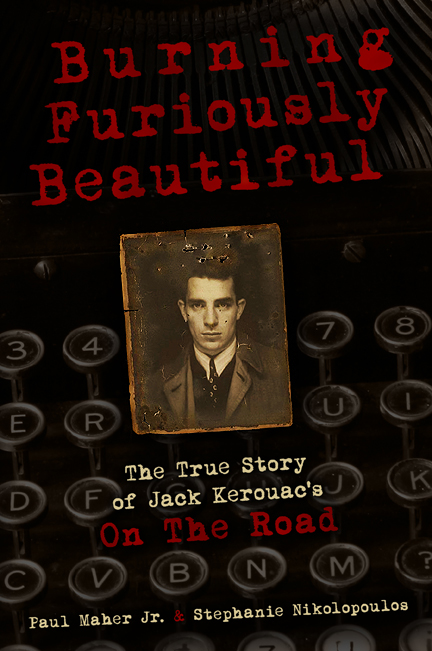
You probably have a pretty good idea by now of what Burning Furiously Beautiful: The True Story of Jack Kerouac’s On the Road is about, but here’s the official synopsis:
Fueled by coffee and pea soup, Jack Kerouac speed-typed On the Road in just three weeks in April 1951. He’d been traveling America for the past ten years and now, at last, the furious energy of his experiences flowed through his fingertips in a mad rush, pealing forth on a makeshift scroll that he laboriously taped together. The On the Road scroll has since become literary legend, and now Burning Furiously Beautiful sets the record straight, uncovering, among other things, the true story behind one of America’s greatest novels.
With unprecedented access to Kerouac’s journals and letters, Burning Furiously Beautiful explores the real lives of the key characters of the novel—Sal Paradise, Dean Moriarty, Carlo Marx, Old Bull Hubbard, Camille, Marylou, and others. Ride along on the real-life adventures through 1940s America that inspired On the Road. By tracing the evolution of Kerouac’s literary development and revealing his startlingly original writing style, this book explains how it took years—not weeks—to ultimately write the seemingly sporadic 1957 novel, On the Road. This revised and expanded edition of Jack Kerouac’s American Journey (2007) takes a closer look at the rise of Jack Kerouac and the Beat Generation.
Paul Maher Jr. is the author of the critically acclaimed biography Kerouac: His Life and Work and Empty Phantoms: Interviews and Encounters with Jack Kerouac.
Stephanie Nikolopoulos is an editor and writer based in New York City.
Maher and Nikolopoulos are currently co-authoring Visions of Kerouac for Rowman & Littlefield (2014).




 Stephanie Nikolopoulos