Tag Archives: visual art

Happy 88th Birthday, Allen Ginsberg!

3 Jun

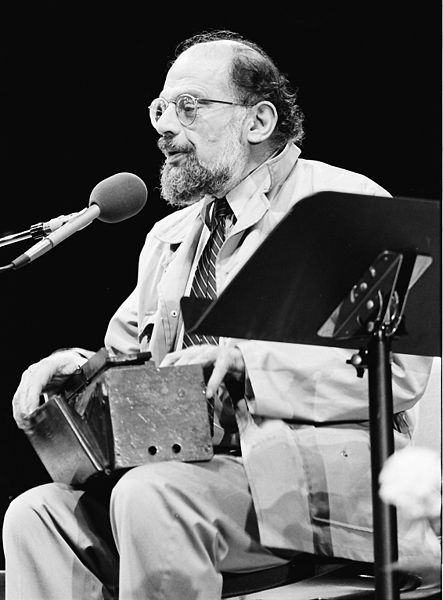
ginsbergAllen Ginsberg at the Miami Bookfair International on November 7, 1985. Photo by MDCarchives via Wikipedia.


Today would’ve been Allen Ginsberg’s eighty-eighth birthday, and in honor of the Jersey-born poet’s powerful and beautiful work we asked people on the Burning Furiously Beautiful facebook page what their favorite Ginsberg poem was. I’ve loved hearing the results! So far we’ve heard:

My favorite is “Sunflower Sutra,” in which Ginsberg writes about Kerouac and him sitting under the shadow of a train as the sun set and spying a dried up sunflower amdist the machinery. The line “when did you forget you were a / flower?” slays me every time.

What’s your favorite poem by Allen Ginsberg? Leave it in the comments below or on the Burning Furiously Beautiful facebook page.

Want to read more about Ginsberg on his birthday?

And if you’ve ever been curious about how Allen Ginsberg met Jack Kerouac in the first place, you can read all about the early origins of the key people who came to represent the Beat Generation but who are all really so much more than that in Burning Furiously Beautiful.


TODAY: William S. Burroughs Centennial Conference

25 Apr

burroughsimage via CUNY

William S. Burroughs turned 100 back in February — and we’re all still celebrating!

Today the WSB@100 Festival continues at the CUNY Center for Humanities. What I particularly love about this event is how academic it is! Though the writers associated with the so-called Beat Generation are studied in colleges across the country, many critics and scholars alike still focus more on the writers’ personal lives than on their literature. The William S. Burroughs Centennial Conferences tackles weightier issues such as innovation and technique, the business of publishing, and gender politics.

Here’s a look at the schedule:

Fri Apr 25, 9:30am – 6:30pm | Conference | Room 9206-9207

William S. Burroughs Centennial Conference

John M. Bennett
Ann Douglas
Oliver Harris
Barry Miles
Jed Birmingham
Charles Plymell
Geoffrey D. Smith
Anne Waldman
Regina Weinreich
Jan Herman

Held in honor of the centennial of William S. Burroughs’s birth, and the WSB@100 Festival in New York City scheduled for the entirety of the month of April, 2014, this conference will explore the life and works of one of the most innovative and influential twentieth-century American writers and artists. Join us for a series of talks and roundtables by editors, artists, and scholars on a range of issues from the problem of gender in Burroughs’s writings to his role in postwar America little magazines, his still unpublished archival materials, cut-up experiments and novels, and his photography.

“Listen to my last words any world. Listen all you boards syndicates and governments of the earth. And you power powers behind what filth deals consummated in what lavatory to take what is not yours. To sell the ground from unborn feet. Listen. What I have to say is for all men everywhere. I repeat for all. No one is excluded. Free to all who pay. Free to all who pain pay.” – William S. Burroughs

This conference is free and open to the public.

This event will be livestreamed. For viewing during the event, please see here: https://videostreaming.gc.cuny.edu/videos/livestreams/page1/

Join this event on Facebook.

SCHEDULE:

9:30AM  Coffee

10:00AM
Editing Burroughs with John Bennett and Geoffrey Smith

11:00AM
Burroughs and Literary Magazines with Jed Birmingham, Charles Plymell, and Jan Herman

12:30PM Lunch

2:00PM
Biography and Photography: Barry Miles in conversation with Oliver Harris

3:30PM
Gender Trouble with Anne Waldman, Regina Weinreich, and Ann Douglas

5:15PM Coffee Break

5:30PM
Keynote:  Oliver Harris Cutting up the Trilogy


Cosponsored by the English Students Association, Lost & Found: The CUNY Poetics Document Initiative, the PhD Program in English, the Center for Lesbian and Gay Studies, the Doctoral Students’ Council, and the WSB@100 Festival.

You can find all the information on the CUNY website.

* * *

Interested in how William S. Burroughs helped shape Jack Kerouac’s literature? Check out Burning Furiously Beautiful: The True Story of Jack Kerouac’s “On the Road,” the book I coauthored with Paul Maher Jr. (2013). It’s available through Lulu’s print edition, Amazon, and Barnes & Noble.


100 Facts on William S. Burroughs for His 100th Birthday

5 Feb

burr2

The title say it all, and I’ve got a lot of ground to cover so let’s just get on with it!

      1. Burroughs was born on February 5, 1914, which would make him 100 years old today!
      2. But he passed away on August 2, 1997
      3. The S. in William S. Burroughs stands for Seward
      4. Burroughs is actually Burroughs II
      5. Burroughs’ father’s name was Mortimer Perry Burroughs
      6. Mortimer ran a gift shop called Cobblestone Gardens
      7. The II comes from his grandfather
      8. William Seward Burroughs I was the founder of the Burroughs Adding Machine company
      9. William S. Burroughs II named his son William Seward Burroughs III
      10. Burroughs’ mother’s name was Laura Hammon Lee
      11. Burroughs’ pen name was William Lee
      12. Burroughs’ maternal grandfather was a minister
      13. In the ’60s, Burroughs joined and left the Church of Scientology
      14. In 1993 he became a member of the Illuminates of Thanateros
      15. Laura Hammon Lee’s family claimed to be related to Confederate General Robert E. Lee
      16. Burroughs’ uncle was Ivy Lee, the founder of modern PR
      17. His family was not very affectionate
      18. He was born in St. Louis, Missouri and lived on Pershing Avenue in the Central West End section of St. Louis
      19. He attended the private school John Burroughs School, named after the naturalist
      20. Burroughs was class of ’31
      21. Burroughs’ first publishing achievement was at the school when his essay “Personal Magnetism” was published in 1929 in the John Burroughs Review
      22. He didn’t graduate from John Burroughs School
      23. On its website, John Burroughs School calls William S. Burroughs a “controversial author”
      24. After John Burroughs School, he attended Los Alamos Ranch School, an elite boarding school in New Mexico
      25. Another famous author later attended Los Alamos Ranch School: Gore Vidal (born 1925)
      26. At the boys boarding school, Burroughs kept a diary about his attachment to another boy at the school
      27. Burroughs was a virgin through high school
      28. Burroughs dropped out of Los Alamos too
      29. Next up, he went to Taylor School in Clayton, Missouri
      30. From there, he went to Harvard to study art
      31. At Harvard, he was part of Adams House
      32. Back home on summer break, Burroughs became a cub reporter for the St. Louis Post-Dispatch
      33. His beat? Police docket
      34. Surprisingly, he hated the job and refused to cover gruesome stories
      35. That summer he lost his virginity
      36. He shed his virginity to a female prostitute
      37. It was back at Harvard that he was introduced to gay culture when he traveled to New York City with his wealthy Kansas City friend Richard Stern
      38. Stern was apparently a bit like Neal Cassady when it came to driving: he drove so fast that Burroughs wanted to get out of the car once
      39. Burroughs graduated from Harvard in 1936
      40. After he graduated, his parents gave him $200 a month
      41. After Harvard, Burroughs went to Vienna to study medicine
      42. There he became involved in the gay subculture
      43. He also met his first wife there, Ilse Klapper, a Jewish woman fleeing the Nazis
      44. Burroughs and Klapper were not romantically involved, but he married her in Croatia so she could move to the US
      45. After they divorced in New York, they remained friends
      46. By 1939, he had become so obsessed with a man that he severed his own finger — the last joint of his left little finger, to be exact
      47. In 1942, Burroughs enlisted in the US Army
      48. When he became depressed that he was listed as 1-A Infantry instead of officer, his mother called a family friend, a neurologist, to get him a civilian disability discharge due to mental instability
      49. It took five months for him to be discharged, and he waited at Jefferson Barracks, near his family home
      50. Afterward, he moved to Chicago
      51. In Chicago, the Harvard grad became an exterminator
      52. The Burroughs family was friends with another prominent family, the Carrs
      53. William S. Burroughs II was eleven years old when Lucien Carr was born
      54. During primary school in St. Louis, Burroughs had met David Kammerer, who was three years older than him
      55. Kammerer had been Carr’s youth group leader and become obsessed with him, following him to the University of Chicago
      56. When Carr fled to Columbia University in New York City, Kammerer followed — as did Burroughs, who moved a block away from Kammerer in the West Village
      57. Carr met Allen Ginsberg at Columbia and introduced him to Burroughs and Carr
      58. Burroughs met Joan Vollmer Adams around this time, and he moved in with her
      59. In the summer of ’44, Carr killed Kammerer with his Boy Scout knife, and then went to Burroughs — Kammerer’s friend — for help
      60. Burroughs flushed Kammerer’s bloody pack of cigarettes down the toilet and told Carr to get a lawyer and turn himself in, but instead Carr sought out help from Jack Kerouac
      61. Burroughs and Kerouac were arrested as material witnesses, but Burroughs’ father posted bail for him (Kerouac married Edie Parker to get bail money)
      62. Burroughs became involved in drugs around this time, becoming addicted to heroin
      63. When Burroughs got arrested for forging a prescription, he was released to his parents in St. Louis
      64. When he was finally allowed to leave, he went back to New York City for Joan Vollmer Adams, and together, with her daughter, moved to Texas
      65. It was Joan who gave birth to William S. Burroughs III in 1947
      66. After Texas, the family moved to New Orleans
      67. Around this time, Burroughs was arrested after police found letters at Ginsberg’s place that incriminated him
      68. Burroughs, Joan, and the kids went on the lam to Mexico
      69. In Mexico, Burroughs decided to go back to school: he studied Spanish and the Mayan language at Mexico City College
      70. He studied under R. H. Barlow, a homosexual from Kansas City who commit suicide through overdose  in January 1951
      71. He also decided to take up a game of William Tell. It didn’t go so well: he shot Joan in the head, killing her
      72. He only spent 13 days in jail, after his brother bribed authorities to let him out while he waited for trial; witnesses were also bribed so Burroughs would appear innocent. Either way, Burroughs skipped town
      73. Burroughs considers his killing of Joan to be the beginning of his life as a writer; he wrote Queer at this time
      74. Queer was not published until 1985; Burroughs’ first book was actually Junkie, published in 1953 — four years before Kerouac’s On the Road came out
      75. Burroughs III went to live with his grandparents in St. Louis; Joan’s daughter, Julie, went to live with her maternal grandmother
      76. Burroughs himself went down to South America in search of the drug yage
      77. From there, he moved to Palm Beach, Florida, with his parents
      78. His parents paid for him to travel to Rome to see Alan Ansen
      79. They didn’t hit it off romantically, so Burroughs left for Tangier, Morocco
      80. When Kerouac visited Burroughs in Tangier in 1957, he typed up his manuscript for him and edited it into Naked Lunch
      81. In 1959, Burroughs moved to the Beat Hotel in Paris; Ginsberg, Ginsberg’s lover poet Peter Orlovsky, poet Gregory Corso, and photographer Harold Chapman lived there
      82. There, he discovered the cut-up technique of Brion Gysin, which greatly influenced his work
      83. In 1966, Burroughs went to London to seek treatment for his drug addiction and worked there for about six years
      84. Student editor Irving Rosenthal, of Chicago Review, lost his job for publishing excerpts of Naked Lunch and founded his own lit mag, Big Table, where he continued to publish Burroughs’ work. The United States Postmaster General found the work so obscene that he ruled it couldn’t be sent through the mail. This intrigued Maurice Girodias, publisher of Olympia Press
      85. A 1966 case against Naked Lunch remains the United States’ last obscenity trial against literature
      86. Back in the US, Burroughs’ own son had gotten involved in drugs and gotten arrested on prescription fraud (just like dear old dad); Burroughs took him to the Lexington Narcotics Farm and Prison
      87. Burroughs covered the 1968 Democratic National Convention for Esquire magazine; he refused to alter his style to fit Playboy‘s literary demands for another article
      88. Burroughs hated teaching because it expended all his energy and he felt like he got nothing back in return
      89. Bookseller James Grauerholz initiated Burroughs’ reading tour, which helped Burroughs remain in the public eye … and make money for it
      90. In 1976, Burroughs’ son had liver cirrhosis and underwent transplant surgery; Burroughs stayed with him in 76 and 77 to help care for him
      91. Burroughs III cut off his father, writing an article in Esquire that said his father had ruined his life, and died in 1981
      92. In 1978, the Nova Convention took place — a multi-venue retrospective of Burroughs’ work that included readings and discussions by Ginsberg, Patti Smith, Frank Zappa, and Timothy Leary in addition to concerts featuring The B-52s, Debbie Harry, and Philip Glass
      93. Speaking of musicians, in the 90s Kurt Cobain hung out with Burroughs
      94. In the 80s, Burroughs moved to Lawrence, Kansas, where he spent the remainder of his life
      95. Always the gun aficionado, there he created an art form in which he used a shotgun to shoot spray paint bottles that would explode paint onto a canvas
      96. In 1983 Burroughs was inducted into the American Academy and Institute of Arts and Letters
      97. He played a character from one of his own short stories in the 1989 film Drugstore Cowboy
      98. His collaboration with Nick Cave and Tom Waits gave birth to Smack My Crack, a collection of short prose and spoken-word album
      99. Burroughs died from complications of a heart attack
      100. He is buried the Burroughs family plot in Bellefontaine Cemetery

Microaggressions

9 Jan

Kiyun Kim’s photography series Microaggressions capture the casual racism of our American society. The Fordham University student photographed fellow students holding signs with the subtle racist remarks they often hear. The comments probably aren’t intended to be racist, and I would imagine many people think they’re actually complimenting the person.

When I found out about Kim’s work via Flavorwire, I recognized a lot of the signs as comments I’d heard directed toward many of my friends. And while White privilege means I don’t have to deal with racism in the same way that others do, as someone whose skin is too pale for Greek functions and whose name is ethnic for many Americans—not all of whom were White—I have heard my fair share of remarks that were less than culturally sensitive.


“Stephanie, can you explain to the class who the Titans are?”

“That’s so nice of you to show an interest in your husband’s culture.”

“In the Koine, there are five different words for ‘love.’ Today we’ll be talking about philia. …I hope I pronounced that correctly with Stephanie sitting in the room!”

“Which is your favorite translation of The Iliad?”

“So how did you find out about this event?”


How do you deal with remarks like this? On the one hand, you don’t want to overreact because usually the people saying these things don’t understand the hurt it may cause. On the other hand, they will continue to say these things to you and to others if they’re not corrected.

Friday Links: Aristophanes Edition

13 Dec

swellfoot

Happy Friday! I’m wrapping up Aristophanes week with some link love devoted to this funny dramatist.

Lysistrata is a name featured on the Heritage Floor at The Dinner Party, at the Elizabeth A. Sackler Center for Feminist Art at the Brooklyn Museum

Pablo Picasso was so inspired by Aristophanes’ Lysistrata that he made several prints related to it, on view at the Met

Artist Aubrey Beardsley, who is often inspired by literature, also created a print inspired by Aristophanes

Obviously, there’s Radiohead’s Cloud Cuckoo Land

Lisa Borders titled her book about a young female busker’s search for home Cloud Cuckoo Land

On Fernhill Farm in Somerset, there’s a festival called Cloud Cuckoo Land

Festivals may seem very post-Woodstock, but Aristophanes was part of a festival back in Ancient Athens, called Lenaia, where he actually won first prize for his play The Knights

There’s an international architecture journal called Cloud-Cuckoo-Land

In London there’s a delightful period-clothing shop called Cloud Cuckoo Land

Percy Bysshe Shelley (Gregory Corso’s favorite poet) imitated Aristophanes’ The Frogs in the comic drama Oedipus Tyrannus: Or, Swellfoot the Tyrrant

“Aristophanes is ridiculous!” shouted Oscar on an episode of The Odd Couple in which he and Felix are contestants on the game-show Password


* * *

Burning Furiously Beautiful: The True Story of Jack Kerouac’s “On the Road” is now available as an ebook and paperback!

Clip: How Do You Like Them Apples?

8 Oct

apple3Carl Larsson’s Apple Harvest (1903)

My latest art post is up on Burnside. It’s all about how artists, from  Louise Moillon to Sarah Stupak, have depicted apples over the years. You can read it here.

* * *

Burning Furiously Beautiful is now available as an ebook! You can download your copy here.

Maria Fragoudaki’s “Superheroes”

3 Oct

mfragoudaki_11-lgMaria Fragoudaki’s “Sometimes I Cannot Control Myself”
2013
Mixed media on canvas. 70in x 56in.

Move over, Ben Affleck! Maria Fragoudaki‘s Superheroes opens tonight at New York’s One Art Space (23 Warren Street; Street level—Gallery 1; Manhattan). Fragoudaki explores issues of identity in New York City. Her larger-than-life works of mixed media shine like the bat signal, exposing the fast-paced, fragmented lives we lead here in Gotham.

Born in Athens, Greece, Fragoudaki has shown her work in New York as part of groups shows in the past, but this is her first solo show in New York City . Tonight’s opening reception begins at 6.

From the press release:

The inspiration for this body of work came in New York during the last two years. The artist explores issues of individual identity in a fast-changing world where anchoring points are disappearing. These themes, familiar in Maria’s work, take a new twist here as emotions are amplified by the uniquely fast-paced rhythm of the archetypal metropolis, New York.
At the center of this whirlpool where anxiety is constant and uncertainty the norm, the need for stable references, strength and reliance become more acute. This prompts her to reach to the world of superheroes, which in addition has direct references to New York. Drawing on the collective unconscious of pop-culture the artist creates immediate associations that facilitate a casual and direct communication with her audience.
In the creative process the superheroes become abstracted moving the focus to the notions they represent. Deceptively simple messages, with child-like directness, are superimposed at times as statements, at time as cries, while the medium of collage enhances the feeling of the fragmented self in the process of constructing identity and meaning.

Maria Fragoudaki’s first solo show in New York induces the public to connect with their emotions and conflicts. This exhibit allows each of us the opportunity to discover our own personal Superhero.

mfragoudaki_12-lgMaria Fragoudaki’s “Spiderman’s Arrival”
2013
Mixed media on canvas. 91in x 27in.

From Fragoudaki’s website:

Maria Fragoudaki was born in Athens in 1983. She studied chemistry, pharmacology and business management in London where she subsequently worked for a few years. She started painting systematically in 2008 and over the last 4 years she attended various courses and seminars in painting & fine art in New York and London. Her work utilises a wide variety of media such as oils and acrylics on large canvas surfaces and she has also produced other mixed media works incorporating the technique of collage. Over the last 4 years Maria has participated in numerous group exhibitions in New York, Belgium and Greece and has also presented her first solo exhibition in Skoufa Gallery in early 2011. She is currently working on her forthcoming solo show in London. Her work has been acquired by private and corporate collections in New York, London, Greece and Belgium.

Superheroes will run at One Art Space through October 24.

* * *

Burning Furiously Beautiful is now available as an ebook! You can download your copy here.

Clip: 8 Contemporary Syrian Artists to Know

20 Sep

With devastating allegations that the Syrian government was responsible for chemical attacks on more than three hundred of its own citizens this past August and nightly news reports detailing the atrocities of civil war, the world casts its collective eye on Syria. Political pundits and laymen alike argue whether the US should step in and take military action.

Syria is more than a land of strife. Its capital, Damascus, is reportedly the oldest continuously inhabited city in the entire world.

From the bible, we know Damascus as the place where Paul was converted to Christianity. By the nineteenth century, Syria significantly contributed to the literature of the Arab world. Today, Damascus has an influential music scene. Syria’s contemporary art speaks to this rich culture as well as its atrocities.

Art preserves history. It is a visual lens through which we can better understand the socio-political milieus that have gone before us and that we live through today. Artists are particularly tuned into the world around them. They interpret what they see through paintings, photography, sculpture, cartoons, and collage, and in turn we may come to understand issues pertaining to religion, the economy, gender, and power through their civilian eyes. Their images may reach us in ways that words—particularly that of news reports—cannot.

Read more of my art post “8 Contemporary Syrian Artists to Know” on Burnside Writers Collective.

Adventuring with Author Larry Closs to See Jonathan Collins’ Beat-inspired Paintings

17 Sep

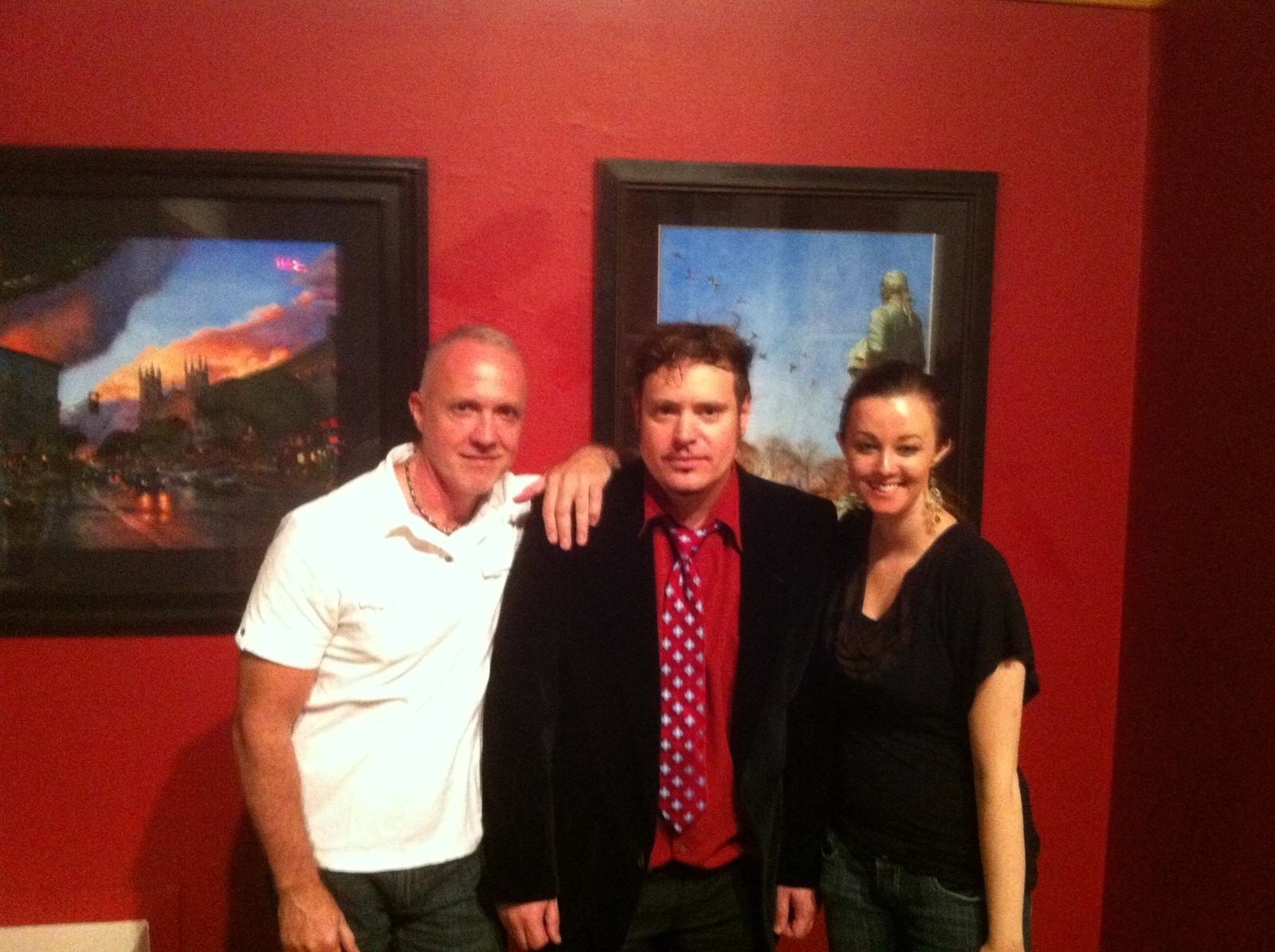
JonThat’s Larry Closs on the left, Jonathan Collins in the middle, and me on the right.

Collins2

Collins3

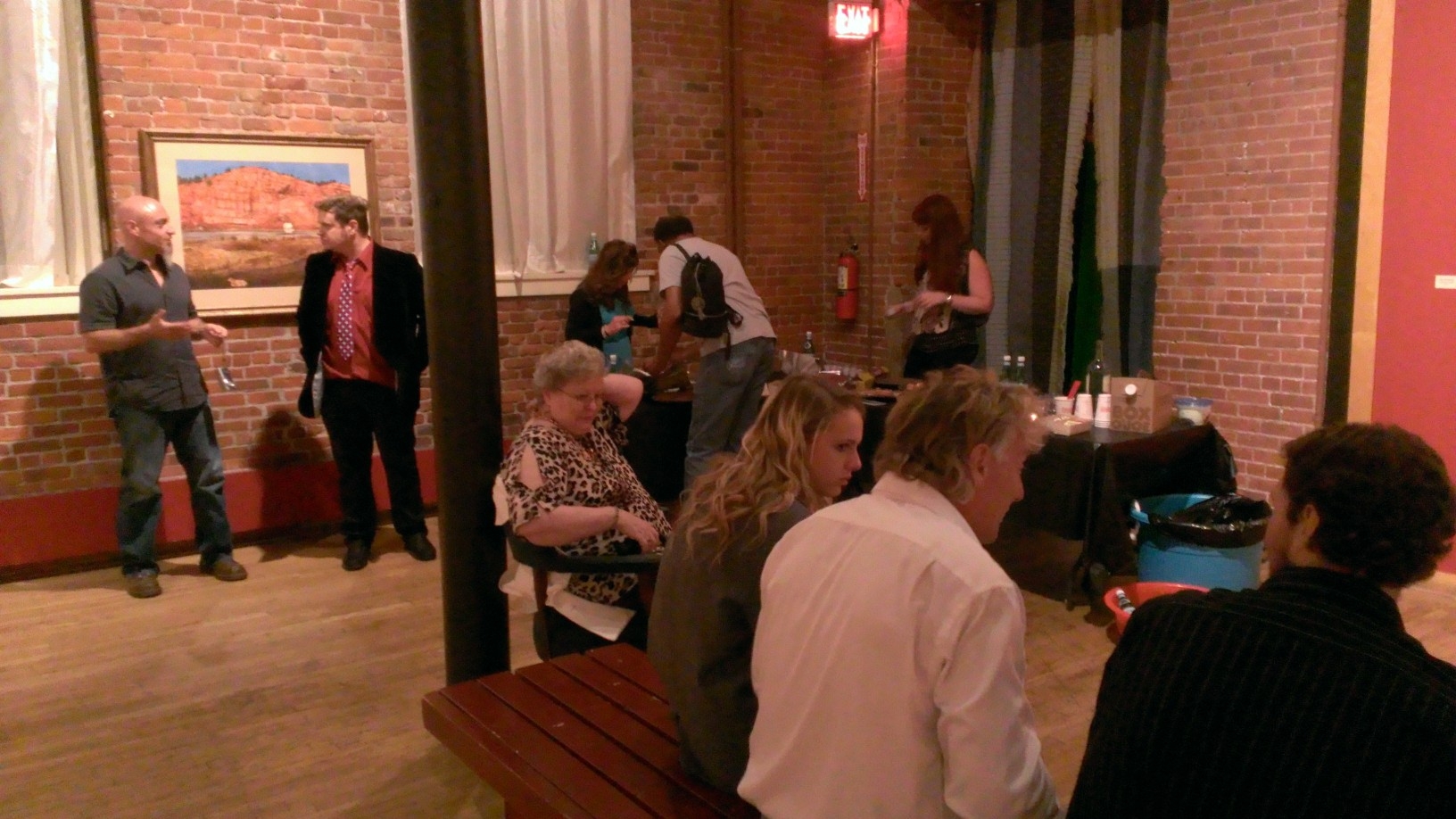
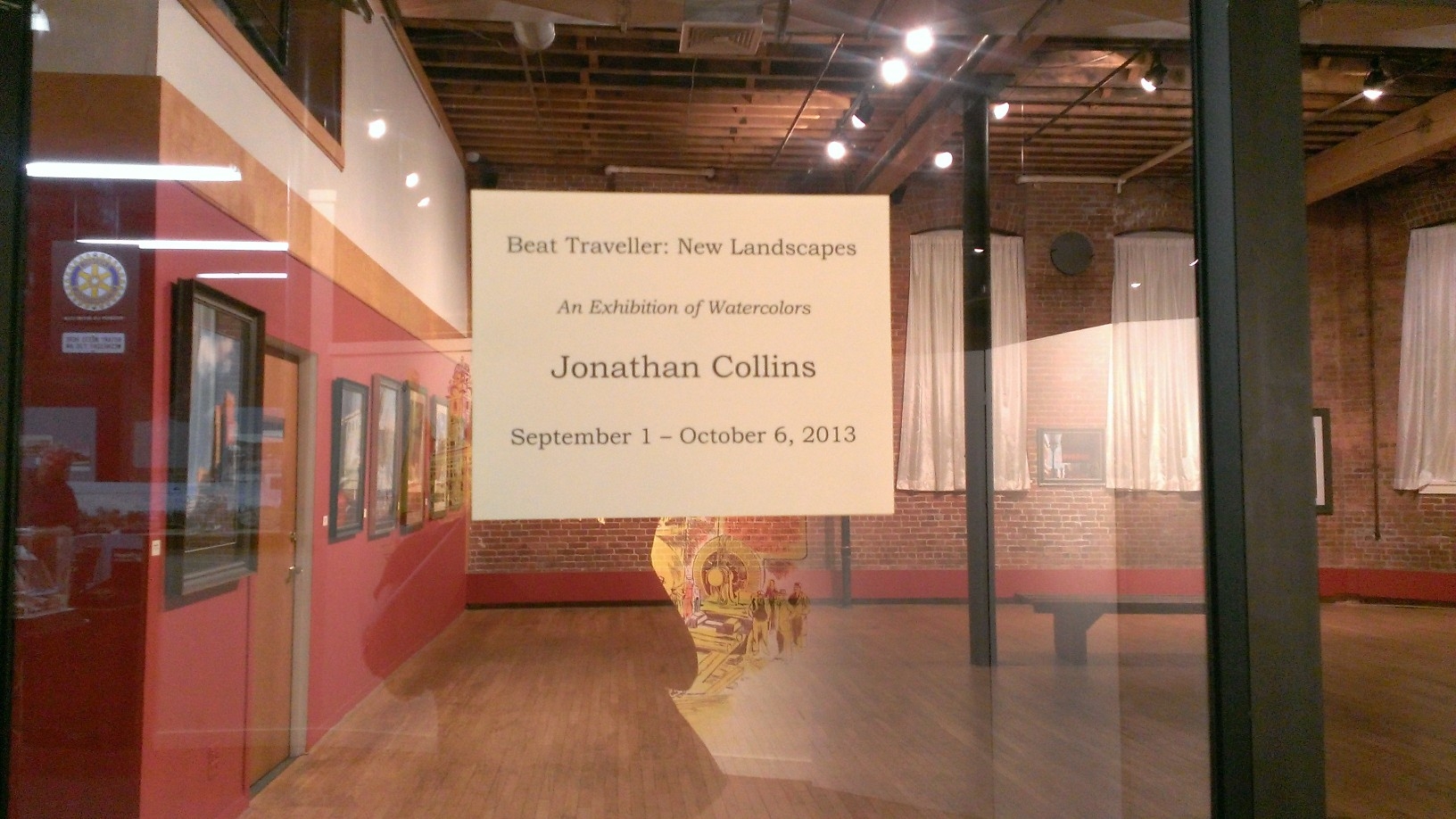
Larry Closs and I took a mini road trip to attend the opening of Jonathan Collins‘ Beat-inspired paintings at the Paterson Museum (2 Market Street, Paterson, NJ). It turned out to be quite the adventure. You may remember Larry as the author of Beatitude, a book I stayed in on a Saturday night to read because I was so captivated by the story I couldn’t put it down. Larry also happens to be a great conversationalist with fascinating stories about the writers’ life, bumping into Beat authors, and his own world travels. I got so caught up in our conversation on the way over to Jonathan’s show that I didn’t pay enough attention to the train directions, and, well, if you want to know what happened, check out Larry’s blog.

The first time I ever saw Jonathan’s paintings, when he’d brought his portfolio down to Cornelia Street Cafe when I was reading with David Amram, they were so realistic I thought they were photographs. Seeing them in person for the first time I was even more impressed by their beauty. From Kerouac’s Moody Street Bridge to neon-lit bars, Jonathan’s watercolors evoke nostalgia. Larry put it this way on his blog:

The paintings illuminate—and celebrate—the sometimes hidden beauty and “mystical qualities” often overlooked in the ordinary, the everyday and even the dreary.

The show runs at the Paterson Museum through October 6.

Collins1

Clip: A Time to Give Up

5 Sep

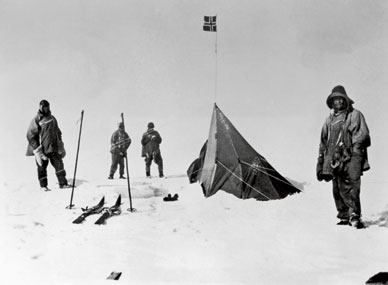
Indelible-South-Pole-expedition-388-thumbPhoto of Robert Falcon Scott’s failed exploration via The Smithsonian‘s article “The Doomed South Pole Voyage’s Remaining Photographs,” which states: “Their return trip would become one of the most dismal failures in the annals of polar exploration.”

Burnside published my latest art post in the “A Time to…” series. It’s

A Time to Give Up


In case you missed the previous posts in the series. They are:

A Time to Search

A Time to Embrace

A Time to Refrain from Embracing

A Time to Gather Stones

A Time to Scatter Stones

A Time to Dance

A Time to Mourn

A Time to Laugh

A Time to Weep

A Time to Build

A Time to Tear Down

A Time to Plant and a Time to Uproot