Archive | June, 2012

New Yorker Quips Greeks Invented Tragedy, Not Much Else Lately

15 Jun


I’m getting sick of the way everyone’s always ragging on Greece.  I just read this comment in “Greece Vs. The Rest” in The New Yorker:

Greeks are fond of pointing out that they invented democracy; they invented tragedy, too, and that is what their situation increasingly looks like, whoever wins the election. The problem is that in recent years they haven’t invented much of anything else.

The author clearly thinks he’s being witty, but it is an insensitive and erroneous remark.  We don’t go around mocking other countries that are experiencing crises.  Why is it okay to denigrate Greece?  Is it because, yes, “Greeks are fond of pointing out that they invented democracy,” and therefore come off as braggers?  Or are other countries purely jealous of how much Greece has influenced the world?

Greece in fact is innovating.  Greece is part of the Global Monitoring for Environmental and Security Initiative.  Three years ago, Nanophos SA received first prize for Innovation and Sustainability in the International Exhibition “100% Detail.” Lavrion Technological and Cultural Park is linking culture and technology research. Furthermore, many well-known international companies—such as Coca-Cola, Ericsson, and Motorola—conduct their research and development in Greece.

Sorry, Greece did not invent the ipod.  Let’s remember that much of modern Greece was under oppression.  During World War I, many Greeks were killed, and Greek refugees fled Turkey for Greece, which led to its own economic stresses.  During World War II, Nazis occupied Greece, sending Greek citizens to concentration camps.  From 1946 to 1949, Greece had a civil war, when it rose up against Communism.  And now, even in the years leading up to the economic crisis, the media has lampooned Greece, scaring off tourists and investors.  It’s hard to be creative and inventive when you’re fighting for your life.

What I do agree with is the author’s statement:

An unsustainable burden is being loaded on those sectors of the population who were already paying.

Just like here in the US, where the rich are able to write everything off so as not to pay taxes, there are many people in Greece who are not paying taxes.  Those who do pay their taxes are being overtaxed.  These are the people who are poorer, who are older, who are retired, who are more generous to those in need, who do what is right, who are loyal to their country.

This is why we saw a 77-year-old man shoot himself in the head in Syntagma Square—the Times Square of Athens—back in April.  As the Guardian reported, he shouted, “I’m leaving because I don’t want to pass on my debts.”

It saddens me that the media is not more compassionate towards Greece.  Yes, there are many things that need to change there, but the blame cannot be placed solely on Greece.  The country has suffered many hardships.  There are real people living in Greece who are, yes, experiencing tragedy.  Maybe we need to cling to our heritage to remind us of what we can accomplish and give us some hope for our future.  Maybe instead of lambasting Greece, the foreign media should believe in Greece.  Because you know what?  Greece has overcome many trials and tribulations, and will rise again.

“On the Road” Makes “30 Books Everyone Should Read Before Turning 30”

14 Jun


Flavorwire listed “30 Books Everyone Should Read Before Turning 30,” and guess what’s on the list?!  That’s right, Jack Kerouac’s On the Road.

Unfortunately, this follows its inclusion:

Plus, then you’ll have ample time to develop your scorn towards it.

Why the scorn, Flavorwire?

As, I wrote in the comments field:

In the 10+ years since I first read “On the Road” when I was a teenager, I have not developed any scorn for it. In fact, as I’ve delved further into Kerouac’s life and work, I’ve come to see just how brilliant his writing is, especially considering English was not his first language. He had to learn the colloquialisms that he’s so often criticized for using. When “On the Road” was published in 1957, it was groundbreaking to use the type of slang Kerouac used and to improvise the way he did.

The comments section isn’t all that kind to the novel, either.  One commenter called it “one-dimensional.”

Really?  I can certainly understand a reader not liking the voice or even the story.  Everyone’s entitled to their own opinions.  There are plenty of people in the comments section admitting they don’t like Jane Austen or Nathaniel Hawthorne.  It’s okay not to enjoy something.  Not everyone has the same taste.  That’s what makes us unique.  But—you knew there was going to be a but—there’s a difference between personal taste and fact.  The fact of the matter is that On the Road is multi-dimensional.

On the Road is about so much more than the literal exploration of a road trip.  Perhaps Dean Moriarty is a bit one-dimensional in the sense that he acts impulsively, living for his own happiness, and never really grows out of that.  The narrator, Sal Paradise, is on a spiritual quest of sorts, though.  He hits the road, trying to leave behind the East of his youth to find himself in the West.  He befriends Dean, even though he knows he’s conning him.  He’s constantly caught between what he thinks he wants and what he really wants.  He’s searching for meaning and beauty and love and friendship.  He’s a complicated character, not entirely sure of what he wants.

Also on the list were a couple of Greek authors!  Namely, Homer and Jeffrey Eugenides.

I’m Reading at The Penny Farthing 6/18/12

13 Jun


I’ll be reading one of my Greek American stories this Monday night, June 18, at The Penny Farthing!

The Storytellers event, hosted by C3, starts at 7 and will be in the super cool downstairs speakeasy of The Penny Farthing at 103 3rd Avenue (@ 13th Street) in New York City.

Hope to see you there!

Tasty Tuesday: Boukiés

12 Jun

When you’re Greek and you live in such a foodie city as New York, you get the following question posed to you quite often: What’s your favorite Greek restaurant in New York City?  I’ve been asked it enough time that I should have a solid answer, but usually I end up staring off into space and saying something vague about the Greek restaurant scene in New York City.  My issue is that most of the Greek restaurants in New York City fall into three camps:

  1. Gyro carts
  2. Diners
  3. Posh Greek restaurants

As far as the gyro carts go, I don’t care how trendy it is to eat out of food trucks, I won’t eat out of carts or trucks.  Okay, maybe I’d do it for ice cream, but I feel anything that could be dangerous if not refrigerated properly or not cooked long and hot enough should not be created on wheels of any sort.  There, I said it.


I love diners.  I’m from Jersey.  However, I don’t really consider diners Greek in the traditional sense.  I’m more apt to order a grilled cheese than tiropita at a diner—even if it is owned by a Greek.

Now, I love luxurious meals at posh restaurants.  However, I just don’t think most Greek food is meant to be upscale.  It could be, don’t get me wrong.  Most of the time, though, the best Greek food gets made in tiny tavernas.  If you’re in New York, you can find these in Astoria.  Part of my prejudice toward super-posh Greek restaurants is that I personally don’t really enjoy most Greek main meals.

I love all the Greek meze (appetizers) and side dishes.  I’m talking tiganita, Greek salad, tzatziki sauce with warm pita, saganaki, feta, french fries with lemon and oregano….  I fill up on all of that and am too stuffed for the main course.

Christos Valtzoglou might be my new best friend.  I’ve never actually met him, but a while back I read on Grub Street that the man behind Pylos was opening up a restaurant called Boukiés, which means “small bites.”  The plan was to have only be two main courses on the menu, with the rest being all those delicious Greek meze I can never get enough of.  Diane Kochilas, whom I’ve previously had the pleasure of interviewing, and Steffen Sander are also involved in the restaurant.

Boukiés opened in March at 29 East Second Street (Second Avenue), taking over the space of Valtzoglou’s former restaurant, Heartbreak.  I’ve been tracking it for a while, but haven’t made it over yet.

I’m excited about the menu.  It includes such items as:

Flaounes me Feta kai Meli
Feta phyllo flutes, drizzled with Greek honey

Manitaropitakia Nymfaio
Northern Greek mushroom phyllo pies

Revithia, Melitzanes V. Elladitika, Aromatiki Saltsa Domatas
Clay-baked chickpeas and eggplants, Northern Greek style, with cinnamon spiced tomato sauce

Sokolata Krya me Rodakina
Chocolate-Mastiha Ganache, Peach Compote

There’s also an impressive Greek wine list.

More recently, Boukiés began serving brunch.  Some of the items offered on their menu include:

Poached eggs with sauteed spinach, tomato compote and
thyme Hollandaise, served on an English muffin

Smoked salmon-asparagus omelet with manouri cheese, 14
lemon zest, and dill

Citrony tsoureki (brioche) french toast served with mix
berries compote

Can’t wait to try Boukiés out!

I’m Mentioned in Sojourners

11 Jun

Oh my gosh!  I forgot to mention back in April that I was mentioned in Sojourners!!  Such an honor.

My Burnside Writers Collective colleague Larry Shallenberger, whom I attended the Festival of Faith and Writing with, wrote the article “On the Need to Start an Ole Boys’ Club For Writers” about strong women literary voices, and there was my name alongside Kim Gottschild, Rachel Held-Evans, Sarah Thebarge, Karen Spears Zacharias, Jo Hilder, and Susan Isaacs.  I’m so fortunate to be part of a collective that has strong literary voices — both male and female — and that is an incredible support network.

In the article, Larry mentions my work in writing about Jack Kerouac.  It’s so interesting that he specifically mentioned this, as opposed to my visual arts writing for Burnside, because the Beat Generation has often been criticized for not being more open to women’s voices.  Furthermore, so many women have told me they don’t enjoy reading Kerouac because of his hyper-masculinity.

Larry blogs about things like, oh, “God Talk and the Stenciling on an Atomic Bomb” and “The Personality Bending Power of Story.”

Goodreads Page for Burning Furiously Beautiful

7 Jun

We’re on Goodreads!  Now you can add Burning Furiously Beautiful as a to-read on Goodreads.

Official Synopsis for Burning Furiously Beautiful

6 Jun

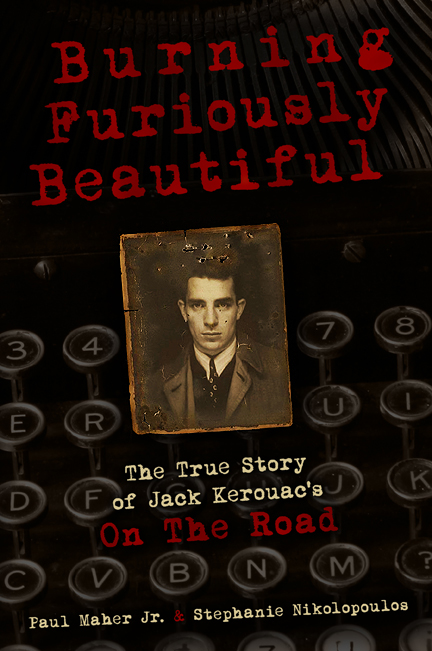
You probably have a pretty good idea by now of what Burning Furiously Beautiful: The True Story of Jack Kerouac’s On the Road is about, but here’s the official synopsis:

Fueled by coffee and pea soup, Jack Kerouac speed-typed On the Road in just three weeks in April 1951. He’d been traveling America for the past ten years and now, at last, the furious energy of his experiences flowed through his fingertips in a mad rush, pealing forth on a makeshift scroll that he laboriously taped together. The On the Road scroll has since become literary legend, and now Burning Furiously Beautiful sets the record straight, uncovering, among other things, the true story behind one of America’s greatest novels.

With unprecedented access to Kerouac’s journals and letters, Burning Furiously Beautiful explores the real lives of the key characters of the novel—Sal Paradise, Dean Moriarty, Carlo Marx, Old Bull Hubbard, Camille, Marylou, and others. Ride along on the real-life adventures through 1940s America that inspired On the Road. By tracing the evolution of Kerouac’s literary development and revealing his startlingly original writing style, this book explains how it took years—not weeks—to ultimately write the seemingly sporadic 1957 novel, On the Road. This revised and expanded edition of Jack Kerouac’s American Journey (2007) takes a closer look at the rise of Jack Kerouac and the Beat Generation.

Paul Maher Jr. is the author of the critically acclaimed biography Kerouac: His Life and Work and Empty Phantoms: Interviews and Encounters with Jack Kerouac.

Stephanie Nikolopoulos is an editor and writer based in New York City.

Maher and Nikolopoulos are currently co-authoring Visions of Kerouac for Rowman & Littlefield (2014).

Life after the MFA

5 Jun

As thesis submission deadline approached, people began asking me what I was planning on doing after graduation.  Then they’d stop themselves, afraid they may have asked too painful of a question.  But it’s not!

In one of my last posts, I left off telling you about grabbing a cup of tea after turning my theses in.  What I didn’t tell you was that on my walk back to my office, while sipping that delicious tea, I made a phone call to biographer Paul Maher Jr.  Paul’s books are some of the most well respected in his categories, and they’ve been translated and sold around the globe.

Inspired by Laura Vanderkam’s List of 100 Dreams, I created my own a while back.  Become a scholar on the Beat Generation was on my list.  I’ve been studying the writers generally categorized as Beat for more than a decade now.  I did my MFA at The New School, where Jack Kerouac took writing classes, and where I connected with writers who had known Jack Kerouac.

Now, my dream of becoming a Beat scholar is being realized.  Paul and I are working on a book that tells the true story of Jack Kerouac’s On the Road.  The phone call to him on Monday was to discuss cover ideas.

I don’t have a big life-altering answer to the question of what I’m doing after the MFA.  Paul and I have been working on this book for a while now, and since I won’t be simultaneously working on a thesis anymore I’ll simply be refocusing my creative energies into the book.  It helps that I didn’t enter the program straight out of undergrad.  I’d already been working in book publishing, a career many of my classmates are hoping to enter, and so graduation isn’t a big scary unknown for me.  I’ll be continuing in my editorial role.  For me, life after the MFA is about continuing to follow my passions while also seizing new opportunities.

I’m extremely excited to say that my post-MFA plan is to co-author a book on Jack Kerouac.

Greek Goddess Skin with Korres Pomegranate Toner & Korres Pomegranate Mattifying Treatment

4 Jun

Thanks to Persephone eating those seeds of the pomegranate, we now experience the changing of the seasons, according to Greek mythology.  Now that spring has sprung and summer is around the corner, modern Greek goddesses are spending more time outdoors and less time caking on makeup.  These warm months are all about catching free summer concerts in the park, vineyard hopping in the Hamptons, and stalking the Coolhaus truck without worrying if your makeup is sweating off.     

The Korres Pomegranate line is perfect for baring your skin this season.

I really love how gentle the Korres Pomegranate Toner is.  I have delicate, sensitive skin and so many toners are just too harsh.  The Korres Pomegranate Toner feels like water—mythical water.  There is absolutely no stinging sensation, and my skin doesn’t feel tight after using it.  Even though it doesn’t feel icy or tingly, I’ve been able to see from my cotton ball that it is working hard to remove impurities.

According to Korres, the Pomegranate Toner:

_Helps purify the skin’s surface by removing excess dirt, oil and impurities while minimizing the look of pores and helping to reduce the appearance or look of redness
_Leaves skin feeling fresh, and looking smoother and more matte
_Formulated with skin conditioners to leave skin feeling soft

It also happens to have a fresh, youthful aroma–unlike most toners, which tend to smell like rubbing alcohol.  Korres Pomegranate Toner has a sweet and invigorating smell.

Even better smelling is the Korres Pomegranate Mattifying Treatment.  However, this product takes about eight weeks to work.  The benefits are impressive, according to Korres:

Breathable, oil absorbing formula to minimize the look/appearance of pores and redness and leave skin with a smooth, matte finish throughout the day.

KEY FEATURES & BENEFITS
_Instantly fills in pores to create a smooth, even skin surface texture.
_Clinically proven after 8 weeks to significantly reduce the visibility of pores (94% of subjects), the appearance of redness (84% of subjects), and improve the overall appearance of skin (88% of subjects)

I’ve been using it only for a few weeks now, and even though it’s probably the best-smelling face-care product I’ve ever used, my skin was shiny as ever in the photos snapped for my MFA graduation and the Mediabistro event I attended. I think my foundation actually rubs most of the product off when I apply it, though, so through trial and error I’ve learned to make sure the Korres Pomegranate Mattifying Treatment is completely dry on my face before applying any face makeup.  (Beauty tip: Apply the Pomegranate Mattifying Treatment all over your face or t-zone, and while it’s drying apply your eye makeup to save time.  It should only take about 20 seconds to dry, and then you can apply foundation.  However, even then, pat your face makeup on gently because if you rub it, the mattifying treatment will come off in the process.)  Even so, the Korres Pomegranate Mattifying Treatment seems to work better for days when I’m not wearing any other face makeup on top of it.  And really, in the summer I don’t want to wear a lot of makeup anyway.

Neither of the scents linger, which is a positive for skincare, but if Korres offered a pomegranate perfume I’d be the first in line.  It’s the perfect daytime scent for summer months.

Greece’s fastest-growing natural skincare company not only draws its inspiration from the flora of Greece, where pomegranates have grown for centuries, it also is committed to eco-friendly practices.  The sleek and sophisticated packaging for Korres Pomegranate Toner and Pomegranate Mattifying Treatment is recyclable, and neither of the products are tested on animals.

So go ahead and channel your inner Greek goddess this summer, knowing that you don’t have to wear a lot of makeup to look beautiful.

Happy 86th Birthday, Allen Ginsberg!

3 Jun


“Poetry is not an expression of the party line.

It’s that time of night, lying in bed, thinking what you really think, making the private world public, that’s what the poet does.”

~Allen Ginsberg


Today would’ve been Allen Ginsberg’s 86th birthday.  In celebration, here are a couple of links:::

2012 Howl Festival

Howl (the film starring James Franco); clip of the section on how to write poetry

Allen Ginsberg reading part 1 of Howl

The flowering dogwood at St. Mark’s is blooming for Ginsberg’s birthday

“when did you forget you were a flower?” ~ Sunflower Sutra (one of my favorite poems — It’s beautiful. It’s true. It makes me tear up.)

Ginsberg’s Karma (documentary on Ginsberg’s time in India; produced by Ram Devineni and hosted by Bob Holman)

Ginsberg’s photography

Vomit Express (Allen Ginsberg and Bob Dylan)

Howl on the list of banned books

Ginsberg’s hometown of Paterson, NJ