Archive | Greekish RSS feed for this section

Dekapentavgoustos

15 Aug

Today, August 15, is Dekapentavgoustos, the Assumption of Mary or the Dormition of the Theotokos.  Most Protestants don’t celebrate it, but this is the third most important religious holiday, after Easter and Christmas, in Greek Orthodoxy.  It celebrates the day the Panagia — the Virgin Mary, the mother of Jesus — was bodily taken up to heaven.  According to Greek Orthodox beliefs, Mary died a natural death and her soul was received by Christ when she passed away.  Three days after her bodily death, her body was resurrected and taken up to heaven.

To commemorate this, Greek Orthodox believers fast for the two weeks leading up to August 15.  This is called the Dormition Fast.  The first day of the fast, August 1, is called Procession of the Cross.

Sunset at Lagouvardos Beach

8 Aug


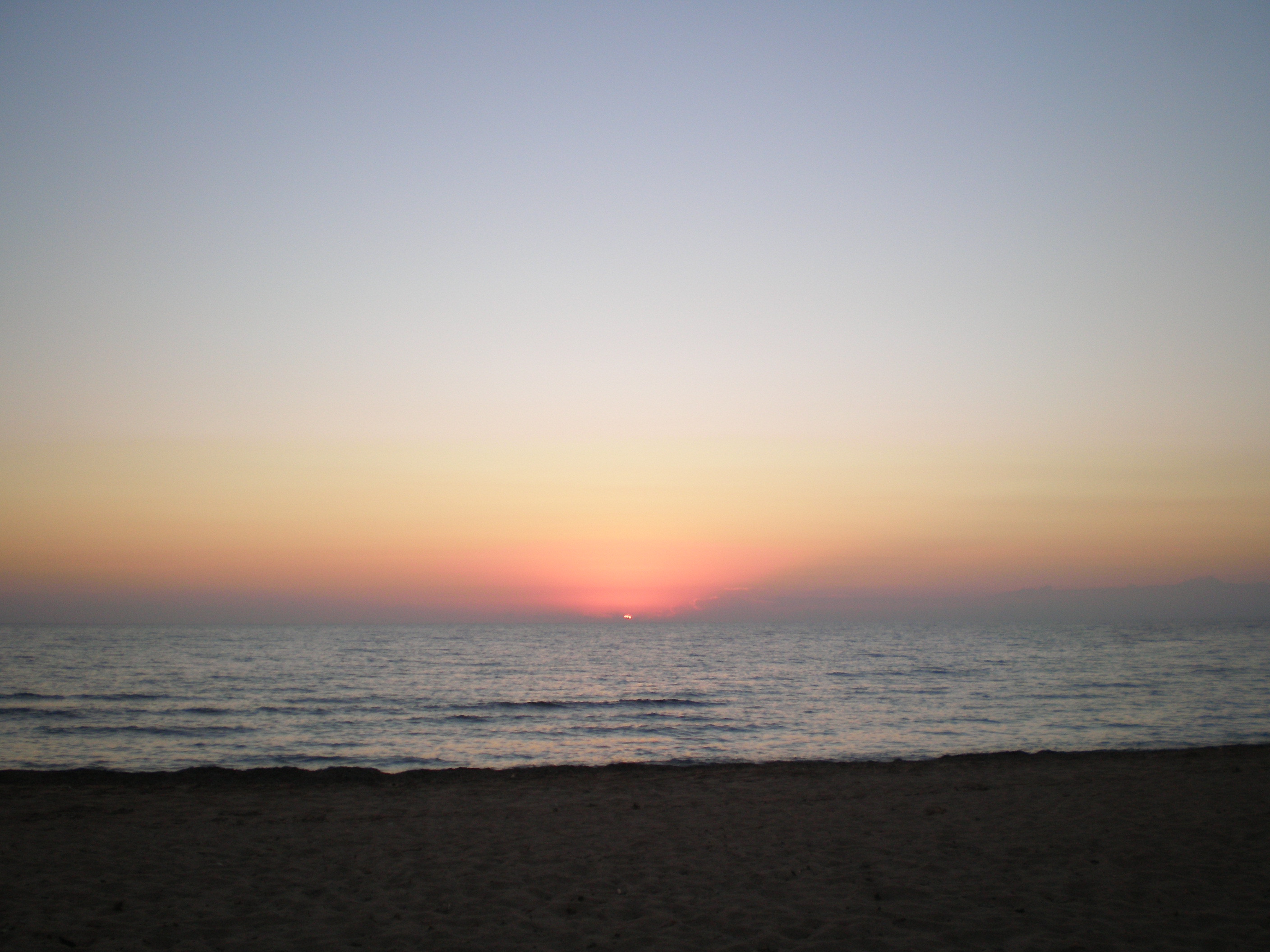
I took these photos on my last trip to Greece.  They’re pictures of the sun setting over Lagouvardos Beach in the Peloponnesus.

It’s rare that I catch the sunset in any meaningful way in the States, but watching the sun set into the ocean is the Greek way of life.  A lot of homes are built with large balconies and a lot of tavernas sit ocean-side so watching the sun set is a natural part of everyday Greek life.  We watch the sunset with the same awe that we watch fireworks.  It captivates our attention as it slowly sinks deeper and deeper into the ocean.  We try to guess when the last sliver of it will disappear until morning.  We savor the color-shifting sky, full of wonder.

Tasty Tuesday: FAGE Greek Yogurt Topped with Fresh Raspberries and Blackberries

2 Aug

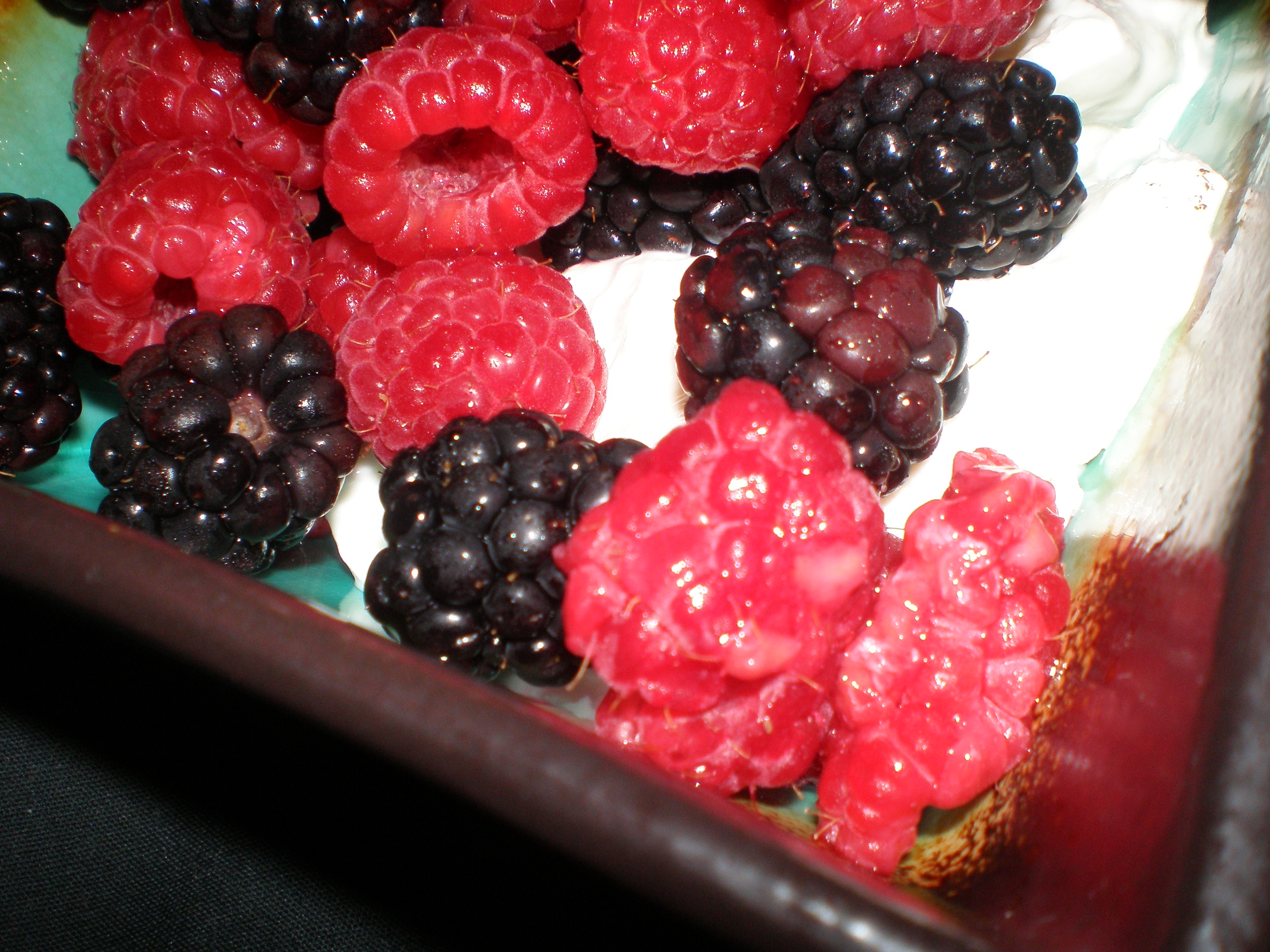
What I love about summer is fresh berries!  Raspberries are probably my favorite food.  (Well, along with brownies and coffee ice cream!  And pasta!)

Lately, I’ve been eating a lot of FAGE Greek yogurt with fresh, organic berries for breakfast and a cup of hazelnut coffee.  It tastes so good and makes me feel happy that I’m being healthy.

According to the nutrition benefits page of the FAGE yogurt website:

FAGE Total Strained Greek Yogurt is an extraordinary source of nutrition. Made from an authentic recipe that dates back to 1926 and using 100% natural ingredients, it contains no added sweeteners, thickeners or preservatives and no powdered milk, powdered cream or powdered protein.

Just whole milk, cream and cultures go through our unique straining process to create this blissful, low-calorie taste experience. In fact, approximately 4 pounds of raw milk are needed to make just one pound of FAGE Total Greek Yogurt.

FAGE Greek yogurt is vegetarian and gluten-free.  The 0% and 2% are also diabetic-friendly.

Meanwhile, raspberries are full of all sorts of antioxidant goodness.  Check out what Wikipedia has to say about raspberry health benefits:

The aggregate fruit structure contributes to its nutritional value, as it increases the proportion of dietary fibre, placing it among plant foods with the highest fibre contents known, up to 20% fibre per total weight. Raspberries are a rich source of vitamin C, with 30 mg per serving of 1 cup (about 50% daily value), manganese (about 60% daily value) and dietary fibre (30% daily value). Contents of B vitamins 1-3, folic acid, magnesium, copper and iron are considerable in raspberries.

Raspberries rank near the top of all fruits for antioxidant strength, particularly due to their dense contents of ellagic acid (from ellagotannins, see for instance raspberry ellagitannin), quercetin, gallic acid, anthocyanins, cyanidins, pelargonidins, catechins, kaempferol and salicylic acid. Yellow raspberries and others with pale-coloured fruits are lower in anthocyanins.

Due to their rich contents of antioxidant vitamin C and the polyphenols mentioned above, raspberries have an ORAC value (oxygen radical absorbance capacity) of about 4900 per 100 grams, including them among the top-ranked ORAC fruits. Cranberries and wild blueberries have around 9000 ORAC units and apples average 2800.

As for blackberries, Wikipedia simply says:

Blackberries are notable for their high nutritional contents of dietary fiber, vitamin C, vitamin K, folic acid – a B vitamin, and the essential mineral, manganese.

Do you prefer raspberries or blackberries?

Tasty Tuesday: Mango Salad with Sophia’s Pomegranate Dressing

26 Jul

I’m not a salad person.  Like a good Greek, my dad ate a huuuuuuge bowl of salad every night at dinner.  Salad seemed like a whole lot of chewing for not a lot of flavor payoff to me, though.  I’ve taste-tasted plenty of dressings at all-you-can-eat buffets, and while blue cheese or Italian might make lettuce a little more palatable it usually ends up making my salad taste rather generic.  “Hi, I’m American, and I like ranch dressing!”  That’s why I was surprised when I found myself tempted by the salad dressings at the grocery store.

Shelved between plastic bottles of gooey dressings was Sophia’s Gourmet Foods Greek Island Dressing.  The tall glass bottle looked sophisticated and down-to-earth at the same time, as if Sophia’s is the shabby chic of salad dressings.  The labels are white with beautiful line illustrations that call to mind late afternoons on the Greek islands.  The contents of the bottles looked thick, textured, and vibrant.  The dressing looked natural and homemade.

I picked up a bottle and read the label.  I’m really into reading labels these days.  It’s crazy the amount of junk (read: preservatives, sugar, coloring) that goes into packaged foods.  Here’s what’s in the Tahini: “Lemon Juice, Tahini, Water, Garlic, Salt, Sesame Seeds, Citric Acid.”  That’s it.  All of the other flavors do contain xantham gum, which helps the dressing achieve the thickness I’d noticed.  Some have various types of sugars added, but a serving size (2 tablespoons) only has 2 grams of sugar.  I wish the natural ingredients themselves did all the thickening and sweetening, but still Sophia’s seems more natural than a lot of other brands on the market.

I selected the “with Pomegranate” dressing.  The ingredients are:

Water, Pomegranate Juice (from Concentrate) Extra Virgin Olive Oil, Lemon Juice, Soybean Oil, Honey, Vinegar, Garlic, Spices, Cultured Dextrose, Salt, Xanthan Gum, Natural Color, Natural Flavor.

Pomegranates, which originated in Iran, are central to the Greek myth of Persephone.  In Greek Orthodox Christianity it is the pomegranate, not the apple, that was the forbidden fruit in the Garden of Eden.  At very traditional Greek weddings, pomegranates are broken on the ground.

Pomegrantes are believed to reduce risk of heart disease.  They’re a good source of vitamin B5 and C.

Sophia’s Greek Island dressing just has pomegranate juice from concentrate so it’s not quite as beneficial as eating a fresh pomegranate on its own, but all the Sophia’s dressings are all natural, gluten free, cholesterol free, and low in sodium.  They also made from extra-virgin olive oil, which is also good for preventing heart disease, according to the research I’ve done previously.

Okay, so it’s pretty healthy but how does it taste??

I loved it!  It tastes fresh and tangy.  The texture isn’t syrupy, goopey, or runny.  It pours out nicely and has a bit of a pomegranate-seed texture which I liked.

I poured it over fresh romaine lettuce and fresh slices of mango.  The tang of the pomegranate and the sweetness of the mango paired really well together.  Delicious!

Burlap to Cashmere Drops New Album Today

19 Jul


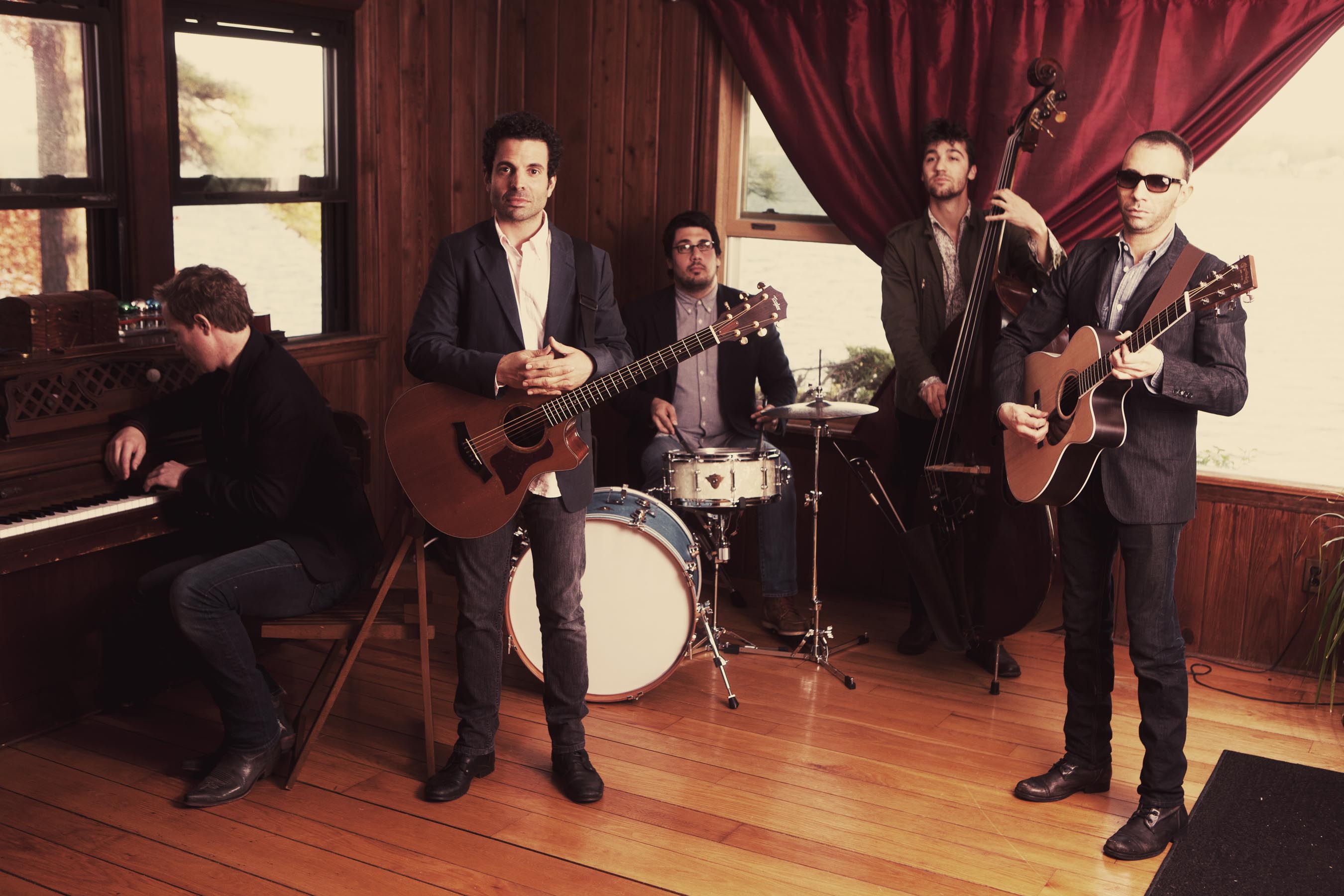
Back when I worked for a little indie newspaper in Los Angeles County, I had the incredible opportunity of interviewing the band Burlap to Cashmere.  They were one of my favorite bands at the time, making the whole experience of calling them up to chat — I remember I interrupted percussionist Scott Barksdale’s breakfast — and seeing them play live at Hollywood’s Key Club intensely exciting.  I was a real journalist, reporting on real stars!

I felt an immediate connection to Burlap to Cashmere.  The fast guitar, the earthy drumbeats, the yelps, the ethnic undertones — it was all so reminiscent of the Greek folk music I grew up listening to at family gatherings … and yet it was modern and lyrical too, preceding the whole indie folk rock movement.  The two founding members, cousins Steven Delopoulos and John Philippidis, were Greek like me.  Not only that, they were from New Jersey like me.  Their songs were poetry.  Their songs were full of Truth and Beauty and Love.

That was more than a decade ago, and they hadn’t put out an album since their Dove Award-winning Anybody Out There? (1998) until now.  Today, they release their new self-titled album.  The line up of the band has changed a bit, but Delopoulos, Philippidis, and Theodore Pagano are still in it.  The new album, Burlap to Cashmere, features songs like the heavily Greek-influenced “Santorini,” the sixties folk rock-sounding “Love Reclaims the Atmosphere,” and the hopeful and faithful “The Other Country.”  Watch videos here.

Hopefully, they’ll be at the Bitter End this summer!

My Material World Project: Hazelnut Eight O’Clock Coffee

18 Jul

The coffee at my office is undrinkable.  It’s not just that it’s often weak, it’s that it tastes like old coffee grinds.  Maybe I got a little spoiled from my previous job.  Prior to this job, I worked for a company that had an on-site chef, who often whipped up fresh juice combinations and smoothies in the test kitchen.  Even the employees’ kitchen was well-stocked with a wide variety of flavored coffees so I could select blueberry or cinnamon roll, depending on my craving.

I’m not a huge coffee snob.  I can enjoy a good cup of diner coffee.  But the coffee here just doesn’t cut it.  There’s a great Swedish coffee shop called FIKA, which I used to stop into on my way to work.  We Swedes know how to make coffee.  Lately, though, I’ve been making my coffee at home before I leave for work.  I’ve been taste-testing my way through different brands and flavors.  The last three bags, though, have all been what I grew up on:  Hazelnut Eight O’Clock Coffee.

My mom is a coffee fiend.  I don’t remember ever seeing her drink water when I was growing up.  It was always a hot cup of hazelnut coffee.  With the coffee machine always on, the kitchen had a warm, sweet smell to it.  To this day, the smell of hazelnut coffee relaxes me and makes me feel comforted.  It makes me feel close to my mom.

Since she lives in Greece and I live in New York, I don’t get to see her all that often.  Maybe it’s silly, but drinking the same brand and flavor that she always drank has made me feel a little closer to her these past few weeks.

This morning, as I was drinking a cup of horrid office coffee (it’s been one of those days when a single cup at home just isn’t enough…), I remembered a factoid I learned when I was reading up on Louie Psihoyos for the post I wrote on the photographer/film director and his efforts to save the whales: he was a major contributor to the UN-sponsored “Material World Project,” a traveling show of portraits of families around the world with their material possessions.  The above photograph is a shot of the coffeepot that my friend Mario gave me one year for Christmas (thank you!) and a bag of hazelnut Eight O’Clock Coffee that I took the other day.  The only thing missing is my mom.

Writing Wednesday: Memoirist Patricia Volonakis Davis on How Cultural Identity Changes after Marriage and Moving

13 Jul

Happily ever after wasn’t the case when first-generation Italian Patricia V.–as in Volonakis–Davis married a Greek national.  The author calls her book Harlot Sauce: A Memoir of Food, Family, Love, Loss, and Greece “a tragedy written as a black comedy,” in her interview with Jane Friedman for the article “How to Find a Direct Line to Your Readers” in Writer’s Digest.

In the interview, Davis alludes that her sense of self shifted when she experienced another culture:

…Harlot’s Sauce was about how being raised first generation Italian-American affected my worldview and attitude about myself, then how these both changed as a result of my marrying a Greek national and moving to Greece with him, in an attempt to save our failing marriage.

As a memoirist writing about identity and culture, I’ve often reflected on how being raised Greek American affected my worldview.  For me, though, it wasn’t just about being Greek–it was about being Other.  Or rather, being Something.  I wasn’t just plain Jane American.  My family did not come over on the Mayflower.  I was more than American.  I was Greek American.

However, I did not fully understand this until I moved to California.  I grew up in a pretty diverse town in New Jersey.  Most people were “ethnic.”  When I moved to California, I was suddenly surrounded by blonde-haired, blue-eyed, white Americans.  They weren’t white like I was white, though.  They were American.  Their family had been here for generations.  It was in moving that I came to a better understanding of who I am as a Greek American and who I am as someone who grew up in Northeast America.

I’ve never lived abroad, like Patricia Volonakis Davis did, but I did wander around Europe for about three months one summer, and I gained further understanding of my identity through these travels.  People were quick to make assumptions about my American-ness.  People didn’t really care that I was of Greek descent.  Being raised in America trumped ethnicity in terms of my identity.

It seems to me that identity is fluid.  Depending on where we are and who we’re “comparing” ourselves with, our identity can shift.

For women especially, identity changes with marriage.  Most women still take on their husband’s name, and our names signal a lot about who we are.  For instance, I saw the name Volonakis, and I immediately assumed the author of Harlot Sauce was Greek, even though as it turns out she’s Italian American.  And yet in some ways she became more Greek than I simply by virtue of living in Greece.

I wonder how many women become culturally Other to what they were raised as because of marriage?

Check next week’s Writing Wednesday for more on Patricia Volonakis Davis.

Gripster: Documentary Films, Dolphins & Pirates

11 Jul

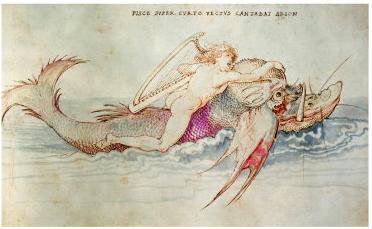
Arion Riding a Dolphin, by Albrecht Dürer (ca. 1514; public domain)

As I mentioned in yesterday’s post, Greek American photographer and film director Louie Psihoyos is the son of an immigrant from the Peloponnesus.  The Peloponnesus incidentally is where my immigrant family came from as well.  Whether it’s a coincidence or a matter of upbringing that Psihoyos was intrigued by dolphins, the Peloponnesus has a dolphin myth.

Arion, the poet who invented the song and dance (called the dithyramb) for the wine god Dionysus, was kidnapped by pirates while returning to Greece from Italy.  In an effort to save his life, Arion sang to the poetry god Apollo, before flinging himself off the ship.  His song attracted a pod of dolphins and one of them carried him to safety, bringing him to the sanctuary of the sea god Poseidon in Cape Tainaron.

A swashbuckling tale of pirates, wine, and poetry, you have to admit this is a pretty cool Greek dolphin myth!

It led me to study up on Cape Tainaron.  Also known as Cape Matapan, it is the southernmost part of mainland Greece.  It’s located in Mani, which reputedly has the world’s best extra-virgin olive oil, grown organically on mountain terraces, and is also known for its superior honey and syglino (pork with oregano, mint, and orange peel.)  There are also some stalactite and stalagmite caves, which are partly underwater, and can be visited by boat.

I’m putting Cape Tainaron on my to-do list for the next time I go to Greece.

For more on Poseidon, check out:::

Gripster: Portlandia, Hipsters, and Greek Myth

Gripster: 2011 Coney Island Mermaid Parade & Greek Mermaid Myths

Greek American Film Directory Louie Psihoyos Saves the Whales

7 Jul

Al Gore & co. made it trendy to go green in the millennium.  Back in the mid- to late-19980s, when I was growing up in a small suburb in northern New Jersey, America’s environmental concern was a little more specific.  We all wanted to Save the Whales.  In 1986 the International Whaling Commission banned commercial whaling.

For photographer and documentary film director Louie Psihoyos, that dream apparently never went away.  Psihoyos’ Oscar Award-winning film, The Cove, uncovers the all-too-real tragedy of dolphin hunting.  (Oceanic dolphins are part of the suborder Odontoceti, toothed whales.)

The film director more recently discovered that the Santa Monica sushi restaurant The Hump was using the meat of protected sei whales in their dishes.  Whale meat is illegal in the United States and was being imported from Japan, which is still a whaling nation (along with the Scandinavian countries of Norway and Iceland and the aboriginal communities of Alaska, northern Canada, and Siberia).  The meat was linked back to seafood vendor Ginichi Y. Ohira, who pled guilty for knowingly selling the whale meat for unauthorized purposes.  He faces arraignment in September.  As for The Hump, it closed its doors, saying:

The Hump hopes that by closing its doors, it will help bring awareness to the detrimental effect that illegal whaling has on the preservation of our ocean ecosystems and species. Closing the restaurant is a self-imposed punishment on top of the fine that will be meted out by the court. The Owner of The Hump also will be taking additional action to save endangered species.

One such action will be to make a substantial contribution to one or more responsible organizations dedicated to the preservation of whales and other endangered species.

It’s nice to know that photographer/film director Louie Psihoyos hasn’t given up the cause of saving the whales.

Psihoyos was born in Dubuque, Iowa, one of the oldest cities west of the Mississippi River.  (Note to self: today publishing is one of the fastest-growing industries in Dubuque, Iowa.)   He is the son of  a Greek immigrant who fled the communist occupation of the Peloponnesos region of Greece during World War II.

Check back tomorrow to hear the story of a dolphin myth from the Peloponnesus!

Follow Friday

1 Jul

Anyone have anything fun going on for July 4 weekend?  Don’t forget to invite me to your BBQs!

As we head into the long weekend, I thought I’d leave you with some links to explore:::

Having walked in on way too many people in bathrooms on planes, I would add Chuck Palahniuk’s “Choke” to the HuffPo’s list of 15 Worst Books to Read on a Plane.

Heading to Greece for your wedding?  Snippet & Ink’s Castaway inspiration board offers some bohemian chic ideas.

Speaking of travel… If I could travel back in time, I’d attend the literary party described in Lapham’s Quarterly.

Would you pay to attend a literary party or even just a reading?  The New York Times has an interesting article on the cost of events at indie bookstores.

Instead of bobbing for apples, try bobbing for olives at your next Greek party.

I’d love to hear from some crafty readers what they’d do with the pages torn out to make the lamp featured on Boing Boing.

It may be more lucrative to self-publish than to sign with a traditional publisher, according to this numbers-oriented article from Publishing Perspectives.