Archive | Greekish RSS feed for this section

Mapping Out Houses of Worship in NYC

24 Mar

Remember the other day when I mentioned that cute little restaurant Penelope?  Well, last Friday Penelope happened to be the opening setting of a New York Times article by Mark Oppenheimer, entitled “Mapping Religious Life in the Five Boroughs, With Shoe Leather and a Web Site.”  The article is about a Texas native named Tony Carnes, who moved to New York to go to The New School, where incidentally I’m enrolled in the MFA program, and who is, according to his website, “exploring the postsecular city.”

He’s mapping out every house of worship in the five boroughs of New York.  My immediate thought was: there are so many churches that make use of school auditoriums, bars, and ballrooms — how will he find those churches, if he’s driving around looking for church signs?  Well, apparently Carnes hears about those by word of mouth.

But he isn’t just mapping the city out.  He and his colleagues are telling stories.  Stories such as:

“The youth of Bethany Baptist Church put together a modestware fashion show in Jamaica, Queens called ‘A World of Difference.’ They follow a long tradition of fashion shows in African American churches.” —Fashion in Church, Jamaica, Queens

“Under the searing sun and stench of roadside garbage, a teenage Hispanic girl carrying a baby boy comes out of a door next to a church. Her tousled hair looked like she’d been up all night. The baby’s unwashed face was smeared with dirt; a diaper was the only thing covering his bare skin.” — Girl Power in Flatbush

“What church would get rid of its pews to make more room for feeding the poor? Surely, wouldn’t the pastor resign, the elders stomp out in exasperation, and the members hastily decamp for a properly pewed church? All that didn’t happen at a Lower East Side church ten years ago when it did just that…” —East Village church threw out its pews to make room for the poor

If you want to know about Greek Orthodox churches and Greek Pentecostal, there’s also an article posted on the census the nonprofit took in Astoria.

I love the way Carnes and his nonprofit organization are uniting houses of worship.  In a way, it’s kind of a blend of the way Burnside Writers Collective gives community and voice to people of varied Christian background (head’s up: check out my church hopping column tomorrow!) and Asphalt Eden illustrates various New York church’s unique personalities by listing events.

In another way, it reminds me of the exciting and noble work the Endangered Language Alliance, headed up by Dan Kaufman, Bob Holman, and Juliette Blevins, is doing, mapping out endangered languages in New York and working to preserve them.

For more on Carnes’ “Journey thru NYC religions” visit http://www.nycreligion.info.
φάε: Spinach & Kimchee Pies — My Childhood in Savory Pastry Form

14 Mar

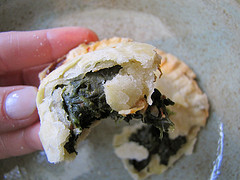
I grew up in a town in New Jersey that was heavily populated by Korean Americans.  You can imagine my delight then when I stumbled upon a kimchee variation of spanikopita.  It was like my childhood in savory pastry form!

On her ever-popular blog, Not Eating Out in New York, Cathy Erway tells how her friend inspired her to make spanikopita.  When she didn’t have any feta cheese in her fridge to make the spinach pie, she decided on a unique alternative: kimchee.  “I’ll take spicy, briny, tart pickled cabbage over feta this time,” she wrote.


Spinach & Kimchee Pie. Photo via Not Eating Out in New York. Used with permission.

For anyone who doesn’t know, spanikopita is the name of a Greek spinach pie that is made out of delicious layers of phyllo dough, spinach, feta cheese, egg, and onion.  This being the season of Great Lent, I should point out that there is also a vegan version that does not contain cheese.

Kimchee, meanwhile, is a popular Korean dish of fermented vegetables.  The main vegetable is cabbage but it could also have onions and cucumbers in it.  Kimchee is having its moment right now.  It’s being packaged up and branded to the foodie hipster crowd.  The brand Cathy uses in her recipe is her friend Kheedim Oh’s Mama O’s Kimchee, but I also discovered via Joy Deangdeelert Cho’s blog, oh joy!, the brand Mother In Law’s Kimchi, which I then stumbled upon at Whole Foods.

Cathy’s spinach & kimchee pies are not your yiayia’s spanikopita.  She combined the spinach and kimchee and folded it into pastry dough.  Get the full recipe and its health benefits on the Not Eating Out in New York blog.

The Quotable Greek: The Secret of Business

7 Mar

“The secret of business is to know something nobody else knows.”

~Aristotle Onassis


Gripster: Community’s Starburns Is “Creepy, Seems Greek”

7 Mar

Greendale Community College held an impromptu election for student government on the last episode of Community, “Intro to Political Science.”  As usual, Jeff scoffed at the idea and then, wearing a leather jacket and tight black jeans, used his lawyerly tricks to prove votes aren’t based on anything of substance.

Troy and Abed gave a rundown of the candidates, which included Starburns.  Describing him, Troy said, “creepy, seems Greek, possible drug dealer.”  The ethnicity on the screen shot shows: Cambodian.  This is right after they said another candidate changed his last name to get the Hispanic vote and right before they mentioned Jeff, whose ethnicity was listed as Northern European.  Mind you, the ethnicity of the ever-perky Annie is listed as “hot.”

Starburns’ given name, we find out via Troy and Abed’s campaign coverage, is Alex Osbourne.  So what gives with the “creepy, seems Greek” comment?  Well, in case you didn’t know, Alex “Starburns” Osbourne is played by Greek-American actor Dino Stamatopoulos.

Stamatopoulos was born in Norridge, Illinois, on December 14, 1964.  He attended Columbia College Chicago before becoming a writer for such shows as The Ben Stiller Show (for which he won an Emmy), The Dana Carvey Show, the Late Show with David Letterman, Late Night with Conan O’Brien, MADtv, and Important Things with Demetri Martin (another fellow Greek-American).  He also wrote the claymation episode of Community that everyone raved about: “Abed’s Uncontrollable Christmas.”

Pretty good for a guy whose Myspace page humbly says, “He’s also written and produced many of show business’ least-watched shows, but he doesn’t care.”  Oh, and according to said Myspace page, he’s got great taste in music.  He likes The Mountain Goats, Nick Cave, John Lennon, and The Magnetic Fields.

If you’re looking to get into screenwriting or comedy writing, you may want to study Stamatopoulos’ Emmy-Award-winning writing.

The next episode of Community will air March 17 and is entitled “Custody Law and Eastern European Diplomacy.”

30 Rock, Franzenfreude, and VIDA: Women Writers

1 Mar

Last week’s 30 Rock was an episode titled “TGS Hates Women,” a commentary on late summer’s “Franzenfreude” and the recent findings by VIDA that women writers don’t get as much attention as male writers.

When I look around the publishing house I work in and the classroom at the MFA program I attend, I see women.  Lots of them.  That’s not to say there aren’t any guys.  There are.  I see them in their windowed offices, I attend the lectures they organize, and I read the newsletters they write.  That isn’t to say there aren’t women in high-level, high-visibility roles.  There are.  But the percentage of men versus women in these upper-management roles is significantly skewed.

That’s why I wasn’t surprised when I read VIDA’s “The Count 2010.”

The short take is that men far outnumber women in getting published in lit mags and having their books reviewed.  I definitely agree with the commenters that the statistics are inconclusive without the facts of how many women versus men submit manuscripts. My editor friend Elizabeth sent me this follow up to the article, in which the editors responded to the criticism that their publications don’t publish an equal ratio of women to men.

Part of the problem is that women do not submit to well-known, “gender-neutral” publications at the same rate as men.  A few months ago, I went with my writer friend Jane to hear Lorrie Moore (Birds of America) talk with fiction editor Deborah Treisman at the wonderfully designed (hello, tilting fish-tank!) (le) Poisson Rouge for The New Yorker Festival. One of the comments that stuck out the most for me (Elissa Bassist, with whom I took class taught by Susan Shapiro, offers further notes on The Rumpus) was that men more often than women submit stories to The New Yorker, which is why men, more often than women, get published in The New Yorker.

I am a feminist, not a whiner.  I don’t believe in railing against the injustices of this or that without actually doing something positive to enact change.  Dialogue itself is useful but dialogue without action is meaningless.  It reminds me of the whole Christian debate of faith versus works, which is solved quite eloquently by the phrase “faith without works is dead.”  In other words, we can talk until we’re blue in the face about how more women should be published but unless more women are submitting quality work and unless more women are studying and working hard to become editors and unless we get over the silly notion that matters of politics are for men and the world at large and matters of domestic life are for women exclusively then all our philosophizing is for naught.  (Yes, I just said “for naught.”)

Women, if you want to be taken seriously as writers and if you want to get published then study writing, write, revise, and submit to publications!  Aim high.  If you get a rejection, try to find out why.  Then find another publication that you believe is a good fit for your writing style (remember there’s a huge difference between Cosmo and The Times) and submit.  Take classes, form writing groups, seek out professional freelance editors, and work on your craft, continually submitting high-quality work.  Make your writing so good they can’t say no!

Let’s not end up like Elaine Mozell in Meg Wolitzer‘s The Wife. Let’s look at the example Tina Fey set by becoming the first female head writer of Saturday Night Live.   And wouldn’t you know it, she’s a Greek!

Cartoon Crush

14 Feb

“You know, guys, sometimes I wish we were cartoon teenagers.”

~ Fez on That 70s Show


In honor of Valentine’s Day, I thought it would be fun to share my cartoon crushes.

Maybe back in ancient Greece, girls got all dreamy-eyed listening to myths about Hercules, but growing up in suburban New Jersey I got crushes on cartoon characters.  It wasn’t the Prince Charming type that I was into, though.  No, I liked them a bit scrappier–and wearing green tunics.

Peter Pan was one of my early cartoon crushes.  Wendy, Tinkerbell, Tiger Lily, and all the mermaids swooned over him, and I could understand why.  He was a real charmer, always flirting with one girl after the other.

My other big cartoon crush was Link from The Legend of Zelda.  On Fridays, instead of The Super Mario Bros. Super Show!, The Legend of Zelda aired on tv.  Like Peter Pan, Link was sarcastic and flirty.

That’s why I was so excited when my friend Sue sent me this link to The Legend of Zelda: The 80s Teen Movie.  If John Hughes made a film about Zelda, this is what it would look like.

Speaking of video games, if you haven’t seen Brothers Mario yet, check out Brothers Mario.

Also, Laura Vanderkam (168 Hours: You Have More Time Than You Think) wrote a telling article awhile back called “The Princess Problem.”


Who are your cartoon crushes??

Σ’αγαπώ: I love you

14 Feb

As a sea captain, traveling the world, my dad picked up words and phrases in many different languages.  “I love you” seems to have been his phrase of choice.  He can say it in practically every language.

Wouldn’t it be nice if the phrase everyone around the world wanted to learn how to say in different languages was “I love you”?

*  *  *

My dad spent some time docked in Japan when he was young, and he was always particularly proud of his ability to profess his love in Japanese.

A few years ago, I traveled to Tokyo and visited the adorable cafe in the pictures above.  The decorations were all heart-shaped and even the foam of the latte was spun into a heart.  Yum!

*  *  *

In Greek, the way you say “I love you” is: Σ’αγαπώ, pronounced s’agapo.

*  *  *

Happy Valentine’s Day!

Feta Salsa

10 Feb

These days it’s all about eating simply.  Dashing between work and class, there are at least two days a week that I eat all three of my meals on the go.  Class doesn’t let out until 10:30 pm, and if I get out a little early I try to pop in Whole Foods to pick up some food since it’s on my way to the subway.

The other day I was in Whole Foods, picking up an orange, pumpkin muffins with actual pumpkin seeds on the tops (double yum!), and soup mix (cut-up fresh veggies that I actually use for stir-fry not soup), when I saw something new: feta salsa.

I eat a lot of pita and hummus and pita and tabouli.  I haven’t gotten sick of it yet, but the idea of something new to put on my pita got my attention.  Unfortunately, I couldn’t justify the price.  It was about $3 more than the hummus.  That might not sound like a lot, but I could buy three Wet ‘n Wild nail polishes for that price or stamps to mail a handwritten letter to a friend.  So, I was quite thrilled when I stumbled upon this feta salsa recipe from Smitten Kitchen.

I’m figuring I could make a batch of it on a Sunday and eat it all week long for lunch.

Feta is one of those cheeses that I love and that makes me feel homesick/festive (my family always ate it at holidays), but that I never really purchase on my own.  I’m not quite sure why.  Maybe because it’s such a distinctive cheese.  I do enjoy it, though, and this feta salsa recipe is a great way to jazz up my lunches.

If you have any tips on quick lunches, leave it in the comments section below.

The Quotable Greek: Change the Eyes

8 Feb

“Since we cannot change reality,

let us change the eyes which see reality.”

~Nikos Kazantzakis


Hello, Carnival; Good-bye Meat

7 Feb

The Carnival season won’t start until next month in Catholic countries (Mardi Gras isn’t until March 8), but the Carnival season in Greece kicks off on February 12 and will run until March 6 this year.  The dates are different but the significance is the same.

The dates differ for the Roman Catholics and Eastern Orthodox because of two things: Firstly, Catholics use the Gregorian calendar, while Orthodox use the Revised Julian calendar.  Secondly, for Catholics, Lent begins on Ash Wednesday, while for Orthodox, Lent begins on Clean Monday.

The concept behind Carnival for both denominations is the same, though.  Carnival marks a season of revelry before Lent begins.  Lent is the forty-day period before Easter when Christians prepare for the crucifixion and resurrection of Christ by fasting and other means.  Since certain foods cannot be eaten during Lent and would spoil before the forty days are up, they had to be eaten ahead of time.  According to some accounts, this resulted in gluttonous parties in the days leading up to Lent, a season we now celebrate as Carnival.

In Greece, Carnival is known as Apokriés (Αποκριές), which literally translates to “saying goodbye to meat.”  Each week there are different celebrations to say good-bye to the favorite foods we’ll be giving up.

2011’s Key Carnival Dates for Eastern Orthodox:

Triodion: Sunday, February 12th
Tsiknopempti or “Burnt Thursday”: February 24th
Tsiknopempti Weekend: Friday, February 25th – Sunday, February 27th
Main Carnival Weekend: Friday, March 4th – Sunday, March 6th
Clean Monday: Monday, March 7th

Just as in other Carnival celebrations around the world, Greeks celebrate Apokriés with parades, floats, and wild masks.