Archive | Greekish RSS feed for this section

2013 Greek American Fashion Week Overview

18 Sep

G1


Mercedes-Benz Fashion Week just wrapped up in New York City, and with it came the second—and highly anticipated—Greek American Fashion Week!

Greek American Fashion Week is presented by the Greek America Foundation, which was founded by Gregory C. Pappas to “promote, preserve and perpetuate the Greek culture, history and heritage in North America,” and the Committee for Fashion & Design was founded by Taso Pardalis and Maria Pardalis. Greek American Fashion Week is “a platform for talented, emerging, and established Greek and Greek-American designers to showcase their creations.” Some of the proceeds from the event go toward an annual scholarship to a Greek American student who is studying fashion design.

The runway show was held on Friday, September 6, at Studio450:

Studio450 is a penthouse duplex loft encompassing the 12th floor, enclosed rooftop room and rooftop terrace of 450 West 31st street. Located in the Hudson Yards, the penthouse features an all white room surrounded by large wrap around windows. The rooftop features a glass room and wrap around outdoor terrace. Both the penthouse and rooftop allow for stunning 360 degree views of New York City and the Hudson River.

On the left is Maria Pardalis, the host of Greek American Fashion Week. Doesn’t she look fabulous?! Her heels are killer.

g3

Fashionistas, models, and those in-the-know mingled at the show.

g4

g5

g6

Loi—the New York City owned by superstar chef Maria Loi—offered a delicious spread of mezze that included spanikopita and tiropita. Cocktails like “the Greek Greyhound” and a selection of wines were provided by Ya Mastiha and Nammos.

Here are Maria and Taso Pardalis with designer Timothy George at the start of the runway show. Timothy George showed his exquisite collection last year (see my coverage here), and this year came back as a mentor.

g2

The 2013 Greek American Fashion Week runway show presented the Spring/Summer 2014 collections of:

Hair was done by Curlisto.

I’ll be featuring each one today on my blog so check back soon!


Never Forget

11 Sep

In remembrance of September 11, here is the Church Hopping post I had done on St. Nicholas Church at the World Trade Center.

The Quotable Greek: I’ve Never Had the Right Words to Describe My Life

9 Sep

“Emotions, in my experience, aren’t covered by single words. I don’t believe in “sadness,” “joy,” or “regret.” Maybe the best proof that the language is patriarchal is that it oversimplifies feeling. I’d like to have at my disposal complicated hybrid emotions, Germanic train-car constructions like, say, “the happiness that attends disaster.” Or: “the disappointment of sleeping with one’s fantasy.” I’d like to show how “intimations of mortality brought on by aging family members” connects with “the hatred of mirrors that begins in middle age.” I’d like to have a word for “the sadness inspired by failing restaurants” as well as for “the excitement of getting a room with a minibar.” I’ve never had the right words to describe my life, and now that I’ve entered my story, I need them more than ever. ”

~Jeffrey Eugenides

Photos from the Greek American Fashion Week Kick-Off Event

6 Sep

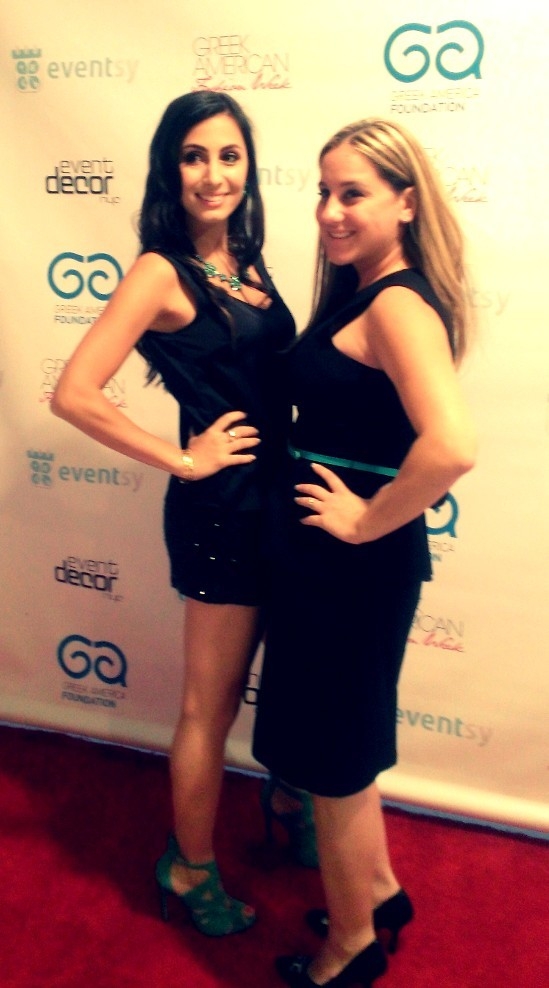
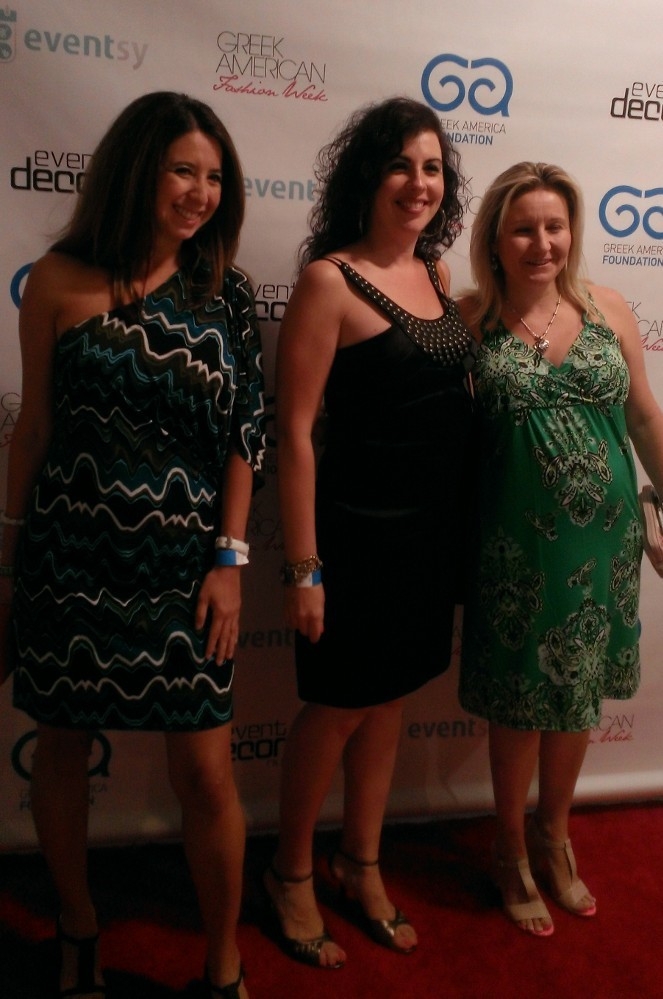
I’m about to head out to the Greek American Fashion Week Runway Event, so I’m leaving you with a few photos I snapped at the Greek American Fashion Week Kick-Off Event that was held on Wednesday night at the Lower East Side’s lush rooftop bar The DL.

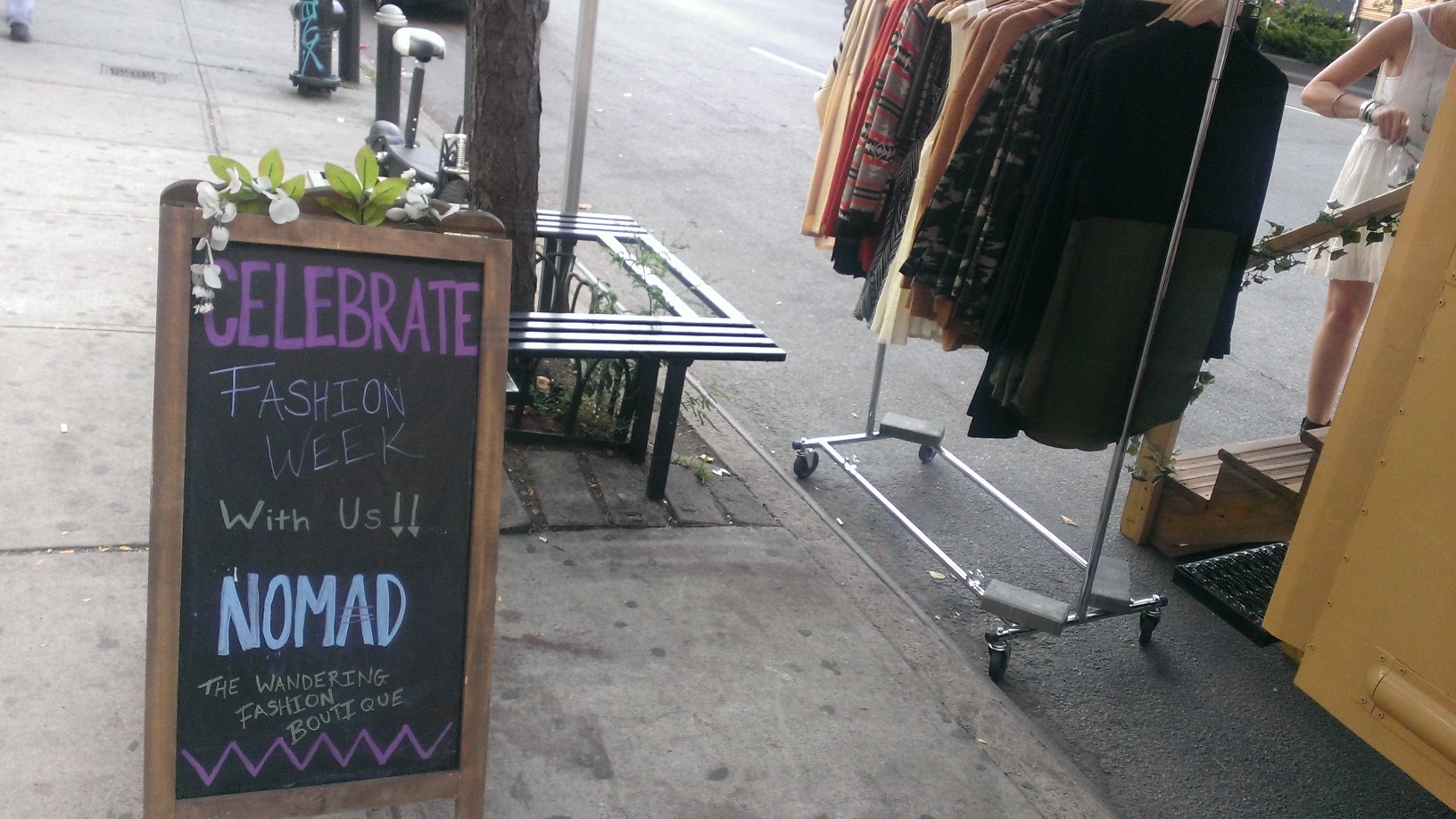
Parked outside was the aptly named Nomad truck, “the wandering fashion boutique” … and you know my obsession with sweet rides.

WP_20130904_005

WP_20130904_006

WP_20130904_007

The rooftop of The DL was turned into a pop-up shop with fashion by the likes of Dani Djokic and Panda Rhand.

WP_20130904_009

WP_20130904_008

WP_20130904_011

In case you’re wondering, I wore a black shift with buttons down the side to the kick-off event. My hair was in a low side bun. I had neutral eye makeup with strong brows and dark, berry lips, inspired by Michelle Williams and Emma Watson.

Lomogram_2013-09-04_09-15-27-PM

I felt like I was at my house in Greece with all the palm trees on the rooftop!

WP_20130904_015

WP_20130904_019

WP_20130904_016

Pizza was provided by Patsy’s (so good with that fresh basil!) and dessert by A2 (the peanut-butter cupcakes were to die for!).

Lomogram_2013-09-04_09-20-54-PMIn full disclosure, the organizers of the Greek American Fashion Week invited me to cover the Greek American Fashion Week events.


Nikolopoulos Revives Homer’s Poetic Language

26 Aug

logo

The National Herald featured me! In the article, I talk about “dead” languages, that great Greek roadtripper Homer, and Scripps College.

Coming Soon: Greek American Fashion Week

22 Aug

GAF

Last year’s Greek American Fashion Show was so inspired that this year, they’re putting on an entire WEEK for Fashion Week:

The Greek America Foundation is hosting “Greek American Fashion Week” September 4-8, 2013 with events taking place throughout New York City.  The week culminates in a Greek American Runway Show at Studio450 and after party at Meli Restaurant on September 6, 2013.

Greek American Fashion Week events include “Greek Fashion’s Night Out” and multiple cocktail hours at venues such as Anassa Taverna. At the main runway event, guests will be dazzled by cutting-edge fashion designs with Greek and American entertainment, a high-end silent auction and gift bags to cap off the evening. All events showcase emerging and established North American fashion designers of Greek descent in an effort to help them forge relationships with those in the fashion industry, assisting them with advancement of their careers.

In addition, renowned menswear designer John Varvatos will be honored with an award for his exceptional contribution to the fashion industry.

A host of supporters and friends will be on hand for the weekend events, including several prominent members from the fashion and retail industry as well as celebrity fashion bloggers.

Proceeds from this program will benefit the programs of the Greek America Foundation, with a particular focus on the creation of a scholarship for a student pursuing fashion design. The Greek America Foundation is a 501(c)(3) non-profit organization dedicated to promoting, preserving and perpetuating the Greek culture, history and heritage in North America.

Tickets will go on sale August 12, available for purchase from the Greek America Foundation’s website (www.greekamerica.org).

More details to be released soon! For additional information, please visit http://www.greekamerica.org/projects/greek-american-fashion-week/.

Who’s coming with me?!

The Light and Life of Greek American Neon Artist Stephen Antonakos (1926–2013)

19 Aug

I learned via Gregory Pappas, founder of the Greek America Foundation, that artist Stephen Antonakos passed away this weekend. I had the great privilege of attending an exhibition of Antonakos’ neon sculptures at the Lori Bookstein Fine Art gallery here in New York City when the abstract artist was honored for the Gabby Awards Lifetime Achievement Award. You can read about that here. Antonakos attended the event, and I remember him being a quiet, humble artist. Yet his work speaks volumes.

Captivated by the neon lights of New York City, the Greek immigrant—Antonakos moved to the US when he was four years old—the artist began incorporating neon into his art in 1960. In an interview with Zoe Kosmidou, he explained the symbolism—or lack thereof—in his neon work:

My forms do not represent, symbolize, or refer to anything outside of themselves. Such specific correspondences would limit the work’s meaning, whereas pure abstraction, liberated from any external references, is capable of saying so much more. My neons relate formally to architecture and space, but they do not represent anything outside themselves.

Even so, raised in the Greek Orthodox Church, the artist’s work did have spiritual subtext. He created crosses and “chapels.”

Earlier, in the mid 1950s, Antonakos was creating collages. In a 2007 interview with Phong Bui for The Brooklyn Rail, Antonakos said:

And since oil painting was too slow for me to keep up with all of the ideas that were racing through my mind, I felt the physical and spontaneous process of putting various objects together was more suitable to what I needed to get done in those years.

His desire to work fast, engage in a spontaneous process, and collage disparate found objects together resonates with the postmodern aesthetic. We hear the same vision in the works of the abstract expressionist painters and the Beat Generation writers. Antonakos revealed that although he admired the work of the abstract expressionists, he felt he could “get more out of” the Italian artists Alberto Burri and Lucio Fontana.

Antonakos went on to have more than 100 solo shows around the work.

For artists of any discipline, one of the great takeaways from Antonakos’ life is that one can have a day job and still be an artist as long as one perseveres. Antonakos worked as a pharmaceutical illustrator during the day and then would work in his studio until 2 in the morning.

Here are a couple of links to celebrate the life and work of this inspired artist:

The Great Valhouli Fauxlore: Atlantic Uncovers Truth Behind Kerouac-Burroughs Fight

9 Aug

No5

Those of us who devote our time studying the life and work of Jack Kerouac and yet who simultaneously spend a lot of our time on Facebook already called “hoax” on that photograph that was being circulated around about a plaque on how Kerouac and William S. Burroughs got into a drunken fight over the Oxford comma. I assumed it was a digitally manipulated photograph. As it turns out, though, it has a fascinating back story. Alexis C. Madrigal uncovered the truth behind the plaque — which actually exists — in the story “Facebook Fauxlore: Kerouac, Burroughs, and a Fight Over the Oxford Comma That Never Was” in The Atlantic.

It’s a great piece — minus the odd portrayal of the Greek American behind the plaque. But we’ll get to that in a minute.

Hot on the trail of something fishy, Madrigal contacted sources Paul Marion; The Morgan Center; Martha Mayo, head of the Center for Lowell History; and Tony Sampas. Marion, author and employee at UMass Lowell Center for Arts and Ideas, had seen the plaque and knew that it was created to promote Mill No. 5 at 250 Jackson Street in Kerouac’s hometown of Lowell, Massachusetts.

Marion referred Madrigal to Ted Siefer’s article “Mill No. 5 brings transformation to Lowell” in The Boston Globe, which explained that developer Constantine Valhouli, with business partner Jim Lichoulas III, was transforming the former textile mill into an office building:

with a kind of fun-house brio to attract the eclectic, off-beat, and hip: boutique movie theater, yoga studio, farm-to-table restaurant, a lounge/library in the style of an English manor — the whole thing decorated with architectural materials salvaged from the likes of Dr. Seuss’ house.

It would appear that Valhouli ascribes to the same Beat philosophy of improvisation as Kerouac. Siefer says:

Valhouli likens the development of the project to how jazz musicians build a song. “We’ve not built from a plan,” he said. “You play a theme, and you just keep playing improvisations over it.”

Madrigal points to the pivotal paragraph in The Globe story for proving the plaque is a fake:

And there, in the 13th paragraph, was proof that we were looked at a false sign: “Inside the entry hall will be a reconstructed early 19th-century New England schoolhouse,” the Globe wrote, “an exhibit that will be part of what Valhouli calls the Lowell Atheneum [AHA!], which will also feature a collection of hand-painted pseudo-historical plaques from New England history [DOUBLE AHA!].”

Madrigal, who went on to interview Valhouli, then explained that Valhouli and Lichoulas thought up the idea of creating “a series of plaques commemorating events that never happened” to support Mill No. 5. They hired Ould Colony Artisans‘ Robert and Judy Leonard to paint the plaque by hand. The artists had created many other historical signs in the Massachusetts area.

I found Madigral’s investigative reporting enthralling.

Still, I was put off by this aside:

I had to get in touch with this Valhouli character, who was, no doubt, swirling his mustache near some railroad tracks looking for damsels.

Okay, I’ll concede that Constantine Valhouli certainly sounded like a “character” for faking people out — although I’m not sure we generally refer to conceptual artists or those who come up with brilliant marketing schemes as “characters.” Instead, I think we tend to use terms like “inspired” and “business-savvy” to describe people who manage to get others talking about their work. A quick look at Mill No. 5’s Facebook page, and the tongue-in-cheek branding is evident:

We’re working on the bathrooms at Mill No. 5 today. Which made us think of the central question of paleontology:
Q: Why can’t you hear a pterodactyl go to the bathroom?
A: Because the P is silent.

Brilliant Subway Panhandling Prank Flips the Script

Hahahahahaha. This. Oh this. The Hipster Logo Design Guide.

But there was “no doubt” in Madrigal’s mind that Valhouli had a mustache and that he swirled it, like some sort of old-timey Western villain? Is the mustache assumption because he’s Greek American or because The Boston Globe article referred to his work as “Disneyland for hipsters”? Where did the leap from real-estate developer to someone who hung out at a train station get made? Was this supposed to tie him closer to Kerouac — or make him sound like some sort of train-hopping hobo? He was out “looking for damsels”? What??

With today’s access to personal information on the Internet, it took only seconds to find Valhouli’s LinkedIn page, and — unless it too is a hoax — discover he (fittingly) received his BA in English and fine art from Georgetown University, where he went on to get his MA in interactive technology. From there, he got his MBA from Columbia University’s Business School. He received the Charles G. Koch Fellowship and was a Peter Agris Fellow. He did equity research for Morgan Stanley and was director of business development for Incogniti before becoming principal at The Hammersmith Group, which describes itself as “a boutique strategy consulting firm with concentrations in real estate and technology.” His LinkedIn summary reads, in part:

Constantine has been featured in the BBC, Businessweek, CNN, Forbes, Fortune, Newsweek, and the Wall Street Journal. He has guest lectured at Columbia Business School, MIT, New York University, and has served as a panelist on internet industry events and at the U.S. Department of State.

There wasn’t a profile picture to verify him peeking out of a train tunnel to leer at women. The Atlantic has created its own “fauxlore” about Constantine Valhouli. Oh, how the tables have turned.

* * *

This post has been updated to correct the publication to The Atlantic.

The Quotable Greek: Words Have a Longer Life

5 Aug

Words have a longer life than deeds.

~ Pindar

You may also enjoy:::

Pindar Pythagoras Wine

Photos from the 2013 New York City Poetry Festival

31 Jul

Po2

Po1

po3

po4

po5

I feel incredibly honored to have been invited to read at the 2013 New York City Poetry Festival. I had such a blast hearing so many great poets read at last year’s festival, and it never occurred to me that just a year later I would be joining them on stage. I have poet RA Araya to thank for continually supporting my writing. He invited me to read Homer in the ancient Homeric Greek and from the literary biography I’m coauthoring with Paul Maher Jr. entitled Burning Furiously Beautiful: The True Story of Jack Kerouac’s “On the Road,” so I read two road trip pieces.

For my Homer selection, I chose the opening passage from The Odyssey. Growing up in the Peloponnesus, my father had to memorize part of the epic poem in school. To this day, he still can recite the lines! I studied Classical Greek at Pomona College (while a student at Scripps), which is different than Homeric Greek. We never really read aloud in class because it’s a “dead” language, one that is no longer spoken but read by scholars. There are debates about how ancient Greek dialects were spoken, as the pronunciation is, according to some scholars, different than modern Greek. I am therefore definitely not adept at reading in the ancient tongue, but if someone asks me to read something specific, I do my best. Fortunately, there are many great English translations of The Odyssey out there too!

It was a no brainer to choose one of the passages about poetry from Burning Furiously Beautiful. In telling the story of the making of the novel On the Road, it was important that the literary biography also explored Kerouac’s poetry and his friendship with other poets. Although he is mainly remembered as a novelist, Kerouac wrote poetry throughout his life, including the period when he was on the road. There’s a really strong section in the book about how Kerouac and Allen Ginsberg influenced each other’s writing, and I wanted to read that, but in the end I found a passage in Burning Furiously Beautiful that seemed to better encapsulate the mood of the Poetry Festival. In the passage, Kerouac has been walking along the highway, hitchhiking, and finds himself composing a poem about everything he sees around him. It reminded me of how out on Governors Island we were all a bunch of writers lofting in the grass and translating the world around us into poetic language.

I read directly after RA, who opened up the event with his famously short-but-sweet poem, and then came Hillary Keel, Sarah Sarai, Carmen Bardeguez-Brown, Kate Levin, Carlos Manuel Rivera, Sparrow, Bonafide Rojas, and Keith Roach. They were amazing! Seriously. Hilary read in German and a couple of the other poets read in Spanish, and I suspect our reading—under the name Miguel Algarin’s Brooklyn Poetry—was the most linguistically diverse at the Festival. I had traveled over the Governors Island with Kate, and I think this was her best reading yet. In addition to poetry about Manhattan and our value as people, she read from her punk novel, which I would’ve thought was a poem if she hadn’t said otherwise. I always enjoy hearing Sarah read, and in particular enjoyed her poem about meeting an angel at a bus stop. The poet who had me in stitches, though, was Sparrow. I’d heard him sing at RA’s birthday party last year, and I loved hearing his one-liner poems this time around.

Special thanks too to our stage manager Liz von Klemperer, who did an excellent job. There were a lot of volunteers who kept the entire event running smoothly. The New York City Poetry Festival is put on by The Poetry Society of New York and is organized by Stephanie Berger and Nicholas Adamski. For the full lineup of the two-day event, check out NYCPF 2013.

I also want to thank my family and friends who trekked out to the island—some coming from as far as Jersey and Brooklyn—to support my reading. The photos here were taken by Leslie Marks, except the last one which is a self portrait. For more photos of me and all the other amazing poets, check out asterix611’s flickr.