Archive | Writing RSS feed for this section

Writing Wednesday: Thrown in the Deep End

20 Apr

One of the big MFAisms is: “Start with the action.”

As a journalist, I understand the importance of strong titles and hooks.  You need to entice the reader, draw him in.  I don’t believe, though, that the hook and action are synonymous.

As a reader, I feel flung into the deep end of a cold swimming pool when a story starts with the action.  I splash around trying to figure out where I am and where I can find some solid ground.  Once on dry land again, I feel like I was needlessly jerked around.  I would’ve loved to swim around, but I prefer to stick my feet in first, test the waters.

I felt relieved then when I read Jane Friedman’s article “The Biggest Bad Advice About Story Openings” on her Writer’s Digest blog There Are No Rule.  Friedman states that an opening with lots of action and little characterization, “Delivers a stereotypical crisis moment that’s full of action or pain, but without a center.”

Isn’t that so true?  Doesn’t it seem like all action stories are the same?  The reason action matters in any type of story is because we are intrigued by the characters.

What are your feelings about starting a story with the action?  What does a great hook look like?

David Foster Wallace Appreciation Project

15 Apr

The folks over at Broadcastr asked me to participate in the David Foster Wallace Appreciation Project.  I’ve written a little bit about Wallace here on the blog as well as over on Burnside (also, check out my BWC editor, Jordan Green’s, piece on Wallace), so I was really excited to be part of the David Foster Wallace Appreciation Project on Broadcastr.

For anyone who doesn’t know, David Foster Wallace‘s novel The Pale King comes out today.  This highly anticipated book is being published posthumously by Little, Brown and Company.

Broadcastr is compiling stories from fans to celebrate the release of The Pale King.  In my appreciation story, I talk about resisting and embracing David Foster Wallace’s style in my own writing.

And when I say “talk,” I mean it literally.  Broadcastr is a social-media platform that collects audio stories.  Last year I was working on curricula for a documentary that involved oral storytelling so I was really intrigued by the idea of contributing audio.  I’ve done a live reading here or there, but this is the first time I’ve ever done a recording.  I hate the sound of my own voice when I hear it on answering machines so I was a bit hesitant, but in the end I really enjoyed the experience of recording something I’d written.  It was a whole new way of viewing a story.

The name of my Broadcastr post is called “Accepting and Rejecting the Influence of David Foster Wallace.”  I hope you’ll check it out and let me know what you think!

Abstract Expressionist New York @ MoMA

8 Apr

As I mentioned, I recently went to the MoMA thanks to the generosity of a friend of mine.  One of the reasons I’d been wanting to go was to see the Abstract Expressionist New York exhibit that’s running through April 25.  The writers of the Beat Generation used to hang out in bars with the abstract-expressionist painters, so I’ve been fascinated by how the literature and visual arts of the 1950s have influenced each other and have done some writing on the subject.

I like this line that was posted on one of the placards in the museum:

With a grave intensity and sense of responsibility the Americans who would later become known as the Abstract Expressionists set out to make art that would reassert the highest ideals of humankind.

It reminds me of how Jack Kerouac said that “beat” stemmed from the biblical beatitudes.

Writing Wednesday: Greek Stereotypes — If You Can’t Beat ‘Em, Join ‘Em … Or Something Like That

6 Apr


“Stereotype” is a dirty word.  Stereotypes of ethnicities and races come with all sorts of negative connotations—the types of assumptions that are too dangerous to even give examples of, but you all know what I’m talking about.

I remember years ago learning that even “positive” stereotypes are negative.

Really?  How can that be?

I’ve been stereotyped.  Because of my last name, people make all sorts of assumptions about the literature I read and the language I speak.

“Did you read the new translation of The Odyssey?”

“Can you tell the class how to pronounce this Greek word?”

“I can’t remember who the god of wine is.  Stephanie, who was it again?”

If it happened once in a blue moon, it wouldn’t be a big deal.  But it happens often enough that it’s at times made me insecure in my identity.  Should I know that there’s a new translation of Homer’s epic poem?  What does it say about me that I don’t know?

Sometimes it works to my advantage, though.  I’ve received opportunities to write about Greek things by virtue of my ethnicity.  That is a positive, but it is also a negative.  Is that the only reason I was selected?, I can’t help but wonder….

“Why do you write about Greek things?” my mom, who is not Greek by blood, asked me.

My lit teacher has a theory that literature is reparative.  We write to rectify, to make ourselves whole.  She may be right.  I write about Greek things because I don’t feel as Greek as others seem to think I should—which makes me think I need to feel more Greek—and my writing seeks to explain, to justify, even to rectify.

Also, I figure if I can’t beat ‘em, join ‘em.  People have been making stereotypes about my interests and knowledge of Greece for decades.  That’s not likely to change.  The stereotyping comes from a good place: people love Hellenic history and Greek culture.  Why not give the people what they want?  After all, I like Greek culture too, even if I don’t always know as much about it as some people assume I do.

A Chat with My Editor Brings Exciting News

1 Apr

Had a great chat with my former editor last week.  He told me about some great events at Cornelia Street Café;  I told him about a reading by a political prisoner I attended at The New School.

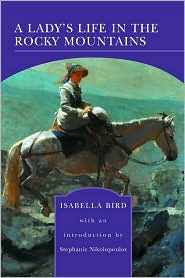
He also let me in on some exciting news::: the ebook edition of A Lady’s Life in the Rocky Mountains—letters by Isabella Bird, introduction by yours truly—is currently one of his bestsellers!


Obviously, I’m happy on a personal and professional level, but I’m also happy because Isabella Bird’s story is so beautiful and inspiring and it deserves a wider audience.  The short of it is that Bird left the comforts of home in Victorian England to travel by herself through the rough terrain of America’s Rocky Mountains.  As I wrote in my introduction to the book, “Whether you’re interested in nature, the history of the Rocky Mountain region, travel writing, Christianity, or women’s studies, Bird’s simple yet provocative letters will entertain your imagination.”

I’d say that’s worth the $1.99 for the nook book!

Writing Wednesday: Who Is the Patron Saint of Your Writing?

23 Mar

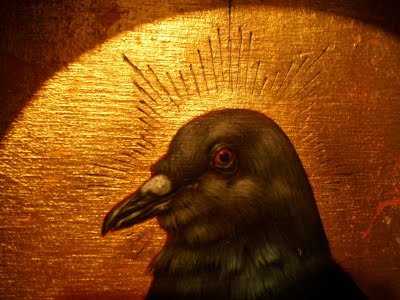
Detail of Turf One's painting "Holy Ghost."

“Who is the patron saint of your writing?” my lit instructor inquired.

I’m taking a class that looks at how classic works of literature inspire contemporary works.  We look, for example, at how Evan S. Connell’s Mrs. Bridge informed Meg Wolitzer’s The Wife.  It seems natural that great authors would inspire other great writers to write either in the same style or the same theme.  And yet, my instructor’s question has had me thinking for days.

I’ve never thought of my own writing as being inspired by another writer.  I don’t try to write like my favorite authors, though I’m sure I must’ve done it subconsciously many times.

In a way, this rejection of sameness is reflective of my life in general.  I was the English major in undergrad who hung out with all the premed students.  I was the Greek kid in middle school with all the Korean and Japanese friends.  It never occurred to me to hang out with people who had my identical interests and culture, and it never occurred to me to try to write like another writer.

Except maybe Gregory Corso.

When I was 22 I wrote an homage to Corso’s “I Am 25.” It was pretty much a rip off of Corso’s poem, but it was meant to be.  Corso writes about stealing the poems of Shelley, Chatterton, and Rimbaud, and I more or less swapped out the names of these “old poetmen” for those of Corso, Kerouac, and Ginsberg.

Along those Beat Generation lines, one of my favorite writers is Jack Kerouac.  Read these lines from On the Road:

“Soon it got dusk, a grapy dusk, a purple dusk over tangerine groves and long melon fields; the sun the color of pressed grapes, slashed with burgundy red, the fields the color of love and Spanish mysteries.”

“The one thing that we yearn for in our living days, that makes us sigh and groan and undergo sweet nauseas of all kinds, is the remembrance of some lost bliss that was probably experienced in the womb and can only be reproduced (though we hate to admit it) in death.”

It pains me how beautiful these words are.  While so much has been made of Kerouac’s subject matter and improvisational style, I find that it is his lyrical descriptions and, yes, the rhythm of his prose that captivate me the most.

I have zig-zagged across the country, visiting places Kerouac visited, and I’ve written short travel articles, but I don’t write road-trip novels.  I would like very much to write about America, though.  I’ve written about Kerouac, sure, but I haven’t (consciously) attempted to write in his style.  I love punctuation rules too much.

I would probably choose Jack Kerouac to be the patron saint of my writing, but in reality, my writing voice comes out more like Sue Monk Kidd or, as my mom has pointed out, Donald Miller and Anna Quindlen.

Others tell me to read David SedarisHe’s Greek!  He writes about his family! And indeed, I do see his humor sometimes creeping into my personal essays.  One time, right after reading David Foster Wallace’s Consider the Lobster, I will confess I conjured up his style for an article I wrote, but I fear that was only similar to off-key humming of a song that just played on the radio.

Must I choose just one patron saint?

I admire great writers, and I love to reference them and turn other readers on to them, but I don’t think I could ever choose just one to be my patron saint.  I’m way too much of a schizophrenic writer for that.

Who is your patron saint of writing?

Biggest Advice for… English Majors

22 Mar


I’ve received a lot of emails lately from students at my alma mater, Scripps College, wanting to know how I got started in book publishing and what advice I have for them.  I’ve been responding to emails individually but I thought it might be helpful to do a series of career-advice posts in addition to my regular Writing Wednesday posts here on the blog.

As with all my posts, this is simply my opinion.  There are a lot of great books, articles, and career counselors who can set you on the path to choosing and establishing your career.  I’m offering my perspective because it’s been requested and because sometimes it’s helpful to hear personal experience, but it’s by no means the only advice and methods available.

First up in this series is my biggest advice for English majors.


Congratulations!  You’ve decided to become an English major.  An English degree is incredibly versatile.  It can be applied to such exciting fields such as book publishing, journalism, teaching, writing, law, and so much more.  You need to know how to write and comprehend the written word in practically every job, whether you’re writing your cover letter for an application or writing a compelling business proposal once you’ve gotten the job of your dreams.

Plus, English majors are just plain cool.  They’re always walking around with dog-eared paperbacks.  They scribble poetry in blue ink on hand-bound journals and think typewriters are still relevant.  They’re in touch with their emotions.  They’re in touch with the emotions of others around them.  They know big words.  They read the book before the movie comes out.  Okay, so maybe I’m stereotyping, but there’s just something so romantic about English majors as opposed to many of the other majors.  I should know.  I was one.

I knew going into college that I wanted to major in English.  I love working with words.  Reading them, writing them, painting them, savoring them.  Though I do wish I’d taken a few more “practical” courses, I don’t regret my decision to major in English.  It’s had a tremendous impact in my career choice as a writer and editor, and I just plain enjoy studying literature on a personal level.

Here are a few tips garnered from my personal experience as an English major that I hope will help those of you pursuing your degree.

  1. Select a wide variety of English courses.  Variety is the spice of life!  Instead of limiting yourself right away to a particular time period in English literature, load up on courses from different time periods and regions.  You’ll gain a more complete awareness of the full history of English literature and learn how they interact and respond to each other.  Remember that in order to fully understand postmodernism, you need to also study modernism.  Take a Southern Gothic class and an Elizabethan Shakespeare class.  Take a women writers course and an Asian American lit course.
  2. Be open-minded.  My undergrad program was heavy on British literature.  At the time I didn’t really appreciate reading books by Samuel Johnson and poetry by Edmund Spenser because I wanted to study the Beats.  Now, while my focus is still on Beat literature, I’m so thankful that I have a wider knowledge of English literature because it informs me of the history and progression of writing.  Plus, Laurence Sterne’s The Life and Opinions of Tristram Shandy, published in 1759, could give postmodernists a run for their money any day!
  3. Research the authors you read.  A little trick I learned in grad school was to look up information on the author before I came to class.  Knowing the author’s biography and bibliography helps give context to their books.
  4. Take creative courses outside your major.  One of the courses that had the most impact on my writing was not an English literature class; it was Introduction to Film, taught at Pitzer College by Professor Alexandra Juhasz.  Through the jump cuts and camera angles, I learned about craft and point of view in a way I’d never thought about so clearly before then.
  5. Take digital art classes.  I studied digital art under Professor Nancy Macko at Scripps, and having that background opened up opportunities in web design, typesetting and page layout, branding and marketing, and production.  Even though I have a production manager now who deals with printer specifications of my books, it helps that I have an understanding of production issues.  Furthermore, I know how to create logos and manipulate images, which I can use on my personal blog to promote my own writing.
  6. Find a second subject that captivates you.  If you’re planning on becoming a writer of any sort or working at a publication, it will be useful to have specialized knowledge in a subject outside of literature.  Whether it’s classical music or psychology, the subject will inform your style and subject matter.  I took History of New York at CMC and continually find myself drawn back to what I learned in that class.  It gave me a broader scope of the New York lit scene I admire so much, and I’ve since gone on to study writing under one of the authors of the books we read in that class.
  7. Think outside the campus bubble.  While many college campuses lend themselves to picturesque academic landscapes, I have to brag that in 2010 Forbes ranked Scripps’ campus one of the most beautiful in the world.  The campus is so pretty and yet the academics so rigorous that I really didn’t think much beyond Elm Tree lawn while I was there.  Not only is there life after college, there’s life going on while you’re at college.  Try to picture where you want to be after college and look into what options are available.  Schoolwork is invaluable but so is eating, so try to remember that your schoolwork is only a means toward something greater: your career.  One lousy paper isn’t going to matter in the grand scheme of your career.  In fact, seeking help from your professor may foster a mentoring relationship that will help you in the long run.

All of this is what I learned from trial and error.  I’d love to hear from other English majors.  What advice would you give to undergrads?  What would you do differently?

I’d also love to hear why those of you who were or are English majors chose that major.  What career do you have or hope to have?

Writing Wednesday: Writing Mentors

16 Mar

I need a writing mentor, I more or less said in a post in January.  I have to admit, though, I felt a little awkward saying it.  Needing a mentor implies the need for help.  And who likes to admit they need help?

Well, it turns out, some of the best authors around have had writing mentors.  Flavorwire posted a great little montage called “A History of Famous Literary Mentorships.”

It featured literary mentoring between such notables as Henry James and Edith Wharton and Joyce Carol Oates and Jonathan Safran Foer.  I would’ve added Allen Ginsberg to the list.  He was constantly running around to different publishers, championing his friends’ works.

I currently have a publishing mentor.  It’s been great bouncing thoughts off her and hearing about her experience.  I also mentor someone, which has been really fun.

While I consider all my workshop instructors and classmates my writing mentors, I’m still seeking someone who can be a one-on-one mentor.  It would be so helpful to get an outside, experienced viewpoint on both my writing and my writing career.

I wonder if my writing would be different if I had a mentor.

30 Rock, Franzenfreude, and VIDA: Women Writers

1 Mar

Last week’s 30 Rock was an episode titled “TGS Hates Women,” a commentary on late summer’s “Franzenfreude” and the recent findings by VIDA that women writers don’t get as much attention as male writers.

When I look around the publishing house I work in and the classroom at the MFA program I attend, I see women.  Lots of them.  That’s not to say there aren’t any guys.  There are.  I see them in their windowed offices, I attend the lectures they organize, and I read the newsletters they write.  That isn’t to say there aren’t women in high-level, high-visibility roles.  There are.  But the percentage of men versus women in these upper-management roles is significantly skewed.

That’s why I wasn’t surprised when I read VIDA’s “The Count 2010.”

The short take is that men far outnumber women in getting published in lit mags and having their books reviewed.  I definitely agree with the commenters that the statistics are inconclusive without the facts of how many women versus men submit manuscripts. My editor friend Elizabeth sent me this follow up to the article, in which the editors responded to the criticism that their publications don’t publish an equal ratio of women to men.

Part of the problem is that women do not submit to well-known, “gender-neutral” publications at the same rate as men.  A few months ago, I went with my writer friend Jane to hear Lorrie Moore (Birds of America) talk with fiction editor Deborah Treisman at the wonderfully designed (hello, tilting fish-tank!) (le) Poisson Rouge for The New Yorker Festival. One of the comments that stuck out the most for me (Elissa Bassist, with whom I took class taught by Susan Shapiro, offers further notes on The Rumpus) was that men more often than women submit stories to The New Yorker, which is why men, more often than women, get published in The New Yorker.

I am a feminist, not a whiner.  I don’t believe in railing against the injustices of this or that without actually doing something positive to enact change.  Dialogue itself is useful but dialogue without action is meaningless.  It reminds me of the whole Christian debate of faith versus works, which is solved quite eloquently by the phrase “faith without works is dead.”  In other words, we can talk until we’re blue in the face about how more women should be published but unless more women are submitting quality work and unless more women are studying and working hard to become editors and unless we get over the silly notion that matters of politics are for men and the world at large and matters of domestic life are for women exclusively then all our philosophizing is for naught.  (Yes, I just said “for naught.”)

Women, if you want to be taken seriously as writers and if you want to get published then study writing, write, revise, and submit to publications!  Aim high.  If you get a rejection, try to find out why.  Then find another publication that you believe is a good fit for your writing style (remember there’s a huge difference between Cosmo and The Times) and submit.  Take classes, form writing groups, seek out professional freelance editors, and work on your craft, continually submitting high-quality work.  Make your writing so good they can’t say no!

Let’s not end up like Elaine Mozell in Meg Wolitzer‘s The Wife. Let’s look at the example Tina Fey set by becoming the first female head writer of Saturday Night Live.   And wouldn’t you know it, she’s a Greek!

Writing Wednesday: The Schizophrenic Writer

23 Feb

“Writing is a socially acceptable form of schizophrenia.”

~E. L. Doctorow

I’ve been attending a lot of seminars on the importance of branding oneself as an artist.  Branding makes sense.  After all, categorization makes buying and selling easier.  Consumers like to know what they’re getting and how to find it, and companies like to make it easy for consumers to find things to buy.  That’s why movie genres like horror, sci-fi, and comedy and music genres like hip hop, country, and pop are so helpful.  If you hate a certain genre, you can just skip over it to find what you do like.

As a writer, though, I have a hard time with branding.  I don’t want to be branded as just The Greek Writer or The Art Writer or The Religious Writer.  Call me schizophrenic but I like having different writing personalities.  I wouldn’t want to only ever watch crime dramas so why would I want to only write about one topic in one voice for the rest of my writing career?

Well, if I want to build up a readership, I have to consider my audience.  Does Stephen King have the same audience as Nicholas Sparks?  Maybe, but not necessarily, and certainly if a reader is in the mood for horror she’s not going to pick up a Nicholas Sparks book.  Whether I like it or not, branding impacts who’s going to read my books.

Some authors, Stephen King included, use pen names.  That’s a great way to keep one’s writing identities separate.  The downside, of course, is that loyal readers that may have taken a chance on a book in a different genre or subject matter (hey, readers don’t always stick to only one genre either!) by the author may miss out on a book they’d love because it’s (supposedly) written by an author they’ve never heard of.

Perhaps then, a better solution is to focus mainly on branding the book instead of the author.  Think of it this way: just as a parent’s children are unique so are an author’s books unique, but that doesn’t mean that they’re not all connected and show traces of the author’s presence in them.  After all, Stephen King’s pseudonym was cracked when a reader thought that a certain Richard Bachman wrote an awful lot like King.

That said, a schizophrenic writer can also be an immature writer who has yet to find her voice.  We all have strengths and weaknesses, likes and dislikes, and sometimes it takes time to discover how those attributes come into play for us as writers.  I, for instance, went through a period where I wrote on any topic that came along with a paycheck.  The articles weren’t bad but one of my readers mentioned they could tell when I was really passionate about a subject.  That made me reevaluate my priorities and my skill set.  Now I still like to experiment with different subject matters but I’m more selective in the voice I use when writing.

How do you deal with writing schizophrenia?