

The National Herald featured me! In the article, I talk about “dead” languages, that great Greek roadtripper Homer, and Scripps College.
The National Herald featured me! In the article, I talk about “dead” languages, that great Greek roadtripper Homer, and Scripps College.
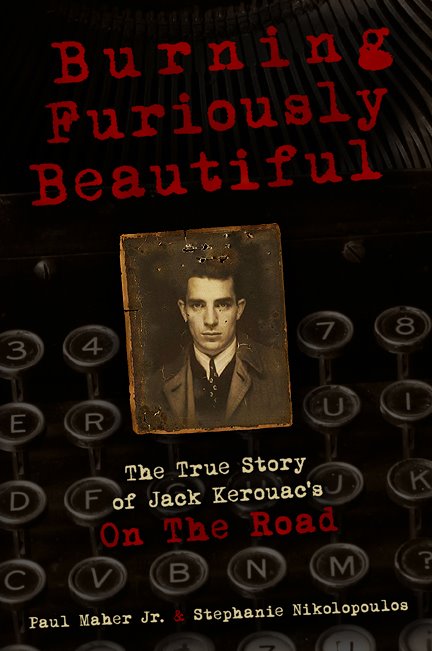
Paul emailed me the other day that we’d crossed the thousand-“like” threshold on our Facebook page for Burning Furiously Beautiful: The True Story of Jack Kerouac’s “On the Road.” I wrote him back: “!!!!!!!!!” …Give or take a few exclamation points.
I cannot thank all of you enough for your support. It means so much to me and for so many reasons. I’m not really a numbers person. Friends have asked me about my writing in the past, and I’ve said that all those Friday nights I spent at home in front of my computer instead of hanging out with friends and all that time I spend frustrated as I edit and rewrite will all be worth it if I reach just one person with my writing. I wasn’t speaking specifically about this book, but it holds true in the sense that if I can enlighten even one person on the fact that Jack Kerouac was a literary artist and not just some beatnik cartoon or if I can give hope to one writer out there who is struggling with yet another draft and thinks they’re rubbish because they mistakenly believe the myth that Kerouac wrote On the Road in just three weeks then I know I’ve done my job. Having a thousand people excited about the book, though, now that’s cake with a whole lot of icing on it!
I feel fortunate to have Paul as a coauthor. He’s so knowledgeable and experienced when it comes to writing about Jack Kerouac. He’s also really easygoing, and I think we’ve been able to work together well. Sometimes we get sidetracked and talk about things like woodland creatures and hot dog vendors and really bad sitcoms, and it’s all quite fun.
We also lucked out to have Igor Satanovsky as our cover designer. We get so many compliments on the cover. It’s usually the first thing people see when it comes to our book, so it was really important to us to have a strong cover and Igor nailed it.
We’ve been really privileged to have some people who have rallied around us and inspiring, encouraging, supporting, and even promoting us.
Most importantly, our families have given us time and space to write. My sister has attended almost every single reading I’ve ever given, Kerouac-related or not. My mom goes around sticking the postcards for our book anywhere she can. My father always made sure I got the best education I could get, which furthered my writing skills.
Many moons ago, before I even began working on this book, David Amram spent time talking to me about Kerouac and dispelled the whole idea of the so-called Beat Generation mythology. Since then, he’s invited me to read with him, has promoted my work in his own shows, and continually pushes me to think about life and art in new ways.
George Koumantzelis has gone out of his way to support our work. Oftentimes getting people to agree to an interview is like pulling teeth, but George actually invited me and arranged for me to interview his uncle Billy, who was Kerouac’s pallbearer. Billy and George have been tremendously gracious toward me. George often sends me helpful news links and posts my blog entries on Facebook.
The first time I ever got to read from Burning Furiously Beautiful was thanks to poet RA Araya, who invited me to read at The Sidewalk Café. He has since invited me many more times to read at various venues, and even when I haven’t read he’s passed out postcards for the book. He also frequently posts my work on Facebook.
One of the goals with our Burning Furiously Beautiful Facebook page was to create an inviting space for Kerouacians, those interested in Beat literature, road trippers, people who dig the history and culture of the ’40s and ’50s, writers, fans of the On the Road film, and the curious. We wanted a page that was informative and entertaining but also a safe place where people could ask questions and connect with each other. We don’t have a thousand people commenting on every single post, but we do have some regular posters as well as people who are actively engaged in leaving comments and forwarding posts. I’ve had the pleasure of even meeting a few of these people in person, which has been super fun. I never really had any friends that were into the Beats so it’s exciting to connect with others who are passionate about their literature.
There are so many people who have helped us get where we are today, in both small and big ways, specific to this book or in more general ways. The post would go on forever if I listed out each and every name, but the support is meaningful and doesn’t go unnoticed. It makes all the difference.
If you aren’t on our Facebook page yet, please do feel to join us. This isn’t some exclusive hipster club. People don’t try to one up each other on our page. We’re just super passionate and want to connect with others.
* * *
Reaching over a thousand “likes” by no means happened overnight. A lot of work goes into finding interesting things to post, responding to people’s comments, commenting on other Facebook pages, and getting lost in the time suck of social media. I’ve also done my fair share of going to talks on social media and scouring the internet for the latest hot tips. So, for today’s Friday Links, I wanted to leave you with a few helpful links for growing your social media. I’m by no means a pro, but some of these people certainly are.
Alt SLC registration just opened up! It’s a great way to learn about blogging
Dave Charest writes How to Get Facebook Likes for Your Page (The Easy Way!)
Author Laura Vanderkam writes about how to Grow your blog readership overnight! (or slowly over 3.5 years)
Conduit offers Ten Tips for Growing Your Target Audience Using Social Media
Photos tend to get more likes than just text, and Lark and Linen provides a Tutorial: Editing Your Photos
Samantha Murphy says that using “I” gets more thumbs up in How to Get More Likes, Shares on Facebook
In case you missed them, here are some of my previous links on social media:::
The true, true story behind the Facebook fauxlore of the Kerouac-Burroughs fight
I am one in a million
My Goodreads To-read list
How many stars should a book get on Goodreads?
Playing around on Google+ I found an article about, well, me
Why I Tweet and post on Facebook
Building your book before you write it
My takeaways from Cup of Jo’s advice on blogging as a career
Social media lessons from last year’s SWSX
I heart social media
Galley Cat’s advice for writers on Pinterest … and I’m on Pinterest
What are YOUR tips for growing your social media?

Jack Kerouac kept a dream journal. This log of nightly dreams was later published by City Lights Press in 1960 as Book of Dreams. Even before it was published, though, Kerouac encouraged others to pay attention to their dreams. He told Allen Ginsberg to infuse his poetry with his dream life.
When I was a high school student, my psychology teacher assigned us the task of keeping a dream journal. Isn’t that the most fantastic homework assignment you can think of?! According to psychology, we dream every night, but only some nights we remember our dreams. Keeping a dream journal was supposed to help us better remember our dreams. I know some people who hardly ever dream, but I have wild dreams—especially after eating pizza!
This past Friday night I had a doozy of a literary dream! I dreamt that I was writing a book entitled Travels with Charlie, which was a riff on John Steinbeck’s Travels with Charley. Steinbeck’s book is a chronicle (it was purported to be nonfiction but it’s since come out that portions of it were made up) of the American road trip he took with his standard-sized poodle. My book, however, was about Charles Darwin’s travels. Incidentally, in real, waking life I once edited a reissue of his travelogue The Voyage of the Beagle. I didn’t make the connection in the dream, but perhaps there was some connection between Steinbeck’s poodle and Darwin’s Beagle. In the dream, I was retracing Darwin’s footsteps for a book about his “road trip.” I kept referring to Charles Darwin as Chuck D. or Chuckie D.—like the rapper!
I definitely need to start a dream journal!
Do you keep a dream journal? What is the wildest dream that you’ve had lately?
If you’ve been following along for a while now, you know I’ve been doing a blog series on Goodreads. Today I want to talk about one of my favorite Goodreads features.
I like that I can keep track of what I’ve read in the past (though I’m sure there are lots I’ve left off), but even better is that I can compile a list of books I want to read. So often I’ll hear about a good book and then forget about if I don’t get to the library or bookstore right away or if another book comes along that I want to read. A couple books on my to-read list right now are:
As you can see, I have very eclectic taste.
I’ve found a few books on Goodreads that I’ve added to my list, but mainly the books on my to-read list have come from stories I’ve heard on NPR, mentions on lit blogs, and random encounters with the authors.
Have you ever found a great book on Goodreads? How do you usually find out about books? What should I add to my ever-growing list of to-read books?
Shameless plug alert: If you’re looking for a book to add to your to-read list, perhaps you want to add Burning Furiously Beautiful: The True Story of Jack Kerouac’s “On the Road.”

Yesterday I wrote about my experience on Goodreads. I think most people use it to write and read reviews of books, but truth be told I don’t do that. The only “review” I give is ranking a book through Goodreads’ star system, and I only do that because it seems sort of mandatory.
I actually feel a sense of anxiety in ranking books. I have very idiosyncratic tastes. I often read books that have gotten a lot of hype and dislike them. But give me a book that the general reading public finds “strange” or that “no one” has heard of and I smatter it with stars.
I think it’s important to acknowledge that we all have different tastes and that a book can be worthwhile even if we didn’t enjoy it. I know that sounds strange, crazy even, but hear me out: I don’t particularly love the story of Hamlet (I mean, come on, it has a ghost in it), but the dialogue, structure, and literary techniques are genius, pure genius.
Also, tastes change over time. I didn’t like David Guterson’s Snow Falling on Cedars the first time I read it. It was required summer reading when I was in high school, and I was decidedly not into love stories or books that heavily emphasized ethnicity issues, a topic my school focused on a lot. When I read it again in college, though, I was drawn into the story itself as if I were reading it for the first time. Sometimes I don’t even re-read a book and my opinion of it changes. I was looking over my Goodreads list and was surprised at how I’d rated some books. Books with three or four stars are the trickiest. I can really enjoy a book yet give it a lower ranking just because it’s not something I feel will stand the test of time or because it doesn’t have that extra little something. In contrast, sometimes I’ll give a book a slightly higher ranking than my gut reaction to it because it is a good book and I don’t want to discredit it even though in my mind there was something missing from it. See, this is why I should probably actually write reviews!
Anyway, here’s a bit of insight into the method of my ranking madness:
Do you think I’m too harsh? Too fickle? How do you rank books on Goodreads? Do you ever go back and change your ranking?


I feel incredibly honored to have been invited to read at the 2013 New York City Poetry Festival. I had such a blast hearing so many great poets read at last year’s festival, and it never occurred to me that just a year later I would be joining them on stage. I have poet RA Araya to thank for continually supporting my writing. He invited me to read Homer in the ancient Homeric Greek and from the literary biography I’m coauthoring with Paul Maher Jr. entitled Burning Furiously Beautiful: The True Story of Jack Kerouac’s “On the Road,” so I read two road trip pieces.
For my Homer selection, I chose the opening passage from The Odyssey. Growing up in the Peloponnesus, my father had to memorize part of the epic poem in school. To this day, he still can recite the lines! I studied Classical Greek at Pomona College (while a student at Scripps), which is different than Homeric Greek. We never really read aloud in class because it’s a “dead” language, one that is no longer spoken but read by scholars. There are debates about how ancient Greek dialects were spoken, as the pronunciation is, according to some scholars, different than modern Greek. I am therefore definitely not adept at reading in the ancient tongue, but if someone asks me to read something specific, I do my best. Fortunately, there are many great English translations of The Odyssey out there too!
It was a no brainer to choose one of the passages about poetry from Burning Furiously Beautiful. In telling the story of the making of the novel On the Road, it was important that the literary biography also explored Kerouac’s poetry and his friendship with other poets. Although he is mainly remembered as a novelist, Kerouac wrote poetry throughout his life, including the period when he was on the road. There’s a really strong section in the book about how Kerouac and Allen Ginsberg influenced each other’s writing, and I wanted to read that, but in the end I found a passage in Burning Furiously Beautiful that seemed to better encapsulate the mood of the Poetry Festival. In the passage, Kerouac has been walking along the highway, hitchhiking, and finds himself composing a poem about everything he sees around him. It reminded me of how out on Governors Island we were all a bunch of writers lofting in the grass and translating the world around us into poetic language.
I read directly after RA, who opened up the event with his famously short-but-sweet poem, and then came Hillary Keel, Sarah Sarai, Carmen Bardeguez-Brown, Kate Levin, Carlos Manuel Rivera, Sparrow, Bonafide Rojas, and Keith Roach. They were amazing! Seriously. Hilary read in German and a couple of the other poets read in Spanish, and I suspect our reading—under the name Miguel Algarin’s Brooklyn Poetry—was the most linguistically diverse at the Festival. I had traveled over the Governors Island with Kate, and I think this was her best reading yet. In addition to poetry about Manhattan and our value as people, she read from her punk novel, which I would’ve thought was a poem if she hadn’t said otherwise. I always enjoy hearing Sarah read, and in particular enjoyed her poem about meeting an angel at a bus stop. The poet who had me in stitches, though, was Sparrow. I’d heard him sing at RA’s birthday party last year, and I loved hearing his one-liner poems this time around.
Special thanks too to our stage manager Liz von Klemperer, who did an excellent job. There were a lot of volunteers who kept the entire event running smoothly. The New York City Poetry Festival is put on by The Poetry Society of New York and is organized by Stephanie Berger and Nicholas Adamski. For the full lineup of the two-day event, check out NYCPF 2013.
I also want to thank my family and friends who trekked out to the island—some coming from as far as Jersey and Brooklyn—to support my reading. The photos here were taken by Leslie Marks, except the last one which is a self portrait. For more photos of me and all the other amazing poets, check out asterix611’s flickr.

I just read in Shelf Awareness that Goodreads has reached 20 million readers. While that number itself is impressive, even more astonishing is the fact that in this past year alone they had doubled their numbers.
I joined Goodreads a while back after someone at a Mediabistro party raved about it as a great way to find out about books and connect with others in the publishing industry. What I like about Goodreads more than reading other people’s reviews is connecting with people who have like-minded literary interests. There are groups for people interested in the Beat Generation and for those interested in travel literature, and, although I’ll admit I don’t check in too frequently (so many social media sites, so little time…), I do enjoy connecting with readers and authors on the message boards.
I also have an author’s page up, where readers can find and review the books I’ve written or contributed to. It’s been encouraging to see people put one of the books I’m working on on their to-read list even before the book has been published! It motivates me to make the book worth their time.
If you’re on Goodreads, will you please add my book to your to-read list? Also, if you’re an author, let me know in the comments below how I can find your book to add to my to-read list.

Mallory Ortberg’s post “The Top Ten Writers Whose Success You’ll Resent This Year” (via Poets & Writers) on The Toast is hilarious and spot on. I kind of resent her for it. I mean, I could’ve written it. You know, if I’d actually thought of it.
Here’s what she wrote about memoirists:
The Memoirist Who Is Your Age And Whose Life Eerily Parallels Yours
“Nobody should write a memoir before they’re fifty,” you announce to your friends over drinks. You are not fifty. “Everyone seems to think being 27 and unhappy in love is all you need to write a book about your life. You should have to get licensed before you can write one.” You are on your fourth glass of wine. It is Tuesday. “You should have to–be Gore Vidal, or a cultural attaché, or have invented genocide or something.” You spilled a little bit of your wine during that last remark, but it has landed on your napkin and you don’t think anyone noticed.
You have never been asked to write a memoir, but you would immediately if anyone seemed interested.
I’m pretty sure I’ve said something similar in the past about why MFA students in their twenties shouldn’t be allowed to enroll in memoir classes.
In other news, I haven’t worked on my memoir in about a year. But I’ve been thinking a lot about it, and I recently realized I have a whole new spin on the ending. That’s the funny thing about memoir. Just when you think you have an ending, something happens in your life that changes the ending … which, PS, reinforces my statement that you should write a memoir too young.
What writers do you resent?
My inbox got a recent happy surprise with the subject header:
‘The Road Is Life’ Celebrate the launch of Granta 124: Travel
In case you don’t recognize the quote, it’s from Jack Kerouac’s On the Road. In part 3, chapter 5, he writes:
Our battered suitcases were piled on the sidewalk again; we had longer ways to go. But no matter, the road is life.
The lit mag will have its New York launch for the issue on July 24th at 7pm at Bookcourt (163 Court Street; Brooklyn). Granta editor John Freeman will supposedly be there–despite May’s news that he is leaving the lit mag. Contributor Phil Klay will also be there. Readings, drinks, and conversation to ensure!
If you’re not in the New York area, you should be! But even if you’re not, Granta also has launches in San Francisco and London.
Book Court has a plethora of other events coming up that include poetry, nonfiction, fiction, photography, and music.
In case you missed it, here’s my recap of hearing Freeman speak about Granta.

June seems to have come and gone ever so quickly this year. I suppose that’s the nature of life. The older we get, the faster the days, months, and years seem to pass. I think even Einstein would agree. June always has thirty days in it—it’s not like sneaky February with its leap year—and yet those thirty days seem to go by so much faster than they did when I was a kid. I remember being in grade school just waiting for school to let out for summer break. The winter months seemed to drag on and on, and that last month til graduation felt like for-ev-errrrr.
The funny thing is, as much as I looked forward to graduating and summer vacation and all the excitement that June brought, it also felt like a sad time. It was a time to say good-bye to teachers who had great impact on my love of reading and writing as well as a time to throw out old notebooks filled with a year’s worth of thoughts and doodles.
It was also a time of change and uncertainty. What would the next school year bring? What would college be like? What kind of job would I find after college? What would it be like to go back to grad school after so many years out of college and in the workforce? Did I take advantage enough of grad school and will I now make good use of my MFA?
I wasn’t in any sort of academic program this year, and yet once again I’ve found June to be a time of exciting and positive change but also uncertainty about what the future holds. I recently made what felt like a pretty big decision that will (hopefully) bring me a bit more stability and permanence in my life, however the decision was made at a time when I found out a family member was making the opposite decision. I guess even as adults, we encounter times when we graduate from one phase of our life into the next.
Years ago, my mother gave me Anna Quindlen’s A Short Guide to a Happy Life. I’ve had to get rid of a lot of books over the years with all my various moves, but I’ve held onto this small volume, inspired by a commencement speech she once gave. I think no matter where we are in life, June is a good midpoint in the year to celebrate the accomplishments we’ve made so far this year and plan for the rest of the year. Commencement addresses like the ones by famous authors below are a great inspiration. I also like Warren Buffett’s recent advice to the Millennial Generation to “stop holding yourself back.”
Ray Bradbury (Fahrenheit 451) at Columbia College
Max Brooks (World War Z) at Pitzer College
Louise Erdrich (Love Medicine) at Dartmouth University
Neil Gaiman (The Sandman, Coraline) at University of the Arts
Sue Monk Kidd (The Secret Life of Bees) at Scripps College (woot!)
Anne Lammott (Traveling Mercies, Bird by Bird) at U.C. Berkeley
Michael Lewis (The Blindside, Moneyball) at Princeton University
Barbara Kingsolver (The Poisonwood Bible) at Duke University
David McCullough (1776) at Wellesley High School
Anna Quindlen (Black and Blue) at Villanova University
J. K. Rowling (Harry Potter) at Harvard University
David Foster Wallace (Infinite Jest) at Kenyon College
Elie Wiesel (Night) at Washington University
And for those of you who dropped out of college: Jack Kerouac did too, but he kept on studying and you too can keep on learning and growing.
Stephanie Nikolopoulos is a writer, editor, writing teacher, and speaker based in New York City.
She is the coauthor, with Paul Maher Jr., of "Burning Furiously Beautiful: The True Story of Jack Kerouac's 'On the Road.'"
You can email her at stephanie_701 {@} yahoo.com


 Stephanie Nikolopoulos