Tag Archives: Allen Ginsberg

Is Hollywood Glamorizing the Beats or Just Retelling Their Stories?

29 Oct

“The flat Hollywood characterization allows viewers to live vicariously through Ginsberg, Kerouac and the gang, but it almost mythicizes them. Hollywood digs right into the drama — catering to what people want to see — and ignores the very human parts of them. But it may be a hard balance to keep. Even when depicting that soul-searching, it’s easy to fall to sentiment. The Beat Generation’s search for belief ends up being something we believe in. We’re all drawn to the image of explorers after all: modern pilgrims, earnestly due west like Lewis and Clark in Mustangs, toward the unknown destination,” writes Karen Yuan in her closing paragraph to “Notebook: Hollywood shouldn’t glamorize the Beat Generation’s self-destruction” in The Michigan Daily.

With descriptions like “wide, fruited plains,” “all vintage Cadillacs and cigarette escapism,” and “slick cool and soft anarchy,” Yuan’s turns of phrases are beautiful in this article. I commend her attention to language in this journalistic essay about writers. It’s a breath of fresh air from so many dry works of criticism. Furthermore, she brings up a valid point on the complexity of Hollywood trying to encapsulate the human experience. Whether one is a so-called Beat, a journalist, or a movie-goer our lives cannot be easily summed up in one film or three films … or even several volumes of literature, as it may be. Yuan herself makes that very point when she says “But it may be a hard balance to keep.”

Consequently, she seems to have out-argued her own thesis, “However, what [Hollywood] doesn’t realize is that the Beats are nothing to be glamorized,” by acknowledging the intricacy of life and that portraying “clouds of brooding angst” doesn’t create balance or reality anymore than depicting “carefree, YOLO-esque youth” does. Though she rightly suggests the Beats’ perpetual movement is related to their “existential search,” it is unclear what she thinks a more accurate adaptation of On the Road or Big Sur would be or how the murder of David Kammerer should have been told.

I would argue that the film adaptation of On the Road did a fine job of showing both sides. It perhaps doesn’t do the existential search justice but there are intimations of it, particularly in the scenes when Sal Paradise hallucinates among the Catholic saints, with the insertion of Proust, and when Dean Moriarty confesses that he doesn’t know why he does the things he does. The go! go! go! mentality comes to a screeching halt in the closing scene, indicating that maybe all those wild times weren’t all they were cracked up to be. Meanwhile, Yuan says Kill Your Darlings contains “tantalizing hints of murder,” when in fact the film does not hint but tells of the events leading up to a murder that landed three of the Beats in jail, with one of them doing time in a reformatory. It does not paint any one character as the villain, but again shows that the people involved and the events that unfolded were complex. Existentialism is a recurring theme of the film as seen through the New Vision. I haven’t seen Big Sur yet, but I’ve read the reviews of the film, and it seems to me that it’s far from glamorizing Kerouac’s life. More so, I’ve read the novel twice and know that it’s actually the antithesis of glamorizing the Beat Generation machine.

So here’s the question … or rather, I should say questions: Is documenting a life, an event, or a novel automatically glamorizing it? Where is the line between telling the truth and glorifying—when storytelling? Do stories have to be redemptive? If they are not redemptive, must they be cautionary tales? If they do not fall into these categories, are we better off ignoring them?

The pastor of the church I grew up in used to say, “Ignorance is not bliss.” Being downright oblivious or purposely ignoring issues doesn’t make them go away. The truth of the matter is the “intrigue and montages of reckless drug use” were a part of the life of Allen Ginsberg, Jack Kerouac, William S. Burroughs, and so forth. And I would gather that the parties and drugs and casual affairs were a lot of fun as they were happening. That’s why people do those things. To categorically demonize these things does a disservice to the truth. The truth of course is much more complex. Consequences aren’t always immediate or even a given. We can look now in hindsight at On the Road and know that Jack Kerouac died at only forty-seven years old, after abusing alcohol. However, we can cast our collective eye on Burroughs and see a man who did a lot of hard drugs who didn’t pass away until he was eighty-three years old.

Yuan says, “They wanted to rebel against this new middle-class United States and find something new to believe in….” Today’s suburban teens and Ivy League undergrads may very well still be searching for something to believe in. I think the Beats’ stories go on, not because they glamorize illicitness, but because they speak to that very basic human need to feel like more than just a cog in the machine but like we’re actually living, that our lives have meaning. I think this is part of what Yuan is advocating for, and I think it’s actually there in the films and in the literature. It’s just not whitewashed, pristine, perfect. But then again, neither is life.


* * *

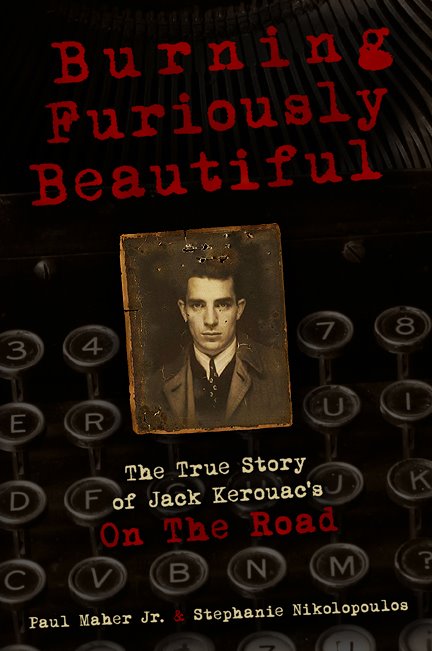
Burning Furiously Beautiful: The True Story of Jack Kerouac’s “On the Road” is now available as an ebook and paperback!
Limited Time Offer: 10% Off the Paperback of Burning Furiously Beautiful

10 Oct

528764_288645227899680_240973182_n

Exciting news!

Pop the champagne! The paperback edition of Burning Furiously Beautiful: The True Story of Jack Kerouac’s “On the Road” is now on sale.

Limited-time offer

We’re giving you an extra 10% off now through the end of Lowell Celebrates Kerouac. (Unfortunately, the books won’t arrive in time for us to sell physical copies at the festival, but at least you’ll get a discount!)

What’s the book about, you ask?

Burning Furiously Beautiful: The True Story of Jack Kerouac’s “On the Road” is the most up-to-date and accurate account of the development of American writer Jack Kerouac’s groundbreaking 1957 novel, On the Road. Using archival resources as the foundation of this book, Kerouac scholars Paul Maher Jr. and Stephanie Nikolopoulos have fashioned a gripping account of the internal and external experiences of Kerouac’s literary development.
Fueled by coffee and pea soup, Jack Kerouac speed-typed On the Road in just three weeks in April 1951. He’d been traveling America for the past ten years and now, at last, the energy of his experiences flowed through his fingertips in a mad rush, pealing forth on a makeshift scroll that he laboriously taped together. The On the Road scroll became literary legend, and now Burning Furiously Beautiful sets the record straight, uncovering the true story behind one of America’s greatest novels.
Burning Furiously Beautiful explores the real lives of the key characters of the novel—Sal Paradise, Dean Moriarty, Carlo Marx, Old Bull Hubbard, Camille, Marylou, and others. Ride along on the real-life adventures through 1940s America that inspired On the Road. By tracing the evolution of Kerouac’s literary development, this book explains how it took years—not weeks—to write the seemingly sporadic 1957 novel. Through new research and exclusive interviews, this revised and expanded edition of Jack Kerouac’s American Journey (2007) takes a closer look at the rise of Jack Kerouac and the Beat Generation, giving insight into Kerouac’s family roots, his time at sea, the shocking murder that landed Kerouac in jail, his romances, and his startlingly original writing style.
Who is my coauthor?

Paul Maher Jr. is the author of the critically acclaimed biography Kerouac: His Life and Work and Empty Phantoms: Interviews and Encounters with Jack Kerouac
Check out my exclusive interview with Paul here.
You can judge our book by its cover
We’ve gotten a lot of compliments on our cover. Credit goes to Igor Satanovsky. He’s an award-winning cover designer that I’ve worked with for many years now on various publishing projects. Igor also is a poet (buy his book here!) and studied with Allen Ginsberg.

* * *

Burning Furiously Beautiful: The True Story of Jack Kerouac’s “On the Road” is now available as an ebook and paperback!
Happy Birthday, Amiri Baraka!

7 Oct

BluesPeople

Happy birthday to the great poet, playwright, critic, and activist Amiri Baraka!

Baraka was born on this day in 1934 in Newark, the same New Jersey city where eight years earlier Allen Ginsberg had been born. His given name was Everett LeRoi Jones, and he went by LeRoi, eventually changing his name in the late 1960s to Amiri Baraka. Baraka had studied at Rutgers University and Howard University before, like  Ginsberg and Jack Kerouac, studying at Columbia University. Also like Kerouac, he took classes at The New School. However, while Ginsberg and Kerouac could be found in the English departments, Baraka’s major fields of study were philosophy and religion. It is not surprising, then, that he became known for his social criticism.

As his website states:

Baraka started his professional career by joining the US Air Force in the early fifties.  Destined to be an accomplished author, he did not serve the military for long and switched to a completely different domain by opting to work in a warehouse for music records. This is where his social circle expanded and added the Black Mountain Poets, New York School Poets and the Beat Generation to it. Also, it developed his interest in Jazz music which later matured in making him one of the most sought after music critics. 

Around that same time, in 1958, he married Hettie Cohen. Together they founded the short-lived lit mag Yugen. He also edited the lit mag Floating Bear with Diane DiPrima. His first book of poems, Preface to a Twenty Volume Suicide Note, was published in 1961. Perhaps the book he is best known for is the 1963 jazz criticism Blues People: Negro Music in White America.

Baraka has gone on to receive the PEN Open Book Award, the James Weldon Johnson Medal for contributions to the arts, an Obie Award (for Dutchman), and the American Academy of Arts & Letters award, and become Professor Emeritus at the State university of New York at Stony Brook and the Poet Laureate of New Jersey.

This is barely even scraping the surface of who Baraka is and the importance of his work. My emphasis on his connection to Ginsberg, Kerouac,  DiPrima, and the Beat Generation is an artificial construct, simply to navigate my usual Kerouac readers. Baraka’s literature and activism is integral to our nation’s history and development. The Poetry Foundation offers a more thorough biography.

Read an excerpt from Blues People on Barnes & Noble.

Find out more on Amiri Baraka’s website.

“Burning Furiously Beautiful” eBook Now Available!

30 Sep

528764_288645227899680_240973182_n


Happy Monday! I have BIG news to share today. Burning Furiously Beautiful: The True Story of Jack Kerouac’s “On the Road” is now available as an eBook! You can get it for $8.99 at Lulu.

Here’s a bit about the book from Lulu:

Burning Furiously Beautiful: The True Story of Jack Kerouac’s “On the Road” is the most up-to-date and accurate account of the development of American writer Jack Kerouac’s groundbreaking 1957 novel, On the Road. Using archival resources as the foundation of this book, Kerouac scholars Paul Maher Jr. and Stephanie Nikolopoulos have fashioned a gripping account of the internal and external experiences of Kerouac’s literary development.

And here’s our synopsis:

Fueled by coffee and pea soup, Jack Kerouac speed-typed On the Road in just three weeks in April 1951. He’d been traveling America for the past ten years and now, at last, the furious energy of his experiences flowed through his fingertips in a mad rush, pealing forth on a makeshift scroll that he laboriously taped together. The On the Road scroll has since become literary legend, and now Burning Furiously Beautiful sets the record straight, uncovering, among other things, the true story behind one of America’s greatest novels. Burning Furiously Beautiful explores the real lives of the key characters of the novel—Sal Paradise, Dean Moriarty, Carlo Marx, Old Bull Hubbard, Camille, Marylou, and others. Ride along on the real-life adventures through 1940s America that inspired On the Road. By tracing the evolution of Kerouac’s literary development and revealing his startlingly original writing style, this book explains how it took years—not weeks—to ultimately write the seemingly sporadic 1957 novel, On the Road. This revised and expanded edition of Jack Kerouac’s American Journey (2007) takes a closer look at the rise of Jack Kerouac and the Beat Generation.

The ebook can be read in the following formats: Windows, PC/PocketPC, Mac OS, Linux OS, Nook, Apple iPhone/iPod/iPad, Android, Kindle (Amazon), Sony Reader, Blackberry Devices, Palm OS PDAs, Cybook Opus, Bebook (Endless Ideas), Papyrus (Samsung) Jetbook (Ectaco), Windows Mobile OS PDAs.

A print book is forthcoming.

Kill Your Darlings Gets the Cartoon Treatment

3 Sep

Kill Your Darlings, a film about a murder, isn’t the first film I’d personally think of for a cartoon treatment, but Randeep Katari created a cartoon image for it that’s actually pretty thought-provoking. You can view it here.

Jonathan Collins’ Beat-Inspired Paintings on View at the Paterson Museum

2 Sep

visions-of-lowell

Remember a while back when I did an interview with painter Jonathan Collins, who created stunning works of art featuring Kerouac’s hometown of Lowell, Massachusetts? Well, starting this weekend, he has an exhibit up at the Paterson Museum!

Here’s the press release:::

The Paterson Museum is pleased to present “Beat Traveller: New Landscapes By Jonathan Collins.” This collection of works will be his first solo show at the Museum. The opening reception of Beat Traveller will be held the museum on Sept. 7 from 7 to 10 p.m. The exhibition will be on view through Oct. 6.

The works of Beat Generation novelist Jack Kerouac and poet and Paterson native, Allen Ginsberg, inspired the paintings. Collins journeyed to San Francisco, California, Lowell Massachusetts, and Paterson, New Jersey and returned depicting striking landscapes, glowing in bold sunlight, hazy sunsets, and moody night scenes.

According to Collins, “Both Ginsberg and Kerouac spawned from supposedly dreary mill towns, but I found each place to have areas of great natural beauty, vast historical interest, and even mystical qualities. Also, my father was from New England, my mother from Paterson, and they met at the foot of the Great Falls in 1951. Consequently these areas have great familial and artistic significance for me.”

Collins’ paintings are highly detailed watercolors that have won him numerous grants and scholarships, enabling extensive travel throughout the United States and Europe.

The Paterson Museum is located at 2 Market St. in the former erecting shop of the Rogers Locomotive Works in the heart of the Paterson Great Falls National Park. The Museum’s visiting hours are Tuesday to Friday from 10 a.m. to 4 p.m. and Saturday and Sunday from 12:30 to 4:30 p.m. For more information contact the Museum at (973) 321.1260 or thepatersonmuseum@gmail.com.

Check it out!

New Trailer for “Kill Your Darlings” Released

23 Aug

KillYourDarlingsPoster photo via imdb

The new Kill Your Darlings trailer released! You can check it out here.

Kill Your Darlings is the film about the 1944 murder in which Jack Kerouac and William S. Burroughs were named as accessories.

Just like in the film adaptation of On the Road where the Marylou/LuAnne character got a lot of publicity because she was played by Kristen Stewart even though LuAnne wasn’t the focus of the book, the buzz around Kill Your Darlings is Harry Potter‘s Daniel Radcliffe playing Allen Ginsberg even though Ginsberg was not the murderer, not the person murdered, and not named as an accessory.

The film is directed by Greek American John Krokidas and stars Daniel Radcliffe as Allen Ginsberg, Ben Foster as William Burroughs, Elizabeth Olsen as Edie Parker, Dane DeHaan as Lucien Carr, David Cross as Louis Ginsberg, Jack Huston as Jack Kerouac, and Michael C. Hall as David Kammerer.

It premiered at Sundance this year, where it was nominated for the Grand Jury Prize, and is set for limited release here in the US on October 18, 2013.

I set up a Kill Your Darlings Pinterest page if you’re interested in seeing photos of the real-life people involved in the murder and of the actors and people involved in the film.

Will you watch Kill Your Darlings when it comes out?


If “Everything Is Possible,” Our Milestones Need to Change

21 Aug

singles-620x412Image from Singles via Salon

In the second paragraph of Sara Scribner’s recent Salon article about Generation X, the journalist says:

Few have even noticed that this small, notoriously rebellious clan – those born roughly between 1965 and 1980, which means about 46 million Xers versus 80 million boomers — has entered middle age.

The article itself is entitled “Generation X gets really old: How do slackers have a midlife crisis?”

Let’s stop right there for a moment. The date range provided here for Generation X refers to people who are currently between 48 and 33 years old. Is 33 middle age? Is 33 “really old”? Hyperbole aside, is 48 even “really old”?

The rest of the article refers to people in their 40s. I get it. The writer is using the median age. Treatises on generations are always rift with broad-swept generalities, however the attention to age in this particular article is telling for the article goes on to bring up issues of delayed adulthood, parents, and leadership.

Scribner quotes historian and generational expert (side note: how does one get to be a generational expert? That sounds like an awesome job) Neil Howe saying:

“Xers experience agoraphobia — everything is possible.”

The article goes on to say:

That’s where this generation gets its reputation as reluctant to grow up. “It’s very hard to mature,” [Howe] says. “In order to mature and become an adult, you have to shut off options. The way Xers were raised, there were always options — their parents told them to keep options open.”

Further on in the article, Scribner explains the result of this:

[Sheryl] Connelly, the Ford futurist, says that some of the postponing of the traditional midlife period may come down to a pushing back of all the major life milestones: “Some of that [midlife questioning] would be fueled by empty nesters – the kids are grown,” she says, explaining a feeling of “now what?” “Demographics have shifted such that with each passing generation, people are postponing marriage.” With dependent kids at home, everything has been pushed back. “There’s nothing midlife about my situation right now.  I think that’s why you don’t hear this conversation.”

Maybe, but that’s assuming that we’re talking about a Gen Xer born closer to the 1965 date. Let’s take someone smack dab in the middle of Gen X. If we’re using the range 1965 to 1980, let’s pick someone born in 1972. That person today (well, depending on when their birthday falls) would be 41 years old. Let’s now assume this person married right out of college and then had a kid the following year, when they were about 24 years old. (Keep in mind, that’s younger than the median age for getting married which is closer to 27.) That child would be about 17 years old. It’s therefore not at all shocking that many—even half of—Gen Xers would have “dependent kids at home.” It would actually be rather traditional and, dare I say, old-fashioned.

More interesting is not that life’s “major life milestones” are happening later but that they’re happening at different times for Gen X.

And, just as interesting is that, even with these societal changes, Scribner still upheld conservative viewpoints of adulthood when she paired the phrase “major life milestones” with Connelly’s quote about “empty nesters,” “postponing marriage,” and “dependent kids at home.”

This is where the article gets fascinating but isn’t fully explored. Yes, perhaps on the whole, people are postponing marriage and children and many who did have children now can’t get rid of their boomerang kids, creating a period of limbo. However, just like the age range of Gen X varies, so does the age that they’re getting married and having kids. That’s apparent even in looking at the celebrities the article mentions. Kurt Cobain (born in 1967) had a baby, and that baby is now 20 years old. Winona Ryder is 41 and has never been married or had children. Liz Phair, who is now 46, married a film editor in 1995 and had a child with him the following year; in 2001 the couple divorced.

I have friends I graduated college with who afterwards got married and now have two or three children. I have other friends I graduated high school with who are still very single—and by “very,” I simply mean that they are not only unmarried but also not in a steady relationship. I have a cousin who is about two years older than me who has a seventeen-year-old son. And I have other cousins who are about a decade older than me and have children the same age and younger than the cousin closer to my age.

At a writing conference, I had an interesting conversation with one of my colleagues. On so many levels we connected. We’d had very similar upbringings. We had comparable goals with our writing. We  shared parallel interests. Only about two years older than me, she is a mother of adolescent children and confessed to fearing empty-nest syndrome. At that moment in the conversation, my unmarried, childless self felt like a complete child next to her.

Going back to the statements about Gen X’s reluctance to grow up and the difficulty of maturing in this day and age, I think Howe’s concept of “agoraphobia” is worth more attention. I wouldn’t necessarily agree with Howe’s assessment that we have a phobia, an irrational fear, of “shut[ting] off options,” but the fact that we have those options is significant. We have the option to get married right out of college or to wait until we’ve experienced more of life, know ourselves better, and have amassed a nest egg to support a family. There’s no longer the same social stigma there once was to have a child out of wedlock and so we have the option to have a child with a significant other who we may already be living with. With the advancement of medicine, we also have the option of waiting until we’re in our 40s to have children.

As Howe says, “everything is possible.” But what does that mean for our identities and for the concept of maturity and adulthood?

Does a Gen Xer who is single and childless at 48 years old have more in common with a single and childless 33 year old Gen Xer than with a 48-year-old Gen Xer with a toddler? Does a Gen Xer who is an empty nester have more in common with the Gen Xer who never had children? Does a divorced Gen Xer in their early 30s have a more similar lifestyle to a Gen Xer in their late 40s who never got married? Is the 48 year old who never got married and never had children less mature, less of an adult, because they haven’t reached certain “milestones”?

Maybe it’s time our concept of maturity shifted to match the time period in which we’re living. Maybe it’s time to recognize that today’s milestones have changed.

The Salon article says “Many Xers seem nostalgic for the serene ‘50s,” but the “serene ’50s childhood” is a myth. One, in fact, that we explore in Burning Furiously Beautiful: The True Story of Jack Kerouac’s “On the Road” when talking about how illness killed off children, how war fractured families, how gender roles were back then, and how supposed countercultural icon Jack Kerouac longed for a wife and a ranch. Marilyn Monroe died at 36, never having a child. Ella Fitzgerald never had a child of her own but adopted one. Allen Ginsberg had a lifelong partner but his relationship was not considered traditional at the time. Clearly, there were people in the 1940s and ’50s who reached adulthood, reach midlife, without achieving traditional milestones. So why do we continue to use the same markers for maturity today that weren’t even accurate in the 1940s?

You may also like:

Blame Parents for Millennials Acting Entitled: Helicopter Parents Have Trophy Kids Who End Up Boomerang Kids

Shunning Cars … and Life

Parallel Generations

Hipsters Hate Driving


Dream Journal: Travels with Chuck D.

15 Aug

Voyage

Jack Kerouac kept a dream journal. This log of nightly dreams was later published by City Lights Press in 1960 as Book of Dreams. Even before it was published, though, Kerouac encouraged others to pay attention to their dreams. He told Allen Ginsberg to infuse his poetry with his dream life.

When I was a high school student, my psychology teacher assigned us the task of keeping a dream journal. Isn’t that the most fantastic homework assignment you can think of?! According to psychology, we dream every night, but only some nights we remember our dreams. Keeping a dream journal was supposed to help us better remember our dreams. I know some people who hardly ever dream, but I have wild dreams—especially after eating pizza!

This past Friday night I had a doozy of a literary dream! I dreamt that I was writing a book entitled Travels with Charlie, which was a riff on John Steinbeck’s Travels with Charley. Steinbeck’s book is a chronicle (it was purported to be nonfiction but it’s since come out that portions of it were made up) of the American road trip he took with his standard-sized poodle. My book, however, was about Charles Darwin’s travels. Incidentally, in real, waking life I once edited a reissue of his travelogue The Voyage of the Beagle. I didn’t make the connection in the dream, but perhaps there was some connection between Steinbeck’s poodle and Darwin’s Beagle. In the dream, I was retracing Darwin’s footsteps for a book about his “road trip.” I kept referring to Charles Darwin as Chuck D. or Chuckie D.—like the rapper!

I definitely need to start a dream journal!

Do you keep a dream journal? What is the wildest dream that you’ve had lately?

Photos from the 2013 New York City Poetry Festival

31 Jul

Po2

Po1

po3

po4

po5

I feel incredibly honored to have been invited to read at the 2013 New York City Poetry Festival. I had such a blast hearing so many great poets read at last year’s festival, and it never occurred to me that just a year later I would be joining them on stage. I have poet RA Araya to thank for continually supporting my writing. He invited me to read Homer in the ancient Homeric Greek and from the literary biography I’m coauthoring with Paul Maher Jr. entitled Burning Furiously Beautiful: The True Story of Jack Kerouac’s “On the Road,” so I read two road trip pieces.

For my Homer selection, I chose the opening passage from The Odyssey. Growing up in the Peloponnesus, my father had to memorize part of the epic poem in school. To this day, he still can recite the lines! I studied Classical Greek at Pomona College (while a student at Scripps), which is different than Homeric Greek. We never really read aloud in class because it’s a “dead” language, one that is no longer spoken but read by scholars. There are debates about how ancient Greek dialects were spoken, as the pronunciation is, according to some scholars, different than modern Greek. I am therefore definitely not adept at reading in the ancient tongue, but if someone asks me to read something specific, I do my best. Fortunately, there are many great English translations of The Odyssey out there too!

It was a no brainer to choose one of the passages about poetry from Burning Furiously Beautiful. In telling the story of the making of the novel On the Road, it was important that the literary biography also explored Kerouac’s poetry and his friendship with other poets. Although he is mainly remembered as a novelist, Kerouac wrote poetry throughout his life, including the period when he was on the road. There’s a really strong section in the book about how Kerouac and Allen Ginsberg influenced each other’s writing, and I wanted to read that, but in the end I found a passage in Burning Furiously Beautiful that seemed to better encapsulate the mood of the Poetry Festival. In the passage, Kerouac has been walking along the highway, hitchhiking, and finds himself composing a poem about everything he sees around him. It reminded me of how out on Governors Island we were all a bunch of writers lofting in the grass and translating the world around us into poetic language.

I read directly after RA, who opened up the event with his famously short-but-sweet poem, and then came Hillary Keel, Sarah Sarai, Carmen Bardeguez-Brown, Kate Levin, Carlos Manuel Rivera, Sparrow, Bonafide Rojas, and Keith Roach. They were amazing! Seriously. Hilary read in German and a couple of the other poets read in Spanish, and I suspect our reading—under the name Miguel Algarin’s Brooklyn Poetry—was the most linguistically diverse at the Festival. I had traveled over the Governors Island with Kate, and I think this was her best reading yet. In addition to poetry about Manhattan and our value as people, she read from her punk novel, which I would’ve thought was a poem if she hadn’t said otherwise. I always enjoy hearing Sarah read, and in particular enjoyed her poem about meeting an angel at a bus stop. The poet who had me in stitches, though, was Sparrow. I’d heard him sing at RA’s birthday party last year, and I loved hearing his one-liner poems this time around.

Special thanks too to our stage manager Liz von Klemperer, who did an excellent job. There were a lot of volunteers who kept the entire event running smoothly. The New York City Poetry Festival is put on by The Poetry Society of New York and is organized by Stephanie Berger and Nicholas Adamski. For the full lineup of the two-day event, check out NYCPF 2013.

I also want to thank my family and friends who trekked out to the island—some coming from as far as Jersey and Brooklyn—to support my reading. The photos here were taken by Leslie Marks, except the last one which is a self portrait. For more photos of me and all the other amazing poets, check out asterix611’s flickr.