Tag Archives: Beat Generation

Is Jack Kerouac a Modern Heir of James Joyce?

12 Feb

ulysses


In The New York Times’ Sunday Book Review, Rivka Galchen and Pankaj Mishra took up the question: “Who Are James Joyce’s Modern Heirs?

The names Lydia Davis, Nadine Gordimer, Kenzaburo Oe, and José Saramago are mentioned between these two award-winning authors, but more than specific names Galchen and Mishra delineate ideas of what Joycean literature is.

Galchen writes:

The text — and it feels more like a “text” than a book — radiates in a way we associate more with parable than with mortal prose, even as any sense of grandness also feels undermined and played with and brought down to size. “Ulysses” thus manages the strange magic of being a mock epic of epic proportions. It reveals a world holy and human.

She goes on to write thoughtfully about language, epics, radiance, and rumor.

Mishra, in turn, writes:

Few declarations of aesthetic autonomy have resonated more in the last century than Stephen Dedalus’s in “A Portrait of the Artist as a Young Man”: “You talk to me of nationality, language, religion,” Stephen tells an Irish nationalist, “I shall try to fly by those nets.” The novel concludes with Stephen’s decision to make a writing career for himself in Europe: “Welcome, O life! I go to encounter for the millionth time the reality of experience and to forge in the smithy of my soul the uncreated conscience of my race.”

He argues that Joyce’s modern heirs are political writers.

As you’ve probably already guessed, I’d submit Jack Kerouac as a potential heir to James Joyce. Let me lay out a brief argument in support of this thesis:

  • Galchen suggests Joyce’s work “radiates in a way we associate more with parable than with mortal prose,” and in some ways this is what Kerouac’s work does. Readers have often criticized On the Road’s rambling prose, replete with multiple road trips, but I’d argue that the work is actually more effective because it is not a simple from-point-A-to-point-B story. Readers do best in thinking of it not just in terms of story but parable.
  • She says Joyce’s work has the “strange magic of being a mock epic of epic proportions.” Kerouac’s narrator Sal Paradise is like Odysseus/Ulysses, a flawed man on a journey. In self-mythologizing himself over the course of several novels, Kerouac created the epic Duluoz Legend.
  • Mishra quotes Joyce’s Stephen Dedalus in A Portrait of the Artist as a Young Man as saying “Welcome, O life!” as he desires to encounter “the reality of experience.” Kerouac echoes this in going out on the road for seven years, seizing life and writing about it.
  • Kerouac is an heir to Joyce’s language, as I pointed out in this post.
  • And his most famous passage closely resembles one of Joyce’s passages in Ulysses.
  • He suggests that Dedalus’ decision to exile himself as an artist in Europe is political. In contrast, critics at the time of On the Road’s publication noted that unlike the Lost Generation, the Beat Generation stayed in America. Kerouac was known to have deep respect for the American flag and his journeys across America show his love for the country. Whether one wants to argue if this is “political” or not, he does represent himself as an artist in America.

What do you think? Is Jack Kerouac James Joyce’s heir?
Bernadette Sees Visions

11 Feb

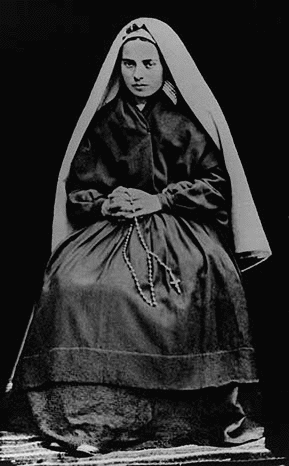
Bernadette_soubirous_2_publicdomainimage via Wikipedia

While out collecting firewood near a French grotto near Massabielle, on February 11, 1858, a fourteen-year-old miller’s daughter by the name of Bernadette Soubirous had a vision of the Immaculate Conception. Some people believed her; others did not. Bishop Laurence questioned her and believed, and today Bernadette is recognized as a saint. The message she had heard from the Immaculate Conception was to build a chapel in the grotto. Today there are many chapels in Lourdes.

There is also a grotto devoted to Our Lady of Lourdes in Lowell, Massachusetts. Jack Kerouac wrote about it, and Allen Ginsberg, Gregory Corso, and Bob Dylan have visited it when stopping by the Beat novelist’s hometown.

I had the good fortune of visiting Lowell’s Grotto of Our Lady of Lourdes with eminent Beat scholar Roger Brunelle, who shared some of his own stories. I wrote about it in my Church Hopping column for Burnside Writers Collective. Two years later I visited again, this time with my Kerouac biography coauthor Paul Maher Jr.


NY Chapter of Scripps Book Club Reads “Burning Furiously Beautiful”!

10 Feb

bookclub1

The New York chapter of the Scripps College alumni book club selected Burning Furiously Beautiful: The True Story of Jack Kerouac’s “On the Road” as their January read and invited me to talk about the book. I had such a great time talking with all these brilliant women about Jack Kerouac, the Beat Generation and Millennials, feminism, and traveling your own path to pursue your dreams.

I’m actually a Scripps alum and wrote my thesis on the Beat Generation, which is when I first came in contact with David Amram. I feel like my life is coming full circle!

I hope I’ll get to participate in more Scripps book clubs and other book clubs in general. If you’re interested in having me speak at your book club, email me at snikolop {@} alumna.scrippscollege.edu.

Find Burning Furiously Beautiful on Amazon and Goodreads. Join the discussion on Facebook!

Happy 88th Birthday, Neal Cassady!

8 Feb

firstthird

Neal Leon Cassady was born on this day in 1926 in Salt Lake City, Utah. His mother, Maude Jean (Scheuer), passed away when he was just ten years old, and his father, Neal Marshall Cassady, went on to raise him on the mean streets of skid row in Denver, Colorado. With an alcoholic father, Cassady soon turned to a life of crime, and was arrested when he was only fourteen years old. At nineteen years old, and fresh out of prison, Cassady married a vivacious fifteen year old by the name of LuAnne Henderson. Together they set out for New York City in 1947 to meet up with a Denver friend who had gone on to study at Columbia. It was through Hal Chase that Cassady met two other young guys who studied at Columbia: Jack Kerouac and Allen Ginsberg. His life would forever change.

Returning to Denver, Cassady met Carolyn Robinson, a young teaching assistant at the theater arts department of the Denver Art Museum, whom he married, after divorcing LuAnne. By 1950 he was in a bigamous relationship with Diane Hansen. Cassady’s romances, command of a steering wheel, and zeal for life inspired Kerouac’s writing, and he became Dean Moriarty in On the Road and the title character of Visions of Cody.

What is sometimes overlooked, though, and which I want to celebrate on his birthday is Cassady’s own writing. It was Cassady’s great “Joan Anderson letter” that took Kerouac’s writing to the next level, inspiring him to become more confessional and spontaneous. Although he died in 1968, Cassady also left us with his own memoir, The First Third. Here’s how it’s described on Barnes & Noble:

Immortalized as Dean Moriarty by Jack Kerouac in his epic novel, On the Road, Neal Cassady was infamous for his unstoppable energy and his overwhelming charm, his savvy hustle and his devil-may-care attitude. A treasured friend and traveling companion of Kerouac, Allen Ginsberg, William Burroughs, and Ken Kesey, to name just some of his cohorts on the beatnik path, Cassady lived life to the fullest, ready for inspiration at any turn.

Before he died in Mexico in 1968, just four days shy of his forty-second birthday, Cassady had written the jacket blurb for this book: “Seldom has there been a story of a man so balled up. No doubt many readers will not believe the veracity of the author, but I assure these doubting Thomases that every incident, as such, is true.”

As Ferlingetti writes in his editor’s note, Cassady was “an early prototype of the urban cowboy who a hundred years ago might have been an outlaw on the range.” Here are his autobiographical writings, the rambling American saga of a truly free individual.

For a critical analysis on the “facts” of The First Third, check out David Sandison and Graham Vickers’ Neal Cassady.

While the salacious details of his personal biography are important perhaps to understanding where he came from and his perspective on life, they should not be confused for the totality of who he is and what he offered the world. Contrary to his wild persona, his prose is tame. He methodically plots out his lineage, trying his best to adhere to some intangible idea of what it means to sound literary. Yet it’s also raw. Cassady refuses to conform to the standard rules of grammar, instead allowing his words to gush over the page.

In honor of Cassady’s birthday, read some of his work! It’s the best way to understand the man behind the myth.

What do you think of Neal Cassady’s writing style? Do you have a favorite biography about Cassady?

Neal Cassady’s Birthday Bash!

7 Feb

Neal

Denver is celebrating Neal Cassady’s birthday (which is tomorrow) tonight! Cassady is, of course, the real life inspiration behind Dean Moriarty in Jack Kerouac’s On the Road, lived with The Grateful Dead for a short time, and drove the bus Further.

His children, Cathy, Jami, and John Allen, will be at Mercury Cafe to celebrate their father and mother’s legacy. David Amram will set the tone for the evening with his vivacious jazz.

Here’s what Brown Paper Bag, where you can purchase tickets (only 20 bucks!), has to say about the event:

5th Annual Neal Cassady Birthday Bash
February 7, 2014
8:00pm
Mercury Cafe 2199 California St.  DENVER!
*A full set of jazz from: the David Amram Quartet.
*Tribute to their late mother Carolyn by: Cathy, Jami and John Allen Cassady
*Poetry, music, reefer and revolution from: John Sinclair and the Blues Scholars
*Also: Readings, reminiscences and more on what would have been the 88th birthday of Denver’s self described, “unnatural son” Neal Cassady.

I want to go so badly! Anyone want to buy me a plane ticket?!


Who Is Rollo Greb in “On the Road”?

6 Feb

contact

Some names are practically synonymous with Jack Kerouac’s On the Road: Dean Moriarty/Neal Cassady, Old Bull Lee/William S. Burroughs, and Carlo Marx/Allen Ginsberg, for sure.

But what about Rollo Greb? Who was he?

The character Rollo Greb in On the Road was based on Alan Ansen. Kerouac renamed him in other books. He was Irwin Swenson in Visions of Cody and Book of Dreams, Austin Bromberg in Big Sur, and Amadeus Baroque (love that name!) in Doctor Sax. Burroughs called him AJ in Naked Lunch and Port of Saints. Gregory Corso named him Dad Deform in American Express. (See Beat Book Covers’ excellent character key.)

But who was he in real life?

Born on January 23, 1922, and raised on Long Island, Ansen attended Harvard University, which incidentally was also William S. Burroughs’ alma mater.

After college and back in New York City, in 1948, Ansen became a research assistant/secretary to W. H. Auden. The English poet had come over to the US with author Christopher Isherwood (The Berlin Stories) in the first month of 1939. Auden dedicated his 1950 book of lectures The Enchafèd Flood to Ansen. Based on the notes he took while working with the poet, Ansen published Table Talk of W. H. Auden. Here’s the write up on Amazon:

In New York, between 1946 and 1948, the scholar and poet Alan Ansen made rapid notes of Auden’s inimitable conversation. This book is a record of Auden’s private, offhand and sometimes wayward remarks and opinions about art, literature, music, politics, religion and sexuality.


Sounds like a must read! I’m adding it to my Goodreads list.

By the time Ansen was working for Auden, Kerouac was already in the early stages of the work that would become On the Road. Poet Ted Joans went so far as to say:

Without Alan Ansen there would be no William Burroughs.

Ansen himself went on to become a poet and playwright, but never reached the same heights of fame that his mentor and Beat contemporaries did.

If you’re looking to read one of Ansen’s works, Contact High is a good place to start. Here’s the copy from Barnes & Noble:

“Alan Ansen’s first book,” James Merrill has noted, “Disorderly Houses (1961), dedicated to both W. H. Auden and William Burroughs, was also his last to be published commercially. Since then this prolific and unpredictable poet’s work has been available only in editions of his own devising, distributed to friends at his own caprice. As one of the happy few, I can report that his gifts remain as brightly unnerving as ever.”
Though perhaps best known as the model for some of the most flamboyant characters in Beat fiction (Rollo Greb in Kerouac’s On the Road, A. J. in Burroughs’s Naked Lunch, Dad Deform in Corso’s American Express) and as Auden’s secretary (he helped Auden with the syllabification of The Age of Anxiety), Alan Ansen is an accomplished poet in his own right. Having affinities with both the Beats and the New York school of poets, Ansen fuses Beat sensibility with formalist rigor. Contact Highs is the first comprehensive collection of his poetry, and includes a biographical introduction, an afterword by poet Rachel Hadas, and a bibliography of Ansen’s elusive works.

“Alan Ansen occupies a specialized evolutionary niche in twentieth-century letters, and his poetry has unjustly been too long obscured by its unfashionable classicism and its author’s self-effacing stance towards a poetic career. His writings achieve the scarcely possible: transmuting existence into life.” (William Burroughs)

“Ansen is the most delicate hippopotamus of poets with his monstrous classical versifications—he gets conversational fatness ‘into stricter order’ by use of weird echosyllabics, polyphony, strict rhymeless pindarics, self-annihilating sestinas, mono-amphisbaenic and echo rhyme, skeltonics, versicles & alcaics coherent Palindromes & such like master eccentricities—a hangup on Forms which interestingly pushes academic models beyond polite limits into the area of lunatic personal genius—This is an amazing book, with many sad poems.” (Allen Ginsberg)

“Whatever the styles, the cadences are powerfully relentless and informed by an intellectual complexity rare today. As witty as O’Hara, Ansen also plunges into the depths of the human condition. This may be one of the more significant poetry publications of the decade; four stars.” (Library Journal)

“[Contact Highs] careens in voice from a tone of bravado—an unwavering insistence on seeing the universe in all its mockery and injustice—to one of unabashed tenderness. And such conflict implies the poetry’s central tension: a desire to be immersed in life’s drama, rather than merely to judge it. Ansen . . . is a vivid creator of worlds with words, but never too sober in his verbal wizardry. Sly and wild in the manner of Gregory Corso or Allen Ginsberg, the poet marries exultant anarchy to traditional forms. Dismissing ‘shameless lyrists’ who ‘warble their hearts’ content,’ like an ‘eerie oddity’ Ansen ‘retails his uniqueness’ with some bitterness but more brio, and many readers will be grateful.” (Publishers Weekly 10-20-89)

“Ansen’s poetry . . . joins Apollonian reserve and formal skill to Dionysiac drug taking and homoeroticism. Between those poles, however, he creates a space of truly living poetry. Recommended.” (Booklist 10-1-89)

“Beautifully wrought formal (though outrageous) verses. . . . His poems speak for themselves, combining playfulness with astonishing erudition, in the fashion of the better poets of what was in my mind ‘the Ginsberg nucleus.'” (Carl Solomon, American Book Review Nov-Dec 90)

Just goes to show you, just because the other characters in On the Road became more notorious doesn’t mean the lesser-known characters aren’t equally as fascinating.

“That Rollo Greb is the greatest, most wonderful of all. That’s what I was trying to tell you – that’s what I want to be. I want to be like him. He’s never hung-up, he goes every direction, he lets it all out, he knows time, he has nothing to do but rock back and forth. Man, he’s the end! You see, if you go like him all the time you’ll finally get it.”

~On the Road

100 Facts on William S. Burroughs for His 100th Birthday

5 Feb

burr2

The title say it all, and I’ve got a lot of ground to cover so let’s just get on with it!

      1. Burroughs was born on February 5, 1914, which would make him 100 years old today!
      2. But he passed away on August 2, 1997
      3. The S. in William S. Burroughs stands for Seward
      4. Burroughs is actually Burroughs II
      5. Burroughs’ father’s name was Mortimer Perry Burroughs
      6. Mortimer ran a gift shop called Cobblestone Gardens
      7. The II comes from his grandfather
      8. William Seward Burroughs I was the founder of the Burroughs Adding Machine company
      9. William S. Burroughs II named his son William Seward Burroughs III
      10. Burroughs’ mother’s name was Laura Hammon Lee
      11. Burroughs’ pen name was William Lee
      12. Burroughs’ maternal grandfather was a minister
      13. In the ’60s, Burroughs joined and left the Church of Scientology
      14. In 1993 he became a member of the Illuminates of Thanateros
      15. Laura Hammon Lee’s family claimed to be related to Confederate General Robert E. Lee
      16. Burroughs’ uncle was Ivy Lee, the founder of modern PR
      17. His family was not very affectionate
      18. He was born in St. Louis, Missouri and lived on Pershing Avenue in the Central West End section of St. Louis
      19. He attended the private school John Burroughs School, named after the naturalist
      20. Burroughs was class of ’31
      21. Burroughs’ first publishing achievement was at the school when his essay “Personal Magnetism” was published in 1929 in the John Burroughs Review
      22. He didn’t graduate from John Burroughs School
      23. On its website, John Burroughs School calls William S. Burroughs a “controversial author”
      24. After John Burroughs School, he attended Los Alamos Ranch School, an elite boarding school in New Mexico
      25. Another famous author later attended Los Alamos Ranch School: Gore Vidal (born 1925)
      26. At the boys boarding school, Burroughs kept a diary about his attachment to another boy at the school
      27. Burroughs was a virgin through high school
      28. Burroughs dropped out of Los Alamos too
      29. Next up, he went to Taylor School in Clayton, Missouri
      30. From there, he went to Harvard to study art
      31. At Harvard, he was part of Adams House
      32. Back home on summer break, Burroughs became a cub reporter for the St. Louis Post-Dispatch
      33. His beat? Police docket
      34. Surprisingly, he hated the job and refused to cover gruesome stories
      35. That summer he lost his virginity
      36. He shed his virginity to a female prostitute
      37. It was back at Harvard that he was introduced to gay culture when he traveled to New York City with his wealthy Kansas City friend Richard Stern
      38. Stern was apparently a bit like Neal Cassady when it came to driving: he drove so fast that Burroughs wanted to get out of the car once
      39. Burroughs graduated from Harvard in 1936
      40. After he graduated, his parents gave him $200 a month
      41. After Harvard, Burroughs went to Vienna to study medicine
      42. There he became involved in the gay subculture
      43. He also met his first wife there, Ilse Klapper, a Jewish woman fleeing the Nazis
      44. Burroughs and Klapper were not romantically involved, but he married her in Croatia so she could move to the US
      45. After they divorced in New York, they remained friends
      46. By 1939, he had become so obsessed with a man that he severed his own finger — the last joint of his left little finger, to be exact
      47. In 1942, Burroughs enlisted in the US Army
      48. When he became depressed that he was listed as 1-A Infantry instead of officer, his mother called a family friend, a neurologist, to get him a civilian disability discharge due to mental instability
      49. It took five months for him to be discharged, and he waited at Jefferson Barracks, near his family home
      50. Afterward, he moved to Chicago
      51. In Chicago, the Harvard grad became an exterminator
      52. The Burroughs family was friends with another prominent family, the Carrs
      53. William S. Burroughs II was eleven years old when Lucien Carr was born
      54. During primary school in St. Louis, Burroughs had met David Kammerer, who was three years older than him
      55. Kammerer had been Carr’s youth group leader and become obsessed with him, following him to the University of Chicago
      56. When Carr fled to Columbia University in New York City, Kammerer followed — as did Burroughs, who moved a block away from Kammerer in the West Village
      57. Carr met Allen Ginsberg at Columbia and introduced him to Burroughs and Carr
      58. Burroughs met Joan Vollmer Adams around this time, and he moved in with her
      59. In the summer of ’44, Carr killed Kammerer with his Boy Scout knife, and then went to Burroughs — Kammerer’s friend — for help
      60. Burroughs flushed Kammerer’s bloody pack of cigarettes down the toilet and told Carr to get a lawyer and turn himself in, but instead Carr sought out help from Jack Kerouac
      61. Burroughs and Kerouac were arrested as material witnesses, but Burroughs’ father posted bail for him (Kerouac married Edie Parker to get bail money)
      62. Burroughs became involved in drugs around this time, becoming addicted to heroin
      63. When Burroughs got arrested for forging a prescription, he was released to his parents in St. Louis
      64. When he was finally allowed to leave, he went back to New York City for Joan Vollmer Adams, and together, with her daughter, moved to Texas
      65. It was Joan who gave birth to William S. Burroughs III in 1947
      66. After Texas, the family moved to New Orleans
      67. Around this time, Burroughs was arrested after police found letters at Ginsberg’s place that incriminated him
      68. Burroughs, Joan, and the kids went on the lam to Mexico
      69. In Mexico, Burroughs decided to go back to school: he studied Spanish and the Mayan language at Mexico City College
      70. He studied under R. H. Barlow, a homosexual from Kansas City who commit suicide through overdose  in January 1951
      71. He also decided to take up a game of William Tell. It didn’t go so well: he shot Joan in the head, killing her
      72. He only spent 13 days in jail, after his brother bribed authorities to let him out while he waited for trial; witnesses were also bribed so Burroughs would appear innocent. Either way, Burroughs skipped town
      73. Burroughs considers his killing of Joan to be the beginning of his life as a writer; he wrote Queer at this time
      74. Queer was not published until 1985; Burroughs’ first book was actually Junkie, published in 1953 — four years before Kerouac’s On the Road came out
      75. Burroughs III went to live with his grandparents in St. Louis; Joan’s daughter, Julie, went to live with her maternal grandmother
      76. Burroughs himself went down to South America in search of the drug yage
      77. From there, he moved to Palm Beach, Florida, with his parents
      78. His parents paid for him to travel to Rome to see Alan Ansen
      79. They didn’t hit it off romantically, so Burroughs left for Tangier, Morocco
      80. When Kerouac visited Burroughs in Tangier in 1957, he typed up his manuscript for him and edited it into Naked Lunch
      81. In 1959, Burroughs moved to the Beat Hotel in Paris; Ginsberg, Ginsberg’s lover poet Peter Orlovsky, poet Gregory Corso, and photographer Harold Chapman lived there
      82. There, he discovered the cut-up technique of Brion Gysin, which greatly influenced his work
      83. In 1966, Burroughs went to London to seek treatment for his drug addiction and worked there for about six years
      84. Student editor Irving Rosenthal, of Chicago Review, lost his job for publishing excerpts of Naked Lunch and founded his own lit mag, Big Table, where he continued to publish Burroughs’ work. The United States Postmaster General found the work so obscene that he ruled it couldn’t be sent through the mail. This intrigued Maurice Girodias, publisher of Olympia Press
      85. A 1966 case against Naked Lunch remains the United States’ last obscenity trial against literature
      86. Back in the US, Burroughs’ own son had gotten involved in drugs and gotten arrested on prescription fraud (just like dear old dad); Burroughs took him to the Lexington Narcotics Farm and Prison
      87. Burroughs covered the 1968 Democratic National Convention for Esquire magazine; he refused to alter his style to fit Playboy‘s literary demands for another article
      88. Burroughs hated teaching because it expended all his energy and he felt like he got nothing back in return
      89. Bookseller James Grauerholz initiated Burroughs’ reading tour, which helped Burroughs remain in the public eye … and make money for it
      90. In 1976, Burroughs’ son had liver cirrhosis and underwent transplant surgery; Burroughs stayed with him in 76 and 77 to help care for him
      91. Burroughs III cut off his father, writing an article in Esquire that said his father had ruined his life, and died in 1981
      92. In 1978, the Nova Convention took place — a multi-venue retrospective of Burroughs’ work that included readings and discussions by Ginsberg, Patti Smith, Frank Zappa, and Timothy Leary in addition to concerts featuring The B-52s, Debbie Harry, and Philip Glass
      93. Speaking of musicians, in the 90s Kurt Cobain hung out with Burroughs
      94. In the 80s, Burroughs moved to Lawrence, Kansas, where he spent the remainder of his life
      95. Always the gun aficionado, there he created an art form in which he used a shotgun to shoot spray paint bottles that would explode paint onto a canvas
      96. In 1983 Burroughs was inducted into the American Academy and Institute of Arts and Letters
      97. He played a character from one of his own short stories in the 1989 film Drugstore Cowboy
      98. His collaboration with Nick Cave and Tom Waits gave birth to Smack My Crack, a collection of short prose and spoken-word album
      99. Burroughs died from complications of a heart attack
      100. He is buried the Burroughs family plot in Bellefontaine Cemetery

Salon Wonders: Is “On the Road” a Classic?

3 Feb

salonOh, hey, that’s an ad for my book on Salon!

What makes a book a classic,” wonders Laura Miller in Salon.

Wouldn’t you know it, Jack Kerouac’s On the Road gets a mention, amongst works by Seamus Heaney, Kurt Vonnegut, David Foster Wallace, Daphne du Maurier, P.G. Wodehouse, Toni Morrison, J. R. R. Tolkien, and Alexandre Dumas. Miller writes:

And what about “On the Road” which to the same reader might seem like an incontestable classic at age 17 and sadly or sentimentally jejune at 45?

Her question in regard to Kerouac’s most famous novel raises some questions of its own:

  • Does our definition of “classic” change with our age?
  • Is On the Road definitively insignificant after age 45?
  • Does content matter more than literary style even for the classics?

But let’s go back to the discussion at hand for a moment to build some context. In her article, Miller points to an interesting discussion on Goodreads:

A fascinating Goodreads discussion on this topic shows participants tossing out all the most common defining characteristics of a classic book. It has stood the test of time. It is filled with eternal verities. It captures the essence and flavor of its own age and had a significant effect on that age. It has something important to say. It achieves some form of aesthetic near-perfection. It is “challenging” or innovative in some respect. Scholars and other experts endorse it and study it. It has been included in prestigious series, like the Modern Library, Penguin Classics or the Library of America, and appears on lists of great books. And last but not least, some people define a classic by highly personal criteria.

She also references an essay by an Italian journalist, translated by Patrick Creagh in 1986:

Perhaps the most eloquent consideration of this question is Italo Calvino’s essay, “Why Read the Classics?,” in which he defines a classic as “a book that has never finished saying what it has to say,” among a list of other qualities.

So does On the Road fit these contrived attributes of a classic?

  • Has On the Road stood the test of time?
  • Does On the Road hold eternal truths?
  • Does On the Road capture its era, the 1940s and ‘50s?
  • Did On the Road have a significant effect on the 1950s?
  • Does On the Road have something important to say?
  • Does On the Road achieve some form of aesthetic near-perfection? Side question: Is aesthetic near-perfection something we can define or is it subjective??
  • Is On the Road challenging? Side question: Does challenging mean from a reading-level standpoint? From a philosophical standpoint?
  • Is On the Road innovative?
  • Has On the Road been included in a prestigious literary series?
  • Has On the Road appeared on a list of great books?
  • Does On the Road fit your own personal criteria of classic?
  • Has On the Road ever finished saying what it’s had to say?

Okay, many of these can be objectively answered as “yes.” One can point to numerous sources that show that Kerouac’s road novel rocked the era in which it was published and continues to be discussed by scholars and pop culture alike today. A few seem debatable, but I would argue that anyone knowledgeable of literary history and criticism would agree—from a literary standpoint—that On the Road is innovative (read Burning Furiously Beautiful for in depth analysis of Kerouac’s literary style) and therefore challenging in both style and content. It also speaks to eternal verities (notably the search for it, for meaning) and therefore has something important to say and continues saying it afresh to new readers. The two questions that remain because they are the most subjective are:

  • Does On the Road achieve some form of aesthetic near-perfection?
  • Does On the Road fit your own personal criteria of classic?

I’d love to hear your thoughts on wrestling with these questions. Is On the Road a classic?

One thing that struck me—hard!—when I was reading Miller’s thought-provoking article is that I immediately agreed that David Foster Wallace’s work is a classic, but was put off by J. R. R. Tolkien being included. While this shows my own personal bias, if pressed I would concede that Lord of the Rings is “a classic” but not “a Classic.” It is, after all, fantasy—genre fiction. And in my mind, as in many other people’s mind, there is a distinction, a dividing line in literature. For some reason, I can concur that magical realism can fall under the category of classic but have a more difficult time with fantasy. Yet, if I hold Lord of the Rings up to the same questions as On the Road, I’m hard-pressed to deny it’s a classic. So what is a classic? What standards should we agree to when defining a work as classic? Are there classics and Classics?

And why do Lord of the Rings nerds get a free pass for liking Tolkien well into their adult years while society derides Kerouac as a novel just for teenagers??

Which Decade Do I Actually Belong In??

30 Jan

quizimage via Buzzfeed

I’m kind of a sucker for personality quizzes, so naturally I took Buzzfeed’s “Which Decade Do You Actually Belong In?” quiz.

Anyone who knew me in high school would probably venture to say I should’ve been around in the ’60s. I became obsessed with The Beatles early on in high school, listening to all their greatest hits, watching their movies, learning how to play their songs on my guitar, and reading book after book about them. I wore bellbottoms and parted my hair down the middle. I thought Mary Quant was a genius. I hosted my own Woodstock party.

On top of my cultural tastes, I had what many East Coasters deemed to be a low-key, chill vibe that seemed to gel with the hippie mentality. I wouldn’t say I was all peace, love, and happiness. I was a teenager, after all, and my mother will gladly tell you I was moody. But, even so, if I was left alone I could easily just lay in the grass outside and ponder life.

But I didn’t get the 1960s; I got the 1950s.

I’d say maybe all reading and studying of Jack Kerouac rubbed off on me, but check out what Buzzfeed had to say about the person who belongs in the ’50s:

You yearn for a simpler time when people were polite, curt, and followed the rules. Maybe people say you’re a conformist, but you know you just like things to stay a certain way. Home is where the heart is.

Yep. That sounds about right. I’m a rule follower through and through and crave stability. Maybe that’s why I’ve always been so drawn to so-called counter-cultural movements and people who rebel against expectations. It’s escapism for me. I admire people who march to the beat of their own drum. I want to be like that. But I’m a cross your “t”s and dot your “i”s type of person. Literally. My career is founded upon anal-retentive attention to detail and to making texts conform to style.

But there is another part of me that does defy rules and expectations. I’ve always been sure of who I am and been true to myself in the greater scheme of life. Tell me I have to participate in class to get ahead, and I will stubbornly keep my mouth because I don’t want to play by society’s rules of social behavior. Expect me to be flaky in business matters because I’m an artist, and I’ll get all type A on you because I really care about my art and understand I have to treat it like a business.

We’re all like that deep down. Complex and individualistic. Not tethered to labels. The same goes for the so-called Beat Generation. Cultural critics argue that Beat writers eroded the pleasantries of the 1950s, but if you really look at the decade and if you really read their works you’ll see it was much more complex than that. The 1950s weren’t all separate twin beds for married couples and Leave It to Beaver childhoods. Jack Kerouac didn’t desire an aimless life on the road; he yearned for a ranch and family life.

Sorry. I didn’t mean to get all philosophical and literary over a Buzzfeed quiz! Anyway, I still think that if I could go back in time I’d want to go back to the 1960s.

What decade did you get? Which decade would you want to live in?

Kerouac Pub Crawl Set in Alabama

23 Jan

WP_20131011_020a photo of a bar in Lowell, MA, where there are also Kerouac pub crawls

Anyone up for a Kerouac-inspired road trip to Alabama?!

There’s an On the Road pub crawl in Gadsden, Alabama, on March 12 at 5pm. David Murdock, an English instructor at Gadsden State Community College, will be giving a lecture on Jack Kerouac’s On the Road at the Back Forty Beer Company and then the group will begin a pub crawl.

There will also be a poetry contest for “beat-style” poems “preferably in ‘stream-of-consciousness'” for those who have pre-registered. You can sign up for the event (seating is limited) with Carol York at carol@gadsdenlibrary.org.

I’ll let anyone who wants to duke out what “beat-style” poetry means do so in the comments section. Here’s a hint: it does not mean saying “man” over and over again while you pound a bongo drum. Want another hint? The poets associated with the Beat Generation each had their own style and voice.

It is, apparently, Gadsden‘s longest running literary pub crawl series. Other authors highlighted in the past have included Hunter S. Thompson, John Milton, and Flannery O’Connor.

For more information on the On the Road pub crawl, visit Al.com.

Oh, and if you’re into beer culture, the story of Back Forty Beer Company is worth checking out. Here’s just a snippet on their name:

Back Forty Beer Company’s name is inspired by an old agricultural term referring to the 40 acres of land situated furthest from the barn. The back 40 acres are historically the most challenging land to maintain and are often overlooked due to their remote location.

Likewise, Alabama is widely seen as the wasteland for craft beer in America. With mass produced light beer being the drink of choice for many Southerners, the craft beer market here has been largely ignored.

However, if you dig a little deeper into the story of the back 40 you will see that because the soil is rarely used, it’s very fertile and is actually capable of producing a tremendous yield.  And just like the farm, the Deep South’s craft beer culture is fertile and primed for harvest.

I visited Alabama once. I saw more Confederate flags and livestock than classic novels and craft beer. Obviously there are probably a lot of different opinions, but I’d be really interested to hear how Kerouac is generally perceived there.