From chapter 1 of Burning Furiously Beautiful: The True Story of “On the Road,” the book I’m coauthoring with Paul Maher Jr.:
Life was no easier for the paternal side of Jack Kerouac according to this retelling of the Kerouac lineage. Leo Duluoz, a pseudonym for Jack’s father Leo Kerouac, was six years old when Gaby was born. He had a dark countenance inclined toward sadness. His father, Jacques, was a carpenter from St. Hubert, Quebec. He possessed superlative skills at this trade to such a degree that he built his own home. Though Gaby was of Norman strain, Duluoz was Breton. The Duluoz family was marked by tragedy and pegged by doom. Over time Leo had eight siblings that were narrowed down to four. Kerouac catalogued the state of the Duluozes via madness and crippling diseases. Uncle Joe, Leo’s brother, was always shouting in his parlor, “La Mort, la mort!” This fatalist stamp manifested itself throughout the corpus of Jack Kerouac.
This sneak peek was first unveiled on our Facebook page. Join the conversation here!
From chapter 1 of Burning Furiously Beautiful: The True Story of Jack Kerouac’s “On the Road,” the book I’m coauthoring with Paul Maher Jr.:
In an unpublished prose fragment, Jack Kerouac incorporated his mother and father’s French-Canadian heritage into one version of his road novel. It was centered on his mother’s birth using the pseudonym of Gaby L’Heureux. Gaby’s pregnant mother unwisely took a long journey by train to visit relatives in St. Pacome in the Quebec province of Canada. Gaby’s mother, though poor, was pure at heart, according to Kerouac. She gave birth to a set of twins before dying in her bed. Gaby survived but her twin did not. Gaby’s widowed father, Louis L’Heureux, who stayed home in Nashua, tended a gloomy bar. Outside, staring at the canopy of stars reeling over him, he adjusted his collar, securing himself unwittingly for one more cruel “blow” to his life.
The mother’s body was brought back to Nashua accompanied by her Aunt Alice and the infant Gaby. Kerouac captured in this bit of wrtiting how the train moved through the New England countryside, and how the Merrimack River wended its way through New Hampshire, a land once inhabited by Algonquin Indians waiting for “life.”
Gaby’s piercing cries irritated the travelers, and she was unaware of the life all around her. At the train station, her father took her in his arms, and he looked down to her adoringly. Alice predicted that they would never be without troubles: “Life is sad, O my love….”
This was first posted on the book’s Facebook page. For the latest, check out our page!
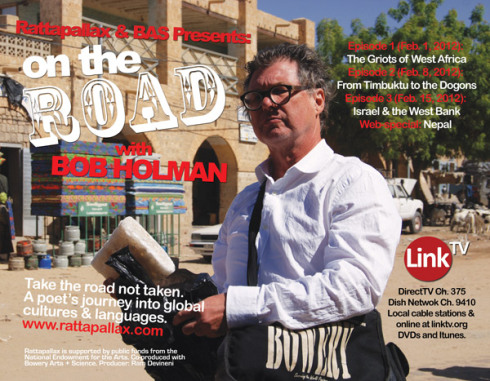
Image via On the Road with Bob Holman / Rattapallax
In April I also worked to create awareness about what we lose when we lose a language. My interview with poet Bob Holman appeared in BOMBlog.
In May I received my MFA in creative nonfiction from The New School. I had a fantastic thesis advisor and a beloved peer group, who challenged me to dig deeper in my memoir about growing up Greek American. After I read a snippet at our thesis reading, an instructor I’d never even had came up to tell me how much he liked my work!
Image via The Human Tower / Rattapallax
In June I witnessed the world record being broken for the tallest castell on a rooftop.
In July I heard Amber Tamblyn read for The Paris Review at the Strand. Afterwards we somehow ended up on the elevator together, and I didn’t say anything to her. I never know in those situations if it’s polite to say something like “nice reading” or if the person just wants her privacy. I know she’s involved in the Beat literature community, though, so I should’ve probably talked to her about that.
Image via The Millions
In August an article I wrote about a funny incident I had related to Jack Kerouac sparked a fiery debate and went viral, getting mentioned everywhere from The New Yorker to The Paris Review.
Photo via RA Araya
In September I had one of the most surreal moments of my life–reading with David Amram. I got to hear him perform again, this time as an enthralled audience member, in December.
I also road tripped through northern and central California, visiting Cannery Row, City Lights Bookshop, The Beat Museum, and attending my college friend’s wedding.
In October Hurricane Sandy hit New York, and I spent a lot of time in bed.
In November I failed miserably at NaNoWriMo, but I had a lot of fun creating this ever-evolving Pinterest board for the book I never wrote.
I also gave a reading that got upstaged by a wedding proposal.
In December there was a flurry of Jack Kerouac-related activities to promote the film adaptation of On the Road, and I got to see author Ann Charters and film director Walter Salles in person at IFC. I also got to take a writing class with screenwriter Jose Rivera at 3rd Ward.
I also went out to Lowell and got to meet Jack Kerouac’s friend and pallbearer Billy Koumantzelis.
“The parties were enormous; there were at least a hundred people at Herb Benjamin’s basement apartment in the west nineties. People overflowed into the cellar compartments near the furnace. Something was gong on in every corner, on every bed and couch, not an orgy, but just a New Year’s party with frantic screaming and wild radio music.”
You can read the whole story beginning with Neal Cassady driving Jack Kerouac’s mom back to New York for New Year’s Eve, on page 225 of On the Road: The Original Scroll, published by Penguin Books in 2008.
The recent film adaptation of On the Road does a splendid job capturing the energy at the New Year’s Eve party. Burning Furiously Beautiful: The True Story of Jack Kerouac’s “On the Road,” the book I’m coauthoring with Paul Maher Jr., tells the true-life events that inspired this story.
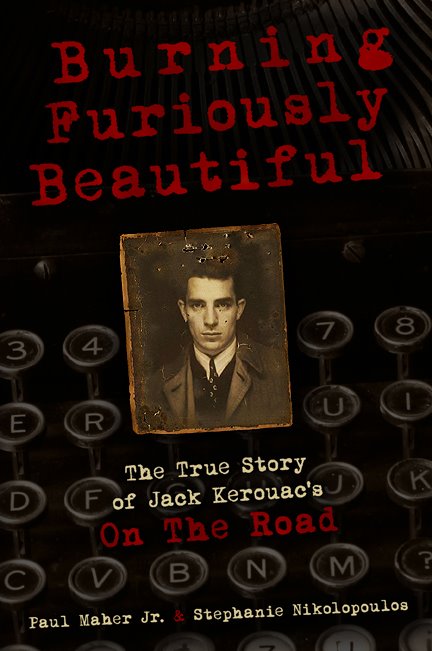
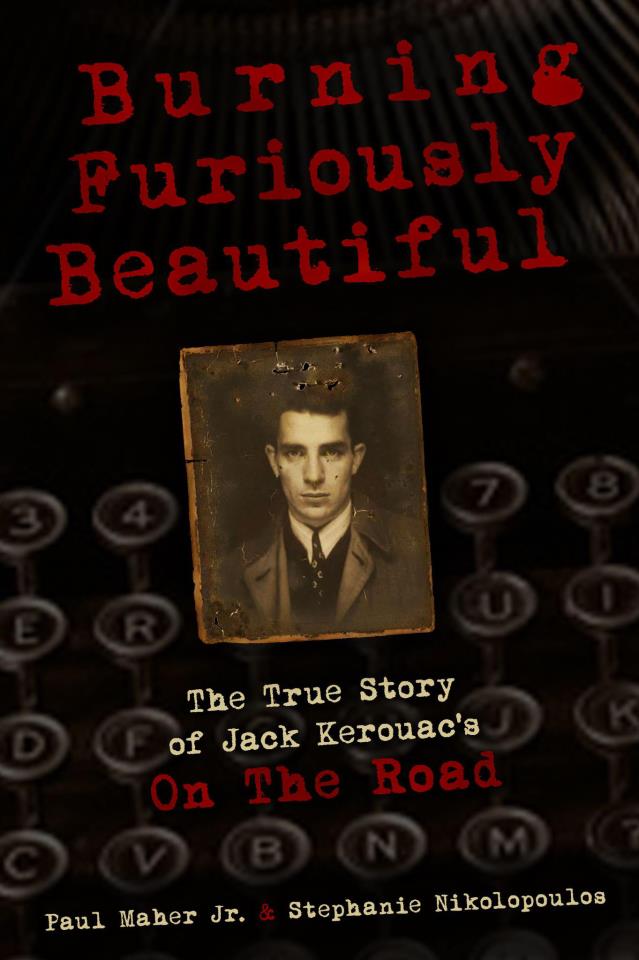
Paul took this photo of our book Burning Furiously Beautiful: The True Story of Jack Kerouac’s “On the Road.” As you can see, it’s all laid out now! It was really important to me that the book not only contain great content but that it also was visually appealing. I love that typewriter font!
The book will be out soon! In the meantime, we’re posting lots of fun content on the book’s facebook page.
At the premiere reading of Burning Furiously Beautiful: The True Story of Jack Kerouac’s On the Road, I read a section from a chapter that mentioned that Kerouac titled an early draft of his road trip novel Gone on the Road. Isn’t it amazing how one word can completely change the perception of a work?
What I didn’t mention at the reading is that this wasn’t the only incarnation of the title. At another point, Kerouac considered changing the title so that it reflected the rock music that was emerging at the time. Considering how influential jazz music was on his writing style and on the content of the book, it’s better that the title wasn’t changed just to capture a certain market. It’s always better to remain true to your voice and vision.
The title On the Road is perfect. And yet in another way it’s just so … obvious. So literal. I wonder if his work were being published for the first time today, if an editor would change the title to something flashier.
On Friday, December 14, I attended a special sneak preview of On the Roadat IFC Center in Greenwich Village. It was history in the making. At long last, Jack Kerouac’s seminal road novel had made its way to the silver screen. Kerouac himself wrote a lot about going to the movies, and he wanted his novel turned into a film. In fact, he even wrote to Marlon Brando, asking him to buy it and star in it.
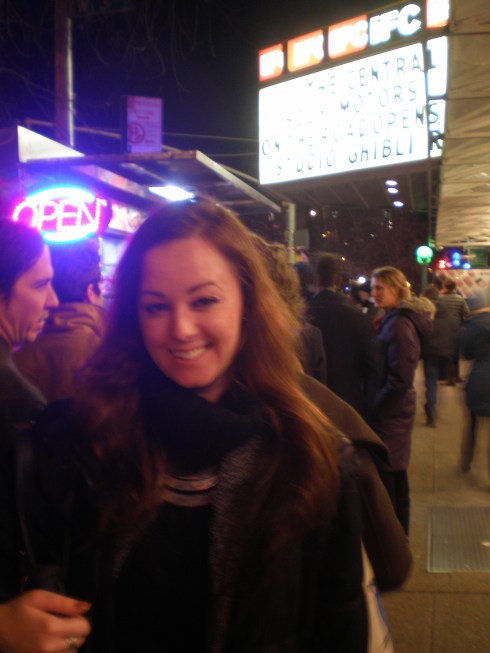
Francis Ford Coppola bought the film rights decades ago. I have a friend who wrote a screenplay that he showed to Coppola, and there have been numerous actors associated with the film adaptation, but the project always seemed to stall. Finally, Walter Salles came on as director and Jose Rivera as screenwriter, and soon after an impressive cast lined up, and the film looked like it would finally take off. And it did! It debuted at Cannes Film Festival in May 2012. Throughout the summer and into the fall, the film showed at theatres across Europe and South America. Those of us in the States read reviews, watched clips, argued about whether the novel could be adapted for film in a successful way, and debated the choices for the cast while we waited for the quintessential American story to come to us. At long last, when it was announced that a sneak preview of On the Road was taking place in the neighborhood Kerouac used to hang out in, people lined up on the Avenue of Americas for a chance to see it. As my good friend Elizabeth and I waited in line, an older man offered us $50 for our movie tickets. Considering we were so excited we were taking photos to commemorate the event, we probably weren’t the best people to try to scalp from. Needless to say, I watched the film, and, for whatever it’s worth, I can now give you my review of On the Road, which opens in New York and LA on December 21 and the rest of the country in January.
Let me start with a caveat: I am perhaps a bit too close to the subject matter to review On the Road objectively. After all, I am writing a book about the true story of On the Road. I have also heard and read reviews by a few other Beat scholars and fans and watched many Youtube clips from the film. I came in with lots of preconceived notions, and I watched the film more as a critic than as your average moviegoer. That said, I did not go into it as a literary snob wanting it to fail. I came into it wanting to see Kerouac’s work done justice.
***
On the Road is wonderfully nuanced. And to me, it’s the nuances in the acting, directing, and screenwriting that make On the Road a worthwhile adaptation of the novel. Everyone involved in the film understood that Kerouac’s novel is not just about some crazy kids driving at high speeds across the country, getting high, and getting laid. They understood that depicting this wild behavior — the film does not censor anything — was necessary not for shock value but because it underscores the complexity of the characters. In particular, the film does justice to the theme of the loss of fathers. Burning Furiously Beautiful, the book I’m coauthoring, delves into the personal life stories of the real-life people the characters are based on, giving further insight into their behavior and lifestyle. Understanding the characters’ back story elucidates their desires and actions, and the film adaptation neither glorifies nor critiques the characters. It gives them space to reveal themselves to the viewer.
Interestingly, the character that fell flat to me was the character of Sal Paradise, based on Jack Kerouac and played by Sam Riley. The actor, screenwriter, and director did a great job showing him to be an observer, which was true to Kerouac’s nature. However, the film itself was not seen through Sal’s eyes. He seemed like just another character. The landscape, the jazz shows, the parties were depicted through a neutral perspective. Not only did this make it difficult to understand Sal’s motivations and character — this is most evident in the scene with Terry (“the Mexican girl”), which isn’t developed enough for us to understand why it’s included — it meant we lost his voice. While critics over the years have focused on the road trip antics, for me, the strength of the novel was its insanely beautiful poetry. The film adaptation was more about the story and less about the literature.
Overall, though, the dialogue for the characters and the acting was phenomenal. Viggo Mortensen needs to star in a biopic on William S. Burroughs. Amy Adams took on the persona of Jane. Kristen Stewart brought a depth to Marylou that Kerouac himself didn’t. Kirsten Dunst showed great emotion in her scenes. Tom Sturridge played Carlo Marx with intensity but also surprising humor; his dialogue was quintessential Ginsberg: dramatic and over the top. Elisabeth Moss’ Galatea was a nice contrast to the other characters, while Danny Morgan’s Ed was a bit too goofy; these two characters are the reason the characters end up at Old Bull Lee and Janes’s place, but if it weren’t for that they could’ve been edited out for the film. Garrett Hedlund was charismatic. He lit up the screen.
My most pressing criticism of the film is that it felt a bit too much like a period piece for my personal preference. I was impressed that the film was historically accurate, and yet I found myself distracted by those details. For example, when the focus was on the exterior of the Hudson, it made the story feel removed instead of vibrant; yet the shots within the car or from the viewpoint of the passenger were beautiful. Likewise, there were times when the wallpaper in a room jumped out at me more than it probably should have. I’m by no means suggesting the story should have been modernized, but the setting and props should not overpower the story. There were also scenes like the one at the jazz club which felt staged, almost cartoonish. I would’ve liked something a bit more raw, a bit grittier or impressionist.
In contrast, the New Year’s Eve party was sheer brilliance. Here were fast cuts and disorienting angles. Here were sweat and thrashing limbs. Here was jazz you wanted to dance to. Here was the energy that made you want to shout go, go, go! There were also beautiful quiet moments laced throughout the film. Poetic landscape. Honest heart-to-hearts. Subtle glances. Almost any time the characters were on the road, the dialogue, the filmography, and the acting were spot on.
The film adaptation of On the Road may enlighten some people’s perception of Jack Kerouac.
I am so excited to have been tagged by Maria Karamitsos for the The Next Big Thing Blog Hop. Even though I’m not a mother, I love reading Maria’s blog From the Mommy Files, which is full of humor and light. She has the gift of storytelling. Her blog entries read like snippets of a novel-like memoir, with dialogue, reflection, and a strong voice, despite the fact that much of her writing is focused on what could be a very technical topic: molar pregnancy. Take for instance, her post “The Influence of the Lost Child,” in which she talks to her two adorable little girls—”BooBoo BeDoux” and “Bebs LaRoux”—about the baby she miscarried. It’s a difficult and heartbreaking subject, yet she injects humor in it through the personalities of her daughters (“it’s tough to be 3, after all!”) as well as tenderness and faith. I’m really excited about the book she’s writing called Positive About Negative: Adventures in Molar Pregnancy. Maria also tagged some other Greek authors for the Blog Hop, and it’s great discovering all these writers.
I’m tempted therefore to write about my memoir about being Greek American, but since my book on Jack Kerouac is coming out first my answers to the Blog Hop questions are about that book.
What is the working title of your book? Burning Furiously Beautiful: The True Story of Jack Kerouac’s On the Road
Where did the idea come from for the book? Paul Maher Jr. had written a book entitled Jack Kerouac’s American Journey: The Real-Life Odyssey of “On the Road” for the fiftieth anniversary of the publication of Kerouac’s seminal work. I had read this book one summer and some months later began reading Paul’s blog. We began talking and decided to revise and expand his book because we knew that a film adaptation of On the Road was coming out and we wanted to provide a resource for those interested in finding out more about this famous novel. It was important to us that the book had a strong narrative, contextual information, and new research because we wanted both the teenager turned on from the film and the literary scholar who’s read every book by Kerouac to enjoy it and find value in it.
What genre does your book fall under? It’s literary criticism and biography.
Which actors would you choose to play your characters in a movie rendition? Isn’t that the million dollar question? There’s been a lot of talk over the years about who should play Sal Paradise and Dean Moriarty in the film adaptation of On the Road. Johnny Depp, Brad Pitt, Colin Farrell, Marlon Brando, you name it, they’ve been associated with it. I almost never go to the movies and don’t really know the young actors of today well enough to say who would be age appropriate to cast. Joseph Gordon-Levitt? Zac Efron? These actors are too old to play the roles now but if I were casting the film back when I first read On the Road as a teenager, this is who I’d pick:
Sal Paradise — Johnny Depp and Ethan Hawke would be excellent choices for Sal Paradise, particularly because they both have a deep appreciation for literature. Depp is a known Kerouac fan and just started his own publishing imprint, and Hawke is a published author.
Dean Moriarty — Woody Harrelson would make a great Dean Moriarty. He can play both earnest and wild so well! Matthew McConaughey would be great as Dean too.
Carlo Marx — I loved James Franco’s portrayal of Allen Ginsberg in Howl, but if I had to select someone else I might go with AdamGoldberg.
Old Bull Lee — The choice of Viggo Mortensen as Old Bull Lee for the Walter Salles film is brilliant, but again if I had to choose someone else maybe I’d with Ewan McGregor.
Marylou — Drew Barrymore would be so much fun to watch as Marylou. Do you remember her in Mad Loveand Boys on the Side? Almost Famous hadn’t been made yet when I was a teenager but Kate Hudson (think Penny Lane) would be my runner-up pick.
What is the one-sentence synopsis of your book? Burning Furiously Beautiful tells the true story of Jack Kerouac travels on the road and how it took him years, not weeks, to write On the Road.
Will your book be self-published or represented by an agency? We decided to self-publish Burning Furiously Beautiful.
How long did it take you to write the first draft of your manuscript? The first draft, so to speak, had already been written and published as Jack Kerouac’s American Journey.
What other books would you compare this story to within your genre? There have been so many biographies of Kerouac written over the years, and each offers its own perspective. Burning Furiously Beautiful uses Kerouac’s journals and letters, as well as archival material from other people who knew Kerouac during the time he was on the road and writing On the Road, to tell a the specific story of the making of a novel that continues to generate interest today.
Who or What inspired you to write this book? Obviously, Paul Maher Jr. inspired Burning Furiously Beautiful as it was his original idea. I, however, had been researching and writing about Kerouac since I was an undergrad many years prior to this and brought my own knowledge and skills to the project. I was very much inspired by the fact that the film adaptation is soon to be released here in the States. There’s a whole new generation coming to Kerouac’s literature, which is immensely exciting to me. Reading Kerouac when I was in high school opened up so many possibilities for me as a reader and writer. I hope that the film will pique people’s interest so that they’ll go back and read Kerouac’s books for themselves—not just On the Road but his other great works as well—and that they’ll watch Pull My Daisy, the film that Kerouac himself spontaneously narrated. Burning Furiously Beautiful is important because it contextualizes On the Road and provides a fascinating look at Kerouac’s life and writing process. This is critical because there’s so much myth surrounding Kerouac and the 1950s. I became engrossed in odd little details like the fact that the Kerouac’s didn’t have a phone and took their calls at the store below their apartment in Queens. It’s so different than today when it seems like every middle schooler has a cell phone. If Cassady could’ve just called Kerouac up on his iphone, he might not have written the infamous Joan Anderson letter that spurred on Kerouac’s writing style.
What else about your book might pique the reader’s interest?Burning Furiously Beautiful is a great book for an aspiring writer, regardless of whether or not you like Kerouac’s writing style. It’s a portrait of a young writer and details how his writing voice developed (his first book has a much different style), what his writing routine was, the editing process (yes, there was one!), what his relationship with other writers and editors was like (imagine lots of parties), and the many false starts he had in writing his book. We even talk about book signings, contracts, and press interviews. Sometimes I’ve felt frustrated with various writing projects of mine, but realizing that Kerouac, who purported to have written On the Road in only three weeks, went through some of the same struggles and took years to find success makes me realize that it’s all part of the writing process.
Part of the way Kerouac wrote his novels was to sit down at a typewriter and write, write, write til the story was told. There’s something to be said about this. The intensity of writing a whole novel in a short time span drives the work. It’s so easy as an author to get distracted, to start something and never complete it, to get so caught up in getting syntax correct that the story never moves forward. The “backspace” button on the computer keyboard is all too familiar to most authors, struggling as self-editors. We want to get it right. Sometimes this happens at the expense of getting it done at all.
While many would disagree, some authors believe that the key to writing is to push out a first draft. Once the backbone of the story is there on the page, the author can always go back and edit it. Most times, the editing process is the longest and most arduous. Whole sections are moved or deleted. Characters are killed off if they’re not important. Diction is tightened.
I decided to participate in NaNoWriMo — National Novel Writing Month — this year to gain a better sense of what Kerouac went through when he wrote his books. Call it “method writing” to understand the subject of my book better.













 Stephanie Nikolopoulos