It’s my b-day celebration… With artists friends at a nice hip restaurant bar with a stage in the back room, free admission with a one drink or coffee minimum… ’tis to be a sweet four hour event, come and go and come back for more on a Sunday that’s surely be filled with fine seasoned performers… Open-mic with band backing yer poetry or and music… Don’t bring a present, bring a poem 🙂 -R!
Seriously, seriously excited about reading while Flashbackpuppy plays and hearing all the other amazing poets and performers. This also will be my debut reading from Burning Furiously Beautiful.
While I was getting my MFA in creative nonfiction at The New School, I kept walking by a Greek restaurant that was being built on University Place. When it finally opened, I was drowning in writing my thesis and Burning Furiously Beautiful. Right before the semester ended my writer friend Allison–who is obsessed with Greece (a good thing considering all the Greek stories I shared in class)–and I went to check it out. Village Taverna was definitely worth the wait.
The food at Village Taverna is classic Greek taverna fare served up in a spacious, beautiful dining area with a casual vibe. The portions were generous–and delicious. I didn’t try the wine, but they have an impressive Greek wine list. Village Taverna has the best vegetarian gyro in New York–the grilled vegetables pita wrap. I want to go back and try their meze–tzatziki and veggie chips, namely–and vegetarian moussaka (it has artichokes in it!).
Who’s with me?!
Village Taverna is located at 81 University Place.
I have so many friends right now who either just got married or are in the process of planning their weddings. There’s so much to consider: venues, wedding cake ganache, narrowing down the guest list, who sits next to whom, DIYing centerpieces, the dress.
Eloping sounds better and better…. And what better way than eloping on the road?!
Green Wedding Shoes featured a couple who got married on the road. Their wedding photos feature retro suitcases, maps, and the classic hand-out-the-window shot.
Did you know that when Jack Kerouac, the author of On the Road, got married he was quite the opposite of being on the road? He’d been arrested as a material witness of a murder. His dad was so upset he refused to post bail. But his girlfriend, Edie Parker, came from a wealthy family. She said she’d post bail—on one condition: that Kerouac agreed to marry her. You can read the whole story in Burning Furiously Beautiful.
I knew I was getting old the day I saw a car commercial where the driver was clearly younger than I am.
So here’s an interesting bit of news: Generation Y doesn’t like to drive. According to Reuter’s “America’s Generation Y not driven to drive,” the Millennials think driving is more of a hassle than it’s worth. A California think tank analyst, Tony Dudzik says instead of a driver’s license, a cell phone is the new rite of passage for young adults.
The article points to a few different reasons why Generation Y may be less interested in driving:
Smart phones make it easier to know public transportation schedules
More Gen-Yers are riding bikes
People are more concerned about saving the planet
Car-sharing services are making it easier not to have to own a car
From a cultural perspective, this makes total sense. Gen Y is the hipster culture. The kids in Williamsburg who listen to low-fi indie music on their hi-tech iphone, knit water-bottle cozies that they sell on etsy, ride their bicycles to work, buy their clothes from Buffalo Exchange, spend their weekends at the food coop, brew their own craft beer, and vlog on YouTube. If they drive, they drive hybrids. Because they’re all about the i-this and the i-that, they seek out community more intentionally. Who needs a car, if your friend or parents (they also happen to be the Peter Pan Generation, living at home after college) have one?
I personally fall somewhere between Gen X and Gen Y, making me part of Generation Flux. Generation X refers to people born between the early 1960s and 1980s, while Generation Y refers those born between the late 1970s and the 2000s. I know when I was growing up, there were a lot of cultural arts programs in the school about saving the rainforest and saving the whales, we studied acid rain and the ozone layer, and we joined KAP: Kids Against Pollution. In drivers ed, they pretty much terrified you with statistics, photos, and videos that suggested it was likely you were going to die if you got behind the wheel. The shows that were popular when I was a teen were Mad About You, Seinfeld, Friends, Will & Grace, and Sex and the City, all of which were set in New York City. Other popular shows like Ally McBeal, Frasier, and ER were also set in cities. Our stars didn’t drive. They took cabs and rode the subway. Is it any surprise that we moved into the city and followed suit?
So will a generation who grew up watching Paris Hilton, Lindsey Lohan, and Snooki getting arrested for driving under the influence and/or crashing their cars, a generation coming of age during the Great Recession, a generation who doesn’t care about driving, embrace the 1950s road trip adventure of On the Road when the movie comes out and the novel by Jack Kerouac it is based on? Well, here’s another interesting twist: Jack Kerouac didn’t like driving either. If you read his novel, you’ll see that most of the time, the character based on him in the novel is on the bus or in the passenger seat.
How do you feel like the era you grew up in influenced you?
Aunt13 over on 8tracks made a mix called Music and Poetry for On the Road. It’s inspired by Jack Kerouac’s On the Road and in the blurb she mentions Burning Furiously Beautiful! How cool is that?!
I have the coolest friends! I am going to be listening to this while I write, for sure, and daydreaming of hitting the road. Aunt13 has over 300 mixes, so be sure to show her some love.
You may recall I posted a while back the soundtrack for the On the Road film. It was just announced yesterday that the film will be making its US debut in late fall.
J. Haeske also made a mix for the soundtrack he’d envision for the film. Teaser! I have an interview with him about his new book on Kerouac lined up for you, so stay tuned.
What songs would you put on a mix for On the Road?
Also, I took my own advice about social media, and created a Facebook page for Burning Furiously Beautiful: The True Story of Jack Kerouac’s On the Road, the book I’m co-authoring with Paul Maher Jr. Be sure to “like” the book on Facebook! We’ll be posting news about the book, information from Across the Underwood, updates on the film, and so much more!
You probably have a pretty good idea by now of what Burning Furiously Beautiful: The True Story of Jack Kerouac’s On the Road is about, but here’s the official synopsis:
Fueled by coffee and pea soup, Jack Kerouac speed-typed On the Road in just three weeks in April 1951. He’d been traveling America for the past ten years and now, at last, the furious energy of his experiences flowed through his fingertips in a mad rush, pealing forth on a makeshift scroll that he laboriously taped together. The On the Road scroll has since become literary legend, and now Burning Furiously Beautiful sets the record straight, uncovering, among other things, the true story behind one of America’s greatest novels.
With unprecedented access to Kerouac’s journals and letters, Burning Furiously Beautiful explores the real lives of the key characters of the novel—Sal Paradise, Dean Moriarty, Carlo Marx, Old Bull Hubbard, Camille, Marylou, and others. Ride along on the real-life adventures through 1940s America that inspired On the Road. By tracing the evolution of Kerouac’s literary development and revealing his startlingly original writing style, this book explains how it took years—not weeks—to ultimately write the seemingly sporadic 1957 novel, On the Road. This revised and expanded edition of Jack Kerouac’s American Journey (2007) takes a closer look at the rise of Jack Kerouac and the Beat Generation.
Paul Maher Jr. is the author of the critically acclaimed biography Kerouac: His Life and Work and Empty Phantoms: Interviews and Encounters with Jack Kerouac.
Stephanie Nikolopoulos is an editor and writer based in New York City.
Maher and Nikolopoulos are currently co-authoring Visions of Kerouac for Rowman & Littlefield (2014).
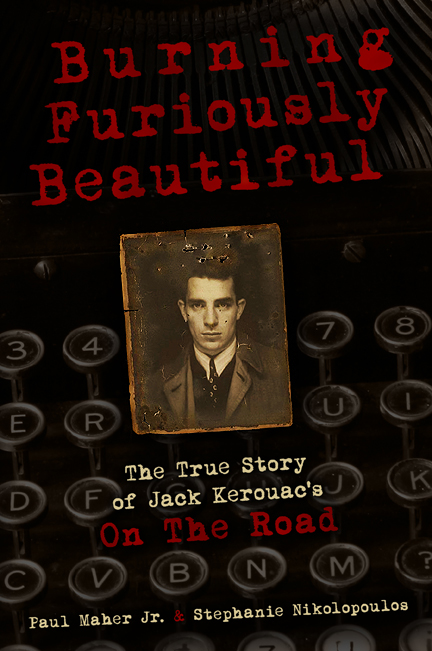
Here’s a sneak peek of the cover design for Burning Furiously Beautiful: The True Story of Jack Kerouac’s On the Road, which I am co-authoring with critically acclaimed Kerouac scholar Paul Maher Jr.
Award-winning designer Igor Satanovsky created the cover. Igor also happens to be a poet in his own right and studied poetry under Allen Ginsberg at City University of New York-Brooklyn College.
When Jack Kerouac went off to Columbia University, he told people he was going to be a journalist. His father, Leo Kerouac, was a printer in Lowell, who owned a print shop called Spotlight Print. Leo handled printing for some of the big businesses in New England, and also did a bit of writing of his own. This inspired Ti Jean, as little Jack was called. He used to lay on the floor, creating his own little newspapers and comics.
In school in New York, first at Horace Mann prep school and then at Columbia, Kerouac contributed to the school newspapers. The writing he did for the papers would best be described as music journalism. He soaked in all the great 1940s bebop of Harlem and wrote jazz reviews.
There was no Pitchfork at the time. Rolling Stone magazine wasn’t founded until 1967. Even many of today’s popular jazz magazines weren’t in existence yet. Music journalism didn’t have the esteem that it does today.
Jack Kerouac may not have gone on to become a famous music critic or any sort of journalist in the traditional sense of the word, but his jazz reviews were not in vain. Writing music reviews, he honed his craft. He learned to listen well, and he learned how to recreate the excitement of a live gig on the page. This all went into his future novels. In On the Road, Kerouac wrote about experiencing jazz firsthand. Today, his books, even if they contain fictional elements, are testaments to the music of the 1940s and ‘50s. Although he may have obscured the names of his friends, the names of musicians and famous jazz clubs remain intact.
Furthermore, bebop style influenced the way Kerouac wrote. He learned about the notion of spontaneity and incorporated it into his own work. His writing style echoes the rawness and the genius of live, spontaneous jazz.
In Burning Furiously Beautiful, Paul Maher Jr. and I write about some of the great jazz clubs of the 1940s and ‘50s that Kerouac visited while he criss-crossed the country. The book tells the true story behind On the Road. It is a portrait of Jack Kerouac, but it’s also a portrait of the United States. In mentioning these jazz clubs that Kerouac visited, we examine a bit of America’s cultural history.
In case for some reason you haven’t seen the trailer for Walter Salles’ On the Road, screenplay by Jose Rivera, here it is. It will star Sam Riley as Sal Paradise, Garrett Hedlund as Dean Moriarty, Kristen Stewart as Marylou, Kirsten Dunst as Camille, Tom Sturridge as Carlo Marx, Viggo Mortensen as Old Bull Lee, Amy Adams as Jane, Alice Braga as Terry, and Danny Morgan as Ed Dunkel.
Cast your opinions in the comments section….
From a purely cinematic standpoint, the landscape looks beautiful. I’ve been following the production of the film for a while and paying particular attention to filming locations. If you think about it, The United States is a character in the book and in the film so it deserves attention, and I think Walter Salles, who directed The Motorcycle Diaries, can accomplish that.
The book I’m coauthoring with Paul Maher Jr., Burning Furiously Beautiful, details the places Jack Kerouac visited and was inspired by when writing On the Road. If you check out our Pinterest board, you can see just how incredible the landscape and history of the places Sal Paradise and Dean Moriarty visit are.




 Stephanie Nikolopoulos