Tag Archives: On the Road

See You Tonight at the Album Release Party

13 Sep

Harrod

Just a reminder that I’ll be reading TONIGHT at Jason Harrod’s album release party!

Here are the essentials:::

When: September 13 @ 7:30pm

Where: IAM (International Art Movement), located at 38 West 39th Street, 3rd Floor, NYC.

Cost: There’s a $10 suggested donation. Wine, beer, and hors d’oeuvres will be available.

Bonus: Musicians Paul and Bets will also be performing.


I’ll be reading from Burning Furiously Beautiful: The True Story of Jack Kerouac’s “On the Road,” which I’m coauthoring with prolific biographer Paul Maher Jr.

I’ll also be reading a personal essay about a road trip I took across the country. The essay was published by Burnside Writers Collective, a website founded by Donald Miller (author of Blue Like Jazz) and Jordan Green.

Both of the stories I’ll be sharing about feeling beat, down and out, yet still searching, wrestling, clinging to God.

Hope to see you there!

* * *

Also, save the date: Thursday, September 19, at 6pm, I’ll be in conversation with Tim Z. Hernandez, author of the beautiful book Manana Means Heaven, at La Casa Azul in Spanish Harlem.

I’ll post on that next week, but in the meantime you can find out more in Appearances.

“On the Road”‘s Dilemma

12 Sep

logo-sm

“[M]ost people (perhaps increasingly) don’t seem to be drawn to fiction that offers more questions than answers,” writes Rob Roberge in “Literary Fiction’s Dilemma” for The Rumpus. Toward the end of the essay, the MFA professor and author of The Cost of Living writes:

We are messy creatures. Beautiful, flawed, disturbed, at times selfless and at times selfish animals left to attempt to make sense of a world that doesn’t lend itself to easy questions or easy answers. To document a world where we are neither gods nor beasts but often a mix of both is to document a world most don’t like to think about.

Roberge makes an interesting—and beautifully written—point that we are complicated beings made up of good and bad characteristics. I wouldn’t necessarily say we don’t want to acknowledge the fact that we don’t live in a black-and-white, all-or-nothing world because I think it’s a very American trait to want to see the silver lining in something and to want to hear a comeback story. I would argue we even prefer our characters a little flawed. We like Jo March, Rodion Raskolnikov, Jay Gatsby, and Tom Sawyer. But I think Roberge is onto something. Even if we don’t desire perfect, goody-two-shoes characters—and I don’t mean to say Roberge is suggesting we do—I think we want the author’s point of view to be morally clear.

Roberge’s thesis does not mention Jack Kerouac, but it got me thinking about the criticism I’ve read about On the Road. So many articles I’ve read about Kerouac’s novel and the recent film adaptation refer to morality:

David Depsey’s 1957 article “In Pursuit of ‘Kicks’” in The New York Times:

Today, one depression and two wars later, in order to remain uncommitted one must at least flirt with depravity. “On The Road” belongs to the new Bohemianism in American fiction in which an experimental style is combined with eccentric characters and a morally neutral point of view.

Referring to Norman Podhoretz’s 1958 essay “The Know-Nothing Bohemians,” Andrew O’Hagan writes the following in the New York Review of Books article “Jack Kerouac: Crossing the Line”:

In actual fact the Beats now seem pretty innocent: far from being a threatening group of “morally gruesome” primitives, they were a bunch of college kids with a few new things to offer.

Yahoo! Movies describes the film On the Road saying:

Dean is extremely charming and has a flexible moral code….

Amanda Chen reviewed the film for Scene Creek:

If you have a thirst for adventure and a loose line of morality, you will enjoy all that Walter Salles has to offer in his cinematic interpretation of Jack Kerouac’s novel, On The Road.

Ann Hornaday reviewed it for the Washington Post:

The literary and larger cultural argument that Kerouac’s book ignited and engaged — about formalism, narrative, morality and breaking open new ways of being and expression — is virtually nonexistent in “On the Road,” Walter Salles’s warm but strangely staid adaptation of a piece of literature that was never meant to be tamed as cinema.

Robert Moor writes in “On The Road Again” for the Paris Review:

The moral atmosphere of American life has changed considerably over the past half century; we have moved towards Kerouac’s liberal ideals, which has slackened the tension between the lived and the imagined.

An anonymous poster on Barnes & Noble left this review:

I can give you symbolism for every event in Vonnegut’s Cat’s Cradle. I can give you the moral, philosophical points of Burgess’ A Clockwork Orange. I can decode the works of Burroughs. But ‘On the Road’ left me feeling like it was pointless…a good, enjoyable read, but…pointless.

These reviews would make one think that Kerouac was the first writer to ever write about characters with flaws, that somehow literature up until 1957 was devoid of characters who did “bad” things—or at least if they were immoral they were severely punished for their crimes. I get the sense that they want to see Dean Moriarty die in a fiery car crash or repent of his sins and devote his life to helping winos and pregnant teens. But that’s not how life works, and I think the beauty of On the Road is that it is complex.

Roberge says readers have trouble with work that “offers more questions than answers.” Interestingly, despite criticism to the contrary, it would appear that Kerouac believed he found good, moral answers:

Dean and I were embarked on a journey through post-Whitman America to FIND that America and to FIND the inherent goodness in American man. It was really a story about 2 Catholic buddies roaming the country in search of God. And we found him.

Kerouac’s characters are complex, flawed, blessed, messy, striking, honest, real. They ask questions we might very well be asking ourselves.

You might also like:

Life Continues to Be Absurd: Saul Bellow, Jack Kerouac, F. Scott Fitzgerald, and Joseph O’Niell

On the Road Turns 56

5 Sep

OnTheRoadimage of the first edition via Wikipedia


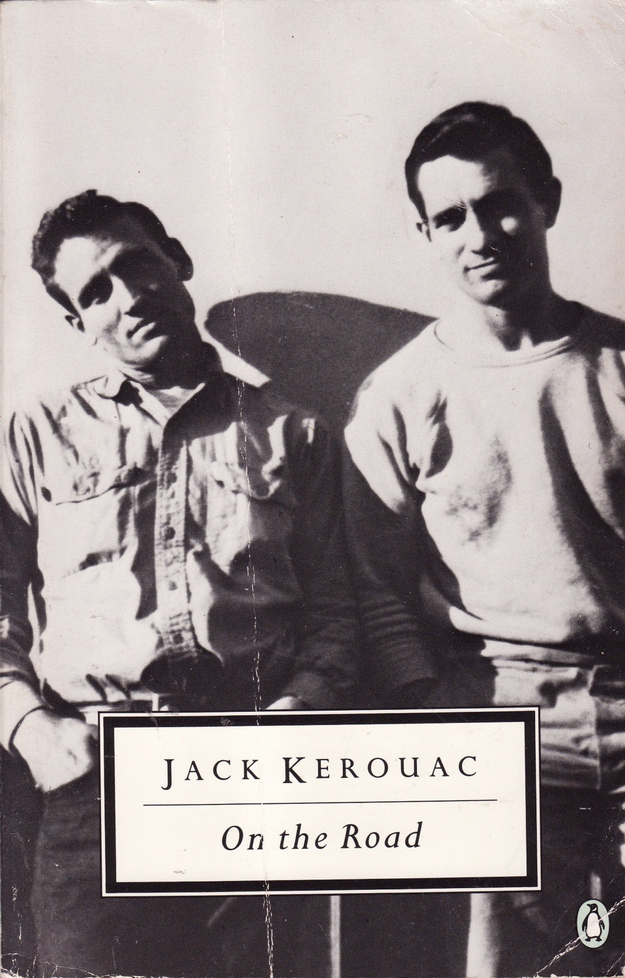
After years of work and years of trying to find a publisher, Jack Kerouac’s On the Road was published by Viking Press on this day in 1957.

20 Reasons to Read “On the Road” in Your 20s

14 Aug

kerouac2

It recently came to my attention that Buzzfeed posted an article called “65 Books You Need to Read In Your 20s,” and I immediately knew Jack Kerouac would make the cut. After all, so many people have told me Kerouac is for young people.

First, though, at number 18 came Ernest Hemingway’s The Sun Also Rises. The write up states:

Another English syllabus special, Hemingway’s tight prose and peerless storytelling are somehow more resonant when you are reading it on your own. Or as my colleague Matt put it: “I couldn’t keep my eyes open for more than five pages of Hemingway growing up, but for some reason I picked this up in my post-graduation haze and was mesmerized.”

I can see that. I was none too fond of Hemingway when I had to read The Snows of Kilimanjaro in class but post-grad enjoyed The Sun Also Rises. It’s been quite some time since I’ve read it and have been thinking I should reread it.


So what do we hear when we get to Kerouac, at number 34? A solitary, cynical line:


So that you’ll realize the way you felt about this book in high school has totally changed.


Really? Kerouac made the list just so that the blogger could diss On the Road? I’m all for personal growth and maturity, and I can certainly understand how some books are more relatable when you’re young, but, even if one thinks that’s the case with On the Road, why suggest someone “waste” valuable reading time rereading it then? Furthermore, why single out On the Road and not, say, Catcher in the Rye? And, if On the Road is deemed a book for teenagers, what are we to make of all the legions of adults who read Harry Potter?


I first read On the Road when I was a teenager, and I read it again when I was in my twenties. And guess what? I continue to pick it up and find inspiration from it. In fact, I think I appreciate certain aspects of it more now than I did when I read it in my teens. Therefore, I’d like to propose reasons why you should read On the Road in your twenties:

  1. Jack Kerouac who? You were busy with homework, video games, and the mall, and never read anything but assigned reading—which never included Jack Kerouac. That’s okay, you can read On the Road now.
  2. You understand more about history and politics now that you’re older and consequently can better understand the significance of this novel being written by an author who served in the Merchant Marine during World War II.
  3. You had heard about the Great Depression, but you didn’t know back then how that was tied to literary movements, and now you can see how money has shaped the art from The Great Gatsby to The Grapes of Wrath to On the Road.
  4. Much of contemporary literature uses a conversational voice so it never occurred to you that Jack Kerouac’s voice, diction, and stream of consciousness were revolutionary for his time period.
  5. You’ve delved into Allen Ginsberg, William S. Burroughs, Gregory Corso, amongst others, and now can make your own judgment about whether or not the term “The Beat Generation” is useful and appropriate.
  6. The main characters in On the Road are in their twenties. The struggles they face growing up and becoming mature adults are the same ones you now face.
  7. You weren’t allowed to take a bus across the country when you were a teenager. But now you can!
  8. You lived a quiet life in the suburbs as a teenager and weren’t exposed to people who’d been in jail, habitually did drugs, married and divorced, and didn’t hold down steady jobs as adults. Those characters may feel less foreign to you as you get older, and you may see them differently now.
  9. When you read the novel as a teenager, you thought Dean Moriarty was the hero. You’re not so sure anymore. This makes Kerouac’s portrayal of him even more intriguing.
  10. You skipped past all those setting descriptions, but now you realize they are pure poetry.
  11. The frenetic travels in the novel seemed exhilarating but confusing or pointless the first time you read the novel. Now, you can examine that as an intentional plot device.
  12. You didn’t think much of the religious aspects of the novel, but now, having heard more about Kerouac’s Catholicism and Buddhism, you can’t help but analyze their significance. This could change your perception.
  13. You enjoyed the romance of “the Mexican girl,” but you didn’t think too much about Kerouac’s portrayal of Mexican and Mexican American field workers, and now you can draw parallels to today’s discussions on the treatment of certain ethnic groups in America.
  14. You want to learn how to write better dialogue.
  15. You read the characters through a contemporary lens when you were younger, but now that you know more about the 1940s and ‘50s you have a greater understanding of the social norms of the time and how they relate to masculinity and gender roles. This can allow you to reexamine issues of identity, misogyny, and power in a novel that includes heterosexuals, bisexuals, homosexuals, male leads, and female minor characters.
  16. You realize in many ways the novel is a love story of America.
  17. You have actually listened to jazz by your twenties and read a little about music theory and now understand its role in the novel and its influence on Kerouac’s prose stylings.
  18. Cars have always been a part of your life, but now that more people your age are eschewing driving, you have a greater appreciation for the socio-economic dynamics of car culture.
  19. You realize that maybe in your younger years you were a bit of a follower, like Sal Paradise, and are now seizing the moment and establishing your own life.
  20. You want to learn how to experiment with syntax.

What would you add to this list?

Friday Links: Homer and Kerouac

26 Jul

the-odyssey

Happy Friday! Any exciting plans for the weekend? I’ll be at the New York City Poetry Festival. Poet RA Araya invited me to read as part of the line up for Miguel Algarin’s Brooklyn Poetry happening on Saturday at 11:40 at the Algonquin stage on Governor’s Island. If you want to come, take the first ferry out of Battery Park. It’s free! The ferry’s free, the poetry reading is free. If it’s anything like last year, you can envision yourself lofting in the grass and losing yourself to the Siren-pull of beautiful words. Speaking of Sirens, I’ll be reading from The Odyssey in its original Homeric Greek (help!) and from the book I’m coauthoring with Paul Maher Jr., Burning Furiously Beautiful: The True Story of Jack Kerouac’s “On the Road.”

In light of this, here are a few Friday links on the topic.

Literary Elitism vs. Populism (Is Homer much better than Kerouac?)

The New Yorker rejects Homer and Kerouac

Paul Maher Jr.’s Jack Kerouac’s American Journey: The Real-Life Odyssey of “On the Road”

“Like Odysseus in Homer’s poems, Kerouac in The Duluoz Legend is a restless adventurer that embarks on an epic journey — an Odyssean archetype of the indomitable wanderer in modern guise,” writes LewRockwell.com

“Dean Moriarty was the Odysseus of Tennyson not Homer, sailing away again from his island-kingdom not because he loved his family less, but because he loved more the drumbeat of heroic adventure in his breast,” writes HistoryJournal.org

Steve McCurry looks at Travelers’ Tales

“[T]he Odyssean archetype of the indomitable wanderer has persisted down to modern times in works as diverse as James Joyce’s “Ulysses,” Jack Kerouac’s “On the Road,” Charles Frazier’s “Cold Mountain,” and even in the film “O Brother, Where Art Though?” in 2000,” writes Lubbock Avalanche-Journal

Everything since the Greeks has been predicted wrong, he says, because geometrical systems of thinking are fundamentally flawed. On the Road, then, is not just a travel memoir, a series of successive “kicks” from travel and all its accompaniments; it is Kerouac’s aesthetic manifesto that he sets up in opposition to the dominant idea of beauty-as-geometrical-harmony. This is why On the Road arrives out of nowhere and goes nowhere. That is why if you look for structure, for symmetry, for a narrative with a categorical beginning, a clear ending and internal consistency throughout, you will be disappointed,” writes anenduringromantic

“I listened to Snyder attentively. I wanted to understand more. In preparing to write the nonfiction saga of our long walk across Turtle Island –  Odyssey of the 8th Fire – I’d been informed by books telling of our human journey: Homer’s Odyssey, Chaucer’s Canterbury Tales, Steinbeck’s Travels with Charlie, William Least Heat Moon’s Blue Highways,  Cervantes’ Don Quixote, and Paolo Cohelo’sThe Pilgrimage. Inevitably, Kerouac’s On the Road also touched me with its entraining cross-America accounts of reaching outward, inward, downward, upward,” writes Steven McFadden


Kristen Stewart Hits the Road

19 Jun

Kristen-Stewart-On-the-Road

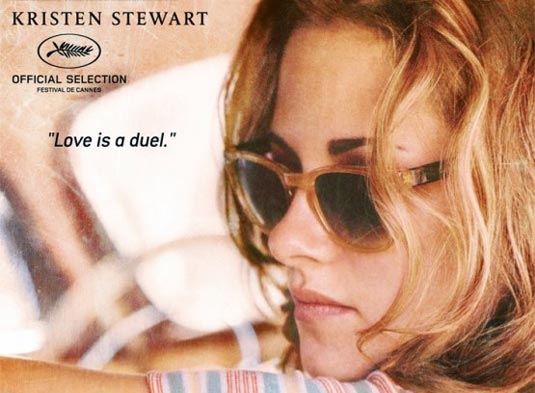
Kristen Stewart, who played Marylou in the film adaptation of Jack Kerouac’s On the Road, is reportedly on a summer road trip in the South. According to several sources, she’s been hanging out at bars and shooting pool in Amarillo, Texas, and Memphis, Tennessee, and is on her way to New Orleans, Louisiana. Among the hotspots stops on her visits: Coyote Ugly Saloon.

Prior to filming On the Road, Stewart had taken a four-week Beatnik Book Camp and taken a road trip. According to Hollywood Life, at a 2012 screening at SVA, she told reporters she avoided the “grimiest” aspects of road tripping.

In March of this year, she and then-boyfriend Robert Pattinson were planning a road trip in Europe for this summer. They were talking about traveling around Italy, Germany, and France in a van. So will they or won’t they? The rumor mill can’t decide.

Here’s my review of the film adaptation of On the Road.

On the Road Gets a Girly Makeover

4 Jun

book-coverimage via Cup of Jo

The cover of Jack Kerouac’s On the Road got a girly makeover last month as part of author Maureen Johnson’s challenge Coverflip, which asked people to imagine how the covers of famous books would look if they had been written by people of the opposite gender.

The experiment stems from the growing conversation surrounding how books are gendered. For more on this subject, I’d recommend reading Deboarah Copaken Kogan’s article “My So-Called ‘Post-Feminist’ Life in Arts and Letters” for The Nation, about the title and cover for her memoir Shutterbabe about her years as a war photographer. (See the disconnect? babe. war.)

The feminized cover of On the Road seen above—a fake, done in jest to prove Johnson’s point that covers are gendered—interestingly enough bears a resemblance to the real marketing materials for the recent film adaptation of Kerouac’s novel. Whether it was the film poster or the trailer, Kristen Stewart—who played LuAnne—was front and center. The US edition of the movie tie-in novel went with a collage effect but check out this Italian cover:

cover2


Lest you think the Italians are alone for some reason, it’s the same cover used for the Australian edition and the French edition.

What are we to make of the fact the movie-tie in editions look more like the fake Coverflip experiment than more recent printings of On the Road? Are the marketing teams behind these new editions trying to appeal to young women? Are they assuaging misogynistic critiques by giving a female character more attention—or are they actually embracing misogyny by using an image of a woman as a marketing tool?

For more on this subject, you might like:

Judging On the Road by Its Covers

Research, Research, Research

29 May

WP_20130525_001

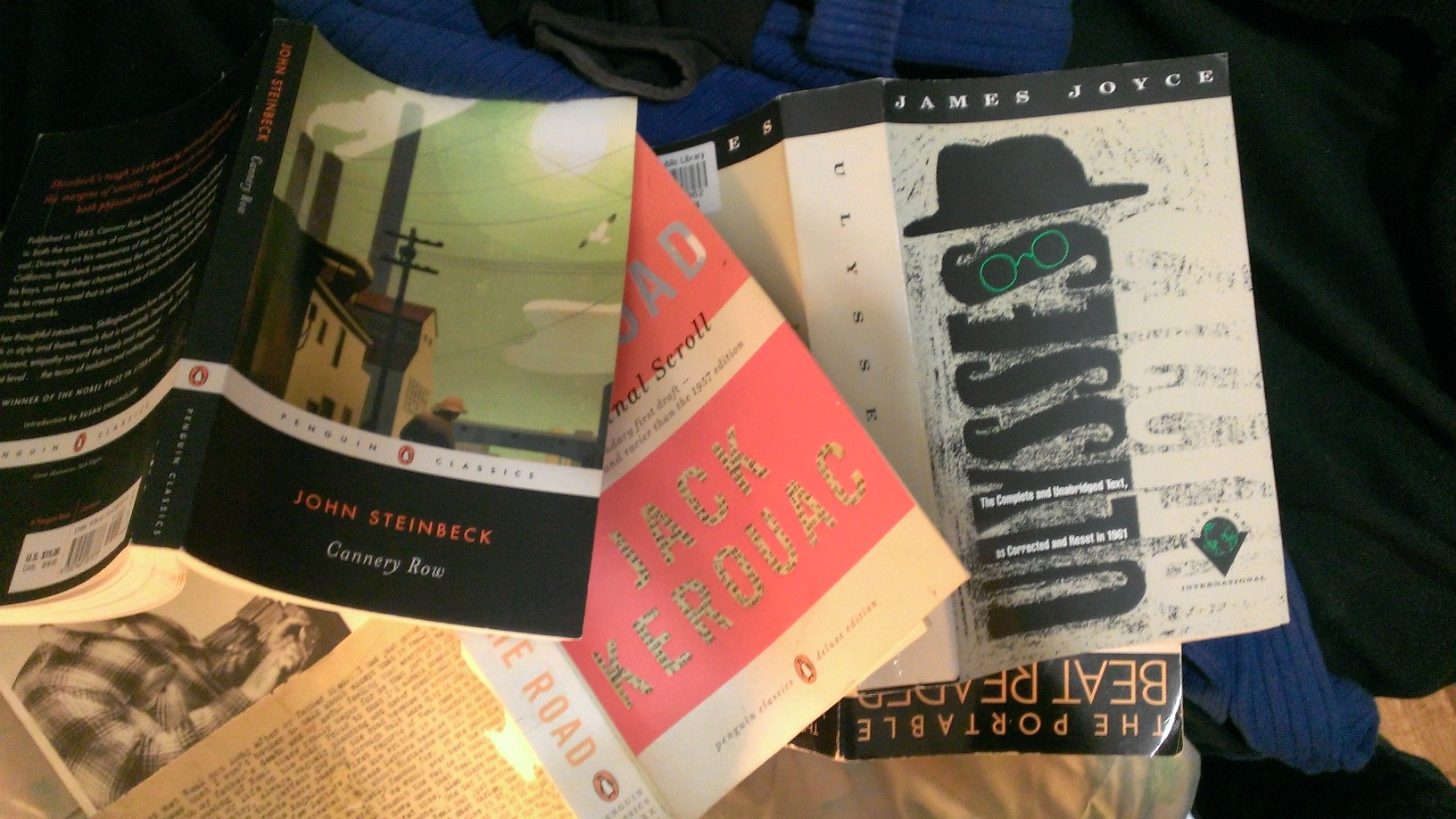
Just a few of the books we’ve been using as research for Burning Furiously Beautiful: The True Story of Jack Kerouac’s “On the Road.”

Are the Beatniks Anti-American?

27 May

OLYMPUS DIGITAL CAMERAAmerican flag outside Kerouac’s birth home

I came to read Jack Kerouac, Allen Ginsberg, Gregory Corso, and Lawrence Ferlinghetti with little to no preconceived ideas about the Beat Generation. I had heard of Gilligan but never Maynard G. Krebs. I associated goatees with Ethan Hawke and turtlenecks with Sharon Stone. I liked the poetry bit in So I Married an Axe-Murderer but associated it with the spoken word poets of 1990s coffeehouses. So when I picked up The Portable Beat Reader, edited by Ann Charters, I had no presupposed knowledge of the writers in it or the culture they apparently inspired, apart from having discovered the book in a photo spread of a teen girl’s magazine. The kids in the spread looked like how I looked–or, rather, the cooler version of how I wished myself to look. That seemed as good a reason as any to beg my mom to buy the book for me.

I discovered humor and beauty and sensitivity in the words of the poets and novelists associated with the Beat Generation. When I read Kerouac explain the definition of “beat” as being both beat down and beatific, I understood and believed his words. It enlightened the way I read On the Road, and yet I read it sympathetically in the first place. I was a lot like Sal Paradise, hanging out with a friend who was wilder than I was. I longing to hit the road, to escape the humdrum of the suburbs and walk the city sidewalks of New York.

It was only later that I discovered that many others viewed the Beats and their work quite differently. It was only through reading biographies and nonfiction books on the Beats that I came to see that these writers were referred to as “beatniks,” and that that had a negative connotation. The term was a derogatory amalgamation of “Beat” and “sputnik,” and not being up on my history in my teen years, I understood it simply to mean they were “far out,” like a satellite in the space race. I had certainly heard of the Cold War, but it took me longer to understand that “beatnik” suggested the writers were somehow anti-American.

The idea of the Beats as anti-American took a long time for me to wrap my head around. Kerouac had written such a beautiful novel about America. He seemed so in love with the country and even made me fall in love with it in a new way. Before then, as the daughter of an immigrant, I had considered travel as something to do outside of America. I’d been to Europe but never the West Coast. Reading the Beats, I wanted to know more about this splendid vision of America they described. Sure, Ginsberg challenged America, but growing up decades later than him I was encouraged in school to think independently as he did. One could speak up in love. One must speak up in love.

As I continued to study Kerouac in particular, I learned about how he had been in the Merchant Marine during World War II. So much of what I read emphasized that he’d gotten discharged from the US Navy after being diagnosed with “schizoid personality.” It took more digging to hear a story like this one of how much Kerouac respected even the American flag:

At a party with Kesey’s Merry Pranksters Kesey came up and wrapped an American flag around me. So I took it (Kerouac demonstrates how he took it, and the movements are tender) and I folded it up the way you’re supposed to, and put it on the back of the sofa. The flag is not a rag.

The Beats were far from squeaky clean, but anti-American? I don’t see it. Perhaps the Beats didn’t jive with sock hops and malt shops, but maybe that’s a good thing because those 1950s stereotypes whitewashed the truth and left out large segments of the population. Some of us had fathers who spoke with an accent the way Ricky Ricardo did. Some of were intelligent but didn’t like stuffiness. Some of us liked to play our music LOUD. Some of us were friends with the outcasts. Some of us were misfits ourselves.

This Memorial Day, remember that many who died fighting for our country were just kids looking for a chance to escape from home or hoping for a chance to make something of their lives or desiring to be a part of something bigger than themselves. And think about today’s generation of Americans, those who may be a little rough around the edges or a little outspoken but who are so full of life, liberty, and justice.

You may also be interested in Memorial Day: Kerouac in the Merchant Marines.

John Muir, Teddy Roosevelt, and Jack Kerouac Write about Nature

23 Apr

muir

“Between every two pines is a doorway to a new world.”

~ John Muir

It was conservationist John Muir‘s birthday over the weekend and yesterday was Earth Day. A few years ago, I had the great pleasure of editing a reissue (not the one pictured above) of his My First Summer in the Sierra and writing the flap copy, and I quickly became absorbed in the poetic language he used to described the beauty of the earth. If you’ve been following my blog for a while, you might have caught on that even though I absolutely love the glittering sidewalks and Art Deco skyscrapers of New York City, I am just as comfortable out in nature. (It’s the suburbs I can’t stand!)

Muir was an early advocate of nature preservation and founded the Sierra Club. He used to hang out with Teddy Roosevelt, whom I’ve also written about, and they’d go off exploring Yosemite. Can you imagine any of our recent presidents going off into the woods with someone we’d today probably label a hippie? It was this very friendship between Roosevelt and Muir that led to America’s natural beauty being preserved. Interestingly enough, Muir and Roosevelt were both rather talented writers, and their works are travelogues through nature.

Jack Kerouac referenced John Muir in The Dharma Bums, a novel that makes you want to drop everything and go sit in the woods for a great long while. He also wrote about Muir in an essay entitled “The Vanishing American Hobo“:

John Muir was a hobo who went off into the mountains with a pocketful of dried bread, which he soaked in creeks.

Kerouac was incredibly well read and would often read history books about America before or during his road trips. As “The Vanishing American Hobo” indicates, Kerouac saw the landscape and economy of America changing before his eyes as he traveled. The era he lived in was the beginning of the great highway system, and he saw why Muir’s conservation efforts were so important.

We tend to associate road tripper Jack Kerouac with cars and bars, but he actually loved nature. On the Road is essentially a glowing account of America’s landscape, the melon patches, the sun-drenched sky, the ragged mountains. In Big Sur, we see him sit out and just stare at the ocean, absorbed in nature. His obsession with animals gives us a poignant insight into his psyche.

We often put labels on people, and to see literature through critics’ lenses. What if we read John Muir’s work as literature instead of viewing it as nature writing? What if we read Jack Kerouac’s work as nature writing instead of counter-cultural novel?

What if we saw a story in a blade of grass? What if we listened really hard to the call of a bird?

You might also be interested in this article I wrote a few years about John Muir for Burnside Writers Collective:

And in this clip of me reading from Burning Furiously Beautiful about Jack Kerouac’s empathy toward animals.