Archive | Beat Generation RSS feed for this section

The British Are Coming!: The Beat Generation’s Influence on The British Invasion

11 Nov

In her fascinating article “Won over by the West: The irresistible allure of Americana for post-war Britons” for the November 2013 issue of British GQ, Olivia Cole posits that imported media of post-World War II America attracted the British to the United States—and specifically points to influence of the Beat Generation.

This week I’ll be talking about Cole’s thesis in greater depth, but I think it’s important to kick this off with the relevant background information. My reasoning for this isn’t just that a lot of people may not be familiar with pop culture history but rather that by stressing the history we may actually come to a stronger argument in support of her thesis.

First things first, a mini timeline:

  • 1922: Jack Kerouac was born
  • 1939-1945: World War II
  • 1947-1991: The Cold War
  • 1955: Allen Ginsberg’s Howl published
  • 1957: Jack Kerouac’s On the Road published
  • 1964: The British Invasion

World War II and the Beat Generation

Born in 1922, Jack Kerouac was college-aged during World War II. As Paul Maher Jr., my coauthor for the book Burning Furiously Beautiful, writes:

Jack Kerouac set sail for Greenland on July 18, 1942 aboard the S. S. Dorchester. He had enlisted in the Merchant Marines and, if we take the romantic view of things,  was looking for intense experiences that could possibly stimulate him as an emerging writer.

Kerouac served in the Merchant Marines and in the United States Navy and was honorably discharged. England and the US were allies. I specifically wanted to reference Greenland, though, because it reminds me of the famous Beatles quip when a reporter asked the Beatles how they’re enjoying their 1964 tour of the United States:

Reporter: How do you find America?

Ringo Starr: Turn left at Greenland.

I’m getting ahead of myself.

Kerouac’s novel was indeed an overnight success and influenced the culture of the time period. However, many derided the Beat Generation as tearing at American values. In 1958, the derogatory term “beatnik” was coined by journalist Herb Caen. It was an amalgamation of the word “beat” and “Sputnik.” Sputnik was a Russian satellite. Remember: this was during the Cold War, and Russia was not our ally. I’m belaboring this point for a reason:

The United States was invaded—culturally—by its ally. We had a British Invasion—on our music.  We did not experience a feared political Russian invasion.

While Beatles record burnings would occur in the years to come, the Beatles—the forerunners of the British Invasion—arrived in the United States, wearing dapper suits and singing about wanting to hold hands. Our allied invaders appeared (though anyone who actually knows their Liverpool and Hamburg start will laugh at this) much more squeaky clean than our own author, Jack Kerouac, who was writing about drugs and s-e-x.

After all the patriotism surrounding World War II and the “beatnik” fad had played out by the sixties, America was primed to look elsewhere—as long as elsewhere was still “safe.”

The British Invasion

The British Invasion occurred less than a decade after Kerouac’s groundbreaking novel On the Road was published, but it was not an immediate reaction to the Beat Generation.

The year 1964 is the year The Beatles landed in America. This set off the British Invasion. The British Invasion refers to British bands such as The Beatles and The Kinks (who were formed in 1964) but also The Rolling Stones (who were formed in 1962) and The Who (who were formed in 1964), not to mention bands who may be less familiar today but still influential such as The Animals, Peter and Gordan, and Herman’s Hermits, who dominated the music scene and wildly impacted the culture of the United States in the mid-60s.

Cole’s article begins with The Kinks’ Ray Davies’ new memoir, mentions the Rolling Stones’ Keith Richards’ memoir, and concludes with Iain Sinclair’s new memoir. A little background information to tie them together: Richards and Sinclair were born in 1943, Davies was born in 1944. Davies and Richards were born in the greater London area, and Sinclair in Wales. In other words, all were born in the UK within a year of each other. While Sinclair is writer and filmmaker and not technically part of the British Invasion, and while Cole herself does not use the phrase, it is central to her themes. Let me state the obvious: These Britons were not peers of Kerouac’s. In fact, they were about twelve or thirteen when On the Road came out.

It’s reasonable to conjecture that it takes a generation for ideas to create momentum and impact culture. Beatnik shtick around the height of the Beat Generation—itself a marketing tool—was gimmick.

The ideas presented by the so-called Beat Generation took hold perhaps in a more powerful way as it basted in young, impressionable minds, who were more willing to see things from a fresh vantage point and implement change. The new generation of creatives could actually impact culture in a much more meaningful way. This is how we see that the bands that rose to prominence during the sixties were more directly impacted by the Beat Generation than perhaps the Beat Generation’s own peers. This is evident in American music of the time as well: Ramblin’ Jack Elliott, born in 1931, was influenced by Kerouac, and Bob Dylan, born in 1941, was encouraged by the Beats.

Now, whether they all truly understood the message behind the different Beat writers works is a different story—as is that hopefully not-too-subtle remark I just made that the writers associated with the Beat Generation can’t all be lumped into one category with one thought. They were individuals and did not always agree with one another’s politics.

The British may have been inspired by the Beat Generation and their work may have resonated with the American audience in the mid-1960s, but Jack Kerouac wanted no credit for the hippie movement that followed. He felt that they distorted his views. If You Walk in Your Sleep…’s “Collective Memory: Kerouac Hated Hippies” speaks to this.

The British are coming! The British are coming! Tune in tomorrow when I talk about the relationship between The Beatles and The Beat Generation.

* * *

Burning Furiously Beautiful: The True Story of Jack Kerouac’s “On the Road” is now available as an ebook and paperback!

Friday Links: Breathe In, Breathe Out

8 Nov

Oh, what a week, what a week. It seems like so many people I know are going through difficult times right now, myself included. I think this weekend we could all use a little nurturing. Here are a couple links to take you into what is hopefully a restful and enjoyable weekend:

Iconoclastic Writer penned a post entitled “Memory Babe: a writing exercise inspired by Jack Kerouac.” It’s an old post, but I think being in tune with our senses and learning to write resonate detail can be meditative

Sometimes just looking at beautiful, far-off lands makes me feel like I can breathe a little more

In an effort to drink less coffee (and ahem stronger drinks) and more tea, I bought a delicious champagne rose tea from Mitsua in New Jersey a few weeks ago

I’m also excited to try the new Teavana that opened up on the Upper East Side — it’s one of Oprah’s favorite things!

My doctor recommended this Upper East Side restaurant to me

I’ve been missing my mom a lot lately, which has made me crave macaroni & cheese, both a comfort food and one of her specialties. I might have to check out one of these places

I’ve been embracing my homebody side these days and reading and rereading the interior decorating magazine Domino — I’m so glad they’re back!

I like to light a candle when I write, and I see that Bath & Bodyworks — my favorite place to buy candles — is having their candle sale

Paul and I are holding a contest where you could win a one-of-a-kind tape that Carolyn Cassady personally gave to Paul. You can find the details and enter (or just vote for your favorite) on the Facebook page for Burning Furiously Beautiful: The True Story of Jack Kerouac’s “On the Road”


Jamming Jack

7 Nov

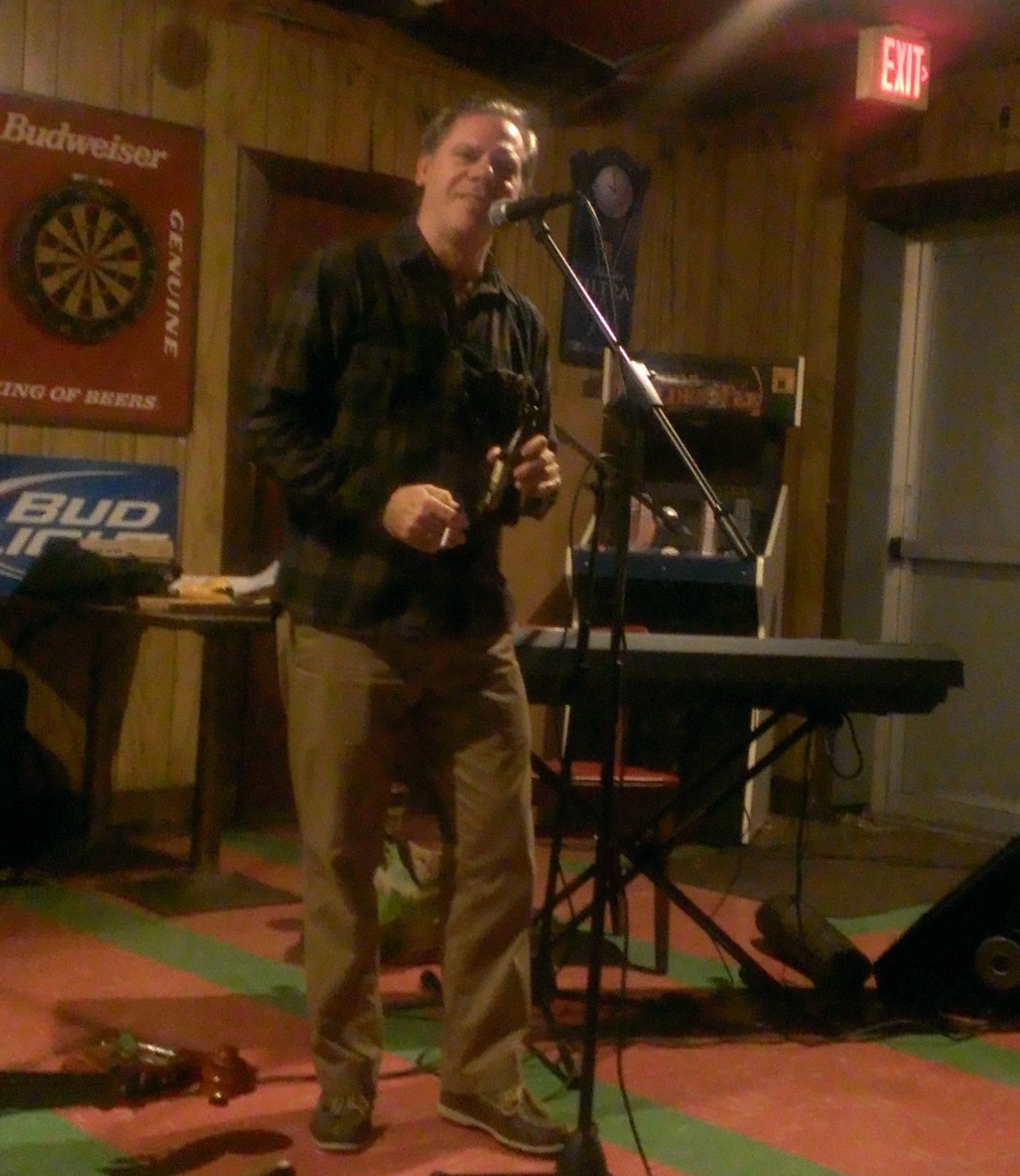
Friday night at Lowell Celebrates Kerouac we all headed over to the White Eagle Pub, a dive bar on Market Street.

WP_20131011_020

The evening started off with a viewing of Brent Mason’s documentary Grave Matters. The thirty-minute film got off to a riotous start when one of the people in the crowd fell or fainted off their chair! The film had to be stopped, but after it was determined she was okay, the documentary started rolling again. Whew, what excitement. Canadian musician and filmmaker Brent Mason explores Jack Kerouac’s life and legend by documenting his visit to the author’s hometown of Lowell, Massachusetts. Complete with interviews from people like Kerouac’s friend and eventual pallbearer Billy Koumantzelis.

Billy was there in the audience and afterwards he introduced me to Brent–who was there with his teenaged son–and Jim Sampas. Jim played some recordings of Jack reciting his work.

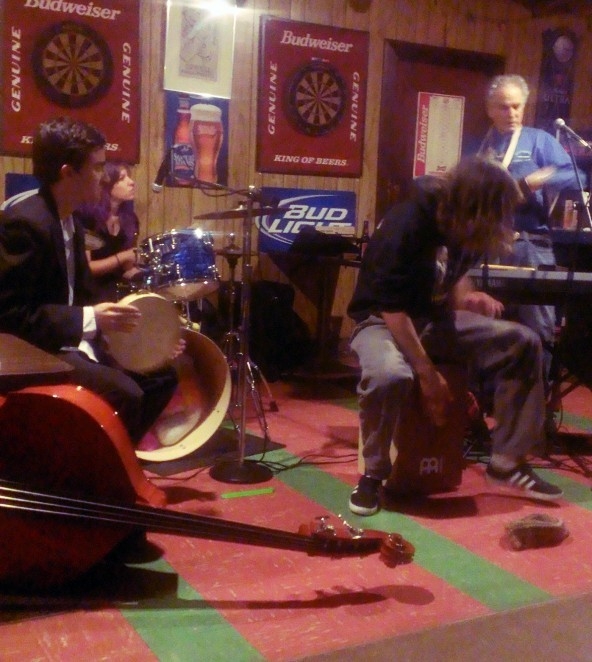
David Amram led Jamming Jack and was magnificent as always. I’ve seen him play a few times now, and each time feels unique.

He also invited people up to read and perform in what turned out to be an inspiring evening.

Jerry

Here Lowell’s very own actor and screenwriter Jerry Bisantz, of Image Theater, performs as Jack Kerouac.

Steve

Christopher Barry and his youngest brother Stephen Barry each performed their poetry. Stephen (pictured above) had flown all the way from California to be at the event. I’ve met Chris a few times, and it’s always a pleasure hearing him read. It was nice meeting his brother and seeing that talent obviously runs in the family.

SteveD

Jazz-poet Steve Dalachinsky, whom I’d heard read at Lowell Celebrates Kerouac two years ago, was back to read more poetry! He is brilliant. His wife Yuko Otomo was in the audience, and I wish she’d read too.

Drummer

Throughout the performances, David was playing the piano. He also selected some wonderful young musicians to accompany them. I believe the drummer and the guy on the tambourine were local students. The guy on the box-drum came from further away and was at LCK two years ago. If anyone has their names or contact info, please do pass it along. They were phenomenal.

Toward the end of the evening, David starts talking, says something about an author who wrote a new book, and that she doesn’t know he’s going to call her stage, and then calls out my name! The last time I read with David I was so nervous I could barely eat the entire day. I didn’t have time to get nervous this time around! I read one of Kerouac’s prose-poems. So beautiful! I don’t know that I did it justice, but it was such an honor to get to read Kerouac’s own words in his hometown and with so many phenomenal musicians and writers there.

The event made me kind of sad… It was so fun and inspiring, and I wish that Kerouac would’ve gotten to see that his literature continues to be appreciated to this day by people who are willing to come from far-flung locales of Canada and California and from people in their teens to people in their 80s.

* * *

Burning Furiously Beautiful: The True Story of Jack Kerouac’s “On the Road” is now available as an ebook and paperback!

Confessions of an Awkward Lowell Celebrates Kerouac Attendee

5 Nov

bus

I hit the road last month to attend Lowell Celebrates Kerouac!

Confession time! In most circumstances I feel like a hanger-on if I’m in the company of whomever is the man or woman of the hour. Maybe it’s related to the Imposter Syndrome Sheryl Sandberg talks about in Lean In. Who am I to talk to someone of great stature? I never want to bother anyone, make it appear that I’m trying to get something out of them, or come out as some zealous fan. So, my typical response is to just keep to myself.

The first year I attended LCK I went alone and barely talked to anyone. I had been studying Kerouac’s literature for more than a decade and was fascinated by everything around me. It felt so surreal to be in Kerouac’s stomping grounds, to see his birth home, the Grotto, the Pawtucket Falls, the mill town he’d loved and written about. Roger Brunelle gave excellent tours, and I was enthralled by every moment of it. I loved every moment of it, and even though I had no one to share it with I didn’t really mind.

This year was completely different. My friend Julie Parker let me crash at her beautiful home outside of Boston, which was brimming with books and paintings and so full of inspiration. She’s a design consultant who does package design, marketing, and brand identity, so when we weren’t at the festival we had endless conversations about publishing and self-promotion.

I got to meet Paul! Oh my gosh, I was so nervous. Paul and I have been collaborating together for almost two years, and I probably spend more time talking on the phone with him than anyone else except maybe my mom when she’s in the States (when she’s in Greece, it’s difficult with the time difference), but we’d never met in person. I guess I was worried by meeting in person, something would change. It ended up being awesome. He gave Julie and me a tour of Lowell, and since he himself grew up there, his insight and stories were really personal.

I also got to catch up with David Amram and Billy Koumantzelis. I first got to know each of them from interviewing them about their friendship with Jack Kerouac, and since then I’ve been careful not to assume they’d remember me or talk to me beyond that. I completely understand that they’d have other, more important, people to talk to. But I didn’t want to go to my default of keeping my distance for fear that would make it seem like I didn’t want to talk to them. Ugh. My head gets so mixed up sometimes! Anyway, I did end up getting to spend time with both of them, and they’re both so gracious and fascinating individuals. For all the negative things that have been said over the years about Jack Kerouac, I have to say that he sure knows how to pick friends. These guys are stand-up gentlemen. Even though I first got to know them because of their friendship with Kerouac, that doesn’t even matter to me anymore. I just like talking to them and hearing their perspectives. When I had first interviewed Billy, I was curious about who he is, and at one point he stopped me and said, “Aren’t you here to ask me about Kerouac?”

Through one of David’s concerts at Cornelia Street Café, I’d met the poet Christopher Barry. He was at LCK too and introduced me to his brother, Stephen Barry, who is also a poet. Chris is a great guy, and it was fun chatting with him and his brother. David also introduced me to Steve Dalachinsky and Yuko Otomo, who are these amazing poets from New York City. Seriously. Probably among the best I’ve ever heard read—and I’ve heard a lot of poets read over the years. I probably would’ve been too shy to ever introduce myself if it weren’t for David. Billy also introduced me to Jim Sampas. You know, the guy behind One Fast Move or I’m Gone and the new film Big Sur. I sat there kind of stunned, saying, “I’m a big fan of your work.” I gave him a postcard for Paul’s and my book, Burning Furiously Beautiful, and Jim said, “I think I’ve heard of this.” Wow. I also got to meet the documentary filmmaker (Grave Matters) Brent Mason. Super nice guy. I met Stephen D. Edington, the organizer of LCK. He’s given sermons at the Unitarian Universalist Church of Nashua, which I’ve read online and found quite interesting.  And, I got to meet Roger Brunelle and his wife, both of whom were so warm. I don’t know why I get so nervous to introduce myself and talk to people sometimes….

Another highlight, though, was meeting people from the Burning Furiously Beautiful Facebook page. I was so touched when they came up and introduced themselves. I am so thankful for the network we have on that page, and it’s been great meeting like-minded people offline.

I guess I write all this to show that even if you sometimes are predisposed toward awkwardness, shyness, and over-thinking things, good things happen when you step out of your comfort zone. A colleague of mine recently posted on Facebook about how his daughter was having trouble with good greetings, that it took her a while to warm up to even people she knew when she’d see them again. I feel a lot like that little girl sometimes. Although this is supposed to be a recap of my time at LCK, I think it’s important that I share my true story. I’ve gotten the impression sometimes that people think if you read Kerouac, you’re trying to be cool. I never really had the impression of Kerouac as the cool guy. I always thought of him as the guy shambling after his friends. I think if you really read and study Kerouac, you understand that he too battled shyness, that although he had a lot of successes he also had a lot of failures, that he was prone to both self-assurance and worry. I think that if we just be ourselves and use our gifts and if we are open to opportunities and push ourselves little by little out of our comfort zone, we will surprise ourselves by what we can do. The key though is that it’s not about being in the spotlight or about others in the spotlight; it’s about the blessings of creating art, doing what we love, and fellowshipping with others.

* * *

Burning Furiously Beautiful: The True Story of Jack Kerouac’s “On the Road” is now available as an ebook and paperback!

I’m Giving a Free Reading Tonight at KGB Bar

2 Nov

Lomogram_2013-09-04_09-15-27-PM

I’m reading at KGB Bar tonight! I’m super excited. I’ve been to a few readings here before, and it’s got a killer atmosphere. Not only that, but check out the impressive lineup:

With Professors:

Wang Ping

Miguel Algarin

Nancy Mercado

Carlos Manuel Rivera

Julie Patton

Everton Sylvester

At 6:30pm Professor Cornelius Eady reads and perform with his Rough Magic band’s guitarist Charlie Rauh and Concetta Abbate on the violin

And poets reading with or without acoustic musicians:
Carl Hancock Rux
Jeff Wright
Brian Omni Dillon
Ronnie Norpel
Susan Yung
Kate Levin
Sarah Sarai
Stephanie Nikolopoulos
R! on verse acoustic guitar & harmonicas

Und singing in German und mit monologue:
Leigh Martha Klinger

I’m listed as a poet, and I do in fact write poetry, but I was planning on reading an excerpt from Burning Furiously Beautiful: The True Story of Jack Kerouac’s “On the Road.” Specifically, I plan on reading about Kerouac’s Greek connection, his Lowell friend Sebastian Sampas.

The event starts at 6 and is free and open to the general public.

KGB Bar is on 85 East 4th Street (near 2nd Avenue)
New York, New York 10003

* * *

Burning Furiously Beautiful: The True Story of Jack Kerouac’s “On the Road” is now available as an ebook and paperback!
Big Sur Comes Out Today

1 Nov

BIG_SUR_400

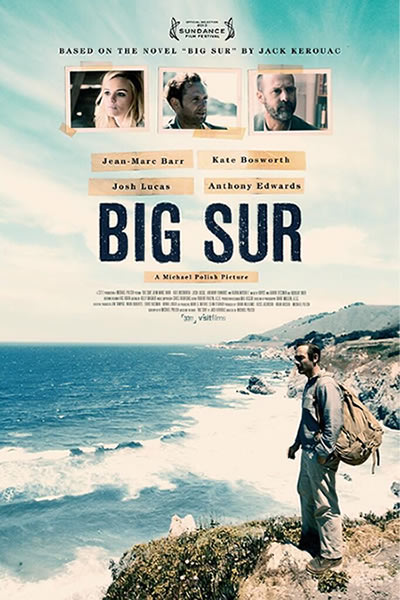
Kalo mina! The film adaptation of Jack Kerouac’s Big Sur comes out today. Will you be watching it?

It stars Jean-Marc Barr as a Jack Kerouac who’s overcome by the notoriety that descends on him after the publication of On the Road. Barr told Salon:

“I’ve been living Kerouac all my life. So there was nothing to play.”

Though that statement seems over-reaching, from the trailers the half-French Catholic does seem to get to a closer emulation of Kerouac than other recent actors.

Of course, he’s also playing Kerouac at a much different point in his life than he’s been portrayed in the other recent films. In “What Hollywood Gets Wrong About Jack Kerouac and the Beat Generation” for The Atlantic, Jordan Larson wrote:

But the current Beat revival arguably goes too far with its re-imagination of the Beat writers’ livelihoods as simple adolescent goofing around—its most prominent writers were, after all, well into their grown-up years when they wrote many of their most notable writings.

Kerouac is definitely an adult in Big Sur. A rather depressed one at that. And it brings up the point I discussed earlier this week when mentioning Karen Yuan’s argument in the article “Notebook: Hollywood shouldn’t glamorize the Beat Generation’s self-destruction” for The Michigan Daily, and that is, whether portraying them as adolescents or as adults, Hollywood and the Beat Generation is being criticized.

What’s interesting about Big Sur, though, is that the executive producer is Jack Kerouac’s nephew Jim Sampas. He was also the producer of One Fast Move or I’m Gone: Kerouac’s Big Sur. Sampas also produced Dr. Sax and the Great World Snake and Joy Kicks Darkness, among other projects.

In 2009, Sampas told IFC:

“‘Big Sur’ is Jack’s most personal and confessional novel. I am blown away by his courage in writing about his own spiral downward with such honesty and depth. My goal is that this film we’ve created influences a younger generation to embrace this work. And if people who see this film are inspired by Jack no holds barred honesty, wouldn’t that be incredible?”

I had the pleasure of meeting Jim Sampas, a fellow Greek American, at this year’s Lowell Celebrates Kerouac, when Billy Koumantzelis (check out his CD on his time with Kerouac) introduced me to him. It will definitely be interesting to view this film in light of the others.

I’ve read mixed reviews, and I’d love to hear what others think of the film. Please post comments if you see it!

* * *

Burning Furiously Beautiful: The True Story of Jack Kerouac’s “On the Road” is now available as an ebook and paperback!

Warby Parker Glasses for Halloween

31 Oct

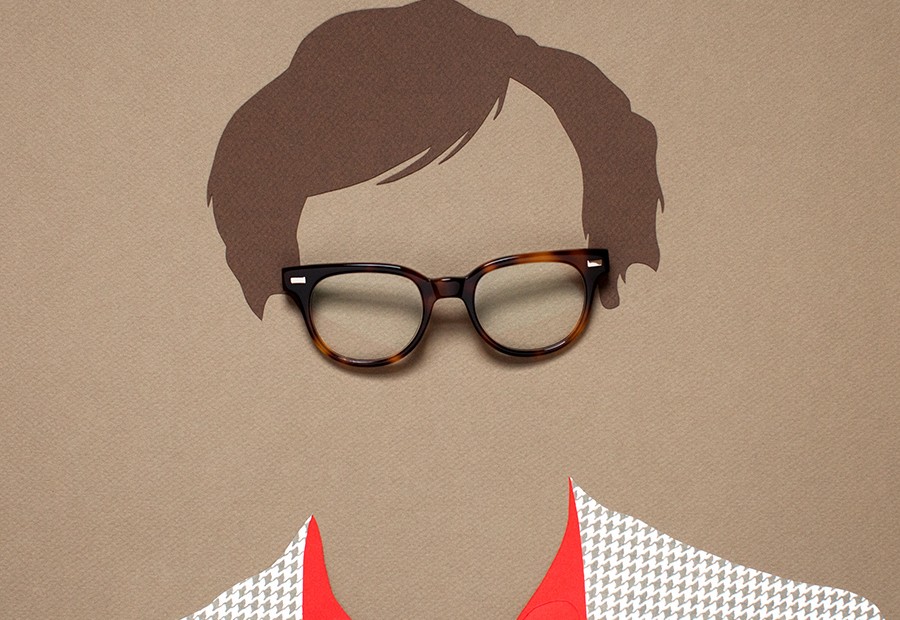
alvie_small-900x620via Warby Parker

Happy Halloween! Though I tortured my sleepover guests with classic horror films when i was a preteen, I’ve never been real big into the scary stuff of Halloween. I do, however, think it’s a super fun opportunity to play dress and reinvent one’s identity for a day.

Then again, I’m a bit of a chameleon when it comes to my style and personality even on an average day. You know how in The Breakfast Club there was the jock, the princess, the brain, the basket case, and the criminal? Or how when you ride the L train you can always tell who’s going to get off at Union Square versus who’s going to Bedford Avenue? I’ve never really identified with one social group or another. One day I might dress preppy in pearls and a button-down shirt with a sweater over it and the next day I might wear lots of dark eye shadow and all black. Likewise, some days I wear glasses and some days I wear contacts. It would be fun to own multiple pairs of glasses to switch out depending on my mood.

Glasses are such a defining accessory/medical need. Certain glasses styles have become synonymous with certain celebrities. Think John Lennon’s little circles. Buddy Holly’s thick frames.

Warby Parker says, “There are plenty of characters to be channeled with the right pair of glasses.” They’re featuring costume ideas like Tootsie, and Dr. Strangelove, Alvie Singer (Annie Hall) on their blog, complete with the prescription glasses they sell. Oh sure it’s a gimmick to get you to buy their merch, but — and I’m not at all affiliated with them and not getting anything for saying this — it’s a rather clever idea. Because sometimes it’s fun to channel someone else for a day!

Also, I really like Warby Parker’s business model: for every pair you buy, they donate to someone in need.

Oh, and get this: their name is a Jack Kerouac reference! Here’s the story:

We’ve always been inspired by the master wordsmith and pop culture icon, Mr. Jack Kerouac. Two of his earliest characters, recently uncovered in his personal journals, bore the names Zagg Parker and Warby Pepper. We took the best from each and made it our name.

So what I want to know then is why they don’t have a blog post for dressing like Allen Ginsberg?! You can’t help but think of his glasses when you visualize him. Plus, with all the Hollywood attention on the Beats lately — characters based on Ginsberg or Kerouac’s alias for him appear in On the Road and Kill Your Darlings — you’d think he’d be a fun person to dress up as for Halloween.

Or maybe I’m the only nerd who thinks dressing like authors and literary characters is a perfectly normal Halloween costume?

And, for a story about the time Allen Ginsberg lost his glasses, check out Burning Furiously Beautiful: The True Story of Jack Kerouac’s “On the Road.” It’s available as an ebook and paperback.


Extraordinary Women of the Fifties: The Beat Women

30 Oct

“Moreover, I was puzzled to read in her introduction how ‘our idea’ of the Fifties is one of a decade reviled for being full of dull and docile women. This does a disservice to so much writing on the “other” Fifties, from Elizabeth Wilson on lesbianism and Angela McRobbie on girls’ subcultures to Deborah Philips and Alison Light on women and fiction,” writes Sheila Rowbotham in “Her Brilliant Career: Ten Extraordinary Women Of The Fifties, by Rachel Cooke, review” for The Telegraph.

Missing from both lists were the women associated with the Beat Generation. Here were women who defied the stereotype of being “dull and docile.” They were renting apartments on their own at a time when women generally lived with their parents until they got married. They were pursuing higher education. They were creating their own innovative, beautiful works.

Much of modern discourse surrounding the Beat Generation has to do with its masculinity and misogyny. Those are important discussions to have. However, I think it does a great disservice to the many talented female writers who were associated with this literary grouping. These weren’t just muses in black stockings. They were and continue to be powerful writers.

* * *

Burning Furiously Beautiful: The True Story of Jack Kerouac’s “On the Road” is now available as an ebook and paperback!

Is Hollywood Glamorizing the Beats or Just Retelling Their Stories?

29 Oct

“The flat Hollywood characterization allows viewers to live vicariously through Ginsberg, Kerouac and the gang, but it almost mythicizes them. Hollywood digs right into the drama — catering to what people want to see — and ignores the very human parts of them. But it may be a hard balance to keep. Even when depicting that soul-searching, it’s easy to fall to sentiment. The Beat Generation’s search for belief ends up being something we believe in. We’re all drawn to the image of explorers after all: modern pilgrims, earnestly due west like Lewis and Clark in Mustangs, toward the unknown destination,” writes Karen Yuan in her closing paragraph to “Notebook: Hollywood shouldn’t glamorize the Beat Generation’s self-destruction” in The Michigan Daily.

With descriptions like “wide, fruited plains,” “all vintage Cadillacs and cigarette escapism,” and “slick cool and soft anarchy,” Yuan’s turns of phrases are beautiful in this article. I commend her attention to language in this journalistic essay about writers. It’s a breath of fresh air from so many dry works of criticism. Furthermore, she brings up a valid point on the complexity of Hollywood trying to encapsulate the human experience. Whether one is a so-called Beat, a journalist, or a movie-goer our lives cannot be easily summed up in one film or three films … or even several volumes of literature, as it may be. Yuan herself makes that very point when she says “But it may be a hard balance to keep.”

Consequently, she seems to have out-argued her own thesis, “However, what [Hollywood] doesn’t realize is that the Beats are nothing to be glamorized,” by acknowledging the intricacy of life and that portraying “clouds of brooding angst” doesn’t create balance or reality anymore than depicting “carefree, YOLO-esque youth” does. Though she rightly suggests the Beats’ perpetual movement is related to their “existential search,” it is unclear what she thinks a more accurate adaptation of On the Road or Big Sur would be or how the murder of David Kammerer should have been told.

I would argue that the film adaptation of On the Road did a fine job of showing both sides. It perhaps doesn’t do the existential search justice but there are intimations of it, particularly in the scenes when Sal Paradise hallucinates among the Catholic saints, with the insertion of Proust, and when Dean Moriarty confesses that he doesn’t know why he does the things he does. The go! go! go! mentality comes to a screeching halt in the closing scene, indicating that maybe all those wild times weren’t all they were cracked up to be. Meanwhile, Yuan says Kill Your Darlings contains “tantalizing hints of murder,” when in fact the film does not hint but tells of the events leading up to a murder that landed three of the Beats in jail, with one of them doing time in a reformatory. It does not paint any one character as the villain, but again shows that the people involved and the events that unfolded were complex. Existentialism is a recurring theme of the film as seen through the New Vision. I haven’t seen Big Sur yet, but I’ve read the reviews of the film, and it seems to me that it’s far from glamorizing Kerouac’s life. More so, I’ve read the novel twice and know that it’s actually the antithesis of glamorizing the Beat Generation machine.

So here’s the question … or rather, I should say questions: Is documenting a life, an event, or a novel automatically glamorizing it? Where is the line between telling the truth and glorifying—when storytelling? Do stories have to be redemptive? If they are not redemptive, must they be cautionary tales? If they do not fall into these categories, are we better off ignoring them?

The pastor of the church I grew up in used to say, “Ignorance is not bliss.” Being downright oblivious or purposely ignoring issues doesn’t make them go away. The truth of the matter is the “intrigue and montages of reckless drug use” were a part of the life of Allen Ginsberg, Jack Kerouac, William S. Burroughs, and so forth. And I would gather that the parties and drugs and casual affairs were a lot of fun as they were happening. That’s why people do those things. To categorically demonize these things does a disservice to the truth. The truth of course is much more complex. Consequences aren’t always immediate or even a given. We can look now in hindsight at On the Road and know that Jack Kerouac died at only forty-seven years old, after abusing alcohol. However, we can cast our collective eye on Burroughs and see a man who did a lot of hard drugs who didn’t pass away until he was eighty-three years old.

Yuan says, “They wanted to rebel against this new middle-class United States and find something new to believe in….” Today’s suburban teens and Ivy League undergrads may very well still be searching for something to believe in. I think the Beats’ stories go on, not because they glamorize illicitness, but because they speak to that very basic human need to feel like more than just a cog in the machine but like we’re actually living, that our lives have meaning. I think this is part of what Yuan is advocating for, and I think it’s actually there in the films and in the literature. It’s just not whitewashed, pristine, perfect. But then again, neither is life.


* * *

Burning Furiously Beautiful: The True Story of Jack Kerouac’s “On the Road” is now available as an ebook and paperback!
We’re in Empty Mirror!

14 Oct

Empty Mirror published an excerpt from Burning Furiously Beautiful!

The excerpt is from the sections “The Sea Is My Brother” and “Schizoid” from the beginning of the biography. It begins with Jack Kerouac’s Lowell friend, a Greek American named Sebastian Sampas, going off to Camp Lee and then tells of Kerouac’s time in boot camp. During this time period, the young author was working on the book The Sea Is My Brother.


Want to read another excerpt?

Here’s one on the tragic life story of Kerouac’s father.

* * *

Burning Furiously Beautiful: The True Story of Jack Kerouac’s “On the Road” is now available as an ebook and paperback!