Archive | Beat Generation RSS feed for this section

I’m Talking with Tim Z. Hernandez; Join Us!

16 Sep


New Image


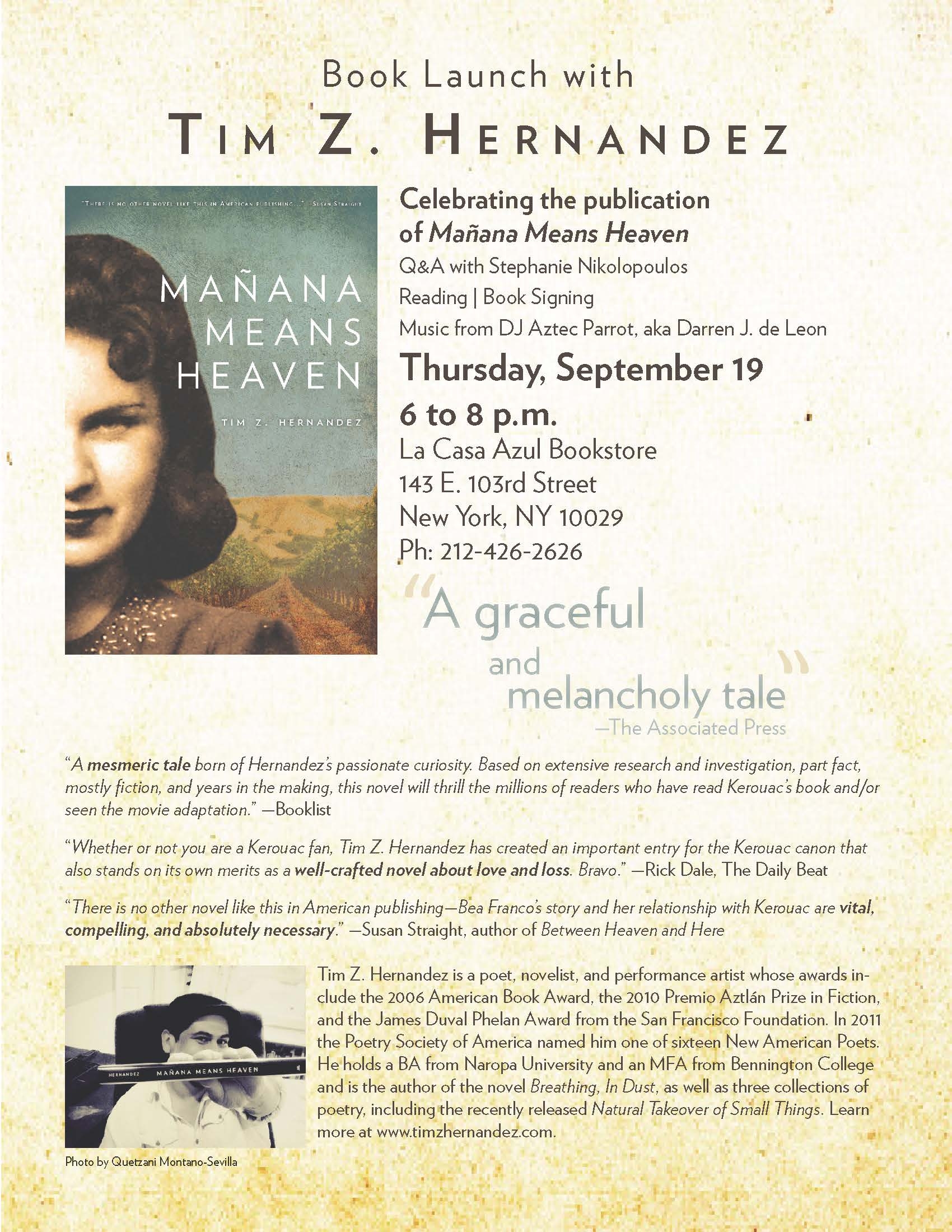
This Thursday I’m going to be in conversation with Tim Z. Hernandez, author of Manana Means Heaven, at the Spanish Harlem bookstore La Casa Azul. DJ Darren de Leon will be spinning music from the 1940s and ’50s. It’s going to be such a fun event. I’m really excited.

Tim’s novel Manana Means Heaven is about the real-life person who inspired Jack Kerouac to write one of the most poignant parts of Jack Kerouac’s On the Road: Bea Franco, “the Mexican Girl.” Tim tracked her down and interviewed her for the book, and she got to see it right before she passed away last month.

An award-winning poet, Tim pays close attention to words and imagery in his novel. We’ve been writing back and forth for a while now, and I have so many questions I want to ask him at the bookstore. There’s going to be a Q&A too so come with questions!

Here’s the essential info:

Thursday, September 19

6pm

La Casa Azul

143 E. 103rd Street, NYC

See you there!

*Please excuse the lack of the proper Spanish “n” with a tilde in “Manana”; I’m not tech-savvy enough to get my blog to use it.


Tim Z. Hernandez Gives a Behind-the-Scenes Look at Manana Means Heaven

16 Sep

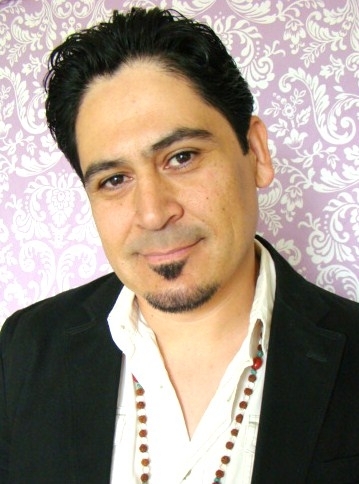
TimTim Z. Hernandez photo courtesy of the University of Arizona Press

I’ve often thought that poets make the best prose writers, and I was reminded of this once again as I read award-winning poet Tim Z. Hernandez’s novel Mañana Means Heaven. The story is about Bea Franco, the real-life woman who inspired Jack Kerouac to write one of the most poignant passages in On the Road—the story of “the Mexican girl,” Terry. Mañana Means Heaven is by no means a work of fan fiction. It is beautifully crafted and painstakingly researched, and stands on its own. Even as I got caught swept up in the story, I kept wondering how Hernandez did it—how was he able to write such a captivating story about a real person, one he’d met and interviewed, one whose children he’d met, who for so long seemed mythical herself yet was perhaps overshadowed by Beat mythmaking?

When the University of Arizona Press asked me if I’d be interested in participating in a blog hop with Tim Hernandez, I jumped on the opportunity. Special thanks to the University of Arizona Press for arranging this interview and for being great to work with. And, of course, a big thanks to Tim for so thoughtfully answering all my questions.

* * *

TimCover

How did you first come across Jack Kerouac’s On the Road and how old were you?

I first read it when I was around 17. I believe a friend of mine from Sweden, Jonas Berglund, turned me onto it. He was the poet back then, while I was mostly into painting. He was trying to get me to go backpacking with him in Europe, and he kept telling me how cool it would be. He told me I should read “On the Road,” so I did. That summer I split with him to Europe.

What did you think of it at the time and how has your perspective on the novel changed over time?

I’ve read OTR three times now. At age 17, and then in my early twenties, and then later at around 30. At age 17 I identified with the desire to break free, to adventure and take risks, to get away from the place I called home. In my early twenties I began questioning whether or not these guys, Kerouac and his crew (The Beats), were just completely insane. Also, the idea of a threshold appeared. I related more with the underlying question Sal Paradise was seeking to answer, that is, do I continue on this path of wild abandon, this path as perpetual seeker of truths, by whatever means, OR, do I fall in line with the rest of the world and live a “normal” life clocking in day to day and having a family? It was a matter of maturation. Not that I decided to let go of that desire “to seek” but just that I would go about it differently, in my own way. And then by age thirty, I was reading the book less for its subject and more for the writing itself, the technique and process, and also the idea of lineage. This is what sparked the initial seed for Mañana Means Heaven.

In the introduction to Manana Means Heaven, you say that you became interested in the story of “the Mexican girl” Terry/Bea Franco because it was the part of Kerouac’s novel that you could relate to. I understand that your parents were migrant workers near where Bea’s family worked as migrant workers. I know you also worked for the California Council for the Humanities interviewing immigrants about their lives and struggles. Were your parents immigrants? Can you talk a little about your relationship to and interest in the migrant worker experience and how it relates to your writing?

Yes, all of this was very influential to my wanting to write about Bea Franco. My work with CCH, and even the Colorado Humanities today, has been very instrumental in the research and process for the making of this book. It’s the experience of working for them that has emboldened me to walk up porches and knock on the front doors of total strangers, for the sake of stories. Not to mention, having these two entities as a resource throughout my research has been invaluable. As for the other part of your question, my parents were migrant farmworkers, but they were born in Los Angeles and Texas, so they weren’t immigrants. I’m the third generation in my family to be born here in the United States, and I think this is also why I related to Bea so much once I finally met her. My first question to her was, “What do you think about being called the Mexican Girl?” She laughed and replied, “I’m not from Mexico, I was born in L.A..” So she was very conscious of her own identity in this way too. She was not an immigrant by any means, and I believe that it’s possible this assumption about her is what kept Kerouac biographers from finding her, or even looking. In any case, having come from the same background as Bea Franco, the farmworker experience, living among the labor camps of the San Joaquin Valley, this was all part of my growing up. My parents and grandparents used to travel all over picking crops, grapes, hoeing sugar beets, so I knew the people from this place very well. When Sal Paradise entered the San Joaquin Valley in “On the Road” I felt he was now entering my world, a distinct place that is in every fiber of who I am, and I knew I could write about this with some authority.

Similar to your experience with Bea Franco, part of what continues to draw me to Kerouac is his ethnic experience and how he writes about feeling a duality within him. I was born here in New York City, but my father is an immigrant. He moved here from Greece when he was in his thirties, and he felt embarrassed because sometimes people couldn’t understand him because of his accent. Kerouac’s parents were immigrants from Quebec, and although he spoke English as a child he really didn’t feel comfortable with the language until he was a teenager. I think our immigrant experience was much different, though, because of our skin color. Kerouac is seen as a quintessential American novelist while Bea got pegged as “the Mexican girl” even though they were both born here in the States. Was Kerouac’s portrayal of the immigrant experience something you were interested in or were you mainly interested in telling Bea’s story?

Yes, all valid points here. Bea too was in that strange purgatory of “immigrant born in the U.S.,” and she too was very light skinned with green eyes, and because of it was sort of an insider-outsider, similar to Kerouac’s and your own situation. In some of our conversations she talked about how she was treated differently, sometimes cruelly, while growing up because of her complexion. In many ways, hers was a real “Chicana” experience, before the term was popular. She was balancing between two cultures at once, was educated in Los Angeles public schools, spoke fluent English and Spanish. She loved both the Mexican classic songs, and the big bands of her time. In 2010 she still had stacks of records by Tommy Dorsey and Glenn Miller, folks like that. When I first met her she had a portrait of Ronald Reagan in her dining room. It took my aback for a moment, until I asked her about it. I was afraid she’d say something like, “He was our greatest President.” But instead, she said, “He was a great actor and I loved his movies,” and then she chuckled. Bea loved being American, and even though her father was from Mexico she clearly identified with aspects from both sides of the border. In regards to the last part of your question, yes, I was mostly after Bea’s story, about who she was/ is. As a fan of Kerouac’s writing, in the beginning it was tough for me to distance the two, but it was necessary to do so. If I was to write about Bea’s life, to fill in that “missing link” about who “The Mexican Girl” was, I had to start from scratch. That is, I had to, in some ways, reject what other biographers had written about her, and even reject what Kerouac himself had written about her, and go straight to the source—Bea and her family—and start there. So then the question of what she remembered of her time with Jack was no longer significant. Instead I would ask her, Tell me who you are? Where were you born? Who did you love? Approaching it this way would allow readers to enter the book on her terms, not based on anything else written about her previously. This is what I was after.

The Beats have often been criticized for the way they treated and portrayed women. In fact, I have been criticized in the media for being a woman who likes Beat writing. You’ve given voice to one of the most influential women connected to the Beats. The story of “The Mexican Girl” was the first part of On the Road Kerouac got published in a lit magazine. Some might argue that Kerouac used her for her body or for gaining experience for his book. Your depiction of their relationship was quite tender and sympathetic toward both of them. It reads like a beautiful love story. What was your thought process in writing about Bea striving to make a change in her life and cheating on her husband, and Jack leaving and never reconnecting with her?

Yes, my initial idea, as I started to envision the book, was that I’d somehow have the opportunity to “even the score.” That I would make Jack out to be this womanizer only after his own “kicks” or “experiences.” Of course, this was still before I had ever met Bea. Too, I think in order to write a good story, an honest or authentic story, at least in this case, one has to suspend those kind of judgments about their own characters. This occurred to me after I had met Bea and began speaking with her. She never viewed herself as the “damsel in distress,” and in fact, was a woman who took responsibility for her own decisions, in her early years and even now, yet was also very much a romantic. After speaking with her I quickly saw that she was not the naive “Mexican Girl” that Kerouac made “Terry” out to be in “On the Road.” Nothing in our conversations told me that for Bea, at least in her own mind and heart, ever doubted their relationship was a real possibility. Of course, she was aware that this could also mean a new start for her and her children. And this is the sense I get too from reading her love letters to him. In the end, the relationship had to feel like a very real possibility, for her mostly, but for Kerouac too. Because if he didn’t believe in it, then going by what I know about her, she would not have wasted her time.

You tracked down the real Bea Franco and got to know her. How did she feel about being a character in Kerouac’s novel and how open was she when answering questions for your book?

When I located her in September 2010, she nor her children had any clue about the legacy of “The Mexican Girl.” She was just about to turn 90 years old, and when I did tell her, I said something to the effect of, “Did you know you are a famous character in a famous American novel?” Her children, Albert and Patricia, laughed out loud. Bea just sort of nodded and said, “Oh really. I didn’t do nothing so special.” The next thing I did was take out a list of over 20 Kerouac biographies that mention her name. She just shrugged, like it was no big deal. Her son though, Albert Franco, who Kerouac dubbed “Little Johnny” in On the Road, he opened up his laptop and started typing stuff into the search engine. There he was now at age 70, blown away by it all. I can’t describe the feeling of it, but the word “surreal” comes to mind. I just sort of sat there praying they wouldn’t kick me out of the house. A couple of visits later, while interviewing Bea, Albert asked me, “After all these years…how can so many people mention my mother’s name in their books and never tell us about it?” I didn’t have an answer for them. But I knew right then that I had already done a couple of interviews and still had not formally asked their permission. I felt, symbolically at least, that this was necessary. So I asked her point blank, “Bea, can I write the book about your life?” She said, “Sure.” I replied to her, “What would you like the world to know about you?” She answered, “Oh, I guess that I tried hard to be a good person.” Albert was sitting with us too. At the time he looked reluctant with the idea of yet another book. I told him, “People will continue to learn about your mother from all these books, or I can write the only book with her input, her own words, from her perspective, and after that everyone will no longer guess at who she is.” I think it was after he did his research on me and saw that I was a kid from Fresno whose parents were also migrant farmworkers, did he finally begin to trust me. Of course, Albert and I are now great friends.

How did her children react? You uncovered Bea’s affair and described her and Jack’s relationship in pretty sensual terms. Did you feel any awkwardness writing about any of this or any responsibility toward her and her family for how you portrayed the events?

Patricia and Albert are both very proud of the book. As are the rest of their family and friends, many of who are the children or grandchildren of some of the background characters in my book. As for the “sensual” aspect, this is probably where I had the toughest time writing the book. Which seems weird coming from me, since both of my first two books have been called “raw,” “graphic,” “sexual,” in past reviews. But here I was dealing with someone else’s life, not purely my own imagination. My first attempts with the love-making scenes were horrible. A good friend who was a first reader told me, “You’re writing as if Bea herself is standing over your shoulder.” And this was true. I was worried about losing the trust of her and her children. I didn’t want it to come across as distasteful. But still, in order for anyone to be convinced of this romance, an affair where two adults holed up in a hotel room for several days, then the range of intimacy had to be present—everything from long talks in the wee hours of the night, to the ebb and flow of emotions, sex, regret, risk, liberation, all at once. I’ve long considered myself to be the kind of writer who doesn’t shy away from “the real,” and in fact, this is what I returned to as the book was being written.

Manana Means Heaven is categorized as a work of fiction. How much of it is true? In literature, where do you think the lines are drawn between fiction and creative nonfiction?

This is the kind of question that would require many pages to even scratch the surface, so I’ll try and give you the brief version. “Fiction” and “Creative Non-Fiction” are genres, and I treat them as such. Neither are qualified substitutes for “the actual.” Isn’t this part of what Kerouac’s own legacy is built on? The idea of writing it as he lived it? If I had to put it into a percentage I would say about 75% of Manana Means Heaven is “true” from Bea’s perspective. The other 25% is authored by me, but also rooted in truth, about the life of farmworkers in the 1940’s, about the history of that part of California and the people who worked the land. Like I told Bea herself, even though it’s called “fiction” it’s still closer to the truth about who you are than anything else out there. Which is odd when considering that most of what is out there can be found in the “Non-fiction” books shelves. Reason being is that biographers have only counted on Kerouac’s version of events. One of the first biographers I contacted when my research began was Paul Maher Jr. This was because his book, “Jack Kerouac’s American Journey” had the most unique pieces of information about Bea than any other book out there at the time. I wondered how he knew certain things, so I asked him. Turns out he had read Bea’s letters to Kerouac, which were housed in Kerouac’s archives at the New York Public Library. So Maher had dug a little deeper than most in regards to Bea. And now only recently, Joyce Johnson’s new book “The Voice is All” has echoed some of what Maher had discovered. I imagine now that my book is out we’ll start to see more accurate information about Bea Franco, which is also a big part of why I wrote this book.

You’re also an award-winning poet. I think poets often make the best writers. Can you talk a bit about how you approached this novel as a poet or how the writing process differed?

Yes, ultimately, I feel at home with poetry. For me, prose is like going to work, slinging a hammer from 6am–5pm. Poetry is like the ice cold beer you crack open when the day is done. Poetry was my focus throughout my undergrad and graduate degrees. But I do love telling stories too. Why can’t both happen? In writing I don’t begin by saying “I’m going to write a poem today.” Or, “I’m going to make this a story.” I write and allow the muse to tell me what it is. Even then I’m skeptical, or open about it. I keep writing until I get to a point where I go, okay, now I have to make a decision here. In the end, my main goal is tell a damn good story. It so happens that for me a good story is one that works on multiple levels. Not merely subject, but on the line level. For me a good story also has language that sings, that isn’t afraid to dig deep in the crates, use fresh turns of phrase, make rhythm, use imagery that evokes emotion.

Can you talk a little about the literary device you used in opening and closing the book in the same way?

Yes, there are two ends to the book, Bea’s story, and then my search for Bea. The idea of starting the book at the second ending emerged somewhat organically. I had to figure out how to let the reader know that this book is rooted in my interviews with Bea, and I had to address the one thing that I knew would be on the minds of Kerouac fans, that is, what did she remember of her time with Kerouac. And then there was one big wrench in the machine that I also had to figure out how to get around. By starting from the very end of what is considered the “non-fiction” portion I was able to set these three things up so that when the reader finally enters the “fictional” portion of Bea’s story, they have suspended their idea of “fiction.” The book went through something like twelve drafts before I could figure this part out. There was a lot of shuffling chapters around and reconfiguring the whole thing…in fact, there were times when I thought to myself, who am I kidding? It’ll never work. But I finally found a combination that did work.

* * *

Tim and I will be continuing this conversation this Thursday night at La Casa Azul.
New Image

* * *

Meanwhile, join Tim Z. Hernandez on the rest of his blog-hop!

Tim Z. Hernandez Blog Tour:

Tuesday, September 17 | The Daily Beat http://thedailybeatblog.blogspot.com/

Wednesday, September 18 | La Bloga http://labloga.blogspot.com/

Thursday, September 19 | The Big Idea http://www.jasonfmcdaniel.com/

Friday, September 20 | The Dan O’Brien Project http://thedanobrienproject.blogspot.com/

Saturday, September 21 | Impressions of a Reader http://www.impressionsofareader.com/

See You Tonight at the Album Release Party

13 Sep

Harrod

Just a reminder that I’ll be reading TONIGHT at Jason Harrod’s album release party!

Here are the essentials:::

When: September 13 @ 7:30pm

Where: IAM (International Art Movement), located at 38 West 39th Street, 3rd Floor, NYC.

Cost: There’s a $10 suggested donation. Wine, beer, and hors d’oeuvres will be available.

Bonus: Musicians Paul and Bets will also be performing.


I’ll be reading from Burning Furiously Beautiful: The True Story of Jack Kerouac’s “On the Road,” which I’m coauthoring with prolific biographer Paul Maher Jr.

I’ll also be reading a personal essay about a road trip I took across the country. The essay was published by Burnside Writers Collective, a website founded by Donald Miller (author of Blue Like Jazz) and Jordan Green.

Both of the stories I’ll be sharing about feeling beat, down and out, yet still searching, wrestling, clinging to God.

Hope to see you there!

* * *

Also, save the date: Thursday, September 19, at 6pm, I’ll be in conversation with Tim Z. Hernandez, author of the beautiful book Manana Means Heaven, at La Casa Azul in Spanish Harlem.

I’ll post on that next week, but in the meantime you can find out more in Appearances.

“On the Road”‘s Dilemma

12 Sep

logo-sm

“[M]ost people (perhaps increasingly) don’t seem to be drawn to fiction that offers more questions than answers,” writes Rob Roberge in “Literary Fiction’s Dilemma” for The Rumpus. Toward the end of the essay, the MFA professor and author of The Cost of Living writes:

We are messy creatures. Beautiful, flawed, disturbed, at times selfless and at times selfish animals left to attempt to make sense of a world that doesn’t lend itself to easy questions or easy answers. To document a world where we are neither gods nor beasts but often a mix of both is to document a world most don’t like to think about.

Roberge makes an interesting—and beautifully written—point that we are complicated beings made up of good and bad characteristics. I wouldn’t necessarily say we don’t want to acknowledge the fact that we don’t live in a black-and-white, all-or-nothing world because I think it’s a very American trait to want to see the silver lining in something and to want to hear a comeback story. I would argue we even prefer our characters a little flawed. We like Jo March, Rodion Raskolnikov, Jay Gatsby, and Tom Sawyer. But I think Roberge is onto something. Even if we don’t desire perfect, goody-two-shoes characters—and I don’t mean to say Roberge is suggesting we do—I think we want the author’s point of view to be morally clear.

Roberge’s thesis does not mention Jack Kerouac, but it got me thinking about the criticism I’ve read about On the Road. So many articles I’ve read about Kerouac’s novel and the recent film adaptation refer to morality:

David Depsey’s 1957 article “In Pursuit of ‘Kicks’” in The New York Times:

Today, one depression and two wars later, in order to remain uncommitted one must at least flirt with depravity. “On The Road” belongs to the new Bohemianism in American fiction in which an experimental style is combined with eccentric characters and a morally neutral point of view.

Referring to Norman Podhoretz’s 1958 essay “The Know-Nothing Bohemians,” Andrew O’Hagan writes the following in the New York Review of Books article “Jack Kerouac: Crossing the Line”:

In actual fact the Beats now seem pretty innocent: far from being a threatening group of “morally gruesome” primitives, they were a bunch of college kids with a few new things to offer.

Yahoo! Movies describes the film On the Road saying:

Dean is extremely charming and has a flexible moral code….

Amanda Chen reviewed the film for Scene Creek:

If you have a thirst for adventure and a loose line of morality, you will enjoy all that Walter Salles has to offer in his cinematic interpretation of Jack Kerouac’s novel, On The Road.

Ann Hornaday reviewed it for the Washington Post:

The literary and larger cultural argument that Kerouac’s book ignited and engaged — about formalism, narrative, morality and breaking open new ways of being and expression — is virtually nonexistent in “On the Road,” Walter Salles’s warm but strangely staid adaptation of a piece of literature that was never meant to be tamed as cinema.

Robert Moor writes in “On The Road Again” for the Paris Review:

The moral atmosphere of American life has changed considerably over the past half century; we have moved towards Kerouac’s liberal ideals, which has slackened the tension between the lived and the imagined.

An anonymous poster on Barnes & Noble left this review:

I can give you symbolism for every event in Vonnegut’s Cat’s Cradle. I can give you the moral, philosophical points of Burgess’ A Clockwork Orange. I can decode the works of Burroughs. But ‘On the Road’ left me feeling like it was pointless…a good, enjoyable read, but…pointless.

These reviews would make one think that Kerouac was the first writer to ever write about characters with flaws, that somehow literature up until 1957 was devoid of characters who did “bad” things—or at least if they were immoral they were severely punished for their crimes. I get the sense that they want to see Dean Moriarty die in a fiery car crash or repent of his sins and devote his life to helping winos and pregnant teens. But that’s not how life works, and I think the beauty of On the Road is that it is complex.

Roberge says readers have trouble with work that “offers more questions than answers.” Interestingly, despite criticism to the contrary, it would appear that Kerouac believed he found good, moral answers:

Dean and I were embarked on a journey through post-Whitman America to FIND that America and to FIND the inherent goodness in American man. It was really a story about 2 Catholic buddies roaming the country in search of God. And we found him.

Kerouac’s characters are complex, flawed, blessed, messy, striking, honest, real. They ask questions we might very well be asking ourselves.

You might also like:

Life Continues to Be Absurd: Saul Bellow, Jack Kerouac, F. Scott Fitzgerald, and Joseph O’Niell

On the Road Turns 56

5 Sep

OnTheRoadimage of the first edition via Wikipedia


After years of work and years of trying to find a publisher, Jack Kerouac’s On the Road was published by Viking Press on this day in 1957.

Kill Your Darlings Gets the Cartoon Treatment

3 Sep

Kill Your Darlings, a film about a murder, isn’t the first film I’d personally think of for a cartoon treatment, but Randeep Katari created a cartoon image for it that’s actually pretty thought-provoking. You can view it here.

Jonathan Collins’ Beat-Inspired Paintings on View at the Paterson Museum

2 Sep

visions-of-lowell

Remember a while back when I did an interview with painter Jonathan Collins, who created stunning works of art featuring Kerouac’s hometown of Lowell, Massachusetts? Well, starting this weekend, he has an exhibit up at the Paterson Museum!

Here’s the press release:::

The Paterson Museum is pleased to present “Beat Traveller: New Landscapes By Jonathan Collins.” This collection of works will be his first solo show at the Museum. The opening reception of Beat Traveller will be held the museum on Sept. 7 from 7 to 10 p.m. The exhibition will be on view through Oct. 6.

The works of Beat Generation novelist Jack Kerouac and poet and Paterson native, Allen Ginsberg, inspired the paintings. Collins journeyed to San Francisco, California, Lowell Massachusetts, and Paterson, New Jersey and returned depicting striking landscapes, glowing in bold sunlight, hazy sunsets, and moody night scenes.

According to Collins, “Both Ginsberg and Kerouac spawned from supposedly dreary mill towns, but I found each place to have areas of great natural beauty, vast historical interest, and even mystical qualities. Also, my father was from New England, my mother from Paterson, and they met at the foot of the Great Falls in 1951. Consequently these areas have great familial and artistic significance for me.”

Collins’ paintings are highly detailed watercolors that have won him numerous grants and scholarships, enabling extensive travel throughout the United States and Europe.

The Paterson Museum is located at 2 Market St. in the former erecting shop of the Rogers Locomotive Works in the heart of the Paterson Great Falls National Park. The Museum’s visiting hours are Tuesday to Friday from 10 a.m. to 4 p.m. and Saturday and Sunday from 12:30 to 4:30 p.m. For more information contact the Museum at (973) 321.1260 or thepatersonmuseum@gmail.com.

Check it out!

Writing Wednesday: 10 Reasons Memoirists Should Make Time to Keep a Diary

28 Aug

I wrote recently about how Jack Kerouac kept a dream journal and have been blogging a lot about social media. In a recent Salon article, Michele Filgate wonders “Will social media kill writers’ diaries?: Now Facebook and Twitter are business necessities, they may be losing writers’ journals. Is something lost?”

Filgate writes that authors’ personal diaries offer a key into their literary development and intentions. She says authors’ social media posts can do the same thing, but that it’s not as authentic:

Even if there is a level of acting involved in authors who use social media, it isn’t anything new. Brian Morton (author of “Starting Out in the Evening” points out: “I’ve read that Tolstoy used to keep two diaries, one that he left lying around for other people to read, the other a more intimate record for himself alone. I think self-exposure on social media is probably like the diary we leave out for others. There’s probably always an element of performance in it, even when it seems most naked.”

The pressure to build a platform and use social media is real for authors. Finding time to write isn’t always easy to begin with, but not it’s a constant juggle between writing (and researching, editing, and pitching) and social media (blogging, tweeting, facebook-ing, and pinterest-ing). In addition to big writing projects, many writers are also taking on small projects, like writing articles for various lit mags.

Diary keeping is last on my literary to-do list, and I miss it! Not only do I miss it for personal reasons, but I miss having a record of what I was going through and what I was feeling at various points in my life. Especially as a memoirist, I think it’s essential to keep a diary.

Here are

  1. It is a log for when and where we were on exact days
  2. It reminds us of precise events in our life
  3. It reminds us of little details that we forget over time
  4. It is a more accurate record of our emotions than our social media entries
  5. It is a raw space to create
  6. It’s a reminder of our growth in life
  7. It’s a reminder of our literary accomplishments
  8. It’s a place to dream and make goals
  9. It’s a good way to warm up our writing muscles
  10. Technology changes over time, so having a tangible diary preserves our day-to-day thoughts

How do you juggle journal-keeping with your other writing and social media? How has keeping a diary helped your writing?


New Trailer for “Kill Your Darlings” Released

23 Aug

KillYourDarlingsPoster photo via imdb

The new Kill Your Darlings trailer released! You can check it out here.

Kill Your Darlings is the film about the 1944 murder in which Jack Kerouac and William S. Burroughs were named as accessories.

Just like in the film adaptation of On the Road where the Marylou/LuAnne character got a lot of publicity because she was played by Kristen Stewart even though LuAnne wasn’t the focus of the book, the buzz around Kill Your Darlings is Harry Potter‘s Daniel Radcliffe playing Allen Ginsberg even though Ginsberg was not the murderer, not the person murdered, and not named as an accessory.

The film is directed by Greek American John Krokidas and stars Daniel Radcliffe as Allen Ginsberg, Ben Foster as William Burroughs, Elizabeth Olsen as Edie Parker, Dane DeHaan as Lucien Carr, David Cross as Louis Ginsberg, Jack Huston as Jack Kerouac, and Michael C. Hall as David Kammerer.

It premiered at Sundance this year, where it was nominated for the Grand Jury Prize, and is set for limited release here in the US on October 18, 2013.

I set up a Kill Your Darlings Pinterest page if you’re interested in seeing photos of the real-life people involved in the murder and of the actors and people involved in the film.

Will you watch Kill Your Darlings when it comes out?


If “Everything Is Possible,” Our Milestones Need to Change

21 Aug

singles-620x412Image from Singles via Salon

In the second paragraph of Sara Scribner’s recent Salon article about Generation X, the journalist says:

Few have even noticed that this small, notoriously rebellious clan – those born roughly between 1965 and 1980, which means about 46 million Xers versus 80 million boomers — has entered middle age.

The article itself is entitled “Generation X gets really old: How do slackers have a midlife crisis?”

Let’s stop right there for a moment. The date range provided here for Generation X refers to people who are currently between 48 and 33 years old. Is 33 middle age? Is 33 “really old”? Hyperbole aside, is 48 even “really old”?

The rest of the article refers to people in their 40s. I get it. The writer is using the median age. Treatises on generations are always rift with broad-swept generalities, however the attention to age in this particular article is telling for the article goes on to bring up issues of delayed adulthood, parents, and leadership.

Scribner quotes historian and generational expert (side note: how does one get to be a generational expert? That sounds like an awesome job) Neil Howe saying:

“Xers experience agoraphobia — everything is possible.”

The article goes on to say:

That’s where this generation gets its reputation as reluctant to grow up. “It’s very hard to mature,” [Howe] says. “In order to mature and become an adult, you have to shut off options. The way Xers were raised, there were always options — their parents told them to keep options open.”

Further on in the article, Scribner explains the result of this:

[Sheryl] Connelly, the Ford futurist, says that some of the postponing of the traditional midlife period may come down to a pushing back of all the major life milestones: “Some of that [midlife questioning] would be fueled by empty nesters – the kids are grown,” she says, explaining a feeling of “now what?” “Demographics have shifted such that with each passing generation, people are postponing marriage.” With dependent kids at home, everything has been pushed back. “There’s nothing midlife about my situation right now.  I think that’s why you don’t hear this conversation.”

Maybe, but that’s assuming that we’re talking about a Gen Xer born closer to the 1965 date. Let’s take someone smack dab in the middle of Gen X. If we’re using the range 1965 to 1980, let’s pick someone born in 1972. That person today (well, depending on when their birthday falls) would be 41 years old. Let’s now assume this person married right out of college and then had a kid the following year, when they were about 24 years old. (Keep in mind, that’s younger than the median age for getting married which is closer to 27.) That child would be about 17 years old. It’s therefore not at all shocking that many—even half of—Gen Xers would have “dependent kids at home.” It would actually be rather traditional and, dare I say, old-fashioned.

More interesting is not that life’s “major life milestones” are happening later but that they’re happening at different times for Gen X.

And, just as interesting is that, even with these societal changes, Scribner still upheld conservative viewpoints of adulthood when she paired the phrase “major life milestones” with Connelly’s quote about “empty nesters,” “postponing marriage,” and “dependent kids at home.”

This is where the article gets fascinating but isn’t fully explored. Yes, perhaps on the whole, people are postponing marriage and children and many who did have children now can’t get rid of their boomerang kids, creating a period of limbo. However, just like the age range of Gen X varies, so does the age that they’re getting married and having kids. That’s apparent even in looking at the celebrities the article mentions. Kurt Cobain (born in 1967) had a baby, and that baby is now 20 years old. Winona Ryder is 41 and has never been married or had children. Liz Phair, who is now 46, married a film editor in 1995 and had a child with him the following year; in 2001 the couple divorced.

I have friends I graduated college with who afterwards got married and now have two or three children. I have other friends I graduated high school with who are still very single—and by “very,” I simply mean that they are not only unmarried but also not in a steady relationship. I have a cousin who is about two years older than me who has a seventeen-year-old son. And I have other cousins who are about a decade older than me and have children the same age and younger than the cousin closer to my age.

At a writing conference, I had an interesting conversation with one of my colleagues. On so many levels we connected. We’d had very similar upbringings. We had comparable goals with our writing. We  shared parallel interests. Only about two years older than me, she is a mother of adolescent children and confessed to fearing empty-nest syndrome. At that moment in the conversation, my unmarried, childless self felt like a complete child next to her.

Going back to the statements about Gen X’s reluctance to grow up and the difficulty of maturing in this day and age, I think Howe’s concept of “agoraphobia” is worth more attention. I wouldn’t necessarily agree with Howe’s assessment that we have a phobia, an irrational fear, of “shut[ting] off options,” but the fact that we have those options is significant. We have the option to get married right out of college or to wait until we’ve experienced more of life, know ourselves better, and have amassed a nest egg to support a family. There’s no longer the same social stigma there once was to have a child out of wedlock and so we have the option to have a child with a significant other who we may already be living with. With the advancement of medicine, we also have the option of waiting until we’re in our 40s to have children.

As Howe says, “everything is possible.” But what does that mean for our identities and for the concept of maturity and adulthood?

Does a Gen Xer who is single and childless at 48 years old have more in common with a single and childless 33 year old Gen Xer than with a 48-year-old Gen Xer with a toddler? Does a Gen Xer who is an empty nester have more in common with the Gen Xer who never had children? Does a divorced Gen Xer in their early 30s have a more similar lifestyle to a Gen Xer in their late 40s who never got married? Is the 48 year old who never got married and never had children less mature, less of an adult, because they haven’t reached certain “milestones”?

Maybe it’s time our concept of maturity shifted to match the time period in which we’re living. Maybe it’s time to recognize that today’s milestones have changed.

The Salon article says “Many Xers seem nostalgic for the serene ‘50s,” but the “serene ’50s childhood” is a myth. One, in fact, that we explore in Burning Furiously Beautiful: The True Story of Jack Kerouac’s “On the Road” when talking about how illness killed off children, how war fractured families, how gender roles were back then, and how supposed countercultural icon Jack Kerouac longed for a wife and a ranch. Marilyn Monroe died at 36, never having a child. Ella Fitzgerald never had a child of her own but adopted one. Allen Ginsberg had a lifelong partner but his relationship was not considered traditional at the time. Clearly, there were people in the 1940s and ’50s who reached adulthood, reach midlife, without achieving traditional milestones. So why do we continue to use the same markers for maturity today that weren’t even accurate in the 1940s?

You may also like:

Blame Parents for Millennials Acting Entitled: Helicopter Parents Have Trophy Kids Who End Up Boomerang Kids

Shunning Cars … and Life

Parallel Generations

Hipsters Hate Driving