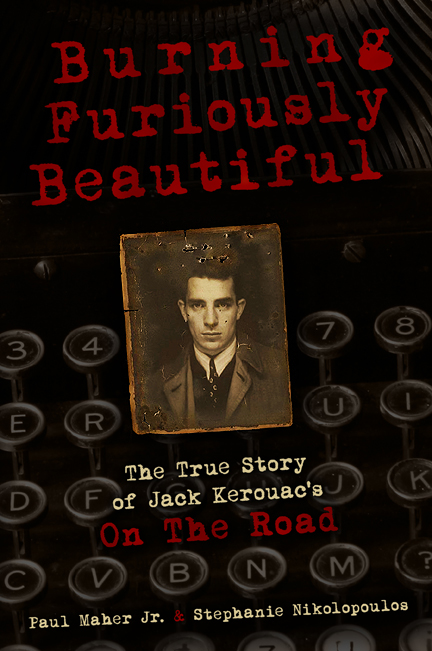
Here’s a sneak peek of the cover design for Burning Furiously Beautiful: The True Story of Jack Kerouac’s On the Road, which I am co-authoring with critically acclaimed Kerouac scholar Paul Maher Jr.
Award-winning designer Igor Satanovsky created the cover. Igor also happens to be a poet in his own right and studied poetry under Allen Ginsberg at City University of New York-Brooklyn College.
Jack Kerouac was in the Merchant Marines during World War II. You can read about his time on the S.S. Dorchester, which ultimately was torpedoed, here.
Kerouac made it out alive, but two of his Greek American friends from Lowell did not: Johnny Koumentzelis and Sebastian Sampas.
Today we remember all of those who selflessly gave of themselves to make our world a better place, and we think of the many families who lost loved ones.
When Jack Kerouac went off to Columbia University, he told people he was going to be a journalist. His father, Leo Kerouac, was a printer in Lowell, who owned a print shop called Spotlight Print. Leo handled printing for some of the big businesses in New England, and also did a bit of writing of his own. This inspired Ti Jean, as little Jack was called. He used to lay on the floor, creating his own little newspapers and comics.
In school in New York, first at Horace Mann prep school and then at Columbia, Kerouac contributed to the school newspapers. The writing he did for the papers would best be described as music journalism. He soaked in all the great 1940s bebop of Harlem and wrote jazz reviews.
There was no Pitchfork at the time. Rolling Stone magazine wasn’t founded until 1967. Even many of today’s popular jazz magazines weren’t in existence yet. Music journalism didn’t have the esteem that it does today.
Jack Kerouac may not have gone on to become a famous music critic or any sort of journalist in the traditional sense of the word, but his jazz reviews were not in vain. Writing music reviews, he honed his craft. He learned to listen well, and he learned how to recreate the excitement of a live gig on the page. This all went into his future novels. In On the Road, Kerouac wrote about experiencing jazz firsthand. Today, his books, even if they contain fictional elements, are testaments to the music of the 1940s and ‘50s. Although he may have obscured the names of his friends, the names of musicians and famous jazz clubs remain intact.
Furthermore, bebop style influenced the way Kerouac wrote. He learned about the notion of spontaneity and incorporated it into his own work. His writing style echoes the rawness and the genius of live, spontaneous jazz.
In Burning Furiously Beautiful, Paul Maher Jr. and I write about some of the great jazz clubs of the 1940s and ‘50s that Kerouac visited while he criss-crossed the country. The book tells the true story behind On the Road. It is a portrait of Jack Kerouac, but it’s also a portrait of the United States. In mentioning these jazz clubs that Kerouac visited, we examine a bit of America’s cultural history.
You’ve seen the posters, the trailers, the movie stills, and the interviews for the On the Road film. Now discover the soundtrack for On the Road.
According to Indiewire, the film will mostly have an original score by Gustavo Santaolalla. The Academy Award-winning composer was behind the music for Babel and Brokeback Mountain.
“On The Road” Soundtrack Tracklist
1. Sweet Sixteen – Greg Kramer
2. Roman Candles
3. Yep Roc Heresy – Coati Mundi
4. Reminiscence
5. Lovin’ It
6. The Open Road
7. Memories / Up to Speed
8. I’ve Got the World on a String – Ella Fitzgerald
9. That’s It
10. Keep it Rollin’
11. Hit That Jive Jack – Slim Gaillard
12. God Is Pooh Bear
13. Death Letter Blues – Son House
14. I Think of Dean
15. Jack Kerouac Reads ‘On the Road’ – Jack Kerouac
Considering how important bebop was to Kerouac’s writing style and even the content of On the Road, music will probably—or at least it should—play a large role in this film. I’m curious if the film will actually incorporate the music that Kerouac listened to in Harlem jazz clubs and the musicians he wrote about in On the Road. Music rights can be hard to obtain, but given that many kids aren’t listening to jazz today, I’d think the estates of many jazz musicians would jump at the chance to get some publicity.
I’m excited to hear Santaolalla’s take on what the music for On the Road should sound like.
The only bros for me are the mad awesome ones, the ones who are mad to chug, mad to party, mad to bone, mad to get hammered, desirous of all the chicks at Buffalo Wild Wings, the ones who never turn down a Natty Light, but chug, chug, chug like f*cking awesome players exploding like spiders across an Ed Hardy shirt and in the middle you see the silver skull pop and everybody goes, “Awww, sh*t!”
So goes On the Bro’d: A Parody of Jack Kerouac’s On the Road, by Mike Lacher, published today. The book reimagines Jack Kerouac’s On the Road as if it were told by someone like How I Met Your Mother‘s Barney–a bro.
Contrary to the popular myth of the scroll, Kerouac spent years trying to get the voice right for On the Road. Yes, he did pound the keys of the typewriter and turn out the novel in a matter of days, but that was only after he had spent years on the road and wrote and rewrote the novel multiple times, with different characters and different narration. Neal Cassady’s famous letters spurred Kerouac on to write in a more confessional and conversational approach. He worked hard to capture the feeling of a real talk, using words like “beat” and “hipster.” However, Kerouac was well educated. He did go to Columbia, after all, and while it may have been on a football scholarship that might make him seem a bit more like a bro, even as a child he used to ditch school so he could go read in the library. While his work may appeal to a guy’s guy because he’s often with his “bro” Neal, recklessly driving, picking up chicks, and smoking pot, the diction and syntax in On the Road reveal that underneath it all he was a sensitive poet who saw the beauty in the color of grapes. After all, this is how the famous quote from Jack Kerouac’s On the Road paraphrased above actually read:
“The only people for me are the mad ones, the ones who are mad to live, mad to talk, mad to be saved, desirous of everything at the same time, the ones who never yawn or say a commonplace thing, but burn, burn, burn, like fabulous yellow roman candles exploding like spiders across the stars and in the middle you see the blue centerlight pop and everybody goes “Awww!”
On the Bro’d is just a parody. It says so right in the subtitle. It’s not meant to be taken seriously, and the idea is actually clever. Still, it points toward a common misconception people have of Jack Kerouac and the Beat Generation, whom critics pejoratively referred to as “beatniks,” meaning the Beats were as “far out” as Sputnik. Keep in mind, Sputnik was launched by the Soviets during the Cold War. Beatnik was not a compliment. Even today, many scholars don’t take Kerouac’s writing seriously because it is so accessible. But his prose is poignant, his message spiritual. He was not saying, the only people for him were the ones who wanted to get drunk. He was saying the only people for him were the ones who want to truly live life to the fullest. He didn’t like the type of brain-zapped people who said commonplace things and wore Ed Hardy t-shirts. He said, “Great things are not accomplished by those who yield to trends and fads and popular opinion.”
I’m curious if you think On the Bro’d is a successful parody? It seems like something that would sell well at Urban Outfitters, yes?
Mark Twain’s original American boy vagabond in search of adventure would inevitably grow up to figure as the care-free rover in Kerouac’s semi-autobiographical novel. Moriarty is described as “a side-burned hero of the snowy West” and a “holy con-man,” which seem to us to be pretty accurate descriptions of how the lawless, fanciful Huck might have turned out. And after all, even though Moriarty and Sal never set off down the river on a raft, you can bet they would have if they could’ve — and we think Huck would be itching to try that ’37 Ford sedan.
Find out all the other great counterparts here, and feel free to add your in the comments section. I’d add:
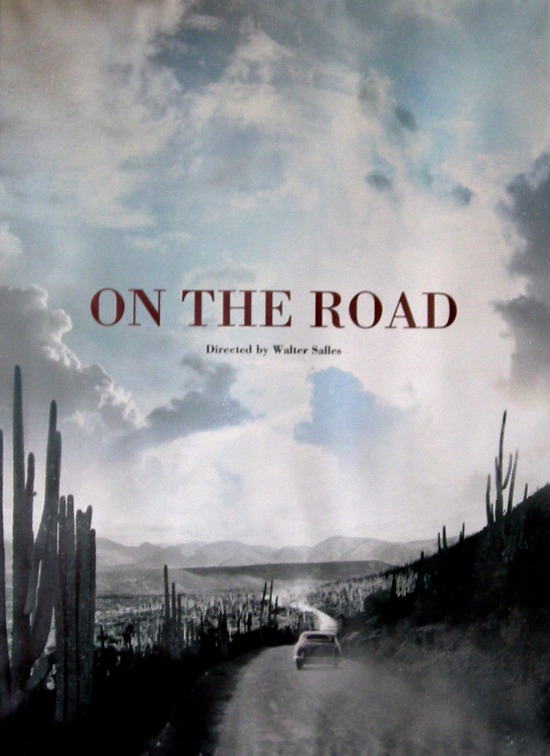
In case for some reason you haven’t seen the trailer for Walter Salles’ On the Road, screenplay by Jose Rivera, here it is. It will star Sam Riley as Sal Paradise, Garrett Hedlund as Dean Moriarty, Kristen Stewart as Marylou, Kirsten Dunst as Camille, Tom Sturridge as Carlo Marx, Viggo Mortensen as Old Bull Lee, Amy Adams as Jane, Alice Braga as Terry, and Danny Morgan as Ed Dunkel.
Cast your opinions in the comments section….
From a purely cinematic standpoint, the landscape looks beautiful. I’ve been following the production of the film for a while and paying particular attention to filming locations. If you think about it, The United States is a character in the book and in the film so it deserves attention, and I think Walter Salles, who directed The Motorcycle Diaries, can accomplish that.
The book I’m coauthoring with Paul Maher Jr., Burning Furiously Beautiful, details the places Jack Kerouac visited and was inspired by when writing On the Road. If you check out our Pinterest board, you can see just how incredible the landscape and history of the places Sal Paradise and Dean Moriarty visit are.
A couple of years ago, I was ravaging the shelves at the New York Public Library, when I came across Barry Miles’ The Beat Hotel: Ginsberg, Burroughs and Corso in Paris, 1957-1963. It was around Memorial Day, and I remember sitting by the fountain in the East Harlem section of Central Park, marveling at the ingenious writing methods of my favorite writers and their fascinating lives. While Burroughs was making his cut-ups and Ginsberg was writing poetry at night and typing them up in the morning, Corso was off wooing girls into buying him dinner.
Called “a vivid picture of literary life along the Left Bank in the late 1950s and early 1960s … [and] fun reading” by Library Journal, The Beat Hotel is a delightful history of a remarkable moment in American literary history. From the Howl obscenity trial to the invention of the Cut-up technique, Barry Miles’s extraordinary narrative chronicles the feast of ideas that was Paris, where the Beats took awestruck audiences with Duchamp and Celine, and where some of their most important work came to fruition — Ginsberg’s “Kaddish” and “To Aunt Rose”; Corso’s The Happy Birthday of Death; and Burroughs’s Naked Lunch. Based on firsthand accounts from diaries, letters, and many original interviews, The Beat Hotel is an intimate look at a place that “gave the spirit of Dean Moriarty and the genius of Genet and Duchamp a place to dream together of new worlds over a glass of vin ordinaire” (San Francisco Chronicle).
Wikipedia gives a little background on the Beat Hotel:
The Beat Hotel was a small, run-down hotel of 42 rooms at 9 Rue Gît-le-Cœur in the Latin Quarter of Paris, notable chiefly as a residence for members of the Beat poetry movement of the mid-20th century.
It was a “class 13” hotel, meaning bottom line, a place that was required by law to meet only minimum health and safety standards. It never had any proper name – “the Beat Hotel” was a nickname given by Gregory Corso, which stuck on [2][3]. The rooms had windows facing the interior stairwell and not much light. Hot water was available Thursdays, Fridays and Saturdays. The hotel offered the opportunity for a bath – in the only bathtub, situated on the ground floor – provided the guest reserved time in beforehand and paid the surcharge for hot water. Curtains and bedspreads were changed and washed every spring. The linen was (sometimes and in principle) changed every month.
The Beat Hotel was managed by a married couple, Monsieur and Madame Rachou, from 1933. After the death of Monsieur Rachou in a traffic accident in 1957, Madame was the sole manager until the early months of 1963, when the hotel was closed. Besides letting rooms, the establishment had a small bistro on the ground floor. Due to early experiences with working at an inn frequented by Monet and Pissarro, Madame Rachou would encourage artists and writers to stay at the hotel and even at times permit them to pay the rent with paintings or manuscripts. One unusual thing that appealed to a clientele of bohemian artists was the permission to paint and decorate the rooms rented in whichever way they wanted.
The Chelsea Hotel is kind of like New York’s answer to Paris’ Beat Hotel. Patti Smith brings the Chelsea Hotel to life in Just Kids, where she also talks about meeting Burroughs, Corso, and Ginsberg and about the idea of improvising in writing. But I digress….
If you follow me on Twitter, you may remember my recent post lamenting Barney Rosset’s death. Rosset didn’t shy away from experimental work, publishing the revolutionary works of the Beats at Grove Press. Upon his death, Regina Weinreich wrote an article about his involvement with the Beat Hotel.
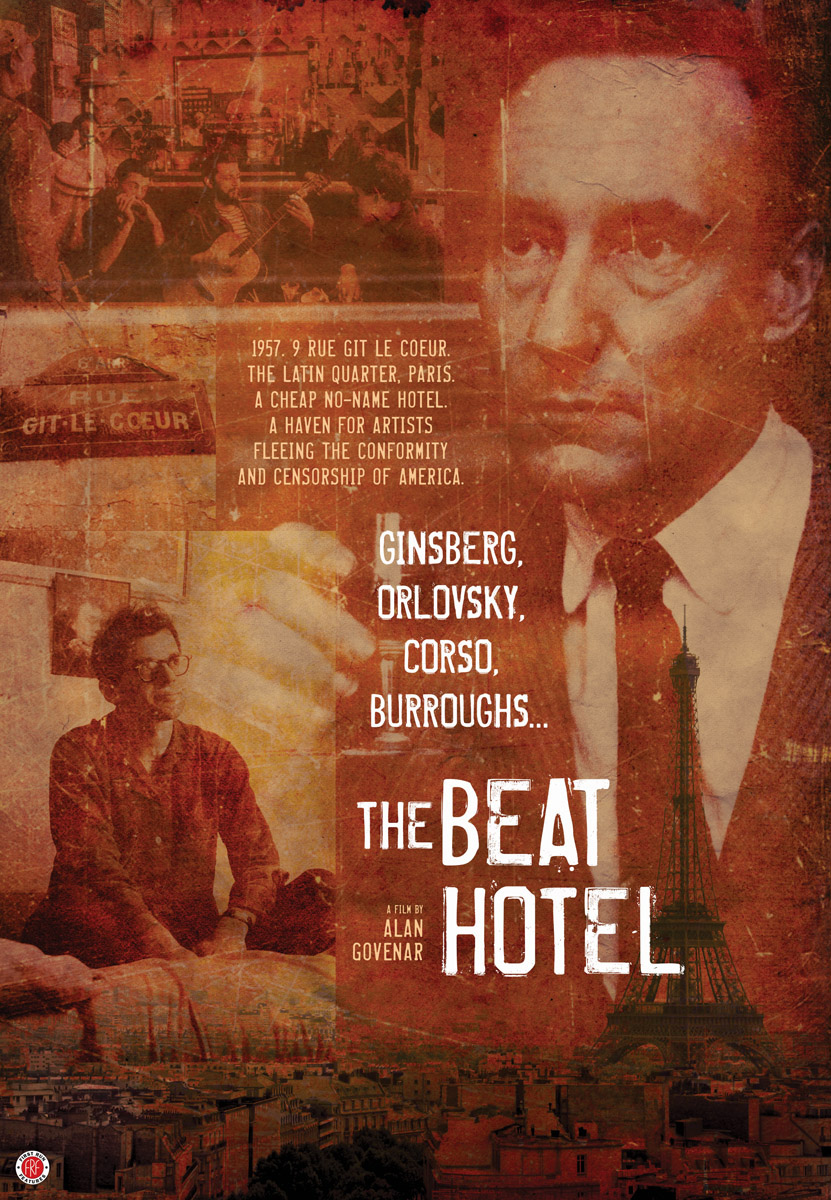
Alan Govenar is directing a new 82-minute documentary, with First Run Features and produced by Documentary Arts, called The Beat Hotel. Here’s the press release:
1957. The Latin Quarter, Paris. A cheap no-name hotel at 9 rue Git le Coeur became a haven for a new breed of artists fleeing the conformity and censorship of America. The hotel soon turned into an epicenter of Beat writing that produced some of the most important works of the Beat generation. It came to be known as the Beat Hotel. Opening March 30 in New York City, to be followed by a rollout to other cities across the country, Alan Govenar’s feature documentary THE BEAT HOTEL explores this amazing place and time.
Fleeing the obscenity trials surrounding the publication of his seminal poem Howl, Allen Ginsberg, along with Peter Orlovsky and Gregory Corso, happened upon the hotel on rue Git le Coeur and were soon joined by William Burroughs, Ian Somerville, and Brion Gysin. Run by the indefatigable Madame Rachou, the Beat Hotel was a hotbed of creativity and permissiveness, where Burroughs and Gysin developed the cut-up writing method; Burroughs finished his controversial book Naked Lunch; Ginsberg began his poem Kaddish; Somerville and Gysin invented the Dream Machine; Corso wrote some of his greatest poems; and Harold Norse, in his own cut-up experiments, wrote a novella, aptly called The Beat Hotel.
British photographer Harold Chapman‘s iconic photos and Scottish artist Elliot Rudie‘s animated drawings capturing Ginsberg, Orlovsky, Corso, Burroughs, Gysin, Somerville and Norse just as they were beginning to establish themselves on the international scene bring THE BEAT HOTEL to life on the screen. The memories of Chapman and Rudie interweave with the first-hand accounts of French artist Jean-Jacques Lebel, British book dealer Cyclops Lester, and 95 year old George Whitman. Together with the insights of authors Barry Miles, Oliver Harris, Regina Weinreich, and Eddie Woods, among others, they evoke a time and place where Chapman, mentored by Cartier-Bresson, roamed around Paris photographing nuns, bums, and the idiosyncrasies of street life; Corso took scissors to Marcel Duchamp’s tie in a Dadaist statement while Ginsberg kissed his knees; and Burroughs, with the help of Somerville’s lighting, learned to disappear before an audience’s eyes.
Director Alan Govenar is a writer, folklorist, photographer, and filmmaker. He is president of Documentary Arts and has a Ph.D. in Arts and Humanities from the University of Texas at Dallas. He is the author of 23 books, including Osceola: Memories of a Sharecropper’s Daughter, which won first place in the New York Book Festival (Children’s Non-Fiction), among other prizes. The off-Broadway premiere of his musical “Blind Lemon Blues,” co-created with Akin Babatunde, received rave reviews in The New York Times and Variety. Govenar’s film Stoney Knows How, based on his book by the same title about Old School tattoo artist Leonard St. Clair, was shown at the Museum of Modern Art in New York and the Centre Georges Pompidou in Paris, and was selected as an Outstanding Film of the Year by the London Film Festival. Govenar also has produced and directed numerous films in association with NOVA, La Sept/ARTE, and PBS for broadcast and educational distribution, including The Voyage of Doom, Le Naufrage de la Belle, The Devil’s Swing, Texas Style, Everything But the Squeak, The Human Volcano, The Hard Ride, Dreams of Conquest, and Little Willie Eason and His Talking Gospel Guitar.
Judging from the trailer, The Beat Hotel looks like it will be a documentary not to be missed by any fans of the Beats.
Burning Furiously Beautiful, the book on Jack Kerouac I’m collaborating on with Paul Maher Jr., is taking shape. Paul suggested I make a Pinterest board based on the book, and I’m super excited about the way it came out. So far I’ve cataloged photographs with captions to tell the story of part 1 of Jack Kerouac’s On the Road. It’s such a fun way to explore a story.
Want to check it out? I’d love to hear your feedback.







 Stephanie Nikolopoulos