Archive | Faith RSS feed for this section

Jonathan Collins’ Beat Generation Locale Series

8 Oct


9 Lupine Road

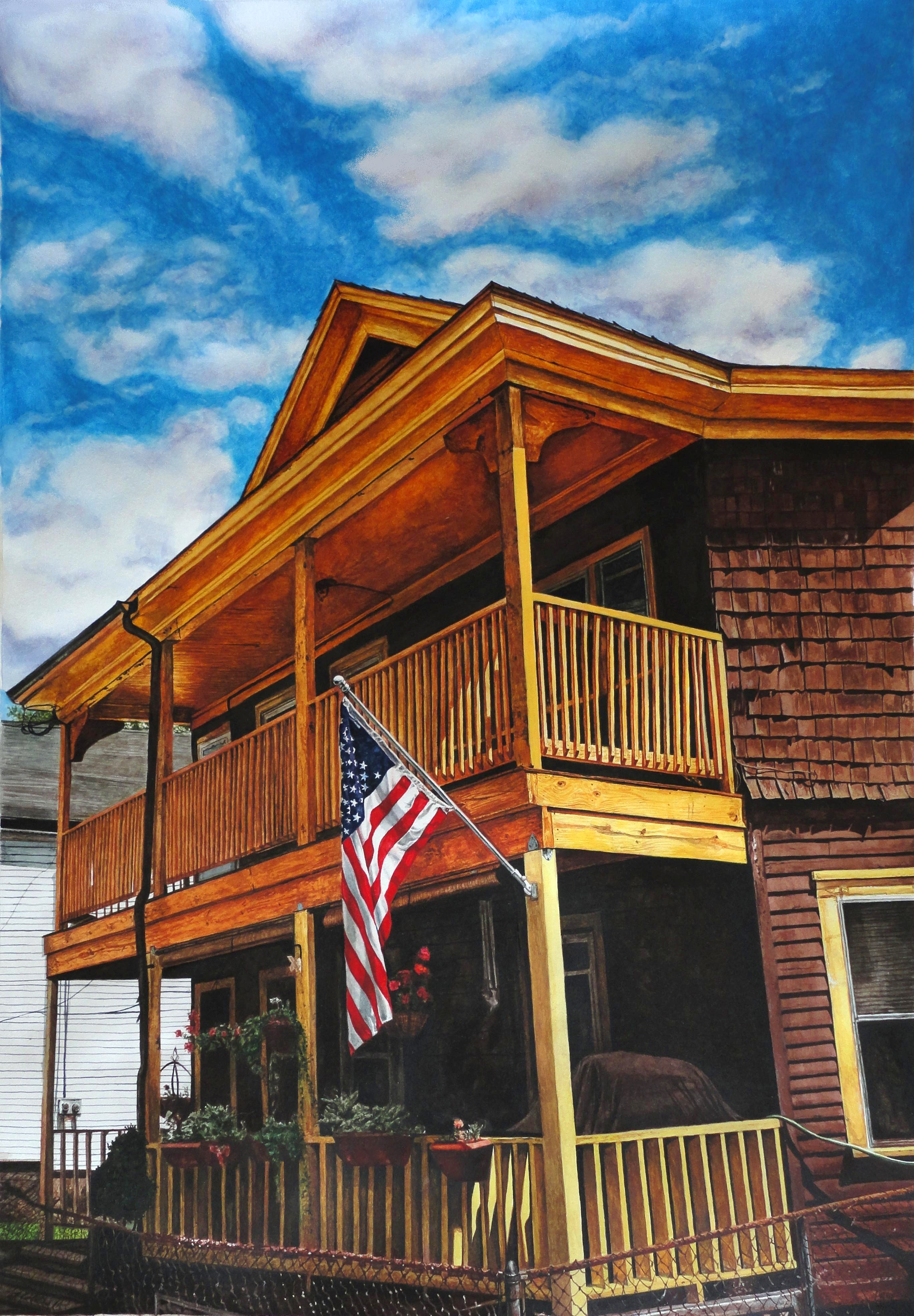
When I first saw artist Jonathan Collin’s paintings in person, I thought they were photographs.  They’re stunning.  Incredibly detailed and richly saturated, his Lowell series captures with paint the Massachusetts landscape that Jack Kerouac captured with words.  More than just setting and subject matter, Collins’ use of chiaroscuro resonates with Kerouac’s literature.  There is light piercing the darkness.

When I asked Jonathan if he’d write a little artist statement, he sent me back an email with the below, saying he’d written it spontaneously and with no revision, according to Beat principles.

Visions of Lowell

Jack Kerouac’s Duluoz Legend has always been an important touchstone of literature and revelation of light and beauty to me. In my research of those heady days of the 40s and 50s, I found them not only to be thrilling, but all in the family.

My father, Don Collins, was also in the Navy in WWII , the Merchant Marines, and traveled the world as Kerouac did. My father came back home, worked and painted, Kerouac wrote!

I began this series of paintings of Beat Generation locales in 2010. Traveling to San Francisco first, via the California Zephyr , in 2007, I was astounded by the natural richness and depth of the American landscape. I strolled the streets of North Beach, with its glistening neons and vibrating nightlife. I recorded everything in my journal, sketchbook, and camera. Everything that rose the hairs on my neck in artistic excitement!

I had been to Lowell many times, from the mid 1990s on, but my trip in July 2011 was intended to document the birth and mystery of the seeds planted in Kerouac’s psyche. From the Lupine Road house, to downtown cobbled streets, to the glowing Grotto, I stood transfixed.

Paterson was where my mother was born, and my parents met at the bridge surrounding the Great Falls. Allen Ginsberg was raised in Paterson and grew up  a mere four blocks from these sites. I found Ginsberg’s poem, “The Green Automobile” to be an exquisite inspiration, tying the mythical past to present;”From Lowell’s Merrimack to Paterson’s Passaic.”

My main focus was not only the historical context both personal and literary , but illumination, literally.  Light is the essence of my paintings and a key ingredient in the tempest of Beat literature. From Rimbaud’s “Illuminations,” to Kerouac’s “Visions” series, Gregory Corso’s visionary odes, to Ginsberg’s “Howl,” his plea for understanding.

The need to shed light, to reveal hidden truths beyond words, to make sense of the beauty and sanctity of life, feeling the mystery in the shadows, was and IS, the artists’ true quest.

Just as the Paterson Falls continue to boom and crash, and the neons of Frisco glow endurably, and the spirit of Lowell pulses in the night, so will the work of the Beats continue to inspire, and illuminate generation after generation.

It is my hope that these paintings will enrich the hearts and minds of others, with a glimpse of the light surrounding us, and pray we honor and express the light within us all.

The Moon Her Majesty

Lord

The Visitation

[The three paintings above are of the Grotto in Lowell and should be viewed from left to right in the order in which they appear.]

Clip: Letter to the Editor Published in Orion

13 Sep

I left a comment on an article on Orion‘s website a while back and one of the editors contacted me to see if they could reprint it in the print edition of their magazine.  Of course I said yes!  I love the articles in Orion.  My comment is now in the letters to the editor section of the September/October 2012 issue on newsstands now.  I’m credited as “Stephanie Niko” because I oftentimes abbreviate my name when I leave comments on blogs.

9/11: Church Hopping at St. Nicholas Church at the World Trade Center

11 Sep

Last year Burnside Writers Collective published my Church Hopping article on St. Nicholas, the Greek Orthodox church that was lost in the terrorist on September 11, 2001.  If you missed it, you can read about it here.

Recently, Patrick J. Foye, Executive Director of the Port Authority, said: “The new World Trade Center will not be whole and complete until the St. Nicholas Greek Orthodox Church is rebuilt.”  You can read about Archbishop Demetrios’ visit to the construction site, where he “stopped in front of the site where St. Nicholas is to be built at the corner of Liberty and Greenwich streets (the south-east corner of WTC),” on the site for the Greek Orthodox Archdiocese of America.

Bullies and Beauty and Beatitudes

13 Aug

“Bullied teen gets plastic surgery” ran the headline on Yahoo.  The accompanying photo showed a typical teen girl.  I clicked on the link to hear her story.  What had she looked like before the surgery?

As it turned out, that photo was the before photo.  My heart broke.

No, she didn’t look like a supermodel—but how many fourteen year olds do?  She looked like a cute little girl.  The type who in a few years would come into her own, but for now was just a typical adolescent.  Maybe in a year or two she’d start tweezing her eyebrows and wearing a little mascara, but at the moment she looked age appropriate and the only thing missing was a smile!  Oh, that little girl.  I recognized the sadness in her eyes.

It brought tears to my own eyes, bringing me back to my own awkward adolescent years.  I didn’t look all that different than that girl.  Judging from some old photos I have lying around, I may have looked worse.  I had tiny ears, but I felt like they stuck out.  I had terribly crooked teeth and had a full mouth of braces.  I was growing out a perm that never had curl or wave—only frizz.  I was skinny.  Not an attractive skinny.  The type of skinny that prompted the doctor to tell me to gain weight.  The list of insecurities went on and on.  Just like this little girl, I was picked on.  I spent many nights crying myself to sleep.

I’m not going to lie.  I still feel scarred from those years.  Getting bullied, feeling ugly, feeling trapped, it’s the worst.  But you know what?  It really does get better.  Maybe not right away.  And maybe you never forget those feelings, but you can move on, and those things that hurt you in the past hopefully make you a stronger person and also a nicer, more compassionate person.  You also discover that beauty is complex and strange and wild.

The doctor who did this little girl’s surgery said in the article, “She was picked for her surgery because of her deformities.”  Looking at the photograph, I don’t see any deformities.  The surgeon pinned her ears back and worked on her chin and nose, according to the article.  Maybe there’s something I’m not seeing in the before photo, but as far as I can tell she’s not “perfect” looking (who is??) but she certainly doesn’t have deformities.

I’m happy the girl who had the surgery is pleased with the outcome.  I’m not anti-plastic surgery.  If at an appropriate age someone wants to have plastic surgery that’s their prerogative.  But there’s a lot you can do without resorting to plastic surgery.  I do believe looks matter.  If your hair is messy, your roots are grown out, and you dress in ill-fitting, wrinkled clothes, it looks like you have little confidence in yourself, and chances are you’ll probably be treated according to way you present yourself.  I’m a sucker for makeover shows.  I cry almost every time I watch someone on TV get a makeover.  Because it’s not just about your looks—it’s about how you feel.  There’s so much you can do with just a little makeup and learning to dress to your body shape.  One of my favorites is What Not to Wear because they stress that you don’t have to lose weight to look great.

Supermodel Tyra Banks has talked for years about the fact that she herself has a big forehead.  Last month she even challenged people to a big forehead contest.  Over the years, she’s encouraged women to work what they got, telling them that those parts of their bodies that they may think are ugly may in fact be the very thing that makes them unique and interesting and beautiful.  Maybe there are aspects of your looks that truly aren’t desirable but those “flaws”—or “deformities”—should still be celebrated.

Tyra Banks told US Weekly:

This is who I am! I’m Tyra Banks and I have cellulite! That makes me ‘flawsome’ because I own it as part of what makes me unique. Don’t get me wrong: I don’t think my cellulite is beautiful, but I think it’s ‘flawsome.’

My blog caption is “Embracing the Beatific.”  When I was thinking about what my blog is about I knew that, although it’s not exclusively what I blog on, I write a lot about the Beat Generation.  Jack Kerouac said that the word “beat” came from the Beatitudes of the bible.

I realized the Beatitudes expressed my viewpoint.  Life isn’t always what it seems.  The meek will inherit the earth.  The poor in spirit will find a kingdom in heaven. Those who cry now will find happiness later.

Beauty is in the imperfect.


Here are some bullying resources and reading material:::

Dear Bully: 70 Authors Tell Their Stories

the column “Interview with My Bully” on Salon.

stopbullying.gov

It Gets Better

Bible verses on confidence

Workplace Bullying Institute


God Has a Sense of Humor — Either That or Everything I Think I Know about Myself Is Wrong

10 Aug


My mother always told me God has a sense of humor.  I believe her.

Growing up, I was terribly shy.  Perhaps because I felt so uncomfortable speaking, I turned to writing.  There, in the safety of my Hello Kitty journal, I could express my innermost fears, my hurts, and also my dreams and loves and cherished memories.

As I grew up, I continued to write.  I wrote for my high school newspaper and became copywriter for my high school yearbook, and when I went off to college I submitted poetry to my college’s paper.  While still an undergrad, I worked my way up from staff writer to editor in chief of a local indie newspaper and also began interviewing musicians for national magazines.  After college, I entered the world of book publishing, where to this day I blissfully sit in silence, getting paid to read for a living.  It’s the perfect job for an introvert.

Although I love editing and working with other authors and editors and designers, I always dreamed of writing my own book, so I’ve continued to work on my own writing.  My weekends are spent at the library or in the bookstore, crafting sentences.  I try to pour my heart out with the same abandon as I did when I was writing in the privacy of my little journal with the lock on it when I was a child, except now I’m working toward having people actually read my work.  I revise, I get feedback, I pitch, I query.  –And I get silence.  It feels like I rarely hear back from acquiring editors.  Writing is what I’m supposed to be good at.  It’s what I’ve always been told I’m good at.  And yet I have a hard time placing my writing in publications.

Instead, the skill I grew up thinking was my weakest is the one being called into action.  I don’t go out trying to book readings, but time and time again, I’m called upon to give readings and to teach.  It’s public speaking in all its knee-shaking glory.

I’m immensely thankful for these opportunities, and they’ve all gone pleasantly well, but I have to laugh that I seem to get more speaking engagements than publishing credits.

* * *

As I was writing this very post a few days ago, I got a message from poet and musician RA Araya asking me to read a poem in Greek at Sunday’s reading.  Talk about irony!  The memoir I’ve been writing deals with my conflicted Greek identity and the fact that I don’t speak Greek.  Now, as I was writing about laughing over the fact that I’m having to overcome my introverted tendencies to give readings, I’m asked to read in the very language I don’t speak.

But you know what?  I said yes.

Maybe I’ll crash and burn and make a fool of myself, but at least I’ll have tried.  Eleanor Roosevelt once said:

Do one thing every day that scares you.

Life is too short to be scared of anything.  Living means growing, and the best way to grow it to try new things.  Challenging yourself can lead to rewards.  I believe people surprise themselves and rise to occasions.  I’ve also learned that people want you to succeed and that literary crowds tends to be rather supportive.

I’m actually excited about this opportunity.  It’s a great way to promote the beauty of the Greek language and culture during Greece’s economic crisis, and I’m thinking I may read something in an archaic Greek dialect (I studied Classical Greek at Pomona College), a dead language, to further bring awareness to endangered languages.

If you’re in New York, stop by.  I can’t promise perfection, but we will have fun!!  Here’s the info:::

August 12, 2012.  5:00-9:00pm.  The Sidewalk Cafe (94 Avenue A).  New York, NY.  Stephanie will be reading from Burning Furiously Beautiful: The True Story of Jack Kerouac’s On the Road, as part of RA’s Music Poetry Jam Celebration.  flashbackpuppy, Patricia Spears Jones, Sparrow, Puma Perl, Kate Levin, Sarah Sarai, Foamola, Virdell Williams, and Steve will also be taking the stage.  Free, but there’s a one-drink minimum.

Now… what to wear?


Also!  Save the date::: September 3 I’m giving a reading that I’m beyond excited about.  Details to come soon.


Do you ever find that the very skill you least like using or think is your weakest is the one you need to rely on the most?  What do you think of Eleanor Roosevelt’s advice to push yourself to do the things that scare you?

Clip: Chapel-Turned-Brewery Hopping

2 Aug


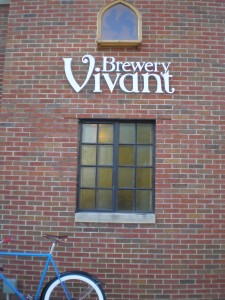
Burnside Writers Collective published my latest Church Hopping column.  In this edition of my ongoing column, I visit Brewery Vivant in Michigan. What’s now a trendy Grand Rapids beer hall used to be the Metcalf Funeral Chapel.  Writers Kim Gottschild and Larry Shallenberger join me.

You can read the full article here.


For the last time Burnside went Church Hopping during the Festival of Faith & Writing, check out: Calvin College Chapel with Fellow Burnside Writers.

For the time Burnside Writers Susan Isaacs and Donald Miller went Church Hopping in New York, check out: Calvary-St. George’s.

For another repurposed church, check out: Don Justo’s “Trash” Cathedral.

Road Trip Writing: On the Road and Through Painted Deserts

16 Jul

Donald Miller’s New York Times-bestselling book Blue Like Jazz recently was made into an indie film, and I had the opportunity to watch a screening in Times Square before the film was officially released on April 13.  I’ve had the immense pleasure of meeting and getting to know some of the “characters” in the book.  I was so proud of them!  Penny Carothers wrote a beautiful article about her experience going to the premier and seeing an actress play her on the silver screen.

The film was very different than the book.  I knew this going into it.  The story of this process of turning a collection of essays from Blue Like Jazz into an actual storyline is told in Miller’s A Million Miles in a Thousand Years.  There’s a scene in A Million Miles when Don is told that he essentially needs to change his life story for the movie.  He says:

“You think they might be bored if we just show my life the way it is,” I clarified. I guess I was asking for reassurance that my life was okay.

From the perspective of a fellow memoirist, I found the process fascinating.   I think memoirists, particularly those who are in the process of turning their book into a movie, should consider reading Blue Like Jazz and A Million Miles in a Thousand Years and then watching the film, just to get a sense of process.

After watching the film Blue Like Jazz, I can’t help but wonder what will happen with the film On the Road.  After all, both are fictional portrayals of real life.  If Blue Like Jazz is any indication, On the Road will be very different than the book.  A guy I interned with years ago at the Bowery Poetry Club left a comment recently in response to one of my Facebook posts, saying that Kerouac wasn’t a good storyteller.  In a way, I kind of agree with him.  On the Road would seemingly make a lot more sense if it was just one big road trip across the United States.  Instead, the protagonist, Sal Paradise, barely hits the road before he turns back around.  There are multiple trips across the country, and the story can get a bit confusing because of that.  Maybe Jack Kerouac was trying too hard to stick to the truth to combine all the trips into one.  Then again, maybe he knew what he was doing.  There’s something so much more telling about Sal Paradise failing his first attempt at road tripping and then frenetically ping-ponging between his mother’s house and the open road than if it had all happened easily, perfectly.  Can the film capture that?  Will it try?  Will gaining cohesive action and a clear plot lessen the reality, the rawness, the beat-ness of life?

While I do recommend Donald Miller’s A Million Miles in a Thousand Years for an honest look at not just the writing process but the process of living life, the Donald Miller book I’d actually recommend as an example of beautiful storytelling and craft is his first book, which was republished as Through Painted Deserts.  This is the book that pays more attention to the way words sound as they roll of the page.  It inspires because of its beauty and simplicity, and not because of grand, sweeping gestures and actions.

Through Painted Deserts is Donald Miller’s road trip book.  Here’s how the overview reads:

This classic road trip tale will inspire readers of all ages.

Fueled by the belief that something better exists than the mundane life they’ve been living, free spirits Don and Paul set off on an adventure-filled road trip in search of deeper meaning, beauty, and an explanation for life. Many young men dream of such a trip, but few are brave enough to actually attempt it. Fewer still have the writing skills of Donald Miller, who records the trip with wide-eyed honesty in achingly beautiful prose. In this completely revised edition, he discusses everything from the nature of friendship, the reason for pain, and the origins of beauty.

As they travel from Texas to Oregon in Paul’s cantankerous Volkswagen van, the two friends encounter a variety of fascinating people, witness the fullness of nature’s splendor, and learn unexpected lessons about themselves, each other, and even God.

Through Painted Deserts is the modern-day, Protestant version of On the Road.  It’s about a young man looking for truth out on the open roads of America.

PS::: You may also like:

my article on Church Hopping with Donald Miller

my article on Church Hopping with Penny Carothers

Clip: In the Bathtub with a Jazz Musician and a Beat Poet

29 Jun


Burnside posted an essay of mine called “In the Bathtub with a Jazz Musician and a Beat Poet.”  It’s a true story.

Road Trip Writing: On the Road and The Canterbury Tales

18 Jun

Jack Kerouac once quipped back at a journalist, “I’m not a beatnik; I’m a Catholic.”  Despite the Beat Generation being associated with the countercultural movement—sex, drugs, and … jazz—Kerouac’s writing so often points toward the spiritual.

Visions of Gerard describes his saint-like brother who died at age nine and touches upon life in the Catholic church in Lowell, Massachusetts.  When he left home, Kerouac began exploring Buddhism.  Ultimately he grew disenchanted by it, though, an experience he describes in Desolation AngelsOn the Road is tinged with the idea of holiness.  Check out this quote:

As we crossed the Colorado-Utah border I saw God in the sky in the form of huge gold sunburning clouds above the desert that seemed to point a finger at me and say, “Pass here and go on, you’re on the road to heaven.”

Beautiful, isn’t it?  In some ways, Sal Paradise—what a name!—is on a pilgrimage.  The point of the trip itself isn’t religious, but along the way Sal sees God in nature and in the act of traveling.  Throughout On the Road, Kerouac writes about searching for the holy.  What he finds there on the open road is the beatific—the blessings that seem contradictory to what the world says are blessings.

If you think about it, one of the earliest road trip novels is about a pilgrimage: The Canterbury Tales.  Chaucer’s fourteenth-century tale has all the seedy characters one might find William S. Burroughs depicting.  The pilgrims are road tripping from Southwark to the Saint Thomas Becket shrine at Canterbury Cathedral.  Just like how Sal Paradise finds he has tell good stories to anyone who picks him up while hitchhiking, the cast of characters in The Canterbury Tales each tell a story along the journey.

To support the National Literacy Trust, a group of modern-day pilgrims recently reenacted The Canterbury Tales.  You can read about it, see photographs, and listen to portions at the Guardian.


* * *

Don’t forget!

I’m reading tonight at 7:00 at The Penny Farthing (103 3rd Ave., downstairs in the speakeasy), here in New York City, as part of the Storytellers event, hosted by C3.

I’m Mentioned in Sojourners

11 Jun

Oh my gosh!  I forgot to mention back in April that I was mentioned in Sojourners!!  Such an honor.

My Burnside Writers Collective colleague Larry Shallenberger, whom I attended the Festival of Faith and Writing with, wrote the article “On the Need to Start an Ole Boys’ Club For Writers” about strong women literary voices, and there was my name alongside Kim Gottschild, Rachel Held-Evans, Sarah Thebarge, Karen Spears Zacharias, Jo Hilder, and Susan Isaacs.  I’m so fortunate to be part of a collective that has strong literary voices — both male and female — and that is an incredible support network.

In the article, Larry mentions my work in writing about Jack Kerouac.  It’s so interesting that he specifically mentioned this, as opposed to my visual arts writing for Burnside, because the Beat Generation has often been criticized for not being more open to women’s voices.  Furthermore, so many women have told me they don’t enjoy reading Kerouac because of his hyper-masculinity.

Larry blogs about things like, oh, “God Talk and the Stenciling on an Atomic Bomb” and “The Personality Bending Power of Story.”