Tag Archives: 1950s

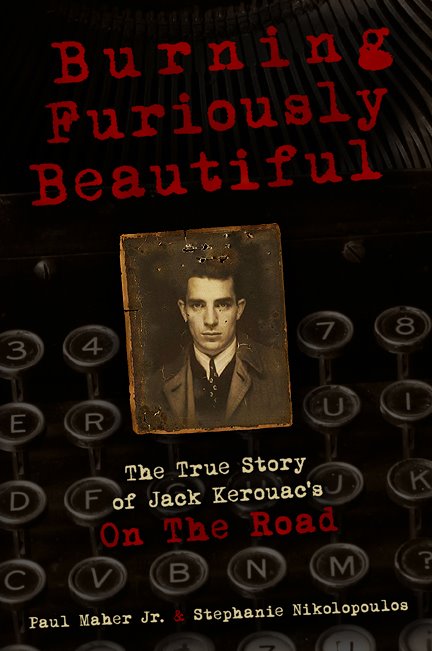
“Burning Furiously Beautiful” eBook Now Available!

30 Sep

528764_288645227899680_240973182_n


Happy Monday! I have BIG news to share today. Burning Furiously Beautiful: The True Story of Jack Kerouac’s “On the Road” is now available as an eBook! You can get it for $8.99 at Lulu.

Here’s a bit about the book from Lulu:

Burning Furiously Beautiful: The True Story of Jack Kerouac’s “On the Road” is the most up-to-date and accurate account of the development of American writer Jack Kerouac’s groundbreaking 1957 novel, On the Road. Using archival resources as the foundation of this book, Kerouac scholars Paul Maher Jr. and Stephanie Nikolopoulos have fashioned a gripping account of the internal and external experiences of Kerouac’s literary development.

And here’s our synopsis:

Fueled by coffee and pea soup, Jack Kerouac speed-typed On the Road in just three weeks in April 1951. He’d been traveling America for the past ten years and now, at last, the furious energy of his experiences flowed through his fingertips in a mad rush, pealing forth on a makeshift scroll that he laboriously taped together. The On the Road scroll has since become literary legend, and now Burning Furiously Beautiful sets the record straight, uncovering, among other things, the true story behind one of America’s greatest novels. Burning Furiously Beautiful explores the real lives of the key characters of the novel—Sal Paradise, Dean Moriarty, Carlo Marx, Old Bull Hubbard, Camille, Marylou, and others. Ride along on the real-life adventures through 1940s America that inspired On the Road. By tracing the evolution of Kerouac’s literary development and revealing his startlingly original writing style, this book explains how it took years—not weeks—to ultimately write the seemingly sporadic 1957 novel, On the Road. This revised and expanded edition of Jack Kerouac’s American Journey (2007) takes a closer look at the rise of Jack Kerouac and the Beat Generation.

The ebook can be read in the following formats: Windows, PC/PocketPC, Mac OS, Linux OS, Nook, Apple iPhone/iPod/iPad, Android, Kindle (Amazon), Sony Reader, Blackberry Devices, Palm OS PDAs, Cybook Opus, Bebook (Endless Ideas), Papyrus (Samsung) Jetbook (Ectaco), Windows Mobile OS PDAs.

A print book is forthcoming.

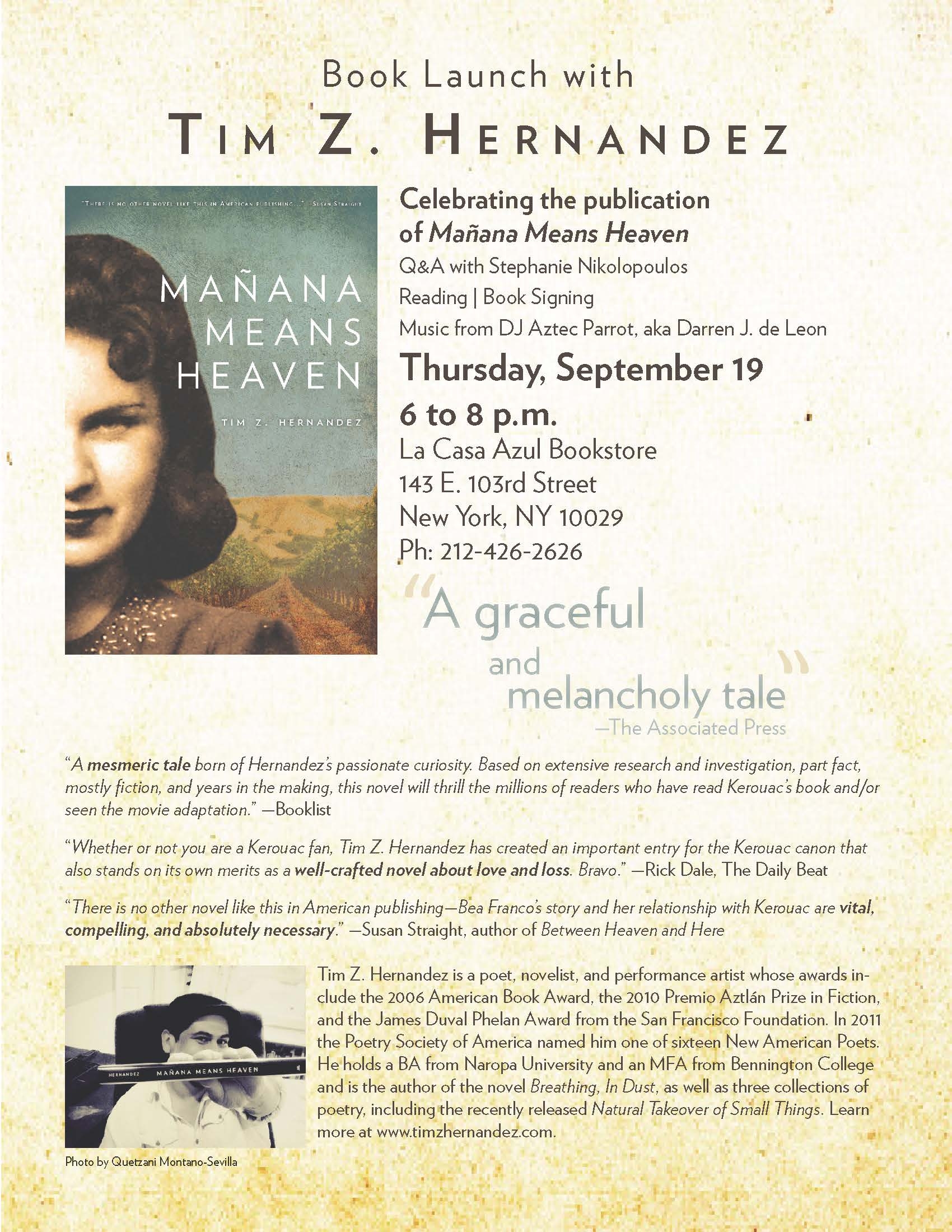
Tonite: I’m Talking with Tim Z. Hernandez

19 Sep

New Image

Just a quick reminder that I’ll be expanding upon my interview with award-winning poet Tim Z. Hernandez at La Casa Azul (143 E. 103rd, NYC) tonight at 6:00. We’ll be talking about his new book Manana Means Heaven, whether Jack Kerouac was a womanizer, what it’s like to write sex scenes about someone’s grandmother, the difference between fiction and creative nonfiction, and a whole lot more.

Tim will give a reading and will sign books — and DJ Aztec Parrot will be spinning music from the 1940s and ’50s.

I’m super excited! Hope to see you there!!

Mediabistro posted about the event here.

* * *

In the meantime, check out the awesome photos of Bea Franco and Tim’s guest post over on Rick Dale’s blog The Daily Beat, read an excerpt of Manana Means Heaven on La Bloga, and stop by to see Tim on The Big Idea. Then, follow along on the rest of Tim’s blog hop:

Friday, September 20 | The Dan O’Brien Project http://thedanobrienproject.blogspot.com/

Saturday, September 21 | Impressions of a Reader http://www.impressionsofareader.com/

If you happen to be in the New York area, Tim Hernandez will also be on a panel at the Brooklyn Book Festival this Sunday:

The Poet & the Poem: Natalie Diaz (When My Brother Was an Aztec), Alex Dimitrov (Begging For It), Lynn Melnick (If I Should Say I Have Hope) and Tim Hernandez (Mañana Means Heaven) will examine politics and identity in poetry, and the complex ways in which a poet’s work can become intertwined with the poets’ personal narrative. Moderated by Hafizah Geter, Cave Canem Foundation.


If “Everything Is Possible,” Our Milestones Need to Change

21 Aug

singles-620x412Image from Singles via Salon

In the second paragraph of Sara Scribner’s recent Salon article about Generation X, the journalist says:

Few have even noticed that this small, notoriously rebellious clan – those born roughly between 1965 and 1980, which means about 46 million Xers versus 80 million boomers — has entered middle age.

The article itself is entitled “Generation X gets really old: How do slackers have a midlife crisis?”

Let’s stop right there for a moment. The date range provided here for Generation X refers to people who are currently between 48 and 33 years old. Is 33 middle age? Is 33 “really old”? Hyperbole aside, is 48 even “really old”?

The rest of the article refers to people in their 40s. I get it. The writer is using the median age. Treatises on generations are always rift with broad-swept generalities, however the attention to age in this particular article is telling for the article goes on to bring up issues of delayed adulthood, parents, and leadership.

Scribner quotes historian and generational expert (side note: how does one get to be a generational expert? That sounds like an awesome job) Neil Howe saying:

“Xers experience agoraphobia — everything is possible.”

The article goes on to say:

That’s where this generation gets its reputation as reluctant to grow up. “It’s very hard to mature,” [Howe] says. “In order to mature and become an adult, you have to shut off options. The way Xers were raised, there were always options — their parents told them to keep options open.”

Further on in the article, Scribner explains the result of this:

[Sheryl] Connelly, the Ford futurist, says that some of the postponing of the traditional midlife period may come down to a pushing back of all the major life milestones: “Some of that [midlife questioning] would be fueled by empty nesters – the kids are grown,” she says, explaining a feeling of “now what?” “Demographics have shifted such that with each passing generation, people are postponing marriage.” With dependent kids at home, everything has been pushed back. “There’s nothing midlife about my situation right now.  I think that’s why you don’t hear this conversation.”

Maybe, but that’s assuming that we’re talking about a Gen Xer born closer to the 1965 date. Let’s take someone smack dab in the middle of Gen X. If we’re using the range 1965 to 1980, let’s pick someone born in 1972. That person today (well, depending on when their birthday falls) would be 41 years old. Let’s now assume this person married right out of college and then had a kid the following year, when they were about 24 years old. (Keep in mind, that’s younger than the median age for getting married which is closer to 27.) That child would be about 17 years old. It’s therefore not at all shocking that many—even half of—Gen Xers would have “dependent kids at home.” It would actually be rather traditional and, dare I say, old-fashioned.

More interesting is not that life’s “major life milestones” are happening later but that they’re happening at different times for Gen X.

And, just as interesting is that, even with these societal changes, Scribner still upheld conservative viewpoints of adulthood when she paired the phrase “major life milestones” with Connelly’s quote about “empty nesters,” “postponing marriage,” and “dependent kids at home.”

This is where the article gets fascinating but isn’t fully explored. Yes, perhaps on the whole, people are postponing marriage and children and many who did have children now can’t get rid of their boomerang kids, creating a period of limbo. However, just like the age range of Gen X varies, so does the age that they’re getting married and having kids. That’s apparent even in looking at the celebrities the article mentions. Kurt Cobain (born in 1967) had a baby, and that baby is now 20 years old. Winona Ryder is 41 and has never been married or had children. Liz Phair, who is now 46, married a film editor in 1995 and had a child with him the following year; in 2001 the couple divorced.

I have friends I graduated college with who afterwards got married and now have two or three children. I have other friends I graduated high school with who are still very single—and by “very,” I simply mean that they are not only unmarried but also not in a steady relationship. I have a cousin who is about two years older than me who has a seventeen-year-old son. And I have other cousins who are about a decade older than me and have children the same age and younger than the cousin closer to my age.

At a writing conference, I had an interesting conversation with one of my colleagues. On so many levels we connected. We’d had very similar upbringings. We had comparable goals with our writing. We  shared parallel interests. Only about two years older than me, she is a mother of adolescent children and confessed to fearing empty-nest syndrome. At that moment in the conversation, my unmarried, childless self felt like a complete child next to her.

Going back to the statements about Gen X’s reluctance to grow up and the difficulty of maturing in this day and age, I think Howe’s concept of “agoraphobia” is worth more attention. I wouldn’t necessarily agree with Howe’s assessment that we have a phobia, an irrational fear, of “shut[ting] off options,” but the fact that we have those options is significant. We have the option to get married right out of college or to wait until we’ve experienced more of life, know ourselves better, and have amassed a nest egg to support a family. There’s no longer the same social stigma there once was to have a child out of wedlock and so we have the option to have a child with a significant other who we may already be living with. With the advancement of medicine, we also have the option of waiting until we’re in our 40s to have children.

As Howe says, “everything is possible.” But what does that mean for our identities and for the concept of maturity and adulthood?

Does a Gen Xer who is single and childless at 48 years old have more in common with a single and childless 33 year old Gen Xer than with a 48-year-old Gen Xer with a toddler? Does a Gen Xer who is an empty nester have more in common with the Gen Xer who never had children? Does a divorced Gen Xer in their early 30s have a more similar lifestyle to a Gen Xer in their late 40s who never got married? Is the 48 year old who never got married and never had children less mature, less of an adult, because they haven’t reached certain “milestones”?

Maybe it’s time our concept of maturity shifted to match the time period in which we’re living. Maybe it’s time to recognize that today’s milestones have changed.

The Salon article says “Many Xers seem nostalgic for the serene ‘50s,” but the “serene ’50s childhood” is a myth. One, in fact, that we explore in Burning Furiously Beautiful: The True Story of Jack Kerouac’s “On the Road” when talking about how illness killed off children, how war fractured families, how gender roles were back then, and how supposed countercultural icon Jack Kerouac longed for a wife and a ranch. Marilyn Monroe died at 36, never having a child. Ella Fitzgerald never had a child of her own but adopted one. Allen Ginsberg had a lifelong partner but his relationship was not considered traditional at the time. Clearly, there were people in the 1940s and ’50s who reached adulthood, reach midlife, without achieving traditional milestones. So why do we continue to use the same markers for maturity today that weren’t even accurate in the 1940s?

You may also like:

Blame Parents for Millennials Acting Entitled: Helicopter Parents Have Trophy Kids Who End Up Boomerang Kids

Shunning Cars … and Life

Parallel Generations

Hipsters Hate Driving


Are the Beatniks Anti-American?

27 May

OLYMPUS DIGITAL CAMERAAmerican flag outside Kerouac’s birth home

I came to read Jack Kerouac, Allen Ginsberg, Gregory Corso, and Lawrence Ferlinghetti with little to no preconceived ideas about the Beat Generation. I had heard of Gilligan but never Maynard G. Krebs. I associated goatees with Ethan Hawke and turtlenecks with Sharon Stone. I liked the poetry bit in So I Married an Axe-Murderer but associated it with the spoken word poets of 1990s coffeehouses. So when I picked up The Portable Beat Reader, edited by Ann Charters, I had no presupposed knowledge of the writers in it or the culture they apparently inspired, apart from having discovered the book in a photo spread of a teen girl’s magazine. The kids in the spread looked like how I looked–or, rather, the cooler version of how I wished myself to look. That seemed as good a reason as any to beg my mom to buy the book for me.

I discovered humor and beauty and sensitivity in the words of the poets and novelists associated with the Beat Generation. When I read Kerouac explain the definition of “beat” as being both beat down and beatific, I understood and believed his words. It enlightened the way I read On the Road, and yet I read it sympathetically in the first place. I was a lot like Sal Paradise, hanging out with a friend who was wilder than I was. I longing to hit the road, to escape the humdrum of the suburbs and walk the city sidewalks of New York.

It was only later that I discovered that many others viewed the Beats and their work quite differently. It was only through reading biographies and nonfiction books on the Beats that I came to see that these writers were referred to as “beatniks,” and that that had a negative connotation. The term was a derogatory amalgamation of “Beat” and “sputnik,” and not being up on my history in my teen years, I understood it simply to mean they were “far out,” like a satellite in the space race. I had certainly heard of the Cold War, but it took me longer to understand that “beatnik” suggested the writers were somehow anti-American.

The idea of the Beats as anti-American took a long time for me to wrap my head around. Kerouac had written such a beautiful novel about America. He seemed so in love with the country and even made me fall in love with it in a new way. Before then, as the daughter of an immigrant, I had considered travel as something to do outside of America. I’d been to Europe but never the West Coast. Reading the Beats, I wanted to know more about this splendid vision of America they described. Sure, Ginsberg challenged America, but growing up decades later than him I was encouraged in school to think independently as he did. One could speak up in love. One must speak up in love.

As I continued to study Kerouac in particular, I learned about how he had been in the Merchant Marine during World War II. So much of what I read emphasized that he’d gotten discharged from the US Navy after being diagnosed with “schizoid personality.” It took more digging to hear a story like this one of how much Kerouac respected even the American flag:

At a party with Kesey’s Merry Pranksters Kesey came up and wrapped an American flag around me. So I took it (Kerouac demonstrates how he took it, and the movements are tender) and I folded it up the way you’re supposed to, and put it on the back of the sofa. The flag is not a rag.

The Beats were far from squeaky clean, but anti-American? I don’t see it. Perhaps the Beats didn’t jive with sock hops and malt shops, but maybe that’s a good thing because those 1950s stereotypes whitewashed the truth and left out large segments of the population. Some of us had fathers who spoke with an accent the way Ricky Ricardo did. Some of were intelligent but didn’t like stuffiness. Some of us liked to play our music LOUD. Some of us were friends with the outcasts. Some of us were misfits ourselves.

This Memorial Day, remember that many who died fighting for our country were just kids looking for a chance to escape from home or hoping for a chance to make something of their lives or desiring to be a part of something bigger than themselves. And think about today’s generation of Americans, those who may be a little rough around the edges or a little outspoken but who are so full of life, liberty, and justice.

You may also be interested in Memorial Day: Kerouac in the Merchant Marines.

Review: Ferlinghetti: A Rebirth of Wonder

14 Mar

ferlinghetti_splash

I caught the documentary Ferlinghetti: A Rebirth of Wonder (2009) at Anthology Film Archives this past weekend. Lawrence Ferlinghetti is one of my favorite poets, for his use of language and whimsy. I’ve long appreciate his commitment to freedom of speech, and this documentary made me more aware of how he used his position as a poet and bookseller for activist purposes. Quirky fact: he uses the windows of his office at City Lights as a “blog,” writing his political thoughts for all who pass by to see.

Ferlinghetti: A Rebirth of Wonder is star-studded, including informative interviews and clips with everyone from Amiri Baraka, David Amram, Jack Hirschman, Michael McClure, Anne Waldman, and George Whitman to Giada Diano, Bill Morgan, Dave Eggers, and Lorenzo Ferlinghetti. It impresses upon the viewer just how important Ferlinghetti is by indicating his support of Bob Dylan, his place in American poetry, awards given to him, and the naming of a street after him.

The biographical background information is fascinating, particularly when we hear about Ferlinghetti’s rearing in France, how his mother’s ineptitude at caring for him led to his being raised by the daughter of the founder of Sarah Lawrence College, and his service in World War II (spoiler alert: he saw Nagasaki right after the bomb dropped). There’s even a scene in which Ferlinghetti searches for his roots in Italy, where he was arrested for trespassing when he tried to get a sneak peek at where his father grew up! This of course is all balanced with his founding of City Lights, the Howl trial, and the Human Be-In.

All of it is wonderful, but its broad scope and pacing left the film falling flat in terms of its aesthetics. As a biographer, I understand how director/producer Christopher Felver must have struggled with the editing process. How could he cut anything out when it’s all so important? No one wants to see significant and appealing research fall on the cutting room floor. As a viewer, though, I would have preferred a more limited scope or narrative approach. It would have been a stronger film if Felver, who worked on the documentary for ten years, ruthlessly edited his work to give it a story arc. This film is best suited for those interested in learning more about the free speech movement, poetry in America, the Beat Generation (though Ferlinghetti adamantly declares in one scene “Don’t call me a Beat! I never was a Beat!”), San Francisco, and the 1950s and ‘60s. I’d recommend Ferlinghetti: A Rebirth of Wonder for high-school English classes as well as for writers in general, as it motivates one to consider poetry as subversive action.

Writing Wednesday: Writing from a Brothel

6 Feb

Dear Mom and Dad,

I’m going to go live in a brothel now. Don’t worry — just as the landlord. William Faulkner told me to.

PS: Sorry for robbing you and drinking all your whiskey. I’m just trying to be a good writer.

xoxo.


Note: This is completely fictional. But, Faulkner’s 1956 interview poses an interesting question: What is the best type of job for a writer to hold to earn some income while working on a book?

Road Trippin’: Fashion by Chance

29 Nov

I always discover the most lovely photos on Katie Armour’s blog The Neo-Traditionalist.  One of her posts a while back was about the clothing line  Chance’s new California collection.  The inspired photographs of California’s breathtaking landscape and close-up shots of cars made me think it would be a great collection to rummage through for a road trip!  As it turns out, founder Julia Leach gets her inspiration from the design of the classic car the Citroen DS, among other “artful classics.”  Just goes to show you that inspiration is everywhere and that cars have had a lasting impact on our culture.

I particularly like the red thread detail of the straw-stitched sun hat and of course all the striped shirts!

Katie oftentimes posts about the 1950s so her blog is a fun read.

Mixtape: Music and Poetry for On the Road

28 Jun

photo via Aunt13’s 8tracks mix

Aunt13 over on 8tracks made a mix called Music and Poetry for On the RoadIt’s inspired by Jack Kerouac’s On the Road and in the blurb she mentions Burning Furiously Beautiful!  How cool is that?!

I have the coolest friends!  I am going to be listening to this while I write, for sure, and daydreaming of hitting the road.  Aunt13 has over 300 mixes, so be sure to show her some love.

You may recall I posted a while back the soundtrack for the On the Road film.  It was just announced yesterday that the film will be making its US debut in late fall.

J. Haeske also made a mix for the soundtrack he’d envision for the film.  Teaser!  I have an interview with him about his new book on Kerouac lined up for you, so stay tuned.

What songs would you put on a mix for On the Road?

Also, I took my own advice about social media, and created a Facebook page for Burning Furiously Beautiful: The True Story of Jack Kerouac’s On the Road, the book I’m co-authoring with Paul Maher Jr.  Be sure to “like” the book on Facebook!  We’ll be posting news about the book, information from Across the Underwood, updates on the film, and so much more!

Abstract Expressionist New York @ MoMA

8 Apr

As I mentioned, I recently went to the MoMA thanks to the generosity of a friend of mine.  One of the reasons I’d been wanting to go was to see the Abstract Expressionist New York exhibit that’s running through April 25.  The writers of the Beat Generation used to hang out in bars with the abstract-expressionist painters, so I’ve been fascinated by how the literature and visual arts of the 1950s have influenced each other and have done some writing on the subject.

I like this line that was posted on one of the placards in the museum:

With a grave intensity and sense of responsibility the Americans who would later become known as the Abstract Expressionists set out to make art that would reassert the highest ideals of humankind.

It reminds me of how Jack Kerouac said that “beat” stemmed from the biblical beatitudes.