Tag Archives: Beat Generation

Clip: Jazz and the Beat Generation

11 Jul

beatsofsummer-button

I’m super excited::: Roof Beam Reader invited me to participate in the Beats of Summer series!

The literary blog is named after a J. D. Salinger novella and is run by a cum laude graduate of California State University, who earned an MA in English with an emphasis on American lit. He is now an academic adviser for two universities while pursing a PhD in English.

The Beats of Summer series so far has included:

Women of the Beat Generation in 3 Easy Steps from Jackie Mania

Jack Kerouac

William S. Burroughs

a giveaway

You can read my article — Jazz and the Beat Generation — here.

Stuff Jack Kerouac Hates

10 Jul

Erin La Rosa wrote a piece for BuzzFeed called “12 Things Famous Authors Absolutely Hated.” You know who hates something? Jack Kerouac. This, according to La Rosa:

Anyone who read On The Road and thought Kerouac was suggested to take up a beatnik lifestyle… you were so epically wrong. Kerouac hated his time searching for answers, and it’s pretty clear from the book that he didn’t find any. Kerouac was a conservative Catholic and always resented that his writing inspired a revolution.

Sucks for Kerouac!

She links to S. Peter Davis’ and David A. Vindiola’s 2010 Cracked article “6 Books Everyone (Including Your English Teacher) Got Wrong. The article says in part:

First of all, Kerouac hated beatniks; he thought they were a bunch of posers. Anyone who wanted to be a part of “The Beat Generation” completely missed the point. In his mind, those who were “Beat” were beaten down by society’s demands and struggled to find their place in the world. It was not something you chose to be because it would help you meet chicks.

“Hate” is such a strong word! Still, I think the articles further the important point that there’s a huge disconnect between the literature of the so-called Beat Generation and the subcultures of beatniks.
Not much has changed. Just look at the way Madison Avenue has marketed the heart out of the arts and music scene of Williamsburg.

Vice’s Suicide Poet: Beat Writer Elise Cowen

20 Jun

Well by now you’ve probably heard about VICE’s suicide fashion spread, “Last Words.” If not, here’s the low down: The lifestyle magazine with the apparently ironic tagline “The Definitive Guide to Enlightening Information” launched The Fiction Issue 2013 featuring all women fiction writers. So far, so good. In fact, almost exemplary considering VIDA’s stats that women authors aren’t equally published. The issue features works by Joyce Carol Oates and Mary Gaitskill, a story on Marilynne Robinson … and a fashion spread on female writers who have committed suicide. Following the public’s uproar, the staff has issued a “statement” explaining their “unconventional” and “artful” approach and “apologiz[ing] to anyone who was hurt or offended.” They have taken it down from their website but not recalled the print publication.

I’m not going to belabor the point about the dangerous implications of “Last Words”—it used self-violence to sell clothing, it said nothing about the writers’ actual work, it glamorized death, it suggested the hysteria of women, oh just to name a few things—but I do want to point out a few things that I haven’t seen the many other critiques point out (though they may certainly be there; I didn’t have time to read every single article): the fashion spread is just one of the many troubling aspects of the issue. Let’s start with the cover: it’s a picture of a skinny woman—her hip bone and clavicle jut out—in a bikini, with her hands behind her back and her legs cut off. Granted it’s a photograph by Ellen Page Wilson of Carole A. Feuerman’s 2008 sculpture Francesca, and Feuerman works out of a feminist perspective, but at quick glance, and when featured on the same page as a link to the Vice “most popular” list that includes “VICE Meets: The Biggest Ass in Brazil,” it would seem to fall in line with the usual negative portrayals of women in the media and representing women as body parts instead of a whole person—even if the artist intended it to show women’s connection with nature and their strength. Oh and that Joyce Carol Oates story I mentioned? It includes a mother on “Xanax or OxyContin.” The one by Mary Gaitskill? About a woman who wonders if it was a mistake not to have children. Hannah H. Kim’s story is about dealing with sadness. Amie Barrodale’s “A Ghost Story” opens with a woman who doesn’t accept a marriage proposal and is disowned by her father, her mother a shut-in with eczema. Zelly Martin’s story “Jailbait” is just what it sounds like: a story about a teenager who drops out of high school after becoming involved with her parents’ friend. They may have literary merit just as the artwork does, but collected together these stories position women as sexual objects and depressives. Based on the staff’s  statement and the fiction and art selected for the issue, “Last Words” was not an “oops” moment for Vice. It was an insidious attack on women.

So just who were these suicidal women portrayed in Vice’s “Last Words”? The spread included Iris Chang, Elise Cowen, Charlotte Perkins, Sylvia Plath, Sanmoa, and Virginia Woolf. Much could be said about any of these writers and why perhaps these particular writers were selected (for instance, the fact that Sanmoa hanged herself with silk stockings and not a rope). The inclusion of Elise Cowen is an interesting one, though, and while I’m by no means endorsing Vice’s tactics, maybe we can turn a negative into an opportunity to discuss the life and legacy of this poet.

Elise Cowen

Vice’s inclusion of Elise Cowen is an interesting choice because she’s not very well known as a poet. As far as I know (a search for her name on BN.com only brings up a DVD), there is no volume of poetry written solely by her. Her work has appeared in various collections but has not appeared on its own. In fact, the first book by her won’t be published until 2014. Tony Trigilio, an English professor at Columbia College Chicago, is editing the first major collection of her writing, entitled Elise Cowen: Poems and Fragments, for Ahsahta Press. Fourteen of those poems were published last year in Court Green, a literary journal Trigilio edits with David Trinidad.

The fact that Vice chose Cowen, when they could have selected more widely published women writers who have committed suicide—for example, travel writer Gertrude Bell, poet Ingrid Jonker (“the South African Sylvia Plath”), or literary critic Beatrice Hastings (Katherine Mansfield’s lover)—suggests the Vice team is either very well read or they were going on cult following more than literary recognition. The reason I am familiar with Elise Cowen, and presumably most other people are as well, is because of her circle of friends.

Elise Cowen dated Allen Ginsberg. In case you’re confused, yes, Ginsberg did date women here or there. He met Cowen through Barnard philosophy professor Alex Greer, and they went out on a date together. They got to talking and discovered they had a mutual friend in Carl Solomon, whom they’d both met while spending time in a mental hospital. Needless to say, Ginsberg and Cowen weren’t the best match: shortly after their romantic involvement, Ginsberg began seeing Peter Orlovsky, who became his lifelong partner, and Cowen began dating a woman with the pseudonym Sheila. The foursome apparently ended up living together after Cowen graduated from Barnard in 1956.

In New York, Cowen supported herself as a typist until she was fired, and then she went to check out the poetry scene in San Francisco, where she lived with an alcoholic painter. She became pregnant and had a late-term abortion and hysterectomy. After she returned to New York, she wound up in Bellevue to get treated for hepatitis and psychosis. Against the doctor’s orders, she checked herself out and went to go live with her parents up in Washington Heights. There, at their Bennett Avenue home, she jumped through the glass of the seventh-story window. Elise Nada Cowen was only twenty-eight years old.

Known at Barnard as Beat Alice, Elise Cowen may not have published a volume of poetry in her lifetime but her story and poetry is known today because of her friends. Her poetry references other great female writers such as Emily Dickinson and Mary Shelley. It is bold, experimental, and sensual.

For more information on Elise Cowen, her poetry, and her friendships, visit:

Elise Nada Cowen ’56 (Barnard College)

The Lady is a Humble Thing: Elise Cowen (Beatdom)

Elise Cowen: Sappho-Dickinson Hybrid with a Beat Sensibility (Jacket 2)

Black daisy chain of nuns (Jacket 2)

On Elise Cowen (1933-1962): poetry on the margins (Wake Your Mind)

Elise Nada Cowen (Cosmic Baseball Association)

Elise Cowen (UPenn)

Women of the Beat Generation (Knight)

Minor Characters (Johnson)

A Different Beat (Peabody)

Journals: Early Fifties, Early Sixties (Ginsberg)

I Celebrate Myself (Ginsberg)


Blame Parents for Millennials Acting Entitled: Helicopter Parents Have Trophy Kids Who End Up Boomerang Kids

12 Jun

YSize

Remember my post from last July “Hipsters Hate Driving”? It was inspired by the Reuters report “America’s Generation Y Not Driven to Drive” that did not once use the word “hipster” but rather “millennials.” Well, apparently Ford—as in the car manufacturer—sponsored a panel discussion with my exact title on May 30, 2013.

Flavorwire’s Tom Hawking caught up with Hipsters Hate Driving keynote speaker and millennials expert Jason Dorsey  in the June 10, 2013, article “Flavorwire Interview: Millennials Expert Jason Dorsey Says Young People ‘Really Do Act Entitled.’” At the Ford panel, “The Gen Y Guy” had said: “[Millennials] don’t want commitment. They drop in and out of experiences. They can’t wear a shirt or blouse if it’s photographed. The worst fear of millennials is wearing the same dress twice on two different [social networks],” and Hawkings got to the bottom of whether Dorsey really did think millennials are that shallow.

Flavorwire’s title quote comes from one of Dorsey’s responses:

When you dig into it, you find that a lot of millennials really do act entitled. They really do show up and have these massive expectations and are not willing to work at [things].

The word “entitlement” has come up again and again in discussions about millennials, and Dorsey argues it’s important to delve into the “why.” Of the root causes, Dorsey mention aspects relating to higher education and employment. Valid points, but I want to highlight a few comments he made that may slip under the cracks. Dorsey says, he focuses on trends like when people of the current generation are “moving out [of parents’ homes]” and “the relationship you have with your parents” as well as “views about parenting, especially how they were raised.”

Now we’re getting somewhere! Think about it for a moment: who are the parents of Generation Y? The oldest of them are Baby Boomers, who are “the generation that received peak levels of income” and “are associated with a rejection or redefinition of traditional values,” as Wikipedia put it. The younger parents are of Generation X, often derided as the Slacker Generation, who, facing economic downfall, turned to entrepreneurship. In other words, the shift from Baby Boomers to Gen X itself set the stage for a new generation that would be less traditional in their career outlooks.

In terms of their parenting style, these Baby Boomer and Gen X parents of Millennials have been called “Helicopter parents.” Jennifer O’Donnell defines this phenomenon in her About.com article “What Are Helicopter Parents?”:

The term “Helicopter parents” is often used to define a group of parents who engage in the practice of over-parenting. Helicopter parents are accused of being obsessed with their children’s education, safety, extracurricular activities, and other aspects of their children’s lives. Critics have criticized helicopter parents for over protecting their children and for failing to instill them with a sense of independence and a can-do attitude. Helicopter parents are also accused of over programming their children, and for failing to allow them free time to play and explore on their own.

She goes on to explain the root causes:

But the practice of over-parenting came into its own sometime during the 1990s when parents were bombarded with news stories about child abductions, academic competition, and ultimately, competition in a global economy.

Wikipedia explained the definition further, giving light into how this parenting technique affected children’s habits:

[The term “helicopter parenting”] gained wide currency when American college administrators began using it in the early 2000s as the Millennial Generation began reaching college age. Their baby-boomer parents in turn earned notoriety for practices such as calling their children each morning to wake them up for class and complaining to their professors about grades the children had received. Summer camp officials have also reported similar behavior from parents.

The children of Helicopter parents became known as Trophy Kids. I very briefly touched on this concept in my post “Parallel Generations,” in which I discussed the commonalities between the Lost Generation, the Beat Generation, and Generation Y, when I said:

Since then we’ve seen Generation Y, also known as the Millennials or Generation Next, who are often thought of as privileged Trophy Kids.

Notice the word “privileged.” Ron Aslop wrote the book on the subject: The Trophy Kids Grow Up. As the book’s website explains:

The millennials are truly trophy kids, the pride and joy of their parents who remain closely connected even as their children head off to college and enter the work force.

As Aslop suggests, these helicopter parents have been extremely involved in their Millennial children’s careers. George’s Employment Blog writes:

Although the Millenials often seek out challenging work and high levels of responsibility, these applicants’ parents are highly involved in their kids’ job search.

In a story entitled “Helicopter Parents Hover in the Workplace” on NPR on February 6, 2012, Jennifer Ludden says parents are doing more than just sending their children wanted ads and helping them with their resumes:

With millennial children now in their 20s, more helicopter parents are showing up in the workplace, sometimes even phoning human resources managers to advocate on their child’s behalf.

She states the facts:

Michigan State University more than 700 employers seeking to hire recent college graduates. Nearly one-third said parents had submitted resumes on their child’s behalf, some without even informing the child. One-quarter reported hearing from parents urging the employer to hire their son or daughter for a position.

The result of helicopter parenting is that Generation Y is coming across as entitled whether it’s their fault—or their parents. The Wall Street Journal article “The ‘Trophy Kids’ Go to Work,” published in 2008, said:

More than 85% of hiring managers and human-resource executives said they feel that millennials have a stronger sense of entitlement than older workers, according to a survey by CareerBuilder.com.

But who’s to blame: the parents or the kids? In the September 12, 2012, BusinessNewsDaily article “What Gen Y Is Not Getting from Their Parents,” David Mielach, writes:

A new survey has found that 69 percent of those between the ages of 18 and 29 receive little financial support from their parents.

He goes on to say:

The research found that 75 percent of young adults would rather live independently of their parents even if it is a struggle to do so financially.

Oh really? Then what are we to make of the rise of the phrase “boomerang kid,” which refers to young adults moving back in with their parents? It’s a concept that had such resonance it got its own (ill-fated) sitcom: How to Live with Your Parents for the Rest of Your Life.  T. J. Wihera wrote in the 2009 Denver Post article “Gen Y: Returning to the Nest”:

The Census Bureau reports that 56 percent of 18- to 24-year-old men and 48 percent of women in the same age bracket were living at home with their parents in 2008, though it should be noted that these numbers also count college students living in the dorms as living at home.

A more recent 2010 article in The Atlantic summed it up in the title “1 in 10 Millennials Living With Parents Because of Recession.” This year, Bloomberg Businessweek launched a business to get boomerang kids out of their childhood bedrooms.

While millennials’ parents may have raised them to be confident, independent-thinkers, and may have done everything in their power to push their little Trophy Kids toward success from a young age, their helicopter parenting techniques may have backfired. Many millennials have become boomerang kids, relying on their over-protective, control-freak parents to continue giving them the direction they have always given them.

In my recent blog post “Shunning Cars … and Life” I touched on the cultural shift that took place around the time of the Beat Generation, saying that while Jack Kerouac went on the road, today’s Generation Y is living a virtual life. Could it be that part of the reason why so many millennials have turned to living life through a computer screen has something to do with helicopter parents who “fail[ed] to allow [their children] free time to play and explore on their own” because “the 1990s […] were bombarded with news stories about child abductions, academic competition, and ultimately, competition in a global economy,” as O’Donnell wrote? In other words, perhaps parents believed life behind the computer was safer and more educational than the alternative of playing carefree outdoors. Children were the gods of their computer worlds, they could control their domain, and they soon became celebrities of social media sites like MySpace [emphasis mine], which furthered the entitlement already instilled in them by their parents.

Of course, these are generalities. Even though he was from the so-called Beat Generation, Jack Kerouac, who used the term “hipster” in his writing, could fit the profile of a millennial. His mother, Gabrielle, hovered like a helicopter parent, and he was a boomerang kid, who was living with his mother even in his forties.

On the Road Gets a Girly Makeover

4 Jun

book-coverimage via Cup of Jo

The cover of Jack Kerouac’s On the Road got a girly makeover last month as part of author Maureen Johnson’s challenge Coverflip, which asked people to imagine how the covers of famous books would look if they had been written by people of the opposite gender.

The experiment stems from the growing conversation surrounding how books are gendered. For more on this subject, I’d recommend reading Deboarah Copaken Kogan’s article “My So-Called ‘Post-Feminist’ Life in Arts and Letters” for The Nation, about the title and cover for her memoir Shutterbabe about her years as a war photographer. (See the disconnect? babe. war.)

The feminized cover of On the Road seen above—a fake, done in jest to prove Johnson’s point that covers are gendered—interestingly enough bears a resemblance to the real marketing materials for the recent film adaptation of Kerouac’s novel. Whether it was the film poster or the trailer, Kristen Stewart—who played LuAnne—was front and center. The US edition of the movie tie-in novel went with a collage effect but check out this Italian cover:

cover2


Lest you think the Italians are alone for some reason, it’s the same cover used for the Australian edition and the French edition.

What are we to make of the fact the movie-tie in editions look more like the fake Coverflip experiment than more recent printings of On the Road? Are the marketing teams behind these new editions trying to appeal to young women? Are they assuaging misogynistic critiques by giving a female character more attention—or are they actually embracing misogyny by using an image of a woman as a marketing tool?

For more on this subject, you might like:

Judging On the Road by Its Covers

From the Comments Section: Kerouac and Steinbeck

31 May

john

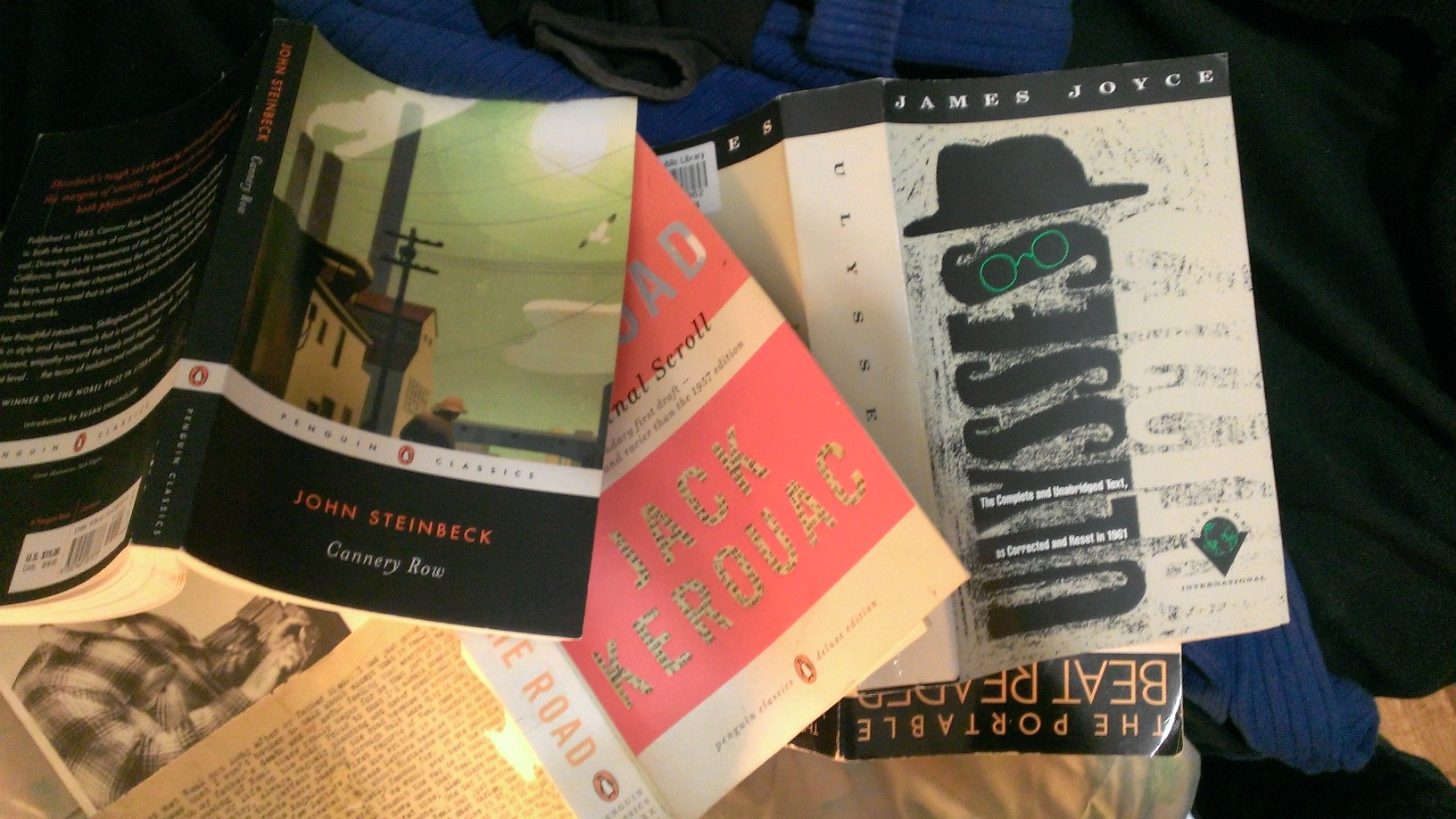
If you happened to read the comments from my post Research, Research, Research, you saw me and author J. Haeske — of the fantastic photo tour blog Retracing Jack Kerouac and the book Anywhere Road — discussing why I had posted a photograph of Steinbeck’s Cannery Row while doing research on Burning Furiously Beautiful: The True Story of Jack Kerouac’s “On the Road.”

Hopefully, I did a decent job answering the question. I’ve written about Jack Kerouac and John Steinbeck before, and I thought I’d use this opportunity to revisit the archives.

Ramblin’ Jack: Just Because You Don’t Like a Book, Doesn’t Mean It Isn’t Well Written — in which I write about how I used to hate Steinbeck

Big Sur and the Best Laid Plans — in which I talk about reading Cannery Row and offer some Steinbeck and Kerouac links

Overarching Writing Tips from Big Sur Writers: Don’t Censor Your First Draft — pretty much what it sounds like; includes tips from Kerouac and Steinbeck

Road Trip: The Salad Bowl of the World — in which I write about writers writing about Salinas Valley

Road Trip: Monterrey — in which I write about Kerouac and Salinas writing about Monterrey

Sweet Ride: Penguin Book Truck — I don’t mention in the article that Penguin published both Kerouac and Steinbeck


Do you see the similarity between Jack Kerouac and John Steinbeck … or is it just me?

Sweet Ride: Penguin Book Truck

30 May

Talk about a sweet ride! Look what I spotted at BookExpo America:

Penguin

That’s the Penguin Book Truck. Here’s Penguin’s press release on it:

Penguin Group (USA) Launches The Penguin Book Truck And Pushcart

NEW YORK, May 28, 2013 /PRNewswire/ — Penguin Group (USA) announced today the launch of its first mobile bookstore: the Penguin Book Truck and the Penguin Book Pushcart.  Inspired by the long tradition of the library book mobile and the recent popularity of food trucks, this mobile bookstore is the perfect way to bring authors and books directly to readers.

The Penguin Book Truck and Penguin Book Pushcart will make their debut on May 30th at New York’s Javits Center during the Book Expo of America.  The Penguin Book Pushcart will be at the Delecorte Theater in New York City’s Central Park for performances at the 2013 season of Shakespeare in the Park.  The Penguin Book Truck and Pushcart will also visit the American Library Association Conference in Chicago, ” Tom Sawyer Day ” at the Mark Twain house in Hartford, CT and numerous other bookstores, festivals, library events and author signings throughout the year.  In October, in conjunction with the National Steinbeck Center’s kickoff of the 75th Anniversary of the publication of John Steinbeck ‘s Pulitzer Prize-winning The Grapes of Wrath, (published by Penguin) the Penguin Book Truck will travel West on Route 66 from Oklahoma to California, following the route of the fictional Joad Family and stopping at numerous museums, universities and historical sites along the way.

The Penguin Book Truck and Pushcart will stock books from all Penguin Group imprints and include a wide selection of titles by authors ranging from Patricia Cornwell to John Green , Elizabeth Gilbert to Khaled Hosseini , Nate Silver to Sylvia Day as well as Penguin Classics. The selection will also be customized for individual events.

Susan Petersen Kennedy , President of Penguin Group (USA), said: “We think the Penguin Book Truck and Pushcart will allow us to, directly and in partnership with bookstores, connect writers with readers and to spread the iconic Penguin brand in fun and exciting new ways. This will be a movable feast of today’s great books.”

Featuring Penguin’s iconic orange logo the Penguin Book Truck is 27 feet long with 96 linear feet of bookshelves on both sides. The truck is LED lit for nighttime events, has awnings to protect shoppers from the elements, and cafe tables and chairs where browsers can sit and authors can sign books.

The Penguin Book Pushcart is inspired by the design of the classic New York City hotdog cart.  It will be transported by the Penguin Book Truck to various locations including bookstores, parks, beaches, sidewalks in shopping districts, summer theaters, and green markets.

To learn more, view photos and follow the schedule of the Penguin Book Truck and Pushcart, you can visit them online at www.penguinbooktruck.com or follow them on twitter @PenguinBookTruck or on facebook at www.facebook.com/PenguinBookTruck.

About Penguin Group (USA)

Penguin Group (USA) Inc. is the U.S. member of the internationally renowned Penguin Group. Penguin Group (USA) is one of the leading U.S. adult and children’s trade book publishers, owning a wide range of imprints and trademarks, including Viking, G. P. Putnam ‘s Sons, The Penguin Press, Riverhead Books, Dutton, Penguin Books, Berkley Books , Gotham Books , Portfolio, New American Library, Plume, Tarcher, Philomel, Grosset & Dunlap, Puffin, and Frederick Warne , among others. The Penguin Group (www.penguin.com) is part of Pearson plc, the international media company.

Wish I could hitch a ride to Tom Sawyer Day and of course get my kicks on Route 66 to celebrate the 75th anniversary of John Steinbeck‘s novel!

Books and road tripping? Jack Kerouac would be proud. Hm… maybe they’ll let me take a cross-country trip on the Penguin Book Truck when Burning Furiously Beautiful comes out. An author can dream….

My first thought, though, when I heard about the Penguin Book Truck was that it reminded me of a book I had edited come to life:

Parnassus

Christopher Morley’s Parnassus on Wheels.


Research, Research, Research

29 May

WP_20130525_001

Just a few of the books we’ve been using as research for Burning Furiously Beautiful: The True Story of Jack Kerouac’s “On the Road.”

Sweet Rides: Literary Modes of Transportation

28 May

OLYMPUS DIGITAL CAMERA

As I mentioned, I’ve been thinking a lot about transportation. So much so, in fact, that I was inspired to start a new board on Pinterest devoted to modes of transportation. It’s called Sweet Rides. I found some sleek cars that would make Neal Cassady‘s fingers itch, but I also looked at alternative vehicles and the writers and literary characters who might use them. I thought about Mark Twain and river boats. Wes Anderson and trains. Che Guevara and motorcycles. Anne of Green Gables and rowboats.  Poets doing spoken word on the New York City subway.

Are the Beatniks Anti-American?

27 May

OLYMPUS DIGITAL CAMERAAmerican flag outside Kerouac’s birth home

I came to read Jack Kerouac, Allen Ginsberg, Gregory Corso, and Lawrence Ferlinghetti with little to no preconceived ideas about the Beat Generation. I had heard of Gilligan but never Maynard G. Krebs. I associated goatees with Ethan Hawke and turtlenecks with Sharon Stone. I liked the poetry bit in So I Married an Axe-Murderer but associated it with the spoken word poets of 1990s coffeehouses. So when I picked up The Portable Beat Reader, edited by Ann Charters, I had no presupposed knowledge of the writers in it or the culture they apparently inspired, apart from having discovered the book in a photo spread of a teen girl’s magazine. The kids in the spread looked like how I looked–or, rather, the cooler version of how I wished myself to look. That seemed as good a reason as any to beg my mom to buy the book for me.

I discovered humor and beauty and sensitivity in the words of the poets and novelists associated with the Beat Generation. When I read Kerouac explain the definition of “beat” as being both beat down and beatific, I understood and believed his words. It enlightened the way I read On the Road, and yet I read it sympathetically in the first place. I was a lot like Sal Paradise, hanging out with a friend who was wilder than I was. I longing to hit the road, to escape the humdrum of the suburbs and walk the city sidewalks of New York.

It was only later that I discovered that many others viewed the Beats and their work quite differently. It was only through reading biographies and nonfiction books on the Beats that I came to see that these writers were referred to as “beatniks,” and that that had a negative connotation. The term was a derogatory amalgamation of “Beat” and “sputnik,” and not being up on my history in my teen years, I understood it simply to mean they were “far out,” like a satellite in the space race. I had certainly heard of the Cold War, but it took me longer to understand that “beatnik” suggested the writers were somehow anti-American.

The idea of the Beats as anti-American took a long time for me to wrap my head around. Kerouac had written such a beautiful novel about America. He seemed so in love with the country and even made me fall in love with it in a new way. Before then, as the daughter of an immigrant, I had considered travel as something to do outside of America. I’d been to Europe but never the West Coast. Reading the Beats, I wanted to know more about this splendid vision of America they described. Sure, Ginsberg challenged America, but growing up decades later than him I was encouraged in school to think independently as he did. One could speak up in love. One must speak up in love.

As I continued to study Kerouac in particular, I learned about how he had been in the Merchant Marine during World War II. So much of what I read emphasized that he’d gotten discharged from the US Navy after being diagnosed with “schizoid personality.” It took more digging to hear a story like this one of how much Kerouac respected even the American flag:

At a party with Kesey’s Merry Pranksters Kesey came up and wrapped an American flag around me. So I took it (Kerouac demonstrates how he took it, and the movements are tender) and I folded it up the way you’re supposed to, and put it on the back of the sofa. The flag is not a rag.

The Beats were far from squeaky clean, but anti-American? I don’t see it. Perhaps the Beats didn’t jive with sock hops and malt shops, but maybe that’s a good thing because those 1950s stereotypes whitewashed the truth and left out large segments of the population. Some of us had fathers who spoke with an accent the way Ricky Ricardo did. Some of were intelligent but didn’t like stuffiness. Some of us liked to play our music LOUD. Some of us were friends with the outcasts. Some of us were misfits ourselves.

This Memorial Day, remember that many who died fighting for our country were just kids looking for a chance to escape from home or hoping for a chance to make something of their lives or desiring to be a part of something bigger than themselves. And think about today’s generation of Americans, those who may be a little rough around the edges or a little outspoken but who are so full of life, liberty, and justice.

You may also be interested in Memorial Day: Kerouac in the Merchant Marines.