Tag Archives: Beat Generation

Life after the MFA

5 Jun

As thesis submission deadline approached, people began asking me what I was planning on doing after graduation.  Then they’d stop themselves, afraid they may have asked too painful of a question.  But it’s not!

In one of my last posts, I left off telling you about grabbing a cup of tea after turning my theses in.  What I didn’t tell you was that on my walk back to my office, while sipping that delicious tea, I made a phone call to biographer Paul Maher Jr.  Paul’s books are some of the most well respected in his categories, and they’ve been translated and sold around the globe.

Inspired by Laura Vanderkam’s List of 100 Dreams, I created my own a while back.  Become a scholar on the Beat Generation was on my list.  I’ve been studying the writers generally categorized as Beat for more than a decade now.  I did my MFA at The New School, where Jack Kerouac took writing classes, and where I connected with writers who had known Jack Kerouac.

Now, my dream of becoming a Beat scholar is being realized.  Paul and I are working on a book that tells the true story of Jack Kerouac’s On the Road.  The phone call to him on Monday was to discuss cover ideas.

I don’t have a big life-altering answer to the question of what I’m doing after the MFA.  Paul and I have been working on this book for a while now, and since I won’t be simultaneously working on a thesis anymore I’ll simply be refocusing my creative energies into the book.  It helps that I didn’t enter the program straight out of undergrad.  I’d already been working in book publishing, a career many of my classmates are hoping to enter, and so graduation isn’t a big scary unknown for me.  I’ll be continuing in my editorial role.  For me, life after the MFA is about continuing to follow my passions while also seizing new opportunities.

I’m extremely excited to say that my post-MFA plan is to co-author a book on Jack Kerouac.
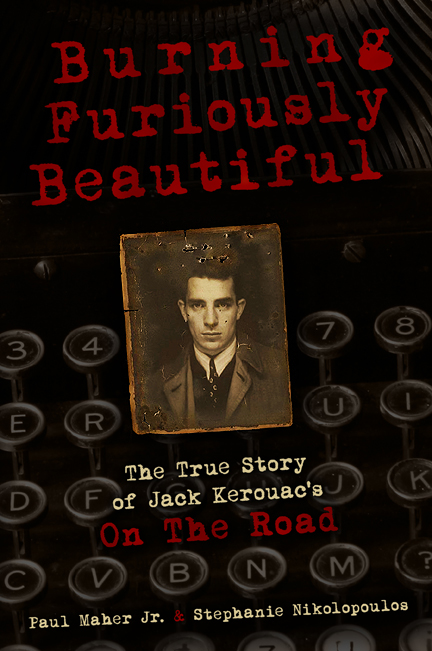
Sneak Peek of the Burning Furiously Beautiful Cover

31 May

Here’s a sneak peek of the cover design for Burning Furiously Beautiful: The True Story of Jack Kerouac’s On the Road, which I am co-authoring with critically acclaimed Kerouac scholar Paul Maher Jr.

Award-winning designer Igor Satanovsky created the cover.  Igor also happens to be a poet in his own right and studied poetry under Allen Ginsberg at City University of New York-Brooklyn College.

Can’t wait to share more with you!

Memorial Day: Kerouac in the Merchant Marines

28 May

Picture via Across an Underwood / Sketches on Kerouac

Jack Kerouac was in the Merchant Marines during World War II. You can read about his time on the S.S. Dorchester, which ultimately was torpedoed, here.

Kerouac made it out alive, but two of his Greek American friends from Lowell did not: Johnny Koumentzelis and Sebastian Sampas.

Today we remember all of those who selflessly gave of themselves to make our world a better place, and we think of the many families who lost loved ones.

On the Bro’d: A Parody of Jack Kerouac’s On the Road​​

15 Apr


The only bros for me are the mad awesome ones, the ones who are mad to chug, mad to party, mad to bone, mad to get hammered, desirous of all the chicks at Buffalo Wild Wings, the ones who never turn down a Natty Light, but chug, chug, chug like f*cking awesome players exploding like spiders across an Ed Hardy shirt and in the middle you see the silver skull pop and everybody goes, “Awww, sh*t!”

So goes On the Bro’d: A Parody of Jack Kerouac’s On the Road, by Mike Lacher, published today.  The book reimagines Jack Kerouac’s On the Road as if it were told by someone like How I Met Your Mother‘s Barney–a bro.

Contrary to the popular myth of the scroll, Kerouac spent years trying to get the voice right for On the Road.  Yes, he did pound the keys of the typewriter and turn out the novel in a matter of days, but that was only after he had spent years on the road and wrote and rewrote the novel multiple times, with different characters and different narration.  Neal Cassady’s famous letters spurred Kerouac on to write in a more confessional and conversational approach.  He worked hard to capture the feeling of a real talk, using words like “beat” and “hipster.”  However, Kerouac was well educated.  He did go to Columbia, after all, and while it may have been on a football scholarship that might make him seem a bit more like a bro, even as a child he used to ditch school so he could go read in the library.  While his work may appeal to a guy’s guy because he’s often with his “bro” Neal, recklessly driving, picking up chicks, and smoking pot, the diction and syntax in On the Road reveal that underneath it all he was a sensitive poet who saw the beauty in the color of grapes. After all, this is how the famous quote from Jack Kerouac’s On the Road paraphrased above actually read:

“The only people for me are the mad ones, the ones who are mad to live, mad to talk, mad to be saved, desirous of everything at the same time, the ones who never yawn or say a commonplace thing, but burn, burn, burn, like fabulous yellow roman candles exploding like spiders across the stars and in the middle you see the blue centerlight pop and everybody goes “Awww!”

On the Bro’d is just a parody. It says so right in the subtitle.  It’s not meant to be taken seriously, and the idea is actually clever.  Still, it points toward a common misconception people have of Jack Kerouac and the Beat Generation, whom critics pejoratively referred to as “beatniks,” meaning the Beats were as “far out” as Sputnik.  Keep in mind, Sputnik was launched by the Soviets during the Cold War.  Beatnik was not a compliment. Even today, many scholars don’t take Kerouac’s writing seriously because it is so accessible.  But his prose is poignant, his message spiritual.  He was not saying, the only people for him were the ones who wanted to get drunk.  He was saying the only people for him were the ones who want to truly live life to the fullest.  He didn’t like the type of brain-zapped people who said commonplace things and wore Ed Hardy t-shirts.  He said, “Great things are not accomplished by those who yield to trends and fads and popular opinion.”

I’m curious if you think On the Bro’d is a successful parody?  It seems like something that would sell well at Urban Outfitters, yes?

Writing Wednesday: If You Miss a Beat, You Create Another

14 Mar

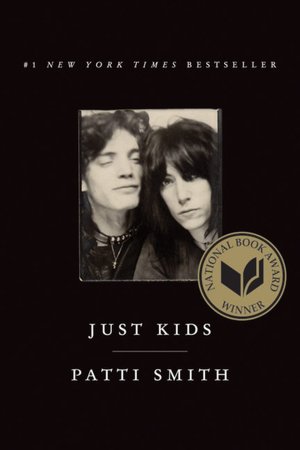
I had the great privilege of hearing Patti Smith read from Just Kids at The New School a while back.  She read from the priceless scene in which she meets Allen Ginsberg at an automat.  I’m quite fond of kitsch automat culture, and used to frequent the one down on Saint Marks when it was still around.  Basically, an automat is fast fast food: you don’t even have to stand in line to order a burger and fries; you just slip a few quarters into a vending machine and out comes surprisingly delicious warm food.  Whenever I ate at the Automat, I felt like I was a character straight out of The Jetsons.  I was hooked on their mac-and-cheese egg rolls.  The resurgence of The Automat only stuck around for a few years, but as a whole they were big a few decades ago.  When Patti Smith was in her early twenties, scraping by to survive, she fed a few quarters into an automat to get some quick, cheap food.  When she turned the knob she discovered the price had gone up.  The machine had sucked up her meager coins and she was about to go hungry when Allen Ginsberg offered her the additional cents and even paid for a cup of coffee.  They get to talking, she knowing perfectly well he is the great poet, and he thinking the whole time she is a handsome boy!

I knew for a long time that I wanted to read Just Kids.  It had all the makings of a book I knew I’d love—New York City, Beat poets, artists, The Hotel Chelsea, Andy Warhol, music, and memoir.  The only problem was that I was inundated with reading assignments for classes and bills to pay for tuition and books for said classes.  Just Kids wasn’t constantly checked out of the library, which was probably for the best because I didn’t have the time to read it anyway.  But!  I have at last read it—savored it.  I so greatly enjoyed Smith’s poetic voice and her obsession over Rimbaud.  I liked reading about Patti Smith and Robert Mapplethorpe’s relationship, their strivings toward art, their fashion!  And I was so happy to discover that in addition to the Allen Ginsberg connection, Smith also befriended poet Gregory Corso, whose poetry I revere.

Patti Smith also began a relationship with Sam Shepard, and they end up collaborating on a play together.  I find great reassurance in reading their exchange.  Smith was nervous about the prospect of improvising during the play, and on page 185 of the first edition (HarperCollins, 2010), Smith asked, “What if I mess it up?  What if I screw up the rhythm?”  Shepard replied:

“You can’t,” he said.  “It’s like drumming.  If you miss a beat, you create another.”

From Just Kids I learned a lot about being part of the “scene,” which comes across as important to the evolution and success of one’s career.  However, this little line spoken by Sam Shepard is a solid reminder that in writing and in life the beat goes on.  If you miss a beat, you improvise and create another.

Do the Brits Love Kerouac More than the Yankees?

3 Dec


Jack Kerouac is the Tupac of the literary world.  Even though he died in the infamous year of 1969, new works of Kerouac’s keep surfacing.  Recent years have seen the publication of Orpheus Emerged (2002) and When the Hippos Were Boiled in Their Tanks (2008), for which he collaborated with William S. Burroughs.  Around Thanksgiving The Sea Is My Brother came out.

Sort of.

The Sea Is My Brother was published in England on November 24, 2011, but it won’t come out in the States until March 6, 2012.  I know this because I’ve been stalking the BN.com product page and was confused when all of a sudden I started getting news that the novel had come out.  I thought maybe it had been released early.  Okay, for any of you who work in publishing, you know that I was really taking a wild leap with that one.  Pub dates shift out further.  Books rarely come in earlier than expected.  So what gives?  Why is a quintessential American author – the author that hitchhiked his way across the United States – being published overseas before in the States?

The good news is if you go to Penguin’s website, you can have the book shipped to you from the UK.  (The rights for the ebook are restricted to the UK.)  You just have pay a whole lot more than if you wait until spring.  Dear Santa….

Here’s the synopsis from Penguin:

Described by Kerouac as being about “man’s simple revolt from society as it is, with the inequalities, frustration, and self-inflicted agonies”, the 158-page handwritten manuscript was Kerouac’s first novel, but was not published during his lifetime. He wrote in his notes for the project that the characters were “the vanishing American, the big free by, the American Indian, the last of the pioneers, the last of the hoboes”. The novel follows the fortunes of Wesley Martin, a man who Kerouac said “loved the sea with a strange, lonely love; the sea is his brother and sentences. He goes down.”

Jack began this work not long after his first tour as a Merchant Marine on the S.S. Dorchester in the late summer of 1942 during which he kept a journal detailing the gritty daily routine of life at sea. Inspired by the trip, which exemplified Jack’s love for adventure and the character traits of his fellow shipmates, the journals were spontaneous sketches of those experiences that were woven into a short novel soon after disembarking from the S.S. Dorchester in October of 1942.

The book also contains correspondence between Kerouac and his Greek childhood friend Sebastian Sampas, with whom he grew up with in Lowell, Massachusetts.  Sampas died while serving in World War II, and Kerouac married his friend’s sister, Stella Sampas.

The BBC’s interview with Dawn Ward quotes the editor as saying Kerouac “‘opens up and shows a side to him that we don’t normally see in his books.'”

The top image is from the hardcover edition published by Penguin the UK.  Below is the cover image being used by Da Capo, an imprint of Perseus Books, which is publishing the book in the States.


Follow Friday

18 Nov

Happy Friday!  Do you have any special plans this weekend?  Here are a few links to keep you occupied.

Writing

5 Alternatives to a Creative Writing MFA via MediaBistro

Success Stories via Literary Kicks

Greece

Greece debt crisis: Who is Lucas Papademos? via the Christian Science Monitor

Vignettes of Modern Greece via GreeceInPrint

Amid Greece’s Challenges, Kalamata Basks in the Sun via CNN

Beat Generation

Jay Farrar channels Kerouac, reaches the heart of America via Good Times

St. Petersburg bar pays tribute to Beat author Jack Kerouac via St. Petersburg Times

The Woman behind Jack Kerouac’s “On the Road” via Marin Independent Journal

Kate Linhardt on “Crazy Wisdom: The Jack Kerouac School of Disembodies Poetics” via IndieWire

Writing Wednesday: What Should I Read Next?

5 Oct

Every writer will tell you that writers should have a healthy reading habit.  The more you read, the better you write.

But what happens when you have no reading inspiration?

The website What Should I Read Next? solves your dilemma by suggesting books based on your favorite authors.

I tried it out and had mixed results.  I typed in “On the Road” and out came:

  • Martin A. Lee, Bruce Shlain – Acid Dreams: The Complete Social History of LSD: The CIA, the Sixties, and Beyond
  • William S Burroughs – Junkie (Traveller’s companion series-no.114, four Square books)
  • Allen Ginsberg, Williams/William Carlos – Howl (Pocket Poets S.)
  • Gregory Corso – Gasoline
  • Lucius Apuleius, Apuleius, Robert Graves – The Golden Ass: The Transformations of Lucius
  • William Burroughs – Naked Lunch: The Restored Text (Harper Perennial Modern Classics S.)
  • Gary Snyder – Turtle Island (A New Directions Book)
  • Paul Auster – Leviatan
  • Kesey Ken – One Flew Over the Cuckoos Nest
  • Rick Moody – Purple America
  • Siegfried Sassoon – The Complete Memoirs of George Sherston (Faber Paper-Covered Editions)
  • Charles Yu, – How to Live Safely in a Science Fictional Universe: A Novel
  • Tracy Barrett – Anna of Byzantium
  • Katsuhiro Otomo – Akira 2

So on and so forth.  Kind of a random list.  The related Beat Generation works make sense, and I can see how a few of the others speak toward a vision of America, but some of it seems just bizarre.


Follow Friday: Beat Generation Edition

22 Jul

Saw James Franco in Howl at the Angelika: amazing.  Now you can watch it for free on Hulu.

Replace “Moloch” with “Murdoch” in Allen Ginsberg’s Howl and this is what you get

John Allen Cassady reveals why even though he’s named after Jack Kerouac (and Allen Ginsberg) he’s named John

The Bowery Poetry Club is hosting a Diane Di Prima film screening on August 7

The Beat Museum is blogging for HuffPo

Anyone get the Penguin On the Road app for iPad?  Company loyalty means I have a Nook.

Wishing I was still living in LA County so I could see the Ed Ruscha and Jack Kerouac exhibit at the Hammer Museum

Abstract Expressionist New York @ MoMA

8 Apr

As I mentioned, I recently went to the MoMA thanks to the generosity of a friend of mine.  One of the reasons I’d been wanting to go was to see the Abstract Expressionist New York exhibit that’s running through April 25.  The writers of the Beat Generation used to hang out in bars with the abstract-expressionist painters, so I’ve been fascinated by how the literature and visual arts of the 1950s have influenced each other and have done some writing on the subject.

I like this line that was posted on one of the placards in the museum:

With a grave intensity and sense of responsibility the Americans who would later become known as the Abstract Expressionists set out to make art that would reassert the highest ideals of humankind.

It reminds me of how Jack Kerouac said that “beat” stemmed from the biblical beatitudes.