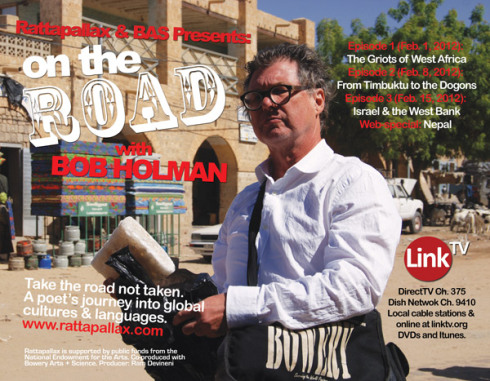
Image via On the Road with Bob Holman / Rattapallax
In April I also worked to create awareness about what we lose when we lose a language. My interview with poet Bob Holman appeared in BOMBlog.
In May I received my MFA in creative nonfiction from The New School. I had a fantastic thesis advisor and a beloved peer group, who challenged me to dig deeper in my memoir about growing up Greek American. After I read a snippet at our thesis reading, an instructor I’d never even had came up to tell me how much he liked my work!
Image via The Human Tower / Rattapallax
In June I witnessed the world record being broken for the tallest castell on a rooftop.
In July I heard Amber Tamblyn read for The Paris Review at the Strand. Afterwards we somehow ended up on the elevator together, and I didn’t say anything to her. I never know in those situations if it’s polite to say something like “nice reading” or if the person just wants her privacy. I know she’s involved in the Beat literature community, though, so I should’ve probably talked to her about that.
Image via The Millions
In August an article I wrote about a funny incident I had related to Jack Kerouac sparked a fiery debate and went viral, getting mentioned everywhere from The New Yorker to The Paris Review.
Photo via RA Araya
In September I had one of the most surreal moments of my life–reading with David Amram. I got to hear him perform again, this time as an enthralled audience member, in December.
I also road tripped through northern and central California, visiting Cannery Row, City Lights Bookshop, The Beat Museum, and attending my college friend’s wedding.
In October Hurricane Sandy hit New York, and I spent a lot of time in bed.
In November I failed miserably at NaNoWriMo, but I had a lot of fun creating this ever-evolving Pinterest board for the book I never wrote.
I also gave a reading that got upstaged by a wedding proposal.
In December there was a flurry of Jack Kerouac-related activities to promote the film adaptation of On the Road, and I got to see author Ann Charters and film director Walter Salles in person at IFC. I also got to take a writing class with screenwriter Jose Rivera at 3rd Ward.
I also went out to Lowell and got to meet Jack Kerouac’s friend and pallbearer Billy Koumantzelis.
Have you ever noticed that Greek families all seem to be named after the same relative? It’s customary in Greek culture to name the firstborn boy after his papou, the father’s father, and the firstborn girl after her yiayia, the father’s mother. Subsequent children are named after the mother’s side of the family.
According to the Greek Orthodox faith, though, children are supposed to be named after the saint whose feast day they are born on.
A child born on December 27 would be named after Saint Stephen. Stephen was one of the first deacons of the Church. However, after a vicious argument, he was accused of blasphemy and sentenced to death by stoning. Standing up for himself and his beliefs, he said that those Church leaders were the very people who persecuted the prophets. He is now recognized as a martyr.
The name “Stephen” comes from the Greek word “stephanos,” which translates to “crowned.”
My birthday is not December 27 nor was my yiayia’s name Stephania, so my name is a bit of a break from the Greek culture. I’m actually named after my father’s stepfather. And yes, family reunions can get a bit confusing, with my cousin Stefanos and I both responding to “Stef.”
Today I’ll be celebrating my name with my family!
How did you get your name? Do you celebrate your name day?
Whether you’re giving a Greek American a taste of their homeland when they can’t make it back for the holidays or satiating a Hellenophile’s interest in Greek culture, there are countless foods, books, beauty products, and jewelry that will suit your needs. Plus, select a gift made in Greece and you’ll also be supporting the struggling Greek economy. Here’s just a small selection of Greek gift ideas, some made in the States, some in Greece, and others elsewhere, but all unique and lovely.
Bonus tip! – Gifts appear so much nicer when they come as a set. You may want to give a cookbook with some Greek spices. A duo or trio of a certain type of product (such as honey or olive oil) is a great way for the recipient to try out a few flavors. Or, you may want to give a gift basket of assorted Greek candies.
Gifts for someone who loves Greek literature:::
Antigonick by Sophocles, translated by Anne Carson, illustrations by Bianca Stone
Bonus tip! – Trying pairing the book with a book light, a notebook and pen, a bookmark with a quote by a Greek philosopher, or a coffee mug (maybe even with a bag of Greek coffee).
Gifts to make someone feel like a beautiful and pampered Greek goddess:::
Bonus tip! – Include a lovely handwritten letter. A bottle of Greek wine (here’s my review of the Greek American wine Pindar) or some fine Greek chocolates (here’s my review of the Greek American chocolatier Chocolate Moderne) would also make someone feel loved and pampered.
As the Greek proverb says, “A gift, though small, is welcome.”
I am so excited to have been tagged by Maria Karamitsos for the The Next Big Thing Blog Hop. Even though I’m not a mother, I love reading Maria’s blog From the Mommy Files, which is full of humor and light. She has the gift of storytelling. Her blog entries read like snippets of a novel-like memoir, with dialogue, reflection, and a strong voice, despite the fact that much of her writing is focused on what could be a very technical topic: molar pregnancy. Take for instance, her post “The Influence of the Lost Child,” in which she talks to her two adorable little girls—”BooBoo BeDoux” and “Bebs LaRoux”—about the baby she miscarried. It’s a difficult and heartbreaking subject, yet she injects humor in it through the personalities of her daughters (“it’s tough to be 3, after all!”) as well as tenderness and faith. I’m really excited about the book she’s writing called Positive About Negative: Adventures in Molar Pregnancy. Maria also tagged some other Greek authors for the Blog Hop, and it’s great discovering all these writers.
I’m tempted therefore to write about my memoir about being Greek American, but since my book on Jack Kerouac is coming out first my answers to the Blog Hop questions are about that book.
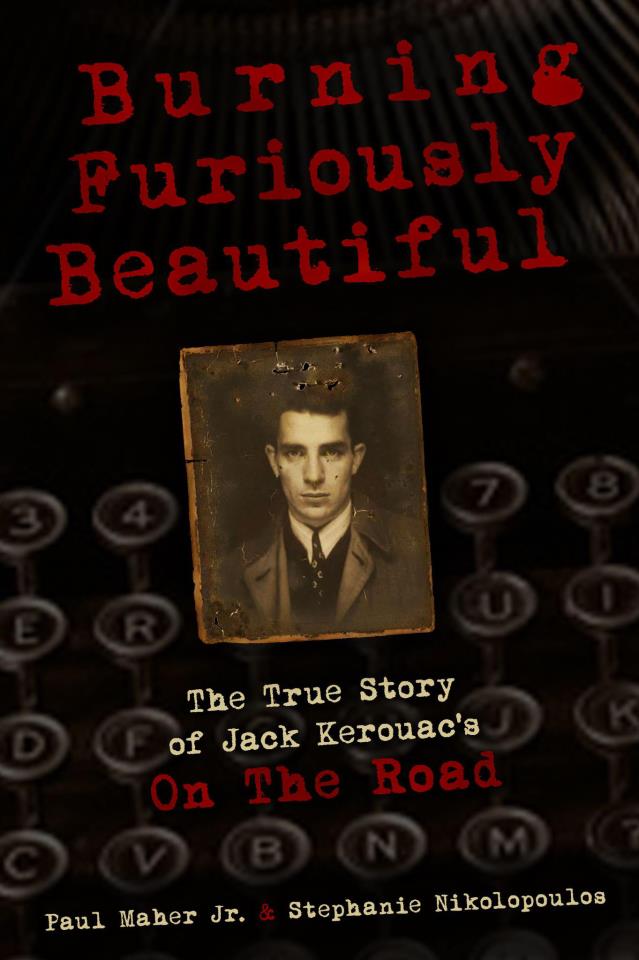
What is the working title of your book? Burning Furiously Beautiful: The True Story of Jack Kerouac’s On the Road
Where did the idea come from for the book? Paul Maher Jr. had written a book entitled Jack Kerouac’s American Journey: The Real-Life Odyssey of “On the Road” for the fiftieth anniversary of the publication of Kerouac’s seminal work. I had read this book one summer and some months later began reading Paul’s blog. We began talking and decided to revise and expand his book because we knew that a film adaptation of On the Road was coming out and we wanted to provide a resource for those interested in finding out more about this famous novel. It was important to us that the book had a strong narrative, contextual information, and new research because we wanted both the teenager turned on from the film and the literary scholar who’s read every book by Kerouac to enjoy it and find value in it.
What genre does your book fall under? It’s literary criticism and biography.
Which actors would you choose to play your characters in a movie rendition? Isn’t that the million dollar question? There’s been a lot of talk over the years about who should play Sal Paradise and Dean Moriarty in the film adaptation of On the Road. Johnny Depp, Brad Pitt, Colin Farrell, Marlon Brando, you name it, they’ve been associated with it. I almost never go to the movies and don’t really know the young actors of today well enough to say who would be age appropriate to cast. Joseph Gordon-Levitt? Zac Efron? These actors are too old to play the roles now but if I were casting the film back when I first read On the Road as a teenager, this is who I’d pick:
Sal Paradise — Johnny Depp and Ethan Hawke would be excellent choices for Sal Paradise, particularly because they both have a deep appreciation for literature. Depp is a known Kerouac fan and just started his own publishing imprint, and Hawke is a published author.
Dean Moriarty — Woody Harrelson would make a great Dean Moriarty. He can play both earnest and wild so well! Matthew McConaughey would be great as Dean too.
Carlo Marx — I loved James Franco’s portrayal of Allen Ginsberg in Howl, but if I had to select someone else I might go with AdamGoldberg.
Old Bull Lee — The choice of Viggo Mortensen as Old Bull Lee for the Walter Salles film is brilliant, but again if I had to choose someone else maybe I’d with Ewan McGregor.
Marylou — Drew Barrymore would be so much fun to watch as Marylou. Do you remember her in Mad Loveand Boys on the Side? Almost Famous hadn’t been made yet when I was a teenager but Kate Hudson (think Penny Lane) would be my runner-up pick.
What is the one-sentence synopsis of your book? Burning Furiously Beautiful tells the true story of Jack Kerouac travels on the road and how it took him years, not weeks, to write On the Road.
Will your book be self-published or represented by an agency? We decided to self-publish Burning Furiously Beautiful.
How long did it take you to write the first draft of your manuscript? The first draft, so to speak, had already been written and published as Jack Kerouac’s American Journey.
What other books would you compare this story to within your genre? There have been so many biographies of Kerouac written over the years, and each offers its own perspective. Burning Furiously Beautiful uses Kerouac’s journals and letters, as well as archival material from other people who knew Kerouac during the time he was on the road and writing On the Road, to tell a the specific story of the making of a novel that continues to generate interest today.
Who or What inspired you to write this book? Obviously, Paul Maher Jr. inspired Burning Furiously Beautiful as it was his original idea. I, however, had been researching and writing about Kerouac since I was an undergrad many years prior to this and brought my own knowledge and skills to the project. I was very much inspired by the fact that the film adaptation is soon to be released here in the States. There’s a whole new generation coming to Kerouac’s literature, which is immensely exciting to me. Reading Kerouac when I was in high school opened up so many possibilities for me as a reader and writer. I hope that the film will pique people’s interest so that they’ll go back and read Kerouac’s books for themselves—not just On the Road but his other great works as well—and that they’ll watch Pull My Daisy, the film that Kerouac himself spontaneously narrated. Burning Furiously Beautiful is important because it contextualizes On the Road and provides a fascinating look at Kerouac’s life and writing process. This is critical because there’s so much myth surrounding Kerouac and the 1950s. I became engrossed in odd little details like the fact that the Kerouac’s didn’t have a phone and took their calls at the store below their apartment in Queens. It’s so different than today when it seems like every middle schooler has a cell phone. If Cassady could’ve just called Kerouac up on his iphone, he might not have written the infamous Joan Anderson letter that spurred on Kerouac’s writing style.
What else about your book might pique the reader’s interest?Burning Furiously Beautiful is a great book for an aspiring writer, regardless of whether or not you like Kerouac’s writing style. It’s a portrait of a young writer and details how his writing voice developed (his first book has a much different style), what his writing routine was, the editing process (yes, there was one!), what his relationship with other writers and editors was like (imagine lots of parties), and the many false starts he had in writing his book. We even talk about book signings, contracts, and press interviews. Sometimes I’ve felt frustrated with various writing projects of mine, but realizing that Kerouac, who purported to have written On the Road in only three weeks, went through some of the same struggles and took years to find success makes me realize that it’s all part of the writing process.
One evening, a student came into our writing workshop at The New School and announced he’d bought a typewriter. We were all very impressed.
“What kind?” we asked.
“Where did you get it?”
Most of us were in our twenties or thirties and had grown up using computers. Many of us had entire mini computers—smart phones—jammed into our pockets and purses at that very moment. We’d attended readings in bars across Manhattan, where authors had read poetry off their iphones.
But a typewriter! Now that sounded really literary. The click-clack of the keys echoing in a bare-bulb room. Allen Ginsberg’s first-thought-best-thought mantra forced upon a generation accustomed to the “backspace” button on our keyboards. Facebook procrastination less accessible.
And the history! Continuing the beautiful tradition of authors attached to specific models of typewriters.
This evening, the documentary The Typewriter will screen at the Lowell National Historical Park Visitor Center Theater (245 Market St.) as part of the Lowell Film Collaborative with Lowell Celebrates Kerouac. Here’s a little bit about the film from its website:
Three typewriter repairmen the filmmakers have interviewed all agree that their business is better than it has been in years.
Perhaps it is a reaction to the plugged in existence of today’s 24/7 communications world. Perhaps it is mere nostalgia and kitsch. Perhaps it is an admiration for the elegance of design and the value of time-tested workmanship. And for some, like typewriter collector Steve Soboroff, it is the appeal of owning machines on which American writers like Ernest Hemingway, Tennessee Williams, Ray Bradbury, John Updike and Jack London typed some of their finest work. (He also owns typewriters once owned by George Bernard Shaw and John Lennon)
The film is directed by Christopher Lockett and produced by Gary Nicholson. You can read fascinating typewriter stories here.
As for Jack Kerouac, he owned several typewriters throughout his lifetime but most famously used a 1930s Underwood typewriter. His father was a printer, so even from a very young age, Kerouac was in a world full of language, literacy, typography, and printing presses. Not surprisingly, he had a reputation for being a speed typist. myTypewriter.com offers some background information on Kerouac’s—as well as other literary figures’—use of typewriters. Burning Furiously Beautiful: The True Story of Jack Kerouac’s On the Roadwill also include information about Kerouac’s typewriter. Larry Closs‘ novel Beatitude also includes a plot involving Kerouac and typewriters.
Here’s a tip for those of you attending Lowell Celebrates Kerouac or if you happen to find yourself in Lowell any other time: you can see one of Kerouac’s Underwood typewriters, and other memorabilia firsthand at the Mill Girls and Immigrants Exhibit at the Morgan Cultural Center. It may sound like an unlikely place to view some of Kerouac’s possessions, and it’s not really well advertised, so it’s easy to miss if you don’t know about it, but the exhibit is open 1:30-5:00pm except on major holidays. It’s free, but even if it weren’t the entire exhibit is fascinating. The case display for Jack Kerouac is very small, but literary pilgrims will appreciate it nevertheless, since it’s rare to have opportunities to view his personal travel gear and typewriter in person. The exhibit is engaging in retelling the story of immigration to Lowell. Many of the immigrants were from Greece so the exhibit gives insight into the influence of Greek culture on Lowell.
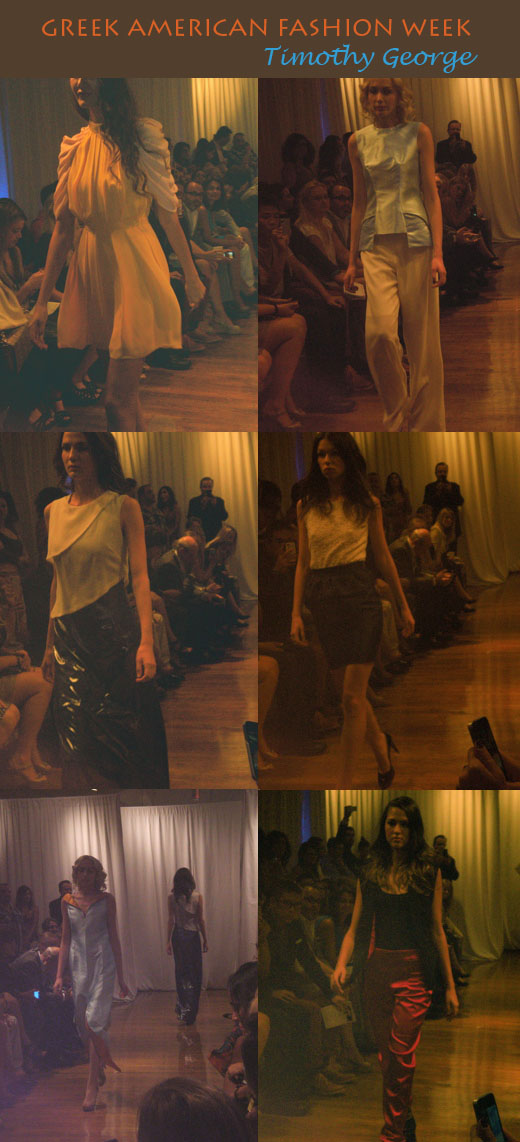
The Greek American Fashion Week Show concluded with the Spring/Summer 2013 collection by Timothy George. Learning through apprenticeships at highly respected garment factories, George debuted work that was pure luxury. His designs looked expensive both in materials used and cuts.
George used beautiful French and Italian fabric. The most stunning fabric was a lightweight teal erupting with raised, soft-looking orange dots. This surreal and gorgeous fabric was used for a wrap blouse, a t-shirt, and a skirt. Pairing them with a high-sheen orange skirt or with a more neutral and plain top or bottom showed how versatile this otherworldly cloth could be. Other fabrics included softer ones, which were masterfully cut to bring a formality to their delicateness or were draped and billowed to promote their femininity. Other fabrics, on the other hand, were tough and high-sheen. With a high-end aesthetic, the collection reflected beauty, extravagance, strength, and femininity.
The first collection to hit the runway at the Greek American Fashion Week Show was one of New York’s own — the Astoria, Queens, born Tatiana Raftis, whose parents hail from Greece and Cyprus. Raftis studied evening-wear design at FIT, The Fashion Institute of Technology, here in New York, and her Spring/Summer 2013 collection boasted drop-dead-gorgeous gowns and dresses for formal occasions. Raftis’ clothing designs are statement pieces that are sure to turn heads.
Raftis’ Spring/Summer 2013 collection is for any woman who wants to exude femininity but still possess a bit of edge. Her dresses evoke medieval princesses who know how to yield a sword. They’re pure romance with florals, pastels, and sequins, and yet the jagged cuts and use of black suggest an intense passion to be reckoned with.
My personal favorites were the dusty lavender gown with the dramatic slit, which someone better snatch up for the next Oscars, as well as the sequined pink shorts, which were styled so perfectly with a white shirt and pink bolero so as to make the outfit look hot yet not overdone.
Tatiana Raftis provides custom orders for clients out of her Queens studio.
Since my thesis was due on a Monday, there wasn’t much opportunity for celebrating. Instead, I went home after a normal day of work, ate leftover spaghetti and opened a bottle of wine I’d been saving.
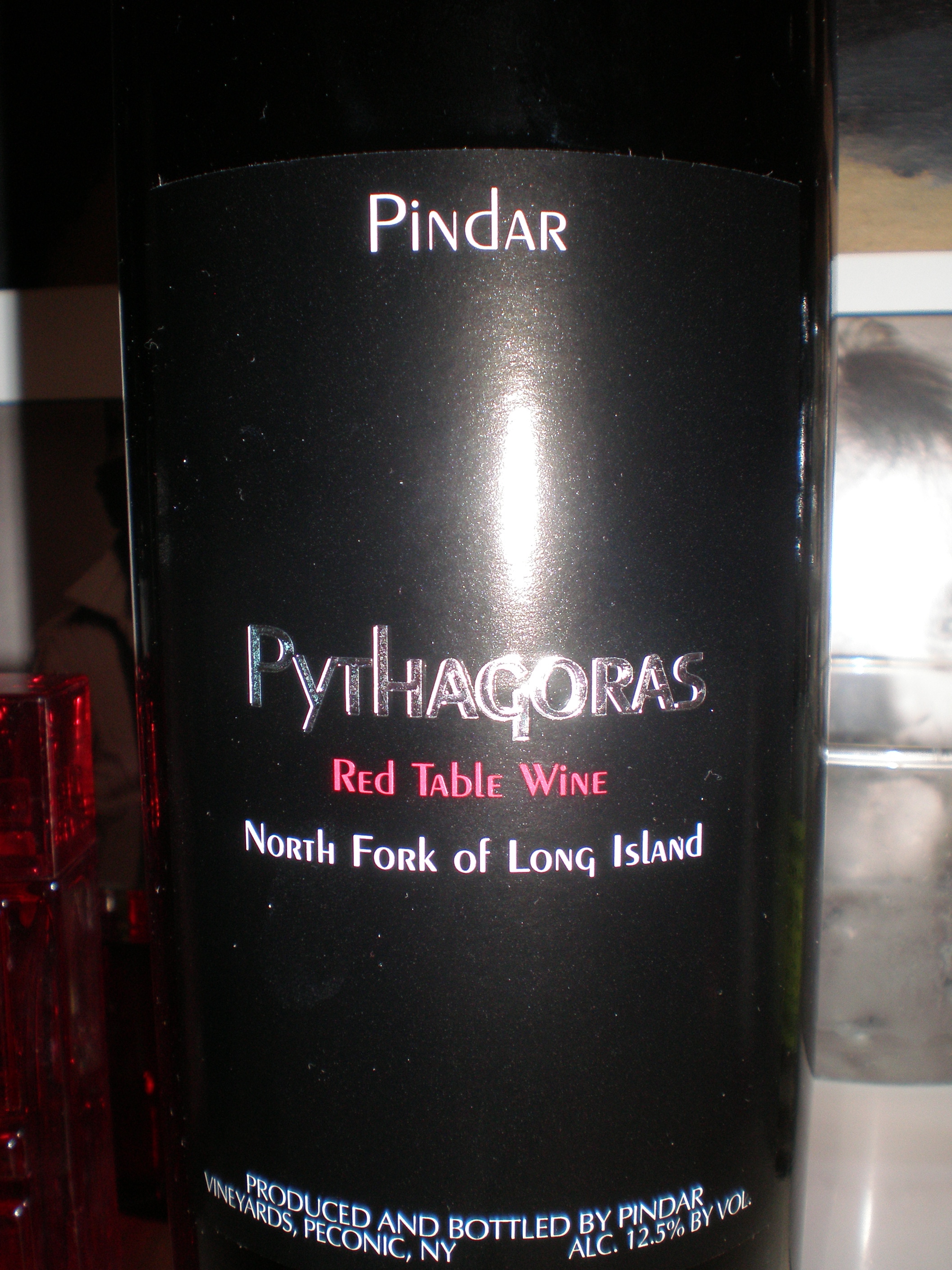
Last summer I had gone wine tasting at a couple vineyards on Long Island and picked up a bottle from Pindar Vineyards. I’d been saving it for a special occasion and thesis submission seemed as good as time as any to crack it open.
The bottle I had picked up surprisingly wasn’t one that I had sampled at the vineyards so I didn’t know what to expect. I picked it out for its name, Pythagoras.
Pythagoras (ca. 570 BC – 495 BC) was a Greek philosopher and mathematician from Samos, an island in the eastern Aegean Sea. He later moved out of Greece an into Calabria, in southern Italy, where he lived in a Greek colony called Croton, by the Ionian Sea. He is, of course, the founder of the Pythagorean theorem. He set up a school in which music, sports, and diet were important elements. This would go on to influence Plato. There’s also a religion associated with Pythagoras, who believed in reincarnation.
The Pythagoras Pindar wine is a Greek wine, but not in the traditional sense. It is not made in Greece but rather by Greek Americans on the North Fork on Long Island, New York. Pindar Vineyards was founded by Dr. Herodotus “Dan” Damianos, who was born in New York City’s Hell’s Kitchen. He began buying farmland in Peconic, North Fork, Long Island, in 1979, and started planting grapes the following year. Today, seventeen different varieties of grapes grow on Pindar Vineyard’s 500 acres.
One of the special aspects of Pindar Vineyards is its commitment to environmental stewardship. The vineyard practices sustainable agriculture. You can read about its green initiative on its website. It’s really quite impressive.
Dr. Dan drew his inspiration for winemaking from the Robert Louis Stevenson quote “wine is like poetry.” It seems fitting that I should enjoy a wine inspired by literature as a celebration to turning in my thesis.
The Pindar Pythagoras is a red table wine. It is light with a deliciously spicy bite. While some reds coat your tongue with sinewy grapes, the Pythagoras has more of a white wine texture. Delicate and effortless, it’s a good summer red. Its buoyancy does not mean it’s watery though. It’s flavorful, with a bit of a kick to it.
This special red was first crafted to celebrate our 20th anniversary. It has the round and full characteristics of Merlot with the slight herbaceousness of Cabernets. This award-winning blend has been named “Best US Red Blend” by the Beverage Testing Institute in Chicago and “Best Red Vinifera” in Vineyard & Winery Management’s “Best of the East” competition. Sure to please a wide range of palates.
It’s a good wine to round out a pasta dish with olives in it or some sinfully dark chocolate.
If you’re here in New York, you can purchase it online, but why not take a day trip to Long Island? You can rent a car or take the Hampton Jitney bus. It’s a great getaway from Manhattan.
I’ve heard a lot of strange comments in my writing workshops. Someone once told me they thought from my writing that I wished I was a boy. Someone else questioned why I write more about Greek identity than Swedish identity. I expect all sorts of reactions to the content of my essays and that I’ll get criticism in regard to structure. It comes with the territory.
What I never suspected was that I’d get feedback on my punctuation.
I don’t recall ever hearing anyone else in a workshop receive comments on their lack of use of the oxford comma or their split infinitives. Actually, that’s not entirely true. I criticized someone’s use of parentheses. If it’s unimportant enough to place in a parenthetical, it’s not important enough to keep in your book. Edit it out! Of course there are exceptions: for example, definitions of foreign words. The other instance of a workshop debate being generated from punctuation had to do with the use of David-Foster-Wallace-like footnotes. For the most part, though, comments about punctuation—errors in punctuation, that is—are kept to written edits on the writer’s page.
That’s why I found it so curious that at least once a semester, someone raised comments praising my grammar and punctuation. As an editor by profession, punctuation is important to a fault for me. I live by Oscar Wilde’s quote:
I was working on the proof of one of my poems all the morning, and took out a comma. In the afternoon I put it back again.
It just never occurred to me that someone might actually notice my punctuation. After all, correct punctuation should be a given. And when punctuation is correct, it generally doesn’t stand out to the reader.
I figured readers maybe noticed my punctuation because I use crazy marks like the semicolon. Who uses the semicolon nowadays?
I’m playing a bit coy, though. I do believe there’s more to punctuation than it just being correct. I don’t intend my punctuation to stand out and grab the reader’s attention. I’m not trying to be a punctuation renegade, experimenting and breaking the rules for purposeful affect. That said, every comma, every em-dash, and yes, every parenthesis conveys subtle meaning.
Think about it. When em-dashes (those long dashes between words) appear in a text, doesn’t it make the work feel more modern and fast-paced than a commonplace comma? And don’t endnotes seem more scholarly than parentheses?
I think punctuation frightens most people. It brings back all this childhood trauma associated with teachers yelling about sentence fragments and marking papers up with green pen. Green is the new red. Green is supposed to be less scary than red, but it isn’t. It means the exact same thing: you made an error.
Don’t let punctuation poison your prose. Get a grip on it and use punctuation just as you use diction as one of your writer’s tools to convey your story to your reader.
While writing for Saturday Night Live, everyone’s favorite Gripster Tina Fey ate a lot of disgusting food in the wee hours of the night, according to Grub Street. The grossest? Old meatballs from Carmines.
The Grub Street article points to the obvious fact that those of us who stay up late, writing at our desks, probably eat pretty poorly. I’ve never been to Carmines, and I don’t eat meatballs anymore, but my sister makes fun of me because I often eat leftover pasta without bothering to heat it up.
















 Stephanie Nikolopoulos