Tag Archives: Greek Orthodox

Death by Pomegranate

19 Jun

Branching out from writing of roses, of the myths and memories and makeup surrounding them, we turn to the Greek vegetation goddess, Persephone, also known as Kore.

The daughter of harvest-goddess Demeter and Zeus, Persephone represents the changing of the seasons.  One day she was out gathering flowers with Athena, goddess of wisdom, and Artemis, goddess of wild animals, when she was abducted by the god of the underworld, Hades.  There, she was tricked into eating the seeds of the pomegranate.  Because she ate four juicy seeds, she was relegated to spending four months of the year in the underworld.  Therefore, she is like vegetation itself, disappearing after the harvest.

In ancient Greek culture, the pomegranate was thought of as the “fruit of the dead.”  In fact, according to Greek Orthodox tradition it was not an apple that Eve ate in the Garden of Eden but rather a pomegranate!  Today, Greek Orthodox believers use pomegranate as an ingredient in koliva, the ritual food prepared for the memorial Divine Liturgy after a death.

Clip: Light of the World

13 Apr

I expanded a post that started out here on this blog, and it’s up on Burnside now!  It’s about the first Greek Easter I spent in New York….


I think there’s probably a law against carrying an open flame in the subway.  I’m not sure.  But it’s a pretty safe bet.  This turns Easter in New York City into a midnight marathon.

Blessed Theophany

7 Jan


I hope you had a blessed Theophany!  It’s truly a memorable site to see priests throwing crosses in the Hudson River here in New York City.

In case you missed my post from last year and have no idea what I’m talking about, here it is again:


I once saw a priest in Brooklyn throw a cross into the muddy waters of the Hudson.  It was a frigid January day, yet a bunch of boys jumped into the river to save the cross.

What would possess a priest to throw a cross into the river?

Theophany; or, as most westerners call it, Epiphany.

The word “Theophany” comes from the Greek “τα Θεοφάνια,” which means “appearance of God,” and January 6 is the feast day that commemorates the incarnation of Jesus.  It celebrates His birth and baptism.

When St. John the Baptist baptized Jesus in the Jordan River, the heavens opened up and the Holy Spirit descended like a dove.  God spoke from the heavens, saying, “This is my Son, whom I love; with him I am well pleased” (Matt 3:17, NIV).  It marked one of the very few times that all three characters of the Trinity—Jesus, the Holy Spirit, and God—revealed themselves at the same time to man.

Jesus’ baptism marks His first step toward Crucifixion, according to Orthodox theology.

And so, on January 6, Orthodox priests throughout the world throw crosses, symbolic of Jesus’ crucifixion, into bodies of water, symbolic of His baptism.  This is called the Blessing of the Waters.  Volunteers jump into the water to retrieve the cross.  The priest, according to tradition, prays a blessing on the person who gets to the cross first and brings it back to him.


Here’s the Troparion (tone 4) from the Eve and Afterfeast hymn, which has some powerful imagery:

The River Jordan receded of old by the mantle of Elisha when Elijah ascended into heaven; and the water was separated to this side and that, the wet element turning into a dry path for Him, being truly a symbol of Baptism, by which we cross the path of transient age. Christ appeared in the Jordan to sanctify its waters.


Dekapentavgoustos

15 Aug

Today, August 15, is Dekapentavgoustos, the Assumption of Mary or the Dormition of the Theotokos.  Most Protestants don’t celebrate it, but this is the third most important religious holiday, after Easter and Christmas, in Greek Orthodoxy.  It celebrates the day the Panagia — the Virgin Mary, the mother of Jesus — was bodily taken up to heaven.  According to Greek Orthodox beliefs, Mary died a natural death and her soul was received by Christ when she passed away.  Three days after her bodily death, her body was resurrected and taken up to heaven.

To commemorate this, Greek Orthodox believers fast for the two weeks leading up to August 15.  This is called the Dormition Fast.  The first day of the fast, August 1, is called Procession of the Cross.

Tasty Tuesday: Mango Salad with Sophia’s Pomegranate Dressing

26 Jul

I’m not a salad person.  Like a good Greek, my dad ate a huuuuuuge bowl of salad every night at dinner.  Salad seemed like a whole lot of chewing for not a lot of flavor payoff to me, though.  I’ve taste-tasted plenty of dressings at all-you-can-eat buffets, and while blue cheese or Italian might make lettuce a little more palatable it usually ends up making my salad taste rather generic.  “Hi, I’m American, and I like ranch dressing!”  That’s why I was surprised when I found myself tempted by the salad dressings at the grocery store.

Shelved between plastic bottles of gooey dressings was Sophia’s Gourmet Foods Greek Island Dressing.  The tall glass bottle looked sophisticated and down-to-earth at the same time, as if Sophia’s is the shabby chic of salad dressings.  The labels are white with beautiful line illustrations that call to mind late afternoons on the Greek islands.  The contents of the bottles looked thick, textured, and vibrant.  The dressing looked natural and homemade.

I picked up a bottle and read the label.  I’m really into reading labels these days.  It’s crazy the amount of junk (read: preservatives, sugar, coloring) that goes into packaged foods.  Here’s what’s in the Tahini: “Lemon Juice, Tahini, Water, Garlic, Salt, Sesame Seeds, Citric Acid.”  That’s it.  All of the other flavors do contain xantham gum, which helps the dressing achieve the thickness I’d noticed.  Some have various types of sugars added, but a serving size (2 tablespoons) only has 2 grams of sugar.  I wish the natural ingredients themselves did all the thickening and sweetening, but still Sophia’s seems more natural than a lot of other brands on the market.

I selected the “with Pomegranate” dressing.  The ingredients are:

Water, Pomegranate Juice (from Concentrate) Extra Virgin Olive Oil, Lemon Juice, Soybean Oil, Honey, Vinegar, Garlic, Spices, Cultured Dextrose, Salt, Xanthan Gum, Natural Color, Natural Flavor.

Pomegranates, which originated in Iran, are central to the Greek myth of Persephone.  In Greek Orthodox Christianity it is the pomegranate, not the apple, that was the forbidden fruit in the Garden of Eden.  At very traditional Greek weddings, pomegranates are broken on the ground.

Pomegrantes are believed to reduce risk of heart disease.  They’re a good source of vitamin B5 and C.

Sophia’s Greek Island dressing just has pomegranate juice from concentrate so it’s not quite as beneficial as eating a fresh pomegranate on its own, but all the Sophia’s dressings are all natural, gluten free, cholesterol free, and low in sodium.  They also made from extra-virgin olive oil, which is also good for preventing heart disease, according to the research I’ve done previously.

Okay, so it’s pretty healthy but how does it taste??

I loved it!  It tastes fresh and tangy.  The texture isn’t syrupy, goopey, or runny.  It pours out nicely and has a bit of a pomegranate-seed texture which I liked.

I poured it over fresh romaine lettuce and fresh slices of mango.  The tang of the pomegranate and the sweetness of the mango paired really well together.  Delicious!

Writing Wednesday: Memoirist Patricia Volonakis Davis on Finding a Direct Line to Your Readers

20 Jul

In my last Writing Wednesday post, I wrote about how memoirist Patricia Volonakis Davis discussed the role of marriage and moving in one’s sense of cultural identity in her deliciously titled memoir Harlot’s Sauce.  In Jane Friedman’s Writer’s Weekly interview, “How to Find a Direct Line to Your Readers,” with Davis, the memoirst divulges some great tips on building a platform and reaching out to potential readers.

When thinking about her readership and trying to build an audience, Davis says:

I contacted Italian-American groups, and philhellenic groups (groups of people who love Greece).

I contacted websites, magazines, blogs that focused on female empowerment and personal growth.

In short, I made a list of the topics I visited in my story, and worked from that, writing articles to appeal to those readers in particular, and posting them on sites that had already cultivated a readership catering to those interests.

This is such great advice!  When I was discussing my memoir with someone recently, the woman with whom I was speaking wondered why I was writing about growing up Greek American.  She happens to know me very well and suggested that I have much more to share with the world than my ethnicity.  She’s right, of course, and I tried to explain that my memoir is actually about so much more than just growing up Greek American.  If I were to make a list similar to Davis’, the topics I touch on and the readers I would reach out to include:

Greek Americans

Swedish Americans

Expatriates: Americans (and other foreigners) living in Greece

First- and second-generation Americans: besides Greek and Swedish, also Korean and Japanese

Protestants

Greek Orthodox believers

People from northern New Jersey

Children of the 1980s

Graduates of women’s colleges

It’s my sincere hope that my memoir speaks to a wide variety of people, uniting readers of various upbringings.

Light of the World

18 Apr

I think there’s probably a law against carrying an open flame in the subway.  I’m not sure.  But it’s a pretty safe bet.  This threw my Easter celebrations into flux last year.

Usually I spend Easter with my family in Baltimore.  Last year, though, Greek Orthodox Easter fell on the same Sunday as “American” (i.e., Protestant and Catholic) Easter, so I decided to stay in New York rather than deal with holiday traffic.

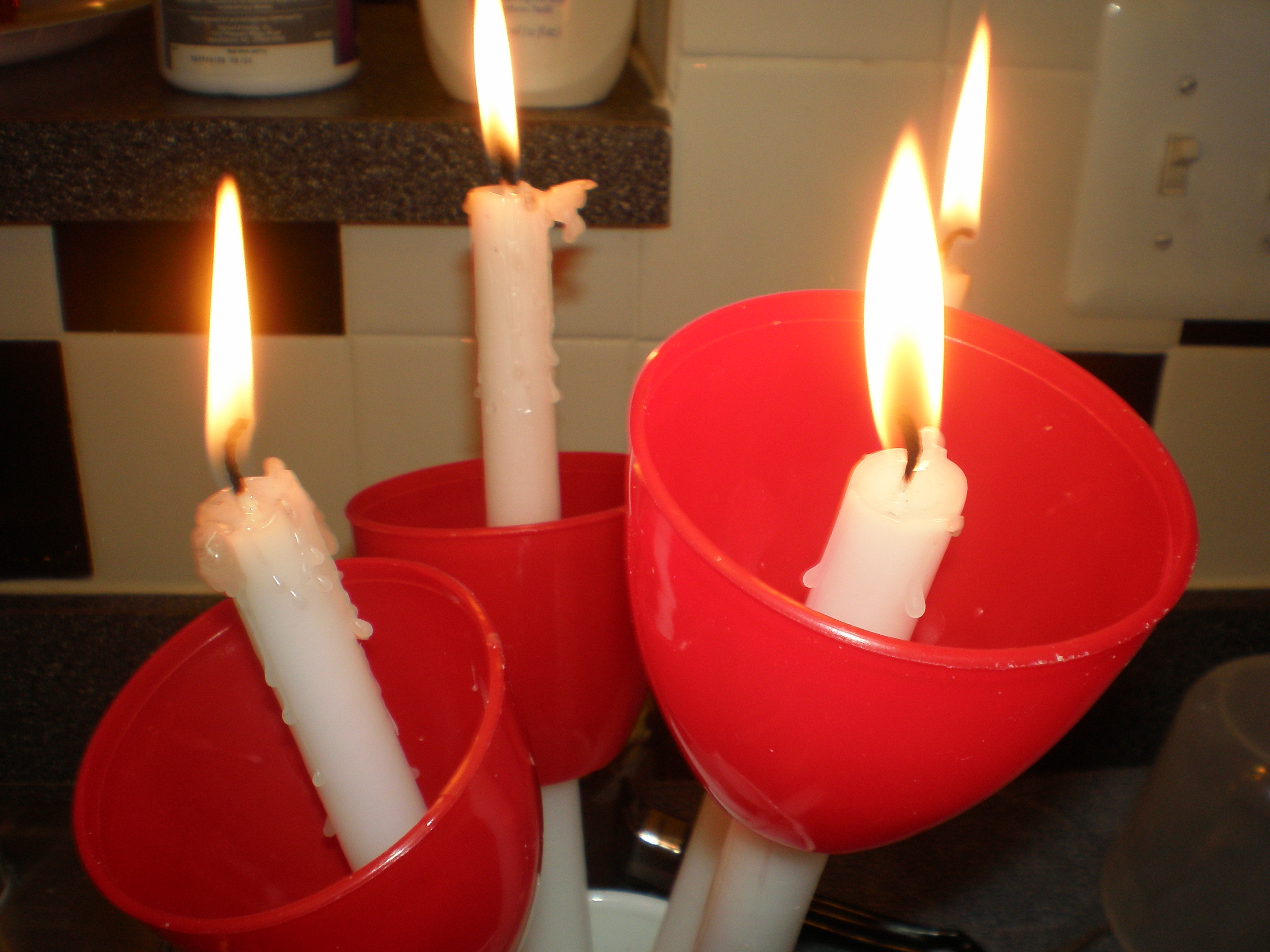
At the Cathedral, we lit candles to signify that now that Jesus is sitting at the right hand of God in heaven, we, the believers, are to be to the light to the world.  We carry our lit candles out of the church with us at the midnight Easter service, and shine them for all the world to see on our way home.  Up until last year, that had always meant carrying our lit candles into my uncle’s van.

Last year, though, I took the subway to the Easter service.  When I left the Cathedral, lit candle in hand, I realized I was more than twenty blocks from my apartment.  How could I get home with my candle still lit?

Surely, I’d get stopped if I tried to go in the subway.

What cabbie wouldn’t object?

I can never figure out the bus system, and it certainly wouldn’t be the solution anyway.

So, I hoofed it.  I got a lot of stares from passersby on my walk home.  At first, the masses coming from the Cathedral looked like we’d attended a vigil.  Or, maybe we were part of a weird cult.  As the crowd dispersed—east, west, uptown, downtown—we began to look like solitary candle holders.  Who were we?  Why were we carrying candles across city sidewalks in the middle of the night?

I’m glad you asked.

2011 Greek Independence Day Parade

29 Mar

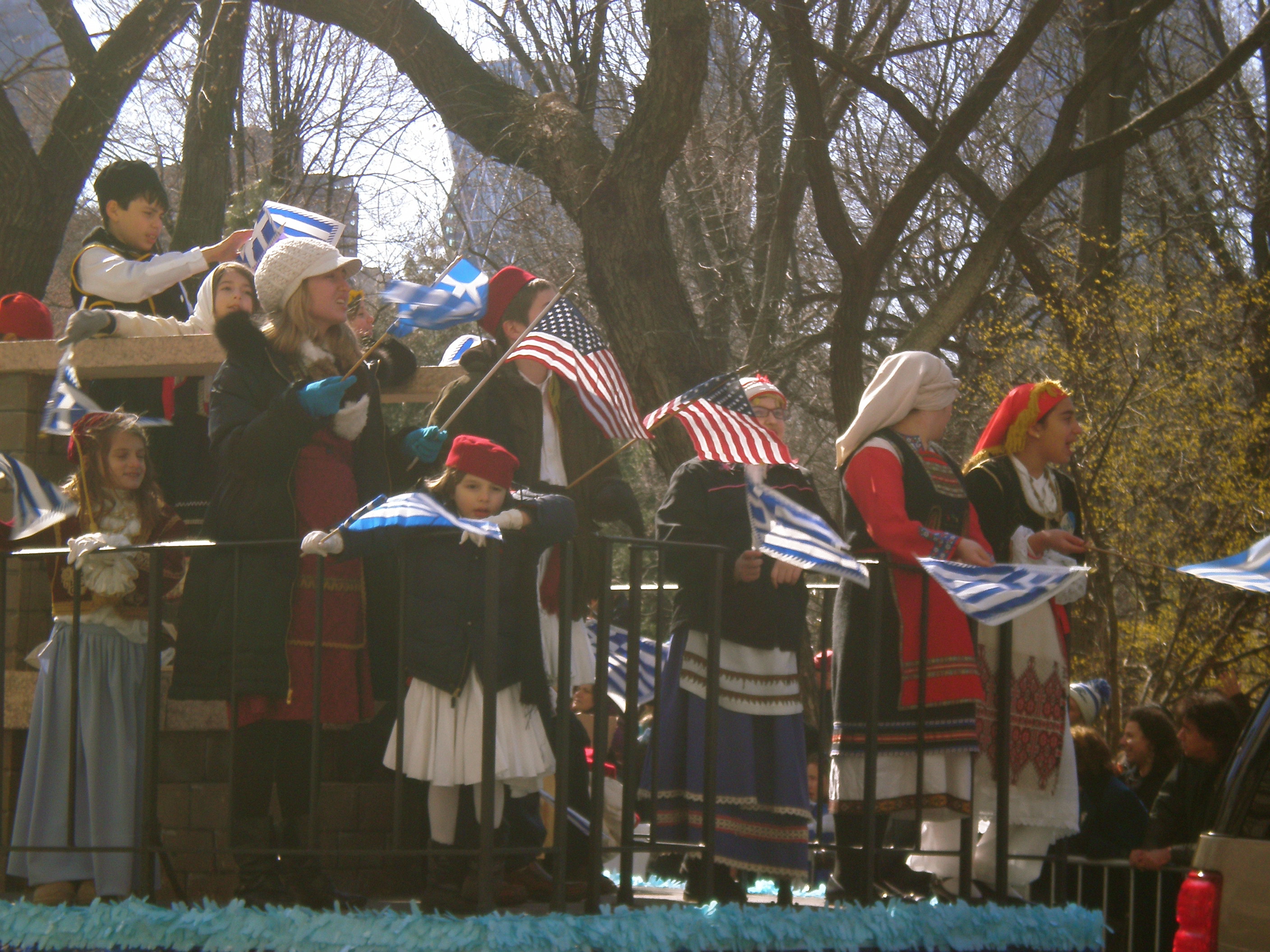
Who made it out to the parade on Sunday to celebrate Greek Independence Day?  My sister and I went after brunch.  It was a great day for a parade.  The sky was a bright, bright blue and the sun was shining.  It was a bit brisk to be standing on the sidelines, but I’m sure those marching in the parade enjoyed that it wasn’t hot out.

Our favorite part was seeing the little kids all dressed up in their Greek costumes.  Seriously adorable!

I also rather enjoyed seeing the Greek-American women who insisted on marching in high heels.  It was quite a few blocks up Fifth Avenue to be clomping around in heels, but they remained stoic.

Greek men and women of all ages layered blue and white clothes on, wore Hellas t-shirts they probably picked up in Plaka, and draped the Greek flag over their shoulders. Super-hero style!

Here are a few pics.


Mapping Out Houses of Worship in NYC

24 Mar

Remember the other day when I mentioned that cute little restaurant Penelope?  Well, last Friday Penelope happened to be the opening setting of a New York Times article by Mark Oppenheimer, entitled “Mapping Religious Life in the Five Boroughs, With Shoe Leather and a Web Site.”  The article is about a Texas native named Tony Carnes, who moved to New York to go to The New School, where incidentally I’m enrolled in the MFA program, and who is, according to his website, “exploring the postsecular city.”

He’s mapping out every house of worship in the five boroughs of New York.  My immediate thought was: there are so many churches that make use of school auditoriums, bars, and ballrooms — how will he find those churches, if he’s driving around looking for church signs?  Well, apparently Carnes hears about those by word of mouth.

But he isn’t just mapping the city out.  He and his colleagues are telling stories.  Stories such as:

“The youth of Bethany Baptist Church put together a modestware fashion show in Jamaica, Queens called ‘A World of Difference.’ They follow a long tradition of fashion shows in African American churches.” —Fashion in Church, Jamaica, Queens

“Under the searing sun and stench of roadside garbage, a teenage Hispanic girl carrying a baby boy comes out of a door next to a church. Her tousled hair looked like she’d been up all night. The baby’s unwashed face was smeared with dirt; a diaper was the only thing covering his bare skin.” — Girl Power in Flatbush

“What church would get rid of its pews to make more room for feeding the poor? Surely, wouldn’t the pastor resign, the elders stomp out in exasperation, and the members hastily decamp for a properly pewed church? All that didn’t happen at a Lower East Side church ten years ago when it did just that…” —East Village church threw out its pews to make room for the poor

If you want to know about Greek Orthodox churches and Greek Pentecostal, there’s also an article posted on the census the nonprofit took in Astoria.

I love the way Carnes and his nonprofit organization are uniting houses of worship.  In a way, it’s kind of a blend of the way Burnside Writers Collective gives community and voice to people of varied Christian background (head’s up: check out my church hopping column tomorrow!) and Asphalt Eden illustrates various New York church’s unique personalities by listing events.

In another way, it reminds me of the exciting and noble work the Endangered Language Alliance, headed up by Dan Kaufman, Bob Holman, and Juliette Blevins, is doing, mapping out endangered languages in New York and working to preserve them.

For more on Carnes’ “Journey thru NYC religions” visit http://www.nycreligion.info.

Hello, Carnival; Good-bye Meat

7 Feb

The Carnival season won’t start until next month in Catholic countries (Mardi Gras isn’t until March 8), but the Carnival season in Greece kicks off on February 12 and will run until March 6 this year.  The dates are different but the significance is the same.

The dates differ for the Roman Catholics and Eastern Orthodox because of two things: Firstly, Catholics use the Gregorian calendar, while Orthodox use the Revised Julian calendar.  Secondly, for Catholics, Lent begins on Ash Wednesday, while for Orthodox, Lent begins on Clean Monday.

The concept behind Carnival for both denominations is the same, though.  Carnival marks a season of revelry before Lent begins.  Lent is the forty-day period before Easter when Christians prepare for the crucifixion and resurrection of Christ by fasting and other means.  Since certain foods cannot be eaten during Lent and would spoil before the forty days are up, they had to be eaten ahead of time.  According to some accounts, this resulted in gluttonous parties in the days leading up to Lent, a season we now celebrate as Carnival.

In Greece, Carnival is known as Apokriés (Αποκριές), which literally translates to “saying goodbye to meat.”  Each week there are different celebrations to say good-bye to the favorite foods we’ll be giving up.

2011’s Key Carnival Dates for Eastern Orthodox:

Triodion: Sunday, February 12th
Tsiknopempti or “Burnt Thursday”: February 24th
Tsiknopempti Weekend: Friday, February 25th – Sunday, February 27th
Main Carnival Weekend: Friday, March 4th – Sunday, March 6th
Clean Monday: Monday, March 7th

Just as in other Carnival celebrations around the world, Greeks celebrate Apokriés with parades, floats, and wild masks.