Tag Archives: Jack Kerouac

Happy 169th Birthday, Saint Bernadette!

7 Jan

Saint Marie-Bernarde Soubirous was born on this day in 1844 in Lourdes, France.  She saw a vision of Mother Mary, who spoke to her in Gascon, which is now an endangered language.  The visions inspired the Grotto of Our Lady of Lourdes in Lowell that Jack Kerouac writes about.  You can read about this famous landmark, where Bob Dylan, Jackie O., and Allen Ginsberg also visited in my Church Hopping column on Burnside Writers Collective.


My Year in Review: 2012

4 Jan

What a full year 2012 was! Here’s a quick little recap:::

aj_originalcov

In January I announced that the rumors were true. But it took the full year for it to finally look like this.

logored

In February I joined Pinterest to discover how it may help me as a writer and have been happily pinning ever since.

creatingspace

In March my personal essay was included in the book Creating Space.

p1015624

In April I was one of the editors representing the Burnside Writers Collective at the Festival of Faith & Writing. It was so special to get to catch up with the other editors and writers, whom I just adore. I also had the opportunity to teach a writing workshop while I was there.

reading

on_the_road

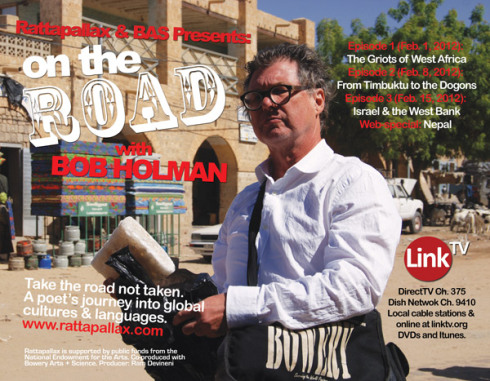
Image via On the Road with Bob Holman / Rattapallax

In April I also worked to create awareness about what we lose when we lose a language. My interview with poet Bob Holman appeared in BOMBlog.

In May I received my MFA in creative nonfiction from The New School. I had a fantastic thesis advisor and a beloved peer group, who challenged me to dig deeper in my memoir about growing up Greek American. After I read a snippet at our thesis reading, an instructor I’d never even had came up to tell me how much he liked my work!

2305th_flyer

Image via The Human Tower / Rattapallax

In June I witnessed the world record being broken for the tallest castell on a rooftop.

paris-review-issue-201-cover

In July I heard Amber Tamblyn read for The Paris Review at the Strand. Afterwards we somehow ended up on the elevator together, and I didn’t say anything to her. I never know in those situations if it’s polite to say something like “nice reading” or if the person just wants her privacy. I know she’s involved in the Beat literature community, though, so I should’ve probably talked to her about that.

570_Road

Image via The Millions

In August an article I wrote about a funny incident I had related to Jack Kerouac sparked a fiery debate and went viral, getting mentioned everywhere from The New Yorker to The Paris Review.

amramstef1

Photo via RA Araya

In September I had one of the most surreal moments of my life–reading with David Amram. I got to hear him perform again, this time as an enthralled audience member, in December.

miguel

Photo via RA Araya

That month I also read for poet Miguel Algarin‘s birthday bash.

p1016108

I also road tripped through northern and central California, visiting Cannery Row, City Lights Bookshop, The Beat Museum, and attending my college friend’s wedding.

p1015207

In October Hurricane Sandy hit New York, and I spent a lot of time in bed.

p10157001

In November I failed miserably at NaNoWriMo, but I had a lot of fun creating this ever-evolving Pinterest board for the book I never wrote.

I also gave a reading that got upstaged by a wedding proposal.

p1016239-e1355694672538

In December there was a flurry of Jack Kerouac-related activities to promote the film adaptation of On the Road, and I got to see author Ann Charters and film director Walter Salles in person at IFC. I also got to take a writing class with screenwriter Jose Rivera at 3rd Ward.

I also went out to Lowell and got to meet Jack Kerouac’s friend and pallbearer Billy Koumantzelis.


What were the highlights of 2012 for you?

New Year’s Eve with Jack Kerouac

1 Jan

9781101201572_p0_v1_s260x420

“The parties were enormous; there were at least a hundred people at Herb Benjamin’s basement apartment in the west nineties. People overflowed into the cellar compartments near the furnace. Something was gong on in every corner, on every bed and couch, not an orgy, but just a New Year’s party with frantic screaming and wild radio music.”

You can read the whole story beginning with Neal Cassady driving Jack Kerouac’s mom back to New York for New Year’s Eve, on page 225 of On the Road: The Original Scroll, published by Penguin Books in 2008.

The recent film adaptation of On the Road does a splendid job capturing the energy at the New Year’s Eve party. Burning Furiously Beautiful: The True Story of Jack Kerouac’s “On the Road,” the book I’m coauthoring with Paul Maher Jr., tells the true-life events that inspired this story.

Proof Copy of “Burning Furiously Beautiful: The True Story of Jack Kerouac’s ‘On the Road'”

26 Dec

312640_349018201862382_1931916268_n

Paul took this photo of our book Burning Furiously Beautiful: The True Story of Jack Kerouac’s “On the Road.”  As you can see, it’s all laid out now! It was really important to me that the book not only contain great content but that it also was visually appealing. I love that typewriter font!

The book will be out soon! In the meantime, we’re posting lots of fun content on the book’s facebook page.

Christmas with Jack Kerouac

24 Dec

OLYMPUS DIGITAL CAMERA


I spotted this festive train outside the National Streetcar Museum when I was in Jack Kerouac’s hometown of Lowell, Mass., earlier this month.

Looking for a Kerouac-related Christmas story? Here’s a snippet from the scroll version of On the Road in which Kerouac describes his Christmas:

“At Christmas 1948 my mother and I went down to visit my sister in the South laden with presents. I had been writing to Neal and he said he was coming East again; and I told him if so he would fine me in Rocky Mount, North Carolina, between Xmas and New Year. One day when all our Southern relatives were sitting around the parlor in Rocky Mount, gaunt men and women with the old southern soil in their eyes talking in low whining voicss about the weather, the crops and the general weary recapitulations of who had a baby, who got a new house and so on, a mud spattered ’49 Hudson drew up in front off the house on the dirt road….”

You can read the whole story beginning on page 212 of On the Road: The Original Scroll, published by Penguin Books in 2008.


Jack Kerouac’s Angry Postcard to His Editor

24 Dec

In 1956, Viking Press expressed an interest in Jack Kerouac’s On the Road.  The author had been writing and rewriting his novel for years, and Kerouac was growing impatient as it languished in the publishing house.  He was working with an editorial consultant named Malcolm Cowley, who had first gained renown for his 1929 book of poetry Blue Juniata before writing one of the first books about the Lost Generation.  Having been associated with the Lost Generation, it in many ways made sense that he was attracted to the Beat Generation.

By the 1940s he was editing Viking Portable editions.  He championed the work of William Faulkner, F. Scott Fitzgerald, Walt Whitman, Ernest Hemingway, and John Cheever.  His interest in Kerouac’s On the Road is important to literary history.  What many people forget is that Kerouac was already an established novelist before On the Road.  He’d written a semi-autobiographical novel entitled The Town and the City that got respectable reviews with comparisons to Thomas Wolfe but which tanked when it came to sales.  Kerouac had literary contacts, but selling On the Road still wasn’t easy.  Cowley was interested but took his sweet time getting back to Kerouac.

On July 9, 1956, Kerouac sent him a postcard depicting the Lower Falls in Yellowstone National Park threatening to sell On the Road elsewhere if he didn’t receive his contract and advance from Viking.  You can read Kerouac’s postcard to Malcolm Cowley (as well as 14 other postcards from authors) at Flavorwire.

Titles Impact Sales: The Many Titles of On the Road

20 Dec

At the premiere reading of Burning Furiously Beautiful: The True Story of Jack Kerouac’s On the Road, I read a section from a chapter that mentioned that Kerouac titled an early draft of his road trip novel Gone on the Road.  Isn’t it amazing how one word can completely change the perception of a work?

What I didn’t mention at the reading is that this wasn’t the only incarnation of the title.  At another point, Kerouac considered changing the title so that it reflected the rock music that was emerging at the time.  Considering how influential jazz music was on his writing style and on the content of the book, it’s better that the title wasn’t changed just to capture a certain market.  It’s always better to remain true to your voice and vision.

The title On the Road is perfect.  And yet in another way it’s just so … obvious.  So literal.  I wonder if his work were being published for the first time today, if an editor would change the title to something flashier.

List of Reviews of “On the Road”

19 Dec

OTRstill

[official film still from On the Road]

Yesterday, I posted my review of the On the Road film adaptation. As LeVar Burton used to say on Reading Rainbow, “But you don’t have to take my word for it.” Here are some other reviews of the film On the Road:

The Beat Museum: “Everyone knows a  book is not a movie and a movie is not a book.  The genius of Jack’ Kerouac’s novels is his prose. It’s not the story, it’s not even the relationships, it’s the prose with the language that he uses to sketch the scene to move the story and to describe the relationships.”

Buzz Sugar: “The plot at times drags, but there is so much energy in the production that I didn’t mind. … This is the role Sam Riley has been waiting for — he’s talented and looks great on screen.”

The Film Pilgrim: “Where Salles really shines is the party/drug scenes, capturing the beatnik life style beautifully.”

Film School Rejects: “For a tale which so obviously values hedonism and free expression, On The Road is ultimately joyless and unengaging, and for a self-discovering road movie to fudge the journey so much and lose almost all lasting meaning is downright criminal.”
The Guardian: “The film is stiflingly reverent towards its source material, and indeed towards itself. It’s good-looking and handsomely produced, but directionless and self-adoring, richly furnished but at the same time weirdly empty, bathed in an elegiac sunset glow of male adoration.”
Hollywood.com: “Incorporating more of Kerouac’s writing as voice-overs or something similar would have given it more life, the kind of vivacity Kerouac sought out in spades, which is why he tolerated Dean’s vagaries for so long. More than most movies, it feels like On the Road could have gone in any direction, expanding or reducing characters, shortening the trips to concentrate on the characters more, emphasizing the effects of their missing fathers or not, and it’s this wishy-washiness that undermines the movie.”
The Hollywood News: “Visually, Salles’ ON THE ROAD is a thing of beauty. Eric Gautier’s cinematography is a wonder to behold: the colouring, the tracking of the characters, and the close quarters filming take the audience to Denver, New York and San Francisco like never before. The images conjured by Kerouac’s words come to life in a way never thought possible. But whilst it looks ravishing the film is full of problems, the first of which is a glaring problem: Hedlund is not Dean Moriarty.”
The Hollywood Reporter: “A beautiful and respectful adaptation of Jack Kerouac’s landmark novel that intermittently leaves the ground to take flight.”
Honi Soit: “Too often unnecessary scenes were included while others were not given the time to become poignant, such as Moriarty’s very brief search for his vagrant father in Denver. I’m happy to concede that part of the frenzy is intentional, to replicate the experience of its addled protagonists, but some tighter editing would not have gone astray.”
The Independent: “Walter Salles takes an orthodox approach to Jack Kerouac’s classic text. As with his adaptation of Che Guevara’s Motorcycle Diaries, Salles seems as preoccupied with the mundane as he is with the tales of threesomes, drugs and broken friendships.”
Indiewire: “The atmosphere of his travels comes first, establishing the book’s searching nature ahead of its loose plot. From that early point, “On the Road” adopts a serious, low-key approach to establishing Sal’s world that keeps the characters grounded.”

LitKicks: “Jack Kerouac would have loved this film version of On The Road.”

Movie News: “As a work of narrative semi-fiction, Salles’ version of Kerouac’s book is appropriately graceful, dirty, and enigmatic. He’s a sensitive director and a good storyteller. What doesn’t come across, though, is why the story matters. Who are these Beatniks?”

The NewStatesman: “Once the beats’ credo of philosophy and pharmaceuticals is established, the film starts noticing those people exasperated or excluded by the party. Sal and Dean may be kings of the road behind their scratched windscreen, but Salles is meticulous in balancing the ledger. There is no liberation in the film without suffering, no beat generation without its beaten-down counterpart (usually female).”

The New Yorker: “I found Garrett Hedlund’s teen-idol depiction of Dean Moriarty particularly unsatisfying. … Hedlund’s performance neuters the book’s animating Mephistophelian spirit.”
The New York Times: “The cinematographer Eric Gautier has done brilliant work elsewhere and doesn’t seem capable of taking a bad shot. But everything tends to look too pretty here — the scenery, sets and costumes included, especially for the rougher byways and more perilous interludes, like the Benzedrine nights that feel more opiated than hopped up.”
NPR: “In fact, any film in which all the characters seem utterly convinced of their own importance and coolness from the outset has the same battle. … There is the Ginsberg-like Carlo (Tom Sturridge), a character drawn here as so self-consciously writer-like that his every appearance inspires twitches. He actually says at one point, while pondering how to describe his feelings, ‘Melancholy’s too languorous!'”
Ropes of Silicon: “The tedious result of this adaptation of Jack Kerouac’s famed novel is, however, unfortunate considering Eric Gautier’s rich, smoke-filled cinematography, Walter Salles’s direction and stand-out performances from most of the cast.”
The Telegraph: “Despite its pretty cast and sun-ripened colours, the film quickly settles into a tedious looping rhythm of Sal Paradise (Sam Riley) experiencing some kind of beatnik debauchery with co-wanderers Dean Moriarty (Garrett Hedlund) and Marylou (Kristen Stewart), before retiring to a shady corner and scribbling wildly in a notebook.”
Time Out London: “Freewheeling spontaneity is tough to convey on screen, and the drink- and drug-fuelled carousing lacks Danny Boyle-style zing. But the bull-nosed cars, jazz soundtrack and soft light of a bygone era are a joy.”
Total Film: “Even if the film has a patchwork quality, Rivera’s script mines some much-needed humour from events – from Stewart giving new meaning to the phrase ‘two-hander’ to the priceless scene where Dean drives Sal’s mother back to New York.”
Variety: “Yet despite the high level of craft here, it’s an inadequate substitute for the thrilling, sustaining intelligence of Kerouac’s voice. Admittedly, any definitive adaptation would have to adopt a radically avant-garde approach to approximate the galvanic impact Kerouac’s novel had on literary form. But even audiences content with an easy-listening version may be put off by the weak conception of Sal’s inner life.”

“On the Road” Review

18 Dec


OLYMPUS DIGITAL CAMERA

OLYMPUS DIGITAL CAMERA

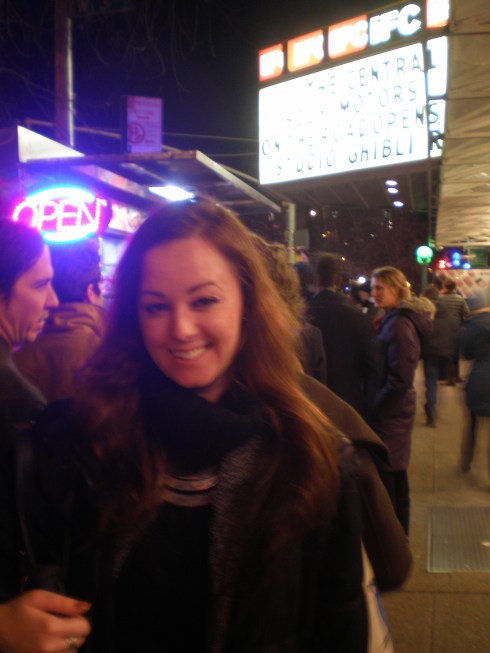
On Friday, December 14, I attended a special sneak preview of On the Road at IFC Center in Greenwich Village. It was history in the making. At long last, Jack Kerouac’s seminal road novel had made its way to the silver screen. Kerouac himself wrote a lot about going to the movies, and he wanted his novel turned into a film. In fact, he even wrote to Marlon Brando, asking him to buy it and star in it.

Francis Ford Coppola bought the film rights decades ago. I have a friend who wrote a screenplay that he showed to Coppola, and there have been numerous actors associated with the film adaptation, but the project always seemed to stall. Finally, Walter Salles came on as director and Jose Rivera as screenwriter, and soon after an impressive cast lined up, and the film looked like it would finally take off. And it did! It debuted at Cannes Film Festival in May 2012. Throughout the summer and into the fall, the film showed at theatres across Europe and South America. Those of us in the States read reviews, watched clips, argued about whether the novel could be adapted for film in a successful way, and debated the choices for the cast while we waited for the quintessential American story to come to us. At long last, when it was announced that a sneak preview of On the Road was taking place in the neighborhood Kerouac used to hang out in, people lined up on the Avenue of Americas for a chance to see it. As my good friend Elizabeth and I waited in line, an older man offered us $50 for our movie tickets. Considering we were so excited we were taking photos to commemorate the event, we probably weren’t the best people to try to scalp from. Needless to say, I watched the film, and, for whatever it’s worth, I can now give you my review of On the Road, which opens in New York and LA on December 21 and the rest of the country in January.
Let me start with a caveat: I am perhaps a bit too close to the subject matter to review On the Road objectively. After all, I am writing a book about the true story of On the Road. I have also heard and read reviews by a few other Beat scholars and fans and watched many Youtube clips from the film. I came in with lots of preconceived notions, and I watched the film more as a critic than as your average moviegoer. That said, I did not go into it as a literary snob wanting it to fail. I came into it wanting to see Kerouac’s work done justice.

***

On the Road is wonderfully nuanced. And to me, it’s the nuances in the acting, directing, and screenwriting that make On the Road a worthwhile adaptation of the novel. Everyone involved in the film understood that Kerouac’s novel is not just about some crazy kids driving at high speeds across the country, getting high, and getting laid. They understood that depicting this wild behavior — the film does not censor anything — was necessary not for shock value but because it underscores the complexity of the characters. In particular, the film does justice to the theme of the loss of fathers. Burning Furiously Beautiful, the book I’m coauthoring, delves into the personal life stories of the real-life people the characters are based on, giving further insight into their behavior and lifestyle. Understanding the characters’ back story elucidates their desires and actions, and the film adaptation neither glorifies nor critiques the characters. It gives them space to reveal themselves to the viewer.

Interestingly, the character that fell flat to me was the character of Sal Paradise, based on Jack Kerouac and played by Sam Riley. The actor, screenwriter, and director did a great job showing him to be an observer, which was true to Kerouac’s nature. However, the film itself was not seen through Sal’s eyes. He seemed like just another character. The landscape, the jazz shows, the parties were depicted through a neutral perspective. Not only did this make it difficult to understand Sal’s motivations and character — this is most evident in the scene with Terry (“the Mexican girl”), which isn’t developed enough for us to understand why it’s included — it meant we lost his voice. While critics over the years have focused on the road trip antics, for me, the strength of the novel was its insanely beautiful poetry. The film adaptation was more about the story and less about the literature.

Overall, though, the dialogue for the characters and the acting was phenomenal. Viggo Mortensen needs to star in a biopic on William S. Burroughs. Amy Adams took on the persona of Jane. Kristen Stewart brought a depth to Marylou that Kerouac himself didn’t. Kirsten Dunst showed great emotion in her scenes. Tom Sturridge played Carlo Marx with intensity but also surprising humor; his dialogue was quintessential Ginsberg: dramatic and over the top. Elisabeth Moss’ Galatea was a nice contrast to the other characters, while Danny Morgan’s Ed was a bit too goofy; these two characters are the reason the characters end up at Old Bull Lee and Janes’s place, but if it weren’t for that they could’ve been edited out for the film. Garrett Hedlund was charismatic. He lit up the screen.

My most pressing criticism of the film is that it felt a bit too much like a period piece for my personal preference.  I was impressed that the film was historically accurate, and yet I found myself distracted by those details. For example, when the focus was on the exterior of the Hudson, it made the story feel removed instead of vibrant; yet the shots within the car or from the viewpoint of the passenger were beautiful. Likewise, there were times when the wallpaper in a room jumped out at me more than it probably should have. I’m by no means suggesting the story should have been modernized, but the setting and props should not overpower the story. There were also scenes like the one at the jazz club which felt staged, almost cartoonish. I would’ve liked something a bit more raw, a bit grittier or impressionist.

In contrast, the New Year’s Eve party was sheer brilliance. Here were fast cuts and disorienting angles. Here were sweat and thrashing limbs. Here was jazz you wanted to dance to. Here was the energy that made you want to shout go, go, go! There were also beautiful quiet moments laced throughout the film. Poetic landscape. Honest heart-to-hearts. Subtle glances. Almost any time the characters were on the road, the dialogue, the filmography, and the acting were spot on.

The film adaptation of On the Road may enlighten some people’s perception of Jack Kerouac.

Beat Poetry Competition at the Nuyorican

17 Dec

OLYMPUS DIGITAL CAMERA OLYMPUS DIGITAL CAMERA OLYMPUS DIGITAL CAMERA OLYMPUS DIGITAL CAMERA OLYMPUS DIGITAL CAMERA OLYMPUS DIGITAL CAMERA OLYMPUS DIGITAL CAMERA OLYMPUS DIGITAL CAMERA

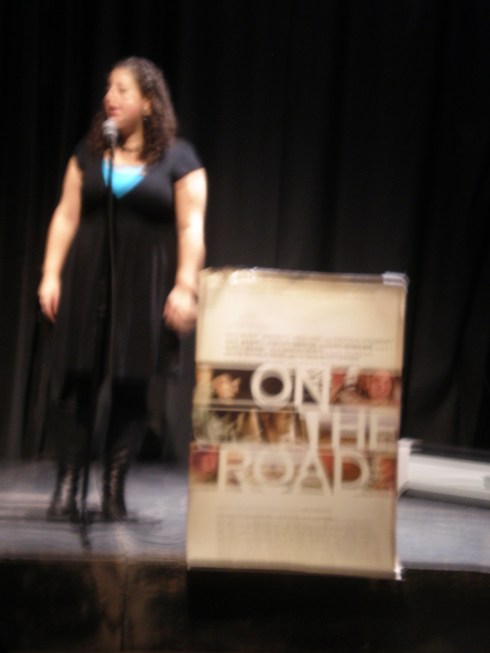
Checked out the Beat poetry slam at The Nuyorican Poets Cafe over on the Lower East Side during Beat Week. “We’re excited to be here in a proper poet’s cafe, celebrating a proper poet,” said host Mahogany Browne. The Nuyorican was cofounded by Miguel Algarin, who knew Jack Kerouac back in the day. Browne encouraged the audience to snap as she read a quote from On the Road “like the Beat poets” did “because they were too high to clap.” Of Kerouac’s famous novel, she said, “It’s a dude book. [The characters] get to travel all over the world and fall in love. I’d be too scared [to go on the road].” Hm… sounds familiar.

Browne, a poet in her own right, said the contestants would be “burning some poems on this motherf*cking mic.” She explained that slam is “the Olympics of poetry.” The poets were competing for a chance to win $50 and the soundtrack to the film adaptation of On the Road. The judges were told to rank each poet from 1 to 10, with decimals and exclamation points encouraged. The poets each had a unique style. Some poets appeared to be seasoned professionals, who had memorized their words, and others seemed like brave young artists. Even the quieter, dreamier poems were powerful. I love the way the photographs I took show the energy of the poetry.

There was also a Jack Kerouac trivia contest. I abstained from reading at the event and wasn’t planning on competing in the trivia contest, but when everyone was stumped, I couldn’t help but blurt out the answer. A teenaged girl in the audience wanted to win so desperately that she practically fell out of her chair trying to ask me for trivia answers. Instead of helping her cheat, I just gave her the winning copy of the On the Road novel. I’ve never seen anyone want to read a book that badly, and it was my little way of encouraging people to read Kerouac.

Afterwards I talked to one of the poets, a guy who’d been on the road himself. He was a truck driver and had also spent time studying painting in Syria. I liked how each poet had their own story to tell.