The writers associated with the Beat Generation were anti-Consumerism, and I have a hard time believing they’d want anyone to buy beatnik merch. They would want you to buy and read their literature instead. However, if you have friends who love Beat literature, you may be hesitant to buy them On the Road because chances are they probably already have dog-eared paperbacks of both the standard novel and the scroll version. Here are a couple of alternative Beat-inspired gifts.
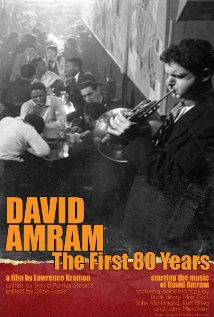
Musician and author David Amram did jazz-poetry performances with Kerouac and other poets. He also wrote the scores to films such as Splendor in the Grass and The Manchurian Candidate and has jammed with a wide variety of musicians. David Amram: The First 80 Years chronicles his genius talent. (You can watch a video of me reading with Amram here.)
Another gift-worthy film is Ginsberg’s Karma, a “documentary about the legendary poet Allen Ginsberg and his mythical journey to India in the early 1960s that transformed his perspective on life and his work.” The film was edited, produced, and directed by Ram Devineni, and features poet Bob Holman. I saw this film at the PEN World Voice Literary Film Feast a few years ago and was inspired to get involved in some of their subsequentprojects.
Billy Koumantzelis was a friend of Kerouac’s back in their hometown of Lowell and served as a pallbearer at his funeral. I picked up this CD when I was at Lowell Celebrates Kerouac in 2011. It’s full of stories about Kerouac hanging out at bars, getting into fights, and appearing on The William Buckley Show and makes a great gift for someone who wants to hear stories from someone who knew Kerouac. (I got to meet Koumantzelis last week, and he is a true gentleman. I’ll be sharing stories from that soon.)
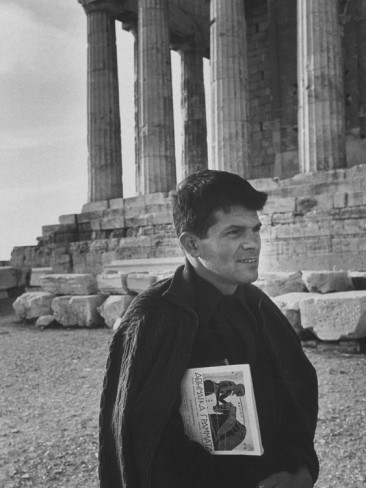
Allen Ginsberg had a portrait of poet Walt Whitman hanging in his apartment. This framed portrait of Gregory Corso is a great tribute to a poet who loved the Classics.
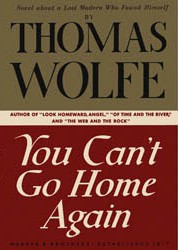
Jack Kerouac was inspired by author Thomas Wolfe. Bundle up Look Homeward, Angel and You Can‘t Go Home Again for the Kerouac fan.
Kerouac wrote about the Grotto in Lowell, which is a beautiful and peaceful space to visit. Artist Jonathan Collins, whom I met at one of my readings, did a series based on the Grotto, which would make a lovely gift.
Another person I met at a reading was Larry Closs, author of the book Beatitude. I stayed up late one night reading this heartbreaking-but-hopeful book of love, friendship, and the power of literature. You can read the synopsis here.
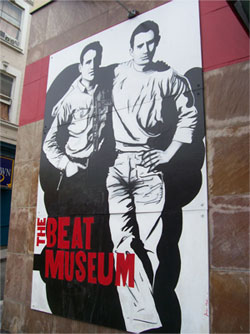
I haven’t finished my California road trip posts yet (so many posts, so little time!), but it will include my visit to The Beat Museum in San Francisco. I was greeted by none other than proprietor Jerry Cimino himself, whose stellar work in preserving Beat history I’ve been following for many years. He took some time out to chat with me and show me the plethora of rare and first-edition Beat books. Even if your budget isn’t big enough for a first edition, you can still get archival lit mags, which make a really cool gift.
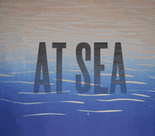
Another place soon to be featured on my California road trip is City Lights Bookstore. In addition to rare and signed copies of books, you can also get some exclusive works here. At Sea is an “Exquisite handmade letterpress edition of Lawrence Ferlinghetti’s new poem” for poet Pablo Neruda.
Of course there are tons of biographies, walking tour books, graphic novels, films, and so forth that would also make great gifts, but if you’re looking for something a bit more off the beaten path (heh), these might be the gifts you’re looking for.
The people behind the On the Road film are uniting a community of angel-headed hipsters. They’ve organized lots of fun activities leading up to the release of the film in the States. Welcome to Beat Week!
Those of us who are passionate about Jack Kerouac’s literature may cringe at the use of the word “beatnik” and the commercialism of the events–the supper club event costs $95 and is a far cry from the cafeteria food Kerouac typically described in his writing; I’m not sure what haircuts have to do with the book or the film adaptation of On the Road and I’m pretty sure Kerouac wouldn’t have been able to afford the prices there–but perhaps these are simply fun events that will inspire a new generation to check out Kerouac’s book for themselves to see what the buzzzzzz is all about. And I must say, the chance to see Jose Rivera and Walter Salles in person is too good to pass up!
What do you think: Is this crass commercialism or an inspired way to engage the Millennial Generation? Is Jack Kerouac finally getting his due or are we headed into Maynard G. Krebs territory?
I was just thinking the other day that it had been a long time since I’d heard about James Franco. I’m serious! It seemed like a year or two ago James Franco was omnipresent. There’s James Franco sleeping in class at Columbia! There’s James Franco explaining it wasn’t technically class! There’s James Franco playing with a cat! There’s James Franco’s book! There’s James Franco teaching at NYU! There’s–well, you get the idea.
And then nothing.
I don’t know why, but I suddenly missed hearing about James Franco. Maybe it had something to do with the fact that we were both getting our MFAs. Or maybe it had to do with the fact that I thought his portrayal of Allen Ginsberg in Howl was authentic.
Well, wouldn’t you know it: today I stumbled upon The Los Angeles Review of Books‘ recent interview with James Franco. In the article, Franco discusses poetry, writing, and filmmaking. He talks about William Carlos Williams, Hart Crane, Allen Ginsberg, Frank Bidart, and his writer mother. He also says that even though he portrayed Allen Ginsberg in Howl it was another author who inspired his foray into Beat literature:
Kerouac came first. On the Road was my introduction to the Beats, but “Howl” was my introduction to poetry. I studied Williams in school, but I didn’t really study him as a craftsman until later, when I went to the writing program at Warren Wilson College in North Carolina.
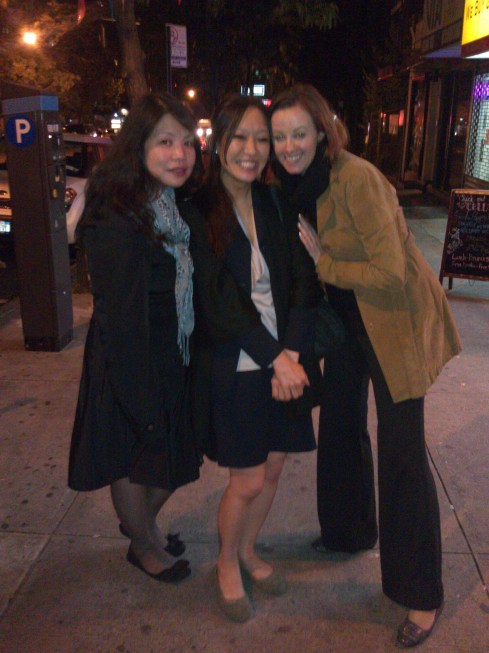
When my dear friend Sue, whom I’ve known since first grade, invited me to a jazz show fundraiser I immediately said yes. As I’ve been studying Jack Kerouac, I’ve been reading a lot about how he frequented the jazz clubs of Harlem and wrote jazz reviews. I’m kind of a method writer, and I like to get out and experience what I’m writing about. And of course it’s great to be able to help others just by doing something you love — listening to music and eating great food. And when I say great food, I mean they had fried olives stuffed with blue cheese! Afterwards, I asked Sue if she’d be interested in doing a little write up, and she not only agreed but was so enthusiastic about it. Below she shares about this worthwhile fundraiser, the great music, and the cute moment we shared with people at our table:
Jack, Josie and I hurriedly rushed into the restaurant. We finally arrived at Lura Restaurant Lounge at 949 Columbus Avenue (Duke Ellington Blvd and 106th Street), way uptown. We were running late for the Jazz for Peace Event, the Global Alliance for Community Development’s (GACD) 2nd Anniversary Fundraiser. Jack serves on GACD’s Board of Directors, and the three of us work for the same company in midtown, where we were rushing in from. I was to meet my friends, Mike and Stephanie, at Lura by 7pm. I walked in and looked around. To my left, Steph sat alone at a table, dressed in black, buried deep in a book. Mike was off to my right at the bar, looking directly at me and smiling.
Josie and I gathered Mike and joined Steph at the table. I know them; they know of each other. The usual chatter ensued, and drinks and food were ordered. Lura has an exceptional menu, and we had a hard time deciding what to get. Everything looked (and was) scrumptious. As we settled in, David McCoy, Executive Director of GACD, stood up in front of the room and talked about the work they are doing and aspire to do and the results of their labor up to that point. One of the most inspiring initiatives that he described was the water programs GACD has designed in collecting and filtering rainwater for communities. It made one feel so proud to be a part of this great cause in some way and was an appropriate reminder of what was going on outside of the room. He turned our attention over to Rick DellaRatta and Jazz for Peace* and, appropriately for a late October evening, they opened up with “Autumn Leaves.”
I noticed that Josie was talking to an elderly couple at the next table. The man was keeping half-time with his hand on the table and on his knee, joking that the music was too fast for old people to dance to. Josie, who was sitting closest to the woman, was deep in conversation, probably partly due to the fact that one could hardly hear anyone unless he or she was right next to you. After a few moments, Josie revealed to us that this couple happened to be, in fact, the parents of the keyboardist and vocalist, Rick DellaRatta. The man, DellaRatta’s father, had been a musician in the War, and his wife, DellaRatta’s mother, was a pianist who had played with him. They’d been married for over 50 years. DellaRatta’s father displayed so much insight into the music being played, the technicalities of it, how each instrument contributed to the overall sound. The bassist plucked away, with all ten fingers at one point. The drummer, who looked like a teenager, blew everybody away with the seeming madness of his drumming. He paused and syncopated with so much force, yet absolute grace and control. The saxophonist, who stood in front, slightly to the right of the stage, whenever I looked over at him, would just be standing there, still, looking out at the audience. Every so often, you’d hear him first, the singing, soaring sounds of the sax, running up and down the octaves where his fingers, all of a sudden, were a blur, a complete contrast to his previous state of inertia. The energy emanating from the stage forced one to stop what one was doing, or even thinking about, and to just feel the music, to let the symphony flow through you and move you.
The next day at work, Jack and I agreed that the night was too short. Josie and I were anxious to see the pictures Mike had taken of us inside and outside the venue.
Please see links for more information on GACD and how you can help support them and their more-than-worthy cause to combat poverty. Hope to see you at GACD’s 3rd Anniversary Fundraiser!
Sue J. Chang lives in Manhattan, NY in Battery Park City and publishes mixes on 8tracks.com.
* Via: On September 25, 2002 Jazz pianist and vocalist Rick DellaRatta was invited to lead a band consisting of Israeli, Middle Eastern, European, Asian and American Jazz Musicians in a concert inside the United Nations for an International audience in what is now considered one of the significant cultural events of our time. Rick named this band JAZZ FOR PEACE™ and has since performed over 800 Benefit Concerts to raise funds, publicity and awareness for outstanding organizations in need worldwide. In addition Jazz for Peace performs educational programs bringing music and Jazz back into the schools and donates musical instruments to underprivileged children. Jazz for Peace concerts have featured Rick DellaRatta along with such notable jazz artists as Paquito D’Rivera, Victor Lewis, Lenny White, Eddie Gomez, Dave Valentin, Ray Mantilla, Rick Margitza and many others. Mr. DellaRatta’s Jazz influenced orchestral composition “Permutata” was recently recorded by the London Symphony Orchestra. For more information please visit http://www.jazzforpeace.org
Athens-based writer Michael Limnios has been interviewing people associated with the Beat Generation for Blues.Gr. He has an impressive catalog of interviews, featuring such names as Amiri Baraka, Helen Weaver, Levi Asher, Dennis McNally, and so many other fascinating figures. I don’t know how I ever got lucky enough to be even remotely associated with these people, but I’m honored. Michael asks unique questions so the interviews touch on aspects of the so-called Beat Generation that aren’t always addressed.
Next time I’m in Greece, I’ll have to see if he’s available to sit down in the platea and chat about the Beats and jazz and rembetiko over a glass of ouzo!
By the time my poor bus rolled into Carmel, the day was fading and the shops had closed their adorable doors. Music from a live concert rose up out of the heart of the main shopping plaza, and the moon made his appearance even though the sun hadn’t quite set yet. I was a little disappointed not to be able to stop into the cheese shop that the wine guide back at the winery had recommended, but I was intent on getting a little culture out of the trip. Man cannot live on cheese alone. I set off to visit the Carmel mission.
I was a little annoyed that I’d paid all this money for a tour that basically amounted to the driver talking over the intercom as he drove the bus and then sleeping while we wandered off on our own into the unknown. That was the point when I actually needed a tour guide. I didn’t need someone to tell me to look out the window because by golly there’s a strawberry field. I needed someone to physically walk me to locations because I’m for someone who loves to travel I’m notoriously bad with directions, and I hate wasting time getting lost when there are things I want to see! I asked the driver to point me in the direction of the Carmel mission, and he told me the twosome up ahead of me were also headed there and honked the bus horn at them so they’d wait for me.
I awkwardly approached, not knowing if I was encroaching on some romantic rendezvous. As it turned out, they were ex-brother and sister-in-law. The woman had married and divorced the guy’s brother. They couple had been divorced for many, many years now, but the woman and the brother had remained good friends and travel companions. Hm… was there maybe something more there? No. He’s gay and in a committed relationship, and she is currently in a serious relationship. They just like to travel together.
Alrighty then! Onward ho! (Actually, I found the relationship backstory out on the return trip.)
The woman once been given a beautiful painting of the San Carlos Borromeo de Carmelo and always wanted to visit it. We set off down the road, the driver having told us it was only about a ten-minute walk. That was a lie. As we were trying to figure out which way to head, a woman in an SUV pulled up and asked us if we wanted a ride. Now, if you’ve read my “Nightmare of a Trip” post, you know that I’m well versed in the dangers of hitchhiking, but I figured I was with two other people. Plus you had to have seen the woman in the SUV. She was skinny with bleached blonde hair and wore these ginormous heels and what may have been a dalmatian-fur coat. I couldn’t tell if she was actually old or if her skin was damaged from too much suntanning. We were grateful to her, though, as she took time out to give us strangers a ride.
The San Carlos Borromeo de Carmelo, like all the shops, had already closed, so we could only peer in over the fence. It was a beauty! Established in 1771, the Community of the Carmel Mission is a working church. The Basilica Church is a registered National Historic Landmark and there are five museums on the grounds.
Of course, the bus also made a stop at the Carmel mission when we left the area, but we didn’t have time to get off the bus at that point, so I’m glad I ventured off to enjoy its peaceful presence.
I’m not sure which mission he’s referring to, but in Big Sur Jack Kerouac writes of Cody, the character based on Neal Cassady, saying:
“Now dont walk too fast, it’s time to stroll along like we used to do remember sometimes on our daysoff on the railroad, or walkin across that Third and Townsend tar like you said and the time we watched the sun go down so perfect holy purple over that Mission cross–Yessir, slow and easy, lookin at this gone valley…”
I am so excited to have been tagged by Maria Karamitsos for the The Next Big Thing Blog Hop. Even though I’m not a mother, I love reading Maria’s blog From the Mommy Files, which is full of humor and light. She has the gift of storytelling. Her blog entries read like snippets of a novel-like memoir, with dialogue, reflection, and a strong voice, despite the fact that much of her writing is focused on what could be a very technical topic: molar pregnancy. Take for instance, her post “The Influence of the Lost Child,” in which she talks to her two adorable little girls—”BooBoo BeDoux” and “Bebs LaRoux”—about the baby she miscarried. It’s a difficult and heartbreaking subject, yet she injects humor in it through the personalities of her daughters (“it’s tough to be 3, after all!”) as well as tenderness and faith. I’m really excited about the book she’s writing called Positive About Negative: Adventures in Molar Pregnancy. Maria also tagged some other Greek authors for the Blog Hop, and it’s great discovering all these writers.
I’m tempted therefore to write about my memoir about being Greek American, but since my book on Jack Kerouac is coming out first my answers to the Blog Hop questions are about that book.
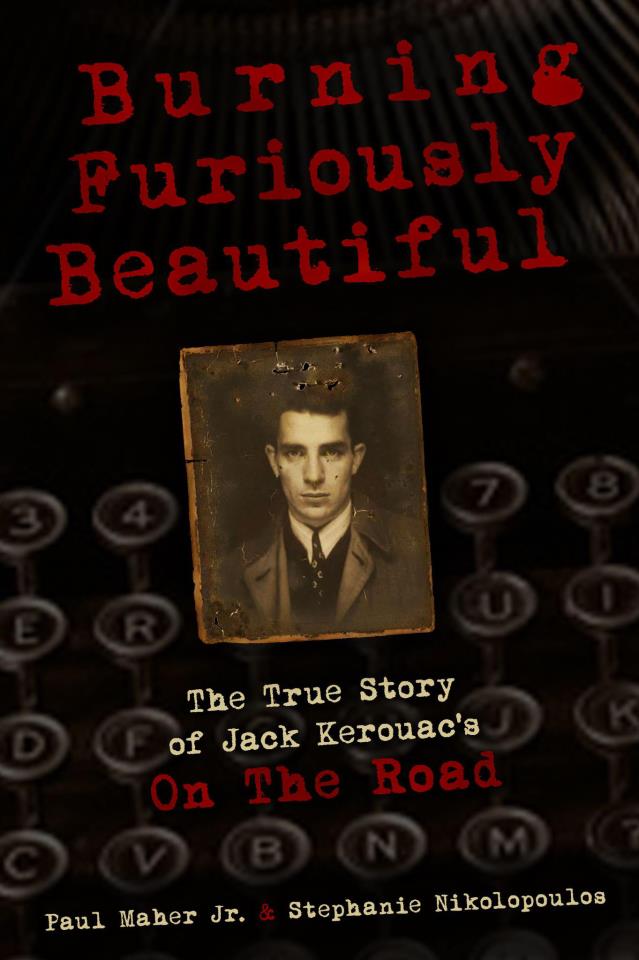
What is the working title of your book? Burning Furiously Beautiful: The True Story of Jack Kerouac’s On the Road
Where did the idea come from for the book? Paul Maher Jr. had written a book entitled Jack Kerouac’s American Journey: The Real-Life Odyssey of “On the Road” for the fiftieth anniversary of the publication of Kerouac’s seminal work. I had read this book one summer and some months later began reading Paul’s blog. We began talking and decided to revise and expand his book because we knew that a film adaptation of On the Road was coming out and we wanted to provide a resource for those interested in finding out more about this famous novel. It was important to us that the book had a strong narrative, contextual information, and new research because we wanted both the teenager turned on from the film and the literary scholar who’s read every book by Kerouac to enjoy it and find value in it.
What genre does your book fall under? It’s literary criticism and biography.
Which actors would you choose to play your characters in a movie rendition? Isn’t that the million dollar question? There’s been a lot of talk over the years about who should play Sal Paradise and Dean Moriarty in the film adaptation of On the Road. Johnny Depp, Brad Pitt, Colin Farrell, Marlon Brando, you name it, they’ve been associated with it. I almost never go to the movies and don’t really know the young actors of today well enough to say who would be age appropriate to cast. Joseph Gordon-Levitt? Zac Efron? These actors are too old to play the roles now but if I were casting the film back when I first read On the Road as a teenager, this is who I’d pick:
Sal Paradise — Johnny Depp and Ethan Hawke would be excellent choices for Sal Paradise, particularly because they both have a deep appreciation for literature. Depp is a known Kerouac fan and just started his own publishing imprint, and Hawke is a published author.
Dean Moriarty — Woody Harrelson would make a great Dean Moriarty. He can play both earnest and wild so well! Matthew McConaughey would be great as Dean too.
Carlo Marx — I loved James Franco’s portrayal of Allen Ginsberg in Howl, but if I had to select someone else I might go with AdamGoldberg.
Old Bull Lee — The choice of Viggo Mortensen as Old Bull Lee for the Walter Salles film is brilliant, but again if I had to choose someone else maybe I’d with Ewan McGregor.
Marylou — Drew Barrymore would be so much fun to watch as Marylou. Do you remember her in Mad Loveand Boys on the Side? Almost Famous hadn’t been made yet when I was a teenager but Kate Hudson (think Penny Lane) would be my runner-up pick.
What is the one-sentence synopsis of your book? Burning Furiously Beautiful tells the true story of Jack Kerouac travels on the road and how it took him years, not weeks, to write On the Road.
Will your book be self-published or represented by an agency? We decided to self-publish Burning Furiously Beautiful.
How long did it take you to write the first draft of your manuscript? The first draft, so to speak, had already been written and published as Jack Kerouac’s American Journey.
What other books would you compare this story to within your genre? There have been so many biographies of Kerouac written over the years, and each offers its own perspective. Burning Furiously Beautiful uses Kerouac’s journals and letters, as well as archival material from other people who knew Kerouac during the time he was on the road and writing On the Road, to tell a the specific story of the making of a novel that continues to generate interest today.
Who or What inspired you to write this book? Obviously, Paul Maher Jr. inspired Burning Furiously Beautiful as it was his original idea. I, however, had been researching and writing about Kerouac since I was an undergrad many years prior to this and brought my own knowledge and skills to the project. I was very much inspired by the fact that the film adaptation is soon to be released here in the States. There’s a whole new generation coming to Kerouac’s literature, which is immensely exciting to me. Reading Kerouac when I was in high school opened up so many possibilities for me as a reader and writer. I hope that the film will pique people’s interest so that they’ll go back and read Kerouac’s books for themselves—not just On the Road but his other great works as well—and that they’ll watch Pull My Daisy, the film that Kerouac himself spontaneously narrated. Burning Furiously Beautiful is important because it contextualizes On the Road and provides a fascinating look at Kerouac’s life and writing process. This is critical because there’s so much myth surrounding Kerouac and the 1950s. I became engrossed in odd little details like the fact that the Kerouac’s didn’t have a phone and took their calls at the store below their apartment in Queens. It’s so different than today when it seems like every middle schooler has a cell phone. If Cassady could’ve just called Kerouac up on his iphone, he might not have written the infamous Joan Anderson letter that spurred on Kerouac’s writing style.
What else about your book might pique the reader’s interest?Burning Furiously Beautiful is a great book for an aspiring writer, regardless of whether or not you like Kerouac’s writing style. It’s a portrait of a young writer and details how his writing voice developed (his first book has a much different style), what his writing routine was, the editing process (yes, there was one!), what his relationship with other writers and editors was like (imagine lots of parties), and the many false starts he had in writing his book. We even talk about book signings, contracts, and press interviews. Sometimes I’ve felt frustrated with various writing projects of mine, but realizing that Kerouac, who purported to have written On the Road in only three weeks, went through some of the same struggles and took years to find success makes me realize that it’s all part of the writing process.
I’ve never been intimidated by a blank page or a brand new diary. When I was younger and in elementary school, I relished in-class writing assignments. Inspiration and ideas came easily to me, and I wrote fast and furious. Perhaps this is because I was a quiet student, who probably went days without speaking in class, so writing assignments gave me a chance to let loose all the thoughts that had been bottled up inside my head.
Most of the time when I sit down to write, I have little idea what will come out. I almost never work off of an outline, and even when I have a thesis or a direction I want to take my work, the writing seems to have a mind of its own. I feel that my job as a writer is to just let the words flow and the story will find itself. If I try to wrestle my words down to keep to some preconceived notion of what I am expected to say, I run the risk of missing something purer and truer.
Much more intimidating to me than the blank page is a work in progress. Are my words rebelling against my story and leading me astray? Has everything I’ve said been gibberish?
Below are famous literary quotes about persevering and finding form and structure:
The work never matches the dream of perfection the artist has to start with. ~William Faulkner
There is no method except to be very intelligent. ~T. S. Eliot
One must be drenched in words, literally soaked in them, to have the right ones form themselves into the proper pattern at the right moment. ~Hart Crane
Something that you feel will find its own form. ~Jack Kerouac
The task of a writer consists in being able to make something out of an idea. ~Thomas Mann
If the artist does not fling himself, without reflecting, into his work, as Curtis flung himself into the yawning gulf, as the soldier flings himself into the enemy’s trenches, and if, once in this crater, he does not work like a miner on whom the walls of his gallery have fallen in; if he contemplates difficulties instead of overcoming them one by one…he is simply looking on at the suicide of his own talent. ~Honore de Balzac
Any man who keeps working is not a failure. He may not be a great writer, but if he applies the old-fashioned virtues of hard, constant labor, he’ll eventually make some kind of career for himself as writer. ~Ray Bradbury
It is perfectly okay to write garbage–as long as you edit brilliantly. ~C. J. Cherryh
Books aren’t written, they’re rewritten. Including your own. It is one of the hardest things to accept, especially after the seventh rewrite hasn’t quite done it… ~Michael Crichton
Get it down. Take chances. It may be bad, but it’s the only way you can do anything really good. ~William Faulkner
Do you plot out your entire work before you begin writing?
Nearly 90% of American wines come from California. While Napa and Sonoma Valley are the most recognizable names associated with California wine production, there are many other fertile regions for grape growing and winemaking throughout California. While I was in Monterey, I stopped by the Bargetto Winery shop for a little lesson on winemaking in the Santa Cruz Mountains and, of course, some wine tasting!
Visiting the Bargetto Winery was one of the highlights of my road trip to Monterey. It was also one of the most unique wine-tasting experiences I’ve had. I’ve gone wine tasting in Tuscany, Long Island, Brooklyn, Manhattan, and Vermont, as well as sampled wines in Oregon. Along the way I’ve encountered some exquisite wines. What made the tasting at Bargetto Winery stand out was the diversification of wines I samples.
The standout wine at Bargetto Winery, for me, was the the Chaucer’s Cellars apricot wine. I was at first hesitant to try this fresh fruit wine. Although I was intrigued, I imagined it would taste like marmalade. What I discovered, though, was a refreshing dessert wine bursting with flavor. It’s sweet but also light. It’s certainly not a wine you’d want to drink glass after glass of, but it is the perfect ending to a meal. The expert who was helping me suggested it also went well with spicy chicken cashew dishes; the website also offers recipe ideas. As the website says:
CHAUCER’S CELLARS, produced by BARGETTO WINERY, has won gold medal winning dessert-style wines for decades. These elegant wines are produced from 100% pure fruit or natural honey without the addition of artificial flavors. The distinct taste of these wines can be enjoyed in the tradition of Medieval England. In the spirit of Geoffrey Chaucer’s Canterbury Tales, experience these unique wines as a pilgrimage in sensory delight.
“A pilgrimage in sensory delight”!
The other dessert wine I tried was definitely my least favorite of all the wines and that was Chaucer’s Mead:
Take a step back in time and enjoy the flavors of this popular Elixir. Our Mead is made with similar recipes used in Medieval Times.
The honey for this specialty dessert-style wine is produced in hives throughout Northern California. It is composed of a blend of three types of honey: alfalfa, sage and orange blossom. Each type brings a unique quality to the blend and contributes to the overall complexity of the Mead. Alfalfa is neutral in flavor but yields a dark, amber color. The orange blossom brings a floral bouquet to the nose of the wine. Sage brings subtle nuances into the blend.
I’m a big fan of all things honey, and I appreciate the blend of three different types of honey produced in California. I’m not a huge fan of mead in general, and the particular mead I was served contained a spice packet of cinnamon and cloves. It tasted like Christmas tea. Not necessarily a bad thing. I would certainly enjoy a hot cup of spiced mead on a snowy winter’s night — but no more than once a year.
I also tried a pinot grigio and a pinot noir, both of which were delicious. The pinot noir had a sexy spiciness to it that made it perfect for drinking on its own or with a strong, peppery cheese.
Two brothers in the Bargetto family emigrated from Italy and started a winery in San Francisco that was shut down during Prohibition. The Bargetto Winery was then established in 1933, meaning it was around during the time Jack Kerouac and his friends were road tripping along the California coastline.
Today, the Bargetto Winery practices sustainability in their winemaking:
There are three aspects to winegrowing sustainability as it applies to our winemaking operations:
The first is Environmentally Sound , in which we strive to produce wines in a green manner. Each month herein we post one of our winery practices like insulation of cooling pipes for energy conservation
The second is Economically Feasible , in which we maintain practices that will allow our winery to continue our long family tradition. Producing consistently quality wines that retain devoted customers and efficient business practices are two examples
The third component is Socially Equitable , in which we strive to provide a healthy and dignified work environment for our employees. Our giving back to the community , especially our LA VITA Fund is another example of this aspect to sustainable winegrowing.
The Santa Cruz Mountains is a beautiful area, which overlooks the ecologically diverse Monterey Bay Sanctuary. We believe we have a duty to do our part in maintaining and improving this natural beauty while being good business citizens of our community.
The Santa Cruz Mountains pass through San Francisco and head all the way down to Monterey Bay and the Salinas Valley. It’s worth noting that the agricultural towns of Salinas and Gilroy, which I also passed through on my road trip, are also known for their wine. The Santa Cruz Mountains is an American Viticultural Area (AVA) that consists of Santa Clara, Santa Cruz, and San Mateo Counties. There are more than 200 vineyards in this area.
You can visit tasting rooms of the Bargetto Winery in Soquel or Monterey (which is where I went).
Speaking of Chaucer, you may also be interested in my earlier post:











 Stephanie Nikolopoulos