Tag Archives: On the Road film

“On the Road” Review

18 Dec


OLYMPUS DIGITAL CAMERA

OLYMPUS DIGITAL CAMERA

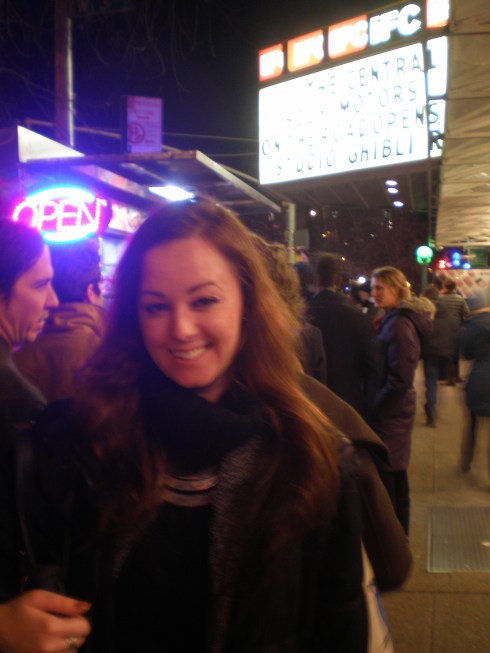
On Friday, December 14, I attended a special sneak preview of On the Road at IFC Center in Greenwich Village. It was history in the making. At long last, Jack Kerouac’s seminal road novel had made its way to the silver screen. Kerouac himself wrote a lot about going to the movies, and he wanted his novel turned into a film. In fact, he even wrote to Marlon Brando, asking him to buy it and star in it.

Francis Ford Coppola bought the film rights decades ago. I have a friend who wrote a screenplay that he showed to Coppola, and there have been numerous actors associated with the film adaptation, but the project always seemed to stall. Finally, Walter Salles came on as director and Jose Rivera as screenwriter, and soon after an impressive cast lined up, and the film looked like it would finally take off. And it did! It debuted at Cannes Film Festival in May 2012. Throughout the summer and into the fall, the film showed at theatres across Europe and South America. Those of us in the States read reviews, watched clips, argued about whether the novel could be adapted for film in a successful way, and debated the choices for the cast while we waited for the quintessential American story to come to us. At long last, when it was announced that a sneak preview of On the Road was taking place in the neighborhood Kerouac used to hang out in, people lined up on the Avenue of Americas for a chance to see it. As my good friend Elizabeth and I waited in line, an older man offered us $50 for our movie tickets. Considering we were so excited we were taking photos to commemorate the event, we probably weren’t the best people to try to scalp from. Needless to say, I watched the film, and, for whatever it’s worth, I can now give you my review of On the Road, which opens in New York and LA on December 21 and the rest of the country in January.

Let me start with a caveat: I am perhaps a bit too close to the subject matter to review On the Road objectively. After all, I am writing a book about the true story of On the Road. I have also heard and read reviews by a few other Beat scholars and fans and watched many Youtube clips from the film. I came in with lots of preconceived notions, and I watched the film more as a critic than as your average moviegoer. That said, I did not go into it as a literary snob wanting it to fail. I came into it wanting to see Kerouac’s work done justice.

***

On the Road is wonderfully nuanced. And to me, it’s the nuances in the acting, directing, and screenwriting that make On the Road a worthwhile adaptation of the novel. Everyone involved in the film understood that Kerouac’s novel is not just about some crazy kids driving at high speeds across the country, getting high, and getting laid. They understood that depicting this wild behavior — the film does not censor anything — was necessary not for shock value but because it underscores the complexity of the characters. In particular, the film does justice to the theme of the loss of fathers. Burning Furiously Beautiful, the book I’m coauthoring, delves into the personal life stories of the real-life people the characters are based on, giving further insight into their behavior and lifestyle. Understanding the characters’ back story elucidates their desires and actions, and the film adaptation neither glorifies nor critiques the characters. It gives them space to reveal themselves to the viewer.

Interestingly, the character that fell flat to me was the character of Sal Paradise, based on Jack Kerouac and played by Sam Riley. The actor, screenwriter, and director did a great job showing him to be an observer, which was true to Kerouac’s nature. However, the film itself was not seen through Sal’s eyes. He seemed like just another character. The landscape, the jazz shows, the parties were depicted through a neutral perspective. Not only did this make it difficult to understand Sal’s motivations and character — this is most evident in the scene with Terry (“the Mexican girl”), which isn’t developed enough for us to understand why it’s included — it meant we lost his voice. While critics over the years have focused on the road trip antics, for me, the strength of the novel was its insanely beautiful poetry. The film adaptation was more about the story and less about the literature.

Overall, though, the dialogue for the characters and the acting was phenomenal. Viggo Mortensen needs to star in a biopic on William S. Burroughs. Amy Adams took on the persona of Jane. Kristen Stewart brought a depth to Marylou that Kerouac himself didn’t. Kirsten Dunst showed great emotion in her scenes. Tom Sturridge played Carlo Marx with intensity but also surprising humor; his dialogue was quintessential Ginsberg: dramatic and over the top. Elisabeth Moss’ Galatea was a nice contrast to the other characters, while Danny Morgan’s Ed was a bit too goofy; these two characters are the reason the characters end up at Old Bull Lee and Janes’s place, but if it weren’t for that they could’ve been edited out for the film. Garrett Hedlund was charismatic. He lit up the screen.

My most pressing criticism of the film is that it felt a bit too much like a period piece for my personal preference.  I was impressed that the film was historically accurate, and yet I found myself distracted by those details. For example, when the focus was on the exterior of the Hudson, it made the story feel removed instead of vibrant; yet the shots within the car or from the viewpoint of the passenger were beautiful. Likewise, there were times when the wallpaper in a room jumped out at me more than it probably should have. I’m by no means suggesting the story should have been modernized, but the setting and props should not overpower the story. There were also scenes like the one at the jazz club which felt staged, almost cartoonish. I would’ve liked something a bit more raw, a bit grittier or impressionist.

In contrast, the New Year’s Eve party was sheer brilliance. Here were fast cuts and disorienting angles. Here were sweat and thrashing limbs. Here was jazz you wanted to dance to. Here was the energy that made you want to shout go, go, go! There were also beautiful quiet moments laced throughout the film. Poetic landscape. Honest heart-to-hearts. Subtle glances. Almost any time the characters were on the road, the dialogue, the filmography, and the acting were spot on.

The film adaptation of On the Road may enlighten some people’s perception of Jack Kerouac.

Beat Poetry Competition at the Nuyorican

17 Dec

OLYMPUS DIGITAL CAMERA OLYMPUS DIGITAL CAMERA OLYMPUS DIGITAL CAMERA OLYMPUS DIGITAL CAMERA OLYMPUS DIGITAL CAMERA OLYMPUS DIGITAL CAMERA OLYMPUS DIGITAL CAMERA OLYMPUS DIGITAL CAMERA

Checked out the Beat poetry slam at The Nuyorican Poets Cafe over on the Lower East Side during Beat Week. “We’re excited to be here in a proper poet’s cafe, celebrating a proper poet,” said host Mahogany Browne. The Nuyorican was cofounded by Miguel Algarin, who knew Jack Kerouac back in the day. Browne encouraged the audience to snap as she read a quote from On the Road “like the Beat poets” did “because they were too high to clap.” Of Kerouac’s famous novel, she said, “It’s a dude book. [The characters] get to travel all over the world and fall in love. I’d be too scared [to go on the road].” Hm… sounds familiar.

Browne, a poet in her own right, said the contestants would be “burning some poems on this motherf*cking mic.” She explained that slam is “the Olympics of poetry.” The poets were competing for a chance to win $50 and the soundtrack to the film adaptation of On the Road. The judges were told to rank each poet from 1 to 10, with decimals and exclamation points encouraged. The poets each had a unique style. Some poets appeared to be seasoned professionals, who had memorized their words, and others seemed like brave young artists. Even the quieter, dreamier poems were powerful. I love the way the photographs I took show the energy of the poetry.

There was also a Jack Kerouac trivia contest. I abstained from reading at the event and wasn’t planning on competing in the trivia contest, but when everyone was stumped, I couldn’t help but blurt out the answer. A teenaged girl in the audience wanted to win so desperately that she practically fell out of her chair trying to ask me for trivia answers. Instead of helping her cheat, I just gave her the winning copy of the On the Road novel. I’ve never seen anyone want to read a book that badly, and it was my little way of encouraging people to read Kerouac.

Afterwards I talked to one of the poets, a guy who’d been on the road himself. He was a truck driver and had also spent time studying painting in Syria. I liked how each poet had their own story to tell.


Jeff Bridges Interviews Garrett Hedlund, Who Plays Dean Moriarty in “On the Road”

13 Dec

I’ve been connected with so many people these days who are interested in the different writers associated with the Beat Generation. Katie, who is researching Joan Burroughs, turned me on to Interview Magazine‘s feature on Garrett Hedlund, who plays the Dean Moriarty character in the film adaptation of Jack Kerouac’s On the Road.

What initially caught my eye was photographer Robbie Fimmano‘s moody portraits of Hedlund. The black-and-white photographs are stunning. I wish I could post them here, but I don’t want to impose on his or the magazine’s copyright, so instead you can check out the online gallery here. He’s looking a bit like Johnny Depp in some of the photographs.

Actor Jeff Bridges, who apparently played his father in Tron (I say apparently because do you really think I watched Tron?), interviewed Hedlund for the magazine, and it starts off kind of cute and silly because they’re calling each other “Dad” and “Son.” Hedlund is from Minnesota and is Swedish, just like my mother, and he talks a little bit about coming from Minnesota in the interview. He also reveals that even though he played Dean Moriarty, the character based on Neal Cassady, in On the Road, he relates more to Sal Paradise. You can read the full interview here.

The film is finally opening in the States on December 21.

Welcome to Beat Week!

12 Dec

The people behind the On the Road film are uniting a community of angel-headed hipsters. They’ve organized lots of fun activities leading up to the release of the film in the States. Welcome to Beat Week!

beat-week

Those of us who are passionate about Jack Kerouac’s literature may cringe at the use of the word “beatnik” and the commercialism of the events–the supper club event costs $95 and is a far cry from the cafeteria food Kerouac typically described in his writing; I’m not sure what haircuts have to do with the book or the film adaptation of On the Road and I’m pretty sure Kerouac wouldn’t have been able to afford the prices there–but perhaps these are simply fun events that will inspire a new generation to check out Kerouac’s book for themselves to see what the buzzzzzz is all about. And I must say, the chance to see Jose Rivera and Walter Salles in person is too good to pass up!

What do you think: Is this crass commercialism or an inspired way to engage the Millennial Generation? Is Jack Kerouac finally getting his due or are we headed into Maynard G. Krebs territory?

The Next Big Thing Blog Hop

21 Nov

I am so excited to have been tagged by Maria Karamitsos for the The Next Big Thing Blog Hop.  Even though I’m not a mother, I love reading Maria’s blog From the Mommy Files, which is full of humor and light.  She has the gift of storytelling.  Her blog entries read like snippets of a novel-like memoir, with dialogue, reflection, and a strong voice, despite the fact that much of her writing is focused on what could be a very technical topic: molar pregnancy.  Take for instance, her post “The Influence of the Lost Child,” in which she talks to her two adorable little girls—”BooBoo BeDoux” and “Bebs LaRoux”—about the baby she miscarried.  It’s a difficult and heartbreaking subject, yet she injects humor in it through the personalities of her daughters (“it’s tough to be 3, after all!”) as well as tenderness and faith.  I’m really excited about the book she’s writing called Positive About Negative: Adventures in Molar Pregnancy.  Maria also tagged some other Greek authors for the Blog Hop, and it’s great discovering all these writers.

I’m tempted therefore to write about my memoir about being Greek American, but since my book on Jack Kerouac is coming out first my answers to the Blog Hop questions are about that book.

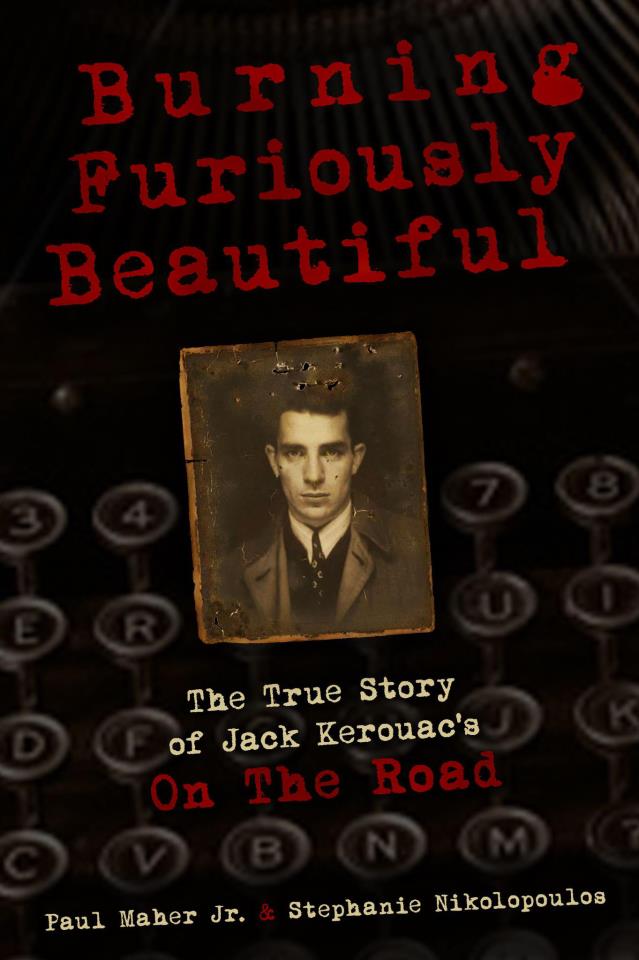
What is the working title of your book?  Burning Furiously Beautiful: The True Story of Jack Kerouac’s On the Road

Where did the idea come from for the book?  Paul Maher Jr. had written a book entitled Jack Kerouac’s American Journey: The Real-Life Odyssey of “On the Road” for the fiftieth anniversary of the publication of Kerouac’s seminal work.  I had read this book one summer and some months later began reading Paul’s blog.  We began talking and decided to revise and expand his book because we knew that a film adaptation of On the Road was coming out and we wanted to provide a resource for those interested in finding out more about this famous novel.  It was important to us that the book had a strong narrative, contextual information, and new research because we wanted both the teenager turned on from the film and the literary scholar who’s read every book by Kerouac to enjoy it and find value in it.

What genre does your book fall under?  It’s literary criticism and biography.

Which actors would you choose to play your characters in a movie rendition?  Isn’t that the million dollar question?  There’s been a lot of talk over the years about who should play Sal Paradise and Dean Moriarty in the film adaptation of On the Road.  Johnny Depp, Brad Pitt, Colin Farrell, Marlon Brando, you name it, they’ve been associated with it.  I almost never go to the movies and don’t really know the young actors of today well enough to say who would be age appropriate to cast.  Joseph Gordon-Levitt?  Zac Efron?  These actors are too old to play the roles now but if I were casting the film back when I first read On the Road as a teenager, this is who I’d pick:

  • Sal Paradise — Johnny Depp and Ethan Hawke would be excellent choices for Sal Paradise, particularly because they both have a deep appreciation for literature.  Depp is a known Kerouac fan and just started his own publishing imprint, and Hawke is a published author.
  • Dean Moriarty — Woody Harrelson would make a great Dean Moriarty.  He can play both earnest and wild so well!  Matthew McConaughey would be great as Dean too.
  • Carlo Marx — I loved James Franco’s portrayal of Allen Ginsberg in Howl, but if I had to select someone else I might go with Adam Goldberg.
  • Old Bull Lee — The choice of Viggo Mortensen as Old Bull Lee for the Walter Salles film is brilliant, but again if I had to choose someone else maybe I’d with Ewan McGregor.
  • Marylou — Drew Barrymore would be so much fun to watch as Marylou.  Do you remember her in Mad Love and Boys on the SideAlmost Famous hadn’t been made yet when I was a teenager but Kate Hudson (think Penny Lane) would be my runner-up pick.


What is the one-sentence synopsis of your book?  Burning Furiously Beautiful tells the true story of  Jack Kerouac travels on the road and how it took him years, not weeks, to write On the Road.

Will your book be self-published or represented by an agency?  We decided to self-publish Burning Furiously Beautiful.

How long did it take you to write the first draft of your manuscript?  The first draft, so to speak, had already been written and published as Jack Kerouac’s American Journey.

What other books would you compare this story to within your genre?  There have been so many biographies of Kerouac written over the years, and each offers its own perspective.  Burning Furiously Beautiful uses Kerouac’s journals and letters, as well as archival material from other people who knew Kerouac during the time he was on the road and writing On the Road, to tell a the specific story of the making of a novel that continues to generate interest today.

Who or What inspired you to write this book?  Obviously, Paul Maher Jr. inspired Burning Furiously Beautiful as it was his original idea.  I, however, had been researching and writing about Kerouac since I was an undergrad many years prior to this and brought my own knowledge and skills to the project.  I was very much inspired by the fact that the film adaptation is soon to be released here in the States.  There’s a whole new generation coming to Kerouac’s literature, which is immensely exciting to me.  Reading Kerouac when I was in high school opened up so many possibilities for me as a reader and writer.  I hope that the film will pique people’s interest so that they’ll go back and read Kerouac’s books for themselves—not just On the Road  but his other great works as well—and that they’ll watch Pull My Daisy, the film that Kerouac himself spontaneously narrated.  Burning Furiously Beautiful is important because it contextualizes On the Road and provides a fascinating look at Kerouac’s life and writing process.  This is critical because there’s so much myth surrounding Kerouac and the 1950s.  I became engrossed in odd little details like the fact that the Kerouac’s didn’t have a phone and took their calls at the store below their apartment in Queens.  It’s so different than today when it seems like every middle schooler has a cell phone.  If Cassady could’ve just called Kerouac up on his iphone, he might not have written the infamous Joan Anderson letter that spurred on Kerouac’s writing style.

What else about your book might pique the reader’s interest?  Burning Furiously Beautiful is a great book for an aspiring writer, regardless of whether or not you like Kerouac’s writing style.  It’s a portrait of a young writer and details how his writing voice developed (his first book has a much different style), what his writing routine was, the editing process (yes, there was one!), what his relationship with other writers and editors was like (imagine lots of parties), and the many false starts he had in writing his book.  We even talk about book signings, contracts, and press interviews.  Sometimes I’ve felt frustrated with various writing projects of mine, but realizing that Kerouac, who purported to have written On the Road in only three weeks, went through some of the same struggles and took years to find success makes me realize that it’s all part of the writing process.

I tag:

Emily Timbol

Nana Ekua Brew-Hammond

Larry Shallenberger 

Michael D. Bobo

Check them out!  They’re each really different from each other.

Judging On the Road by Its Covers

30 Jul

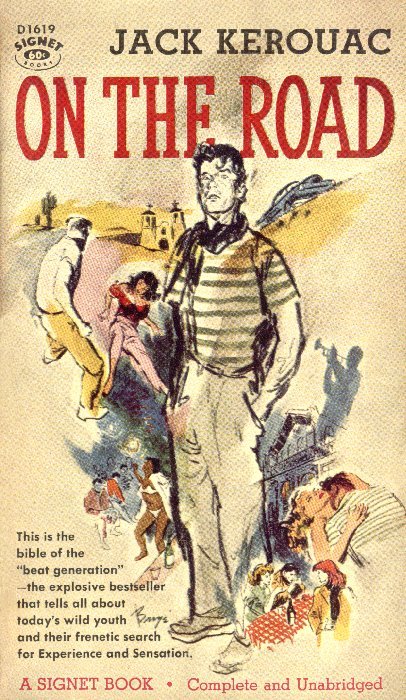
Okay, by now you’ve probably heard about the six year old who guesses what classic novels are about based on their covers, but I can’t resist rehashing her cute take on this early On the Road cover:


 “I think it’s about a car. A car that goes to Mexico, Indonesia and other places. It’s about a car that goes on all sorts of adventures. The guy on the cover is a teen, he likes to drive people places a lot. And he’s French.”

The cover she was looking at was the Signet 1958 edition.  I love that she guesses that the book is an adventure in many places and correctly guesses Mexico is one of them.

The fact that she guesses the main character is French is so perfect.  Of course, her guess is based on the drawing of a man in a Parisian-inspired striped shirt and scarf, which probably anyone would guess means the character is French.

Kerouac indeed was the son of French Canadian immigrants, but the kicker is that he’s usually thought of as either being very American or being anti-American.  In the 1960s, beatniks were depicted as wearing black turtlenecks and berets. In reality, Kerouac didn’t wear a costume of striped shirts or black turtlenecks.  If you look at most pictures of him, his clothes are nondescript.  He wore a lot of t-shirts and flannel and overcoats.

That’s why it’s so fascinating to look at the 1958 edition from a historical perspective on the evolution of Kerouac’s image.  As they’d do with any author, the publishing house tried to brand Kerouac.  In 1958, the striped shirt and scarf flung over his shoulder imparted a worldly, European air, meant to invoke a bohemian vibe.


The only other edition published before that was the Viking 1957 edition.  Of course, if you know about book publishing, you already know that Signet and Viking are both imprints of Penguin.  The difference between these two covers, though, is starting.  The cover of the first edition of On the Road, the Viking 1957 edition, was all black with a small rectangular abstract image in the center.  Bouncing text announced the title.  There was no image of a person or a car at all.  And yet the book sold so well that by the next year when the Signet edition came out, the cartoony line drawing cover featured the ringing endorsement “This is the bible of the ‘beat generation.’”

It should be noted that this Singet cover not only featured the Frenchman, but in the background there was a woman in a bikini and a couple making out.  Again, the publisher was trying to brand On the Road in a very specific way.  The third incarnation of the cover design for the US edition of On the Road came in 1965 when the extraneous people were deleted from the design and just the Frenchman was left standing on his lonesome, without even a car.  It lacked sex appeal, but someone must’ve liked it because two years later all the publisher did was switch from a cream colored background to a white background.  The following year, 1968, saw a cover design of a cartoony couple embracing in a car.  It marked a return to the sex theme.


Since then, the book has undergone many significant cover design changes, but what’s so interesting is that from the 1970s to the ‘90s the covers did not feature people at all.  They returned to the more metaphorical design of the first edition, featuring variations of the sun or a car.  It’s also worth noting that this was the time period in which Jack Kerouac fell out of popularity.

It wasn’t until Penguin released the 1991 paperback that the cover design included a people again.  And this is where it gets really interesting.  The romance angle is completely dropped and has not been seen in any US cover since the Signet 1968 edition.  Now, the focus becomes about friendship—a bromance, if you will—and cool hipsters hanging out in gritty New York.  The cover of the 1991 edition is a photograph of Jack Kerouac and Neal Cassady, the real life inspiration for the main characters of the novel.  The Penguin 1994 edition a collage of photos of Kerouac and his friends.  The US doesn’t see another woman on the cover until the Penguin 2011 amplified edition, which again embraces the photographic collage style.


Other covers published between the ‘70s and today tended to be text only, feature landscape (with or without a car), or a picture of the lone traveler.  They tend to be spectacularly uninspired and ugly.

In Germany and France, where the film version of On the Road has already been released in theatres, there are new editions with covers boasting the poster image for the film.  Will we be seeing a US edition with the actors’ faces instead of Kerouac’s on the cover?

Which cover inspires you to read On the Road?