
Kill Your Darlings, a film about a murder, isn’t the first film I’d personally think of for a cartoon treatment, but Randeep Katari created a cartoon image for it that’s actually pretty thought-provoking. You can view it here.
Tag Archives: visual art
Jonathan Collins’ Beat-Inspired Paintings on View at the Paterson Museum
2 Sep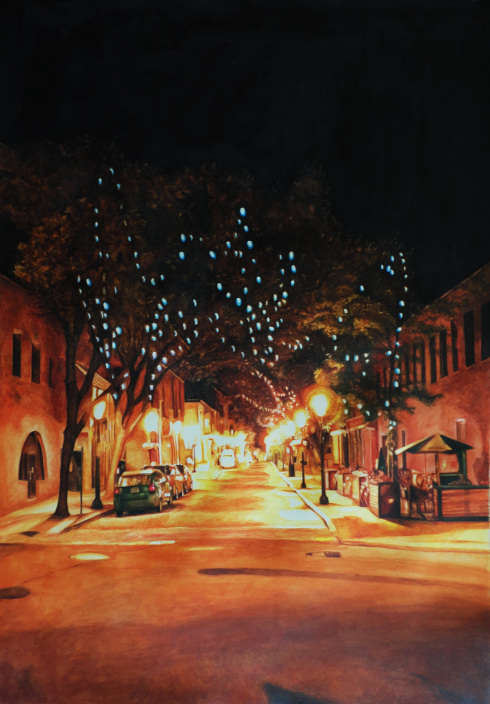
Remember a while back when I did an interview with painter Jonathan Collins, who created stunning works of art featuring Kerouac’s hometown of Lowell, Massachusetts? Well, starting this weekend, he has an exhibit up at the Paterson Museum!
Here’s the press release:::
The Paterson Museum is pleased to present “Beat Traveller: New Landscapes By Jonathan Collins.” This collection of works will be his first solo show at the Museum. The opening reception of Beat Traveller will be held the museum on Sept. 7 from 7 to 10 p.m. The exhibition will be on view through Oct. 6.
The works of Beat Generation novelist Jack Kerouac and poet and Paterson native, Allen Ginsberg, inspired the paintings. Collins journeyed to San Francisco, California, Lowell Massachusetts, and Paterson, New Jersey and returned depicting striking landscapes, glowing in bold sunlight, hazy sunsets, and moody night scenes.
According to Collins, “Both Ginsberg and Kerouac spawned from supposedly dreary mill towns, but I found each place to have areas of great natural beauty, vast historical interest, and even mystical qualities. Also, my father was from New England, my mother from Paterson, and they met at the foot of the Great Falls in 1951. Consequently these areas have great familial and artistic significance for me.”
Collins’ paintings are highly detailed watercolors that have won him numerous grants and scholarships, enabling extensive travel throughout the United States and Europe.
The Paterson Museum is located at 2 Market St. in the former erecting shop of the Rogers Locomotive Works in the heart of the Paterson Great Falls National Park. The Museum’s visiting hours are Tuesday to Friday from 10 a.m. to 4 p.m. and Saturday and Sunday from 12:30 to 4:30 p.m. For more information contact the Museum at (973) 321.1260 or thepatersonmuseum@gmail.com.
Check it out!
The Light and Life of Greek American Neon Artist Stephen Antonakos (1926–2013)
19 AugI learned via Gregory Pappas, founder of the Greek America Foundation, that artist Stephen Antonakos passed away this weekend. I had the great privilege of attending an exhibition of Antonakos’ neon sculptures at the Lori Bookstein Fine Art gallery here in New York City when the abstract artist was honored for the Gabby Awards Lifetime Achievement Award. You can read about that here. Antonakos attended the event, and I remember him being a quiet, humble artist. Yet his work speaks volumes.
Captivated by the neon lights of New York City, the Greek immigrant—Antonakos moved to the US when he was four years old—the artist began incorporating neon into his art in 1960. In an interview with Zoe Kosmidou, he explained the symbolism—or lack thereof—in his neon work:
My forms do not represent, symbolize, or refer to anything outside of themselves. Such specific correspondences would limit the work’s meaning, whereas pure abstraction, liberated from any external references, is capable of saying so much more. My neons relate formally to architecture and space, but they do not represent anything outside themselves.
Even so, raised in the Greek Orthodox Church, the artist’s work did have spiritual subtext. He created crosses and “chapels.”
Earlier, in the mid 1950s, Antonakos was creating collages. In a 2007 interview with Phong Bui for The Brooklyn Rail, Antonakos said:
And since oil painting was too slow for me to keep up with all of the ideas that were racing through my mind, I felt the physical and spontaneous process of putting various objects together was more suitable to what I needed to get done in those years.
His desire to work fast, engage in a spontaneous process, and collage disparate found objects together resonates with the postmodern aesthetic. We hear the same vision in the works of the abstract expressionist painters and the Beat Generation writers. Antonakos revealed that although he admired the work of the abstract expressionists, he felt he could “get more out of” the Italian artists Alberto Burri and Lucio Fontana.
Antonakos went on to have more than 100 solo shows around the work.
For artists of any discipline, one of the great takeaways from Antonakos’ life is that one can have a day job and still be an artist as long as one perseveres. Antonakos worked as a pharmaceutical illustrator during the day and then would work in his studio until 2 in the morning.
Here are a couple of links to celebrate the life and work of this inspired artist:
- Proscenium by Stephen Antonakos by Marjorie Welish in BOMB
- Oral history interview from 1975 with Paul Cummings on the Archives of American Art
- In conversation with Phong Bui in the Brooklyn Rail
- ART TOPOS
- The architecture of light and space, an interview with Zoe Kosmidou
Clip: One Subject Many Ways: The Sunflower
6 Aug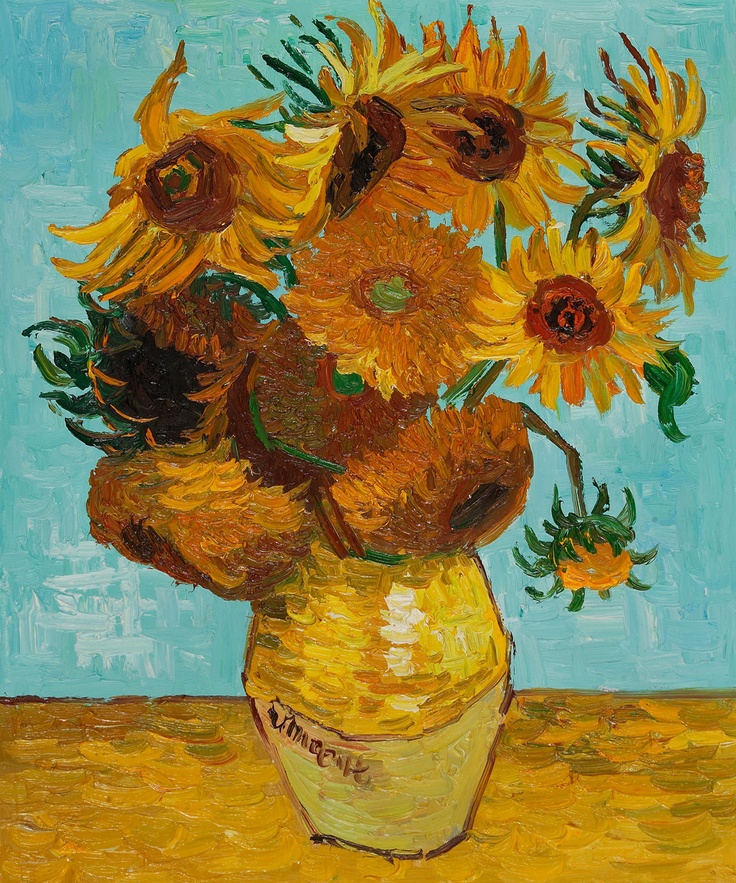
I’m currently enjoying art critic Martin Gayford‘s The Yellow House: Van Gogh, Gauguin, and Nine Turbulent Weeks in Arles. Published in 2009 by Hachette, the well-researched book tells the story of how the artists ended up living in a house together in the south of France and how their time together influenced their work. It’s a great read for anyone interested in artists’ collaborations.
Both Vincent van Gogh and Paul Gauguin painted sunflowers, but today we remember van Gogh’s still lifes better. It got me thinking about how even though van Gogh’s name seems synonymous with sunflowers, so many other artists throughout history have also painted this captivating flower.
Read more and see painting selections at Burnside Writers Collective.

Clip: New Abstraction News
24 Jul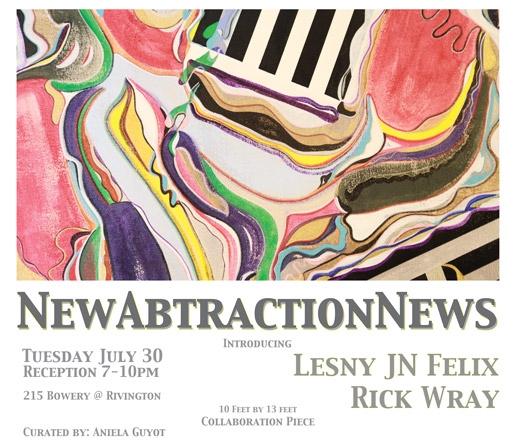
Back in 2008, I had the fun experience of doing PR for Lesny JN Felix‘s art exhibit at Gallery Bar down on the Lower East Side. I got to see his paintings, wrote up his press release, and helped him with set up for the opening reception. We also attended other artists’ shows and had a lot of conversations about the art world. I was thrilled when he asked me to write the catalog copy for his upcoming new exhibition.
Painter Lesny JN Felix is starting his own one-person school of art: the New Abstraction News. The Haitian’s show Instant Identification will debut at the Lower East Side’s pop-up gallery 215 Bowery (215 Bowery St., Manhattan) on Tuesday, July 30, 2013, with a free opening reception from 7 to 10 p.m. There will be one hour of hands-on silkscreen making.
The exhibition includes a collaborative painting with artist Rick Wray that emphasizes JN Felix’s unique New Abstraction News style and, in contrast with Wray’s style, explores the diversity found within abstract art. Fans and collectors will have the opportunity to meet both artists.
Since JN Felix’s last major show in New York, his work has matured into more complex abstractions. Read more here.
In the catalog copy itself, I explore how JN Felix works in a similar method as Jack Kerouac and how he is different than the abstract expressionists of the 1940s and ’50s. You can pick up a copy of the catalog at the show. Hope to see you there! It’s going to be a lot of fun!
Clip: A Time to Embrace … Or Not
19 JulForgot to mention that Burnside published two of my art posts:
A Time to Refrain from Embracing
In case you missed them:
A Time to Plant and a Time to Uproot
Clip: One Object Many Ways: The Rose
1 Jul
Kalo mina! It’s no longer national rose month, but hey, you can still enjoy my post on how different artists have interpreted the rose.
The one about is by Piet Mondrian — the guy known for neo-plasticism, you know: white background with a grid occasionally colored in with primary colors.
You might also enjoy my other posts on roses:
Chloris and the Greek Myth of the Rose
Mighty Aphrodite: Korres Wild Rose + Vitamin C Advanced Brightening Sleeping Facial
Clip: A Time to Dance
22 MayThe latest in my Ecclesiastical “A Time to…” series posted on Burnside.
Clip: A Time to Mourn
8 MayBurnside published my visual art take on the verse “a time to mourn.” You can see it here.
Yiasou!
Stephanie Nikolopoulos is a writer, editor, writing teacher, and speaker based in New York City.

She is the coauthor, with Paul Maher Jr., of "Burning Furiously Beautiful: The True Story of Jack Kerouac's 'On the Road.'"
You can email her at stephanie_701 {@} yahoo.com

 Stephanie Nikolopoulos