Archive | Greekish RSS feed for this section

Memorial Day: Kerouac in the Merchant Marines

28 May

Picture via Across an Underwood / Sketches on Kerouac

Jack Kerouac was in the Merchant Marines during World War II. You can read about his time on the S.S. Dorchester, which ultimately was torpedoed, here.

Kerouac made it out alive, but two of his Greek American friends from Lowell did not: Johnny Koumentzelis and Sebastian Sampas.

Today we remember all of those who selflessly gave of themselves to make our world a better place, and we think of the many families who lost loved ones.

Chloris and the Greek Myth of the Rose

21 May


The Greek myth of the rose is one of my favorites.

Chloris, the goddess of the flowers, was in the forest one day when she tripped over a beautiful nymph lying lifeless.  Chloris was so overcome by the nymph’s fate that she reached out to the other gods to transform her into a flower.

Aphrodite gave her beauty.

Dionysus, the god of wine, gave her nectar for a sweet-smelling fragrance.

The three Graces—the Charites known as Thalia, Euphrosyne, and Aglaea—gave her charm, joy, and brilliance or splendor.

Roses from My Father

17 May

When I was a little girl, my father used to surprise me with roses.  Most of the gardening my father did was of a practical nature: cucumber and tomato plants, the occasional “karpouzi” (watermelon) if the raccoons didn’t get to it first (they always got to it first).  He had grown up on a farm in Greece, and gardening was not a hobby so much as a way of life and a means toward putting food on the table.  There were very few flowers in our garden in New Jersey.

In our backyard, there was a tattered fence that separated our yard from a little brook.  It was here that he planted roses.  In the spring, the thorny bushes climbed up the fence in a tangled mess.  Then one summer morning, while I was still asleep, they bloomed pink, yellow, white, and red, opening their petals up to the blue, blue sky.  My father would cut these beautiful roses and present them to me.  He told me I was a delicate flower.

I’ve been swirling in these memories of my father out in the garden, as I’ve been writing my memoir.

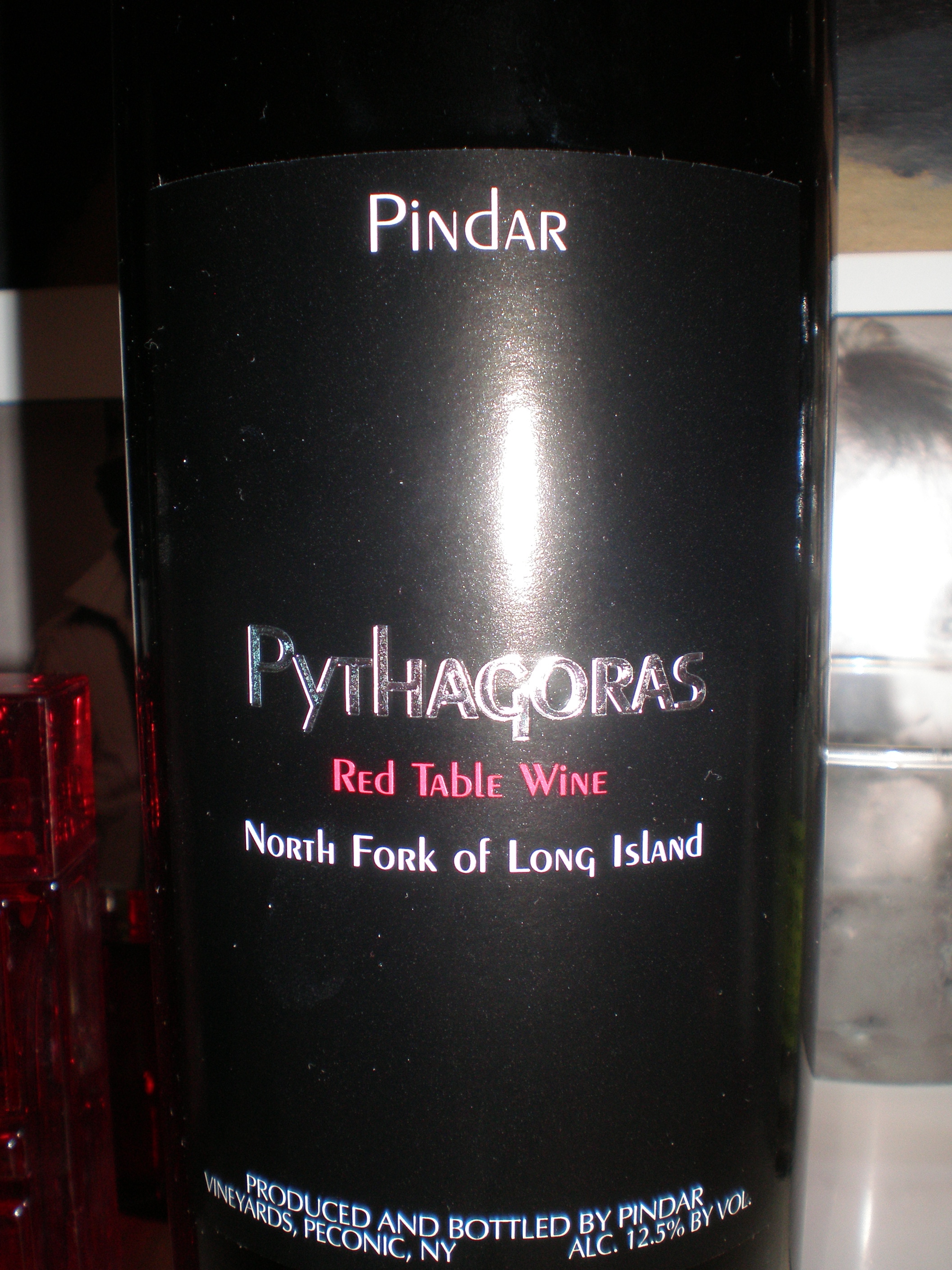
Tasty Tuesday: Pindar Pythagoras Wine, Greek American Wine from Long Island

15 May


Since my thesis was due on a Monday, there wasn’t much opportunity for celebrating.  Instead, I went home after a normal day of work, ate leftover spaghetti and opened a bottle of wine I’d been saving.

Last summer I had gone wine tasting at a couple vineyards on Long Island and picked up a bottle from Pindar Vineyards.  I’d been saving it for a special occasion and thesis submission seemed as good as time as any to crack it open.

The bottle I had picked up surprisingly wasn’t one that I had sampled at the vineyards so I didn’t know what to expect.  I picked it out for its name, Pythagoras.

Pythagoras (ca. 570 BC – 495 BC) was a Greek philosopher and mathematician from Samos, an island in the eastern Aegean Sea.  He later moved out of Greece an into Calabria, in southern Italy, where he lived in a Greek colony called Croton, by the Ionian Sea.  He is, of course, the founder of the Pythagorean theorem.   He set up a school in which music, sports, and diet were important elements.  This would go on to influence Plato.  There’s also a religion associated with Pythagoras, who believed in reincarnation.

The Pythagoras Pindar wine is a Greek wine, but not in the traditional sense.  It is not made in Greece but rather by Greek Americans on the North Fork on Long Island, New York.  Pindar Vineyards was founded by Dr. Herodotus “Dan” Damianos, who was born in New York City’s Hell’s Kitchen.  He began buying farmland in Peconic, North Fork, Long Island, in 1979, and started planting grapes the following year.  Today, seventeen different varieties of grapes grow on Pindar Vineyard’s 500 acres.

One of the special aspects of Pindar Vineyards is its commitment to environmental stewardship.  The vineyard practices sustainable agriculture.  You can read about its green initiative on its website.  It’s really quite impressive.

Dr. Dan drew his inspiration for winemaking from the Robert Louis Stevenson quote “wine is like poetry.”  It seems fitting that I should enjoy a wine inspired by literature as a celebration to turning in my thesis.

The Pindar Pythagoras is a red table wine.  It is light with a deliciously spicy bite.  While some reds coat your tongue with sinewy grapes, the Pythagoras has more of a white wine texture.  Delicate and effortless, it’s a good summer red.  Its buoyancy does not mean it’s watery though.  It’s flavorful, with a bit of a kick to it.

Here’s how Pindar describes the Pindar Pythagoras:

This special red was first crafted to celebrate our 20th anniversary. It has the round and full characteristics of Merlot with the slight herbaceousness of Cabernets. This award-winning blend has been named “Best US Red Blend” by the Beverage Testing Institute in Chicago and “Best Red Vinifera” in Vineyard & Winery Management’s “Best of the East” competition. Sure to please a wide range of palates.

It’s a good wine to round out a pasta dish with olives in it or some sinfully dark chocolate.

If you’re here in New York, you can purchase it online, but why not take a day trip to Long Island?  You can rent a car or take the Hampton Jitney bus.  It’s a great getaway from Manhattan.

Mighty Aphrodite: Korres Wild Rose + Vitamin C Advanced Brightening Sleeping Facial

10 May

I’m in love with all the flowers that are blooming around the city right now.  Seeing delicate flowers push out of the ground and bloom in spite of in this concrete jungle inspires me.  It shows that even here in New York City, where you have to push for a spot on the subway and climb five flights of stairs to your overpriced, walk-up apartment, you can be tough and beautiful.  It’s like wearing a flower-print dress and a leather jacket.  Or like dark chocolate with rose hips.  It’s like having a fancy picnic in the shadow of skyscrapers in Central Park.  It’s like a wild rose.

Writing and editing around the clock, I haven’t exactly been getting a lot of sleep lately.   That’s the plight of a modern New York woman, though, isn’t it?  Sacrificing sleep to follow one’s passion.  I’m finally stepping out from behind my computer screen, to give a reading, though, and I don’t want to actually look like I’ve been burning the midnight oil.  I want to look picture-ready for my reading and graduation.  This is a time to celebrate!

I was so excited to discover Korres Wild Rose + Vitamin C Advanced Brightening Sleeping Facial.  It uses wild rose oil to give a natural, healthy glow to skin.  It’s facial in a jar!  That means saving the time of actually going to the dermatologist or beautician to get a facial.  Just put it on before you go to sleep and wake up the next morning moisturized and radiant.  When Korres offered to send me the Wild Rose + Vitamin C Advanced Brightening Sleeping Facial, I was so happy because they’re one of my favorite Greek beauty companies.  Founded out of Athens’ oldest homeopathic pharmacies, Korres creates products that are natural and certified organic.  The Wild Rose + Vitamin C Advanced Brightening Sleeping Facial doesn’t contain parabens, synthetic dye, or animal by-products and is not tested on animals.  Korres’ Greek homeopathic roots and the company’s commitment to both beauty and environmentalism make Korres Wild Rose + Vitamin C Advanced Brightening Sleeping Facial is indulgence one can feel good about!

After a long day of editing, a dinner meeting, and attending a reading, I was more than ready for bed by the time I got home the other night.  I felt so indulgent as I applied The Wild Rose + Vitamin C Advanced Brightening Sleeping Facial for the first time.  It smelled heavenly.  The facial is made with a fragrance, but it doesn’t smell overwhelmingly of rose.  More so, it has the intoxicating fragrance of beauty and sophistication.  It’s a bit powdery and old-fashioned, a luxurious aroma that drifted me off to sweet dreams.  Even though I have sensitive skin, the perfume did not irritate my skin.  Wild rose extract (Rose canina) is a natural source of Vitamin C, and so it actually soothes skin.

The Korres sleeping facial is made from a traditional recipe of Vitamin E, soybean oil, rosemary leaf extract, rose hip oil, and jojoba oil.  A clinical study showed that 100% of subjects who used Korres Wild Rose + Vitamin C Advanced Brightening Sleeping Facial had “improvements in skin’s moisture levels and texture” and “visible reduction in appearance of expression lines.”  Meanwhile, 84% saw “improved skin radiance” and 78% “had visibly improved skin smoothness.”  If you ever read the fine print of beauty and skincare products, you know that those are pretty astounding statistics.

In Greek mythology, roses were actually white until the goddess Aphrodite was pricked by a rose when she was hurrying to save her protege, Adonis, and her blood stained the white rose petals red.  Women have been rushing about since ancient times.  Hey, we’ve got proteges to look after!  But sometimes we need to slow down, indulge in an impromptu picnic in the park, and take care of ourselves.

Tasty Tuesday: FAGE Yogurt Topped with Fresh Strawberries and Bananas

8 May


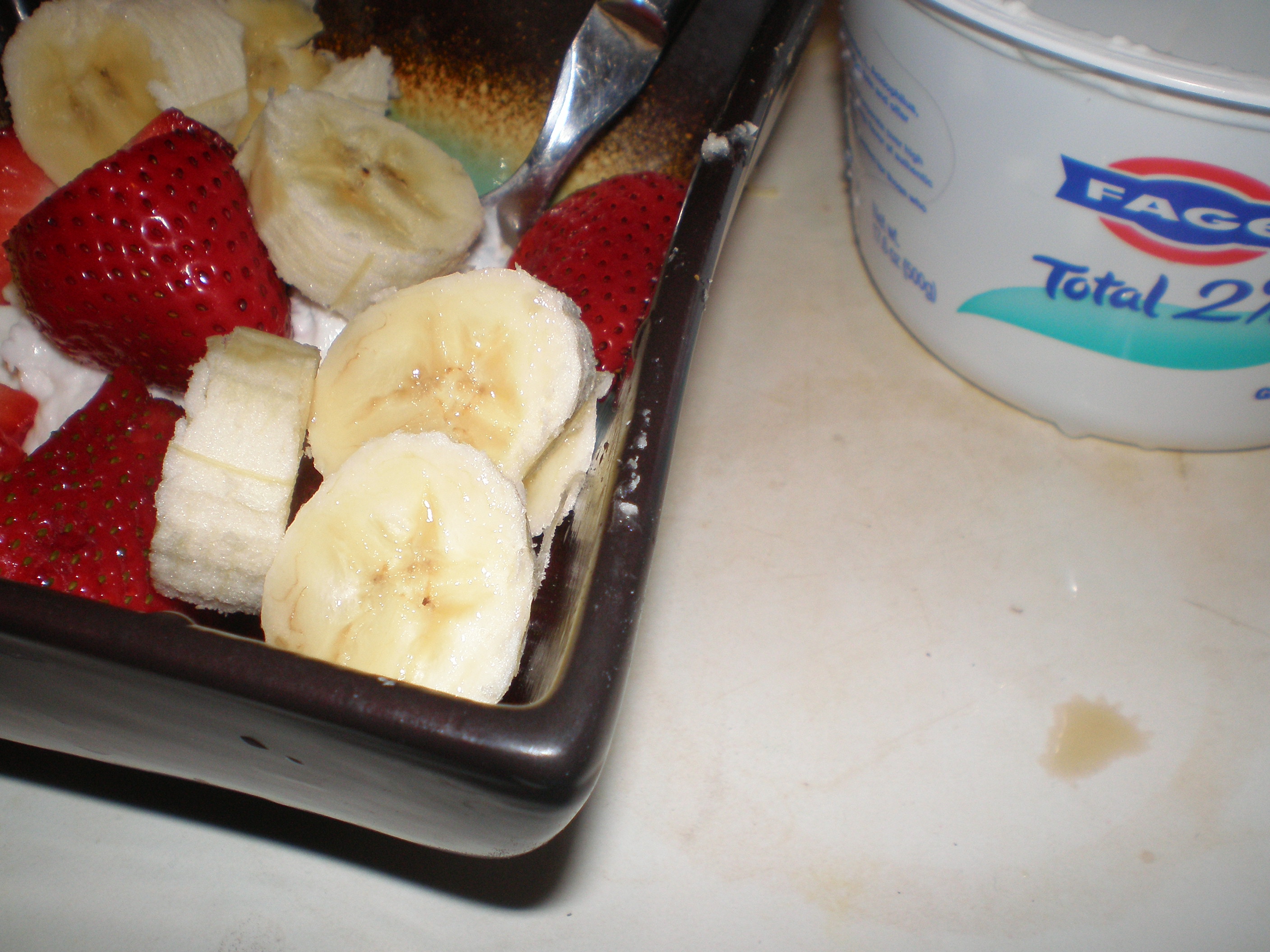
Now that spring is here I found strawberries at a good price!  I chopped them up along with a banana and sprinkled them over FAGE Greek yogurt.  So delicious!

I’m not really a morning person so I need a breakfast that is quick and easy to make.  This does the trick!  I love FAGE Greek yogurt.  I’ve tried switching it out for less expensive yogurts, but then I never want to actually eat the yogurt.  FAGE yogurt is just so much creamier.  It’s almost as indulgent as ice cream.  Almost.  The strawberries were a fun touch.  I hardly ever buy berries because they’re so expensive, but berries are so healthy and delicious.  My favorites are raspberries and blackberries, but they weren’t on sale.

I know that FAGE makes yogurt with a side of strawberry, strawberry gogi, and raspberry, but I’m not into the jelly-like consistency.  I much prefer the fresh fruit.  That said, FAGE is committed to making healthy foods.  The Philippou family motto in 1926 was “We would never make a product that we would not give to our children.”  The ingredients are 100% natural.  I just happen to prefer fresh fruit.

Yogurt and fruit are such a part of Greek culture.  I remember when I was a child, my father always had to have plain yogurt.  He ate it plain too.  The fruit came afterward and was eaten by itself.  I like to jazz it up.  I like fruit and yogurt together.  I guess that  makes me very American.

A Tree Flowers in Queens

3 May


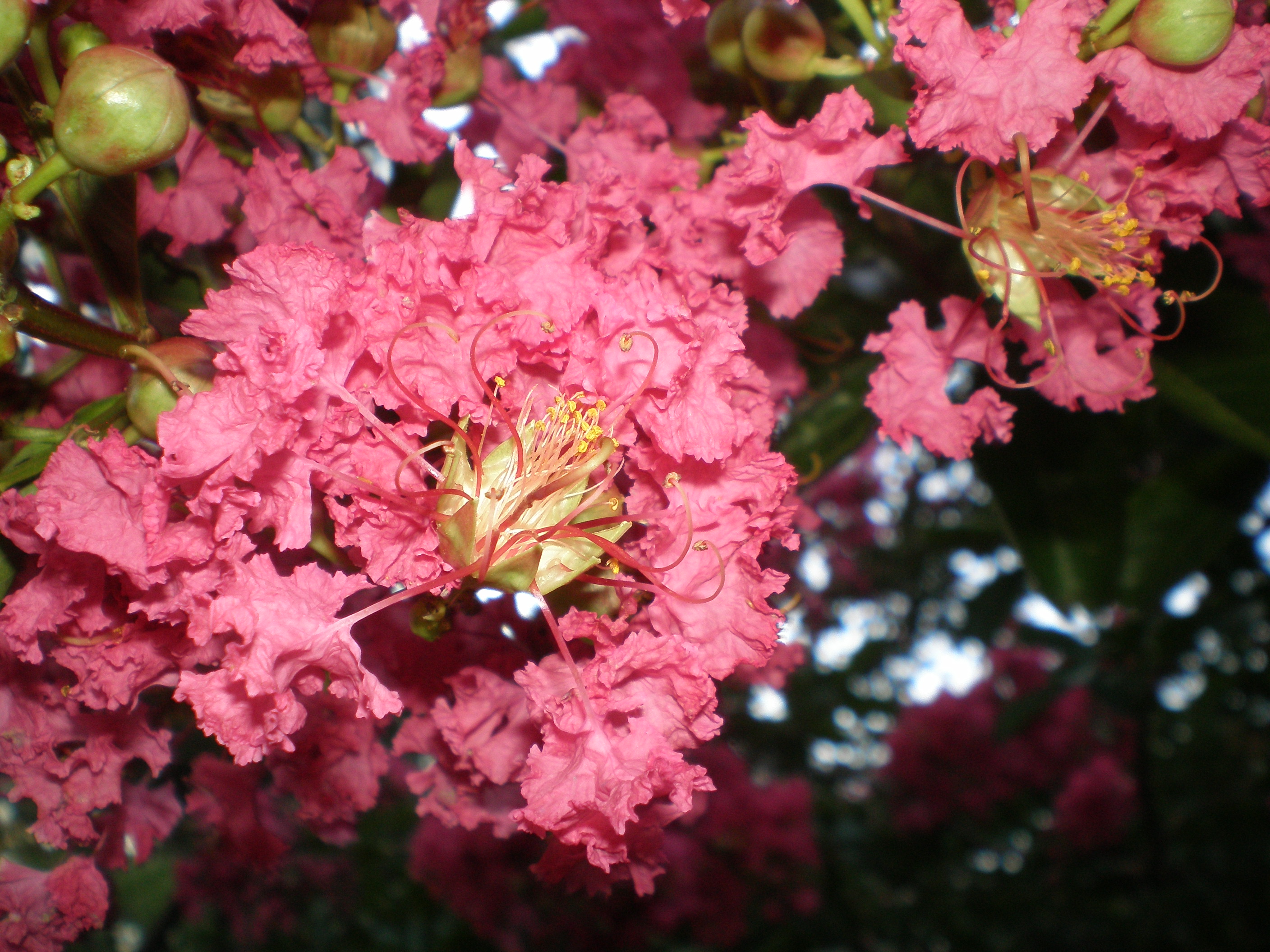
I got off the subway in Astoria, and this is the image that greeted me.  I just had to stop and take a photograph.  I love the delicacy of the pink petals against the steel of the subway ramp, the art in nature and graffiti, the way the tree reaches out to the blue sky, persevering.  We must bloom where we are planted.

Astoria is a neighborhood in Queens, New York, that in the 70s had the largest Greek population outside of Greece itself.

Lunch-Break Rendezvous to Celebrate the Feast of the Flowers

1 May


Let’s all ditch work today and celebrate the Feast of the Flowers!  …Okay, okay, I’ll behave.  I’ll take a nice long walk through the park during my lunch break for Protomayia (May 1).  Now that the weather’s warming up, I use my lunch break to get a little sun on my face, stretch my legs, and admire the beauty of the every day.  I used to feel guilty about leaving my desk for lunch.  I thought I should just power through and get work done.  But I’ve found that actually taking my lunch break energizes me.  I come back feeling so refreshed and ready to tackle projects with a clear mind.  Maybe today for the Feast of the Flowers I’ll buy some fresh flowers for my desk while I’m out!

Greeks celebrate May 1 (also known as May Day, Labor Day, and Protomayia) with the enchanting Feast of the Flowers.  Revelers flee to the countryside on this national labor holiday to herald spring.  By May 1, most of the Greek islands are warm with gentle breezes and the mainland can even get hot.  It’s a marvelous day of picnicking and flying kites and enjoying nature.  People spend the day collecting flowers and turning them into wreathes.  There are even several flower festivals throughout Greece.  Isn’t the Feast of the Flowers the loveliest of holidays?

Memoir Outtake: Albanian Greeks at the Greek Consulate

16 Apr

All the endangered language research I’ve been doing seeped its way into the rough draft of my memoir.  Below is a scene in which I encounter two darker-skinned boys at the Greek Consulate in New York City.  From the looks of them, I gather that they must be Albanians.  As I’m dealing with my own language issues at the Consulate, I begin to think about theirs.  This section turned out to be too Wikipedia-ish in comparison to the lighter, humorous tone of that chapter in my memoir, so I was advised to take it out.  Still, I found the subject matter fascinating, and so I’m posting it here as an outtake.

Two dark-skinned boys in their teens or twenties—it was hard to tell—filled out paperwork at the long table.  They wore motorcycle-style jackets that made them look tough but in more of a poor than badass look.  I wondered if they were perhaps Albanian refugees.  Cham Albanians began migrating to Greece during the Middle Ages.  They speak the Cham Albanian language, a type of Tosk Albanian that was the language of the most well-known bejtexhinj, Muhamet Kyçyku, first poet of the Albanian National Renaissance.  Bejtexhinj is the oftentimes religious poetry written in Albanian with Arabic alphabet and Persian, Turkish, and Arabic words, that began in the eighteenth-century to rebel against the influence of the Ottoman Empire.  During that time and also in the early twentieth century, Albanians known as  Arvanites came to Greece as well.  The Tosk Albanian dialect they speak, known as Arvanitika, is now an endangered language, as they assimilate into Greek culture.  Though sometimes Arvanitika is used interchangeably, the Orthodox Albanians who in the 1920s came to northeastern Greece, namely to the areas of Western Thrace and Greek Macedonia, are called Shqiptars.  They speak the Northern Tosk Albanian.  Although many Arvanitika fought against the Ottomans in the Greek War for Independence from 1821 to 1832, by World War II the Cham Albanians had sided with Italy and Germany and had to flee from Greece to Albania, Turkey, and the United States.  After the fall of Communism in 1991, another group of Albanians came over to Greece to escape economic depravity.  Today, most Albanians living in Greece self-identify as Greek; they have converted to Greek Orthodox Christianity and speak the Greek language.  Now, listening in on the two boys consulting each other for their paperwork, I couldn’t tell whether they spoke an Albanian dialect or Greek.

Clip: Light of the World

13 Apr

I expanded a post that started out here on this blog, and it’s up on Burnside now!  It’s about the first Greek Easter I spent in New York….


I think there’s probably a law against carrying an open flame in the subway.  I’m not sure.  But it’s a pretty safe bet.  This turns Easter in New York City into a midnight marathon.