God Has a Sense of Humor — Either That or Everything I Think I Know about Myself Is Wrong

10 Aug


My mother always told me God has a sense of humor.  I believe her.

Growing up, I was terribly shy.  Perhaps because I felt so uncomfortable speaking, I turned to writing.  There, in the safety of my Hello Kitty journal, I could express my innermost fears, my hurts, and also my dreams and loves and cherished memories.

As I grew up, I continued to write.  I wrote for my high school newspaper and became copywriter for my high school yearbook, and when I went off to college I submitted poetry to my college’s paper.  While still an undergrad, I worked my way up from staff writer to editor in chief of a local indie newspaper and also began interviewing musicians for national magazines.  After college, I entered the world of book publishing, where to this day I blissfully sit in silence, getting paid to read for a living.  It’s the perfect job for an introvert.

Although I love editing and working with other authors and editors and designers, I always dreamed of writing my own book, so I’ve continued to work on my own writing.  My weekends are spent at the library or in the bookstore, crafting sentences.  I try to pour my heart out with the same abandon as I did when I was writing in the privacy of my little journal with the lock on it when I was a child, except now I’m working toward having people actually read my work.  I revise, I get feedback, I pitch, I query.  –And I get silence.  It feels like I rarely hear back from acquiring editors.  Writing is what I’m supposed to be good at.  It’s what I’ve always been told I’m good at.  And yet I have a hard time placing my writing in publications.

Instead, the skill I grew up thinking was my weakest is the one being called into action.  I don’t go out trying to book readings, but time and time again, I’m called upon to give readings and to teach.  It’s public speaking in all its knee-shaking glory.

I’m immensely thankful for these opportunities, and they’ve all gone pleasantly well, but I have to laugh that I seem to get more speaking engagements than publishing credits.

* * *

As I was writing this very post a few days ago, I got a message from poet and musician RA Araya asking me to read a poem in Greek at Sunday’s reading.  Talk about irony!  The memoir I’ve been writing deals with my conflicted Greek identity and the fact that I don’t speak Greek.  Now, as I was writing about laughing over the fact that I’m having to overcome my introverted tendencies to give readings, I’m asked to read in the very language I don’t speak.

But you know what?  I said yes.

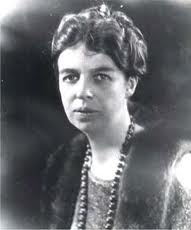
Maybe I’ll crash and burn and make a fool of myself, but at least I’ll have tried.  Eleanor Roosevelt once said:

Do one thing every day that scares you.

Life is too short to be scared of anything.  Living means growing, and the best way to grow it to try new things.  Challenging yourself can lead to rewards.  I believe people surprise themselves and rise to occasions.  I’ve also learned that people want you to succeed and that literary crowds tends to be rather supportive.

I’m actually excited about this opportunity.  It’s a great way to promote the beauty of the Greek language and culture during Greece’s economic crisis, and I’m thinking I may read something in an archaic Greek dialect (I studied Classical Greek at Pomona College), a dead language, to further bring awareness to endangered languages.

If you’re in New York, stop by.  I can’t promise perfection, but we will have fun!!  Here’s the info:::

August 12, 2012.  5:00-9:00pm.  The Sidewalk Cafe (94 Avenue A).  New York, NY.  Stephanie will be reading from Burning Furiously Beautiful: The True Story of Jack Kerouac’s On the Road, as part of RA’s Music Poetry Jam Celebration.  flashbackpuppy, Patricia Spears Jones, Sparrow, Puma Perl, Kate Levin, Sarah Sarai, Foamola, Virdell Williams, and Steve will also be taking the stage.  Free, but there’s a one-drink minimum.

Now… what to wear?


Also!  Save the date::: September 3 I’m giving a reading that I’m beyond excited about.  Details to come soon.


Do you ever find that the very skill you least like using or think is your weakest is the one you need to rely on the most?  What do you think of Eleanor Roosevelt’s advice to push yourself to do the things that scare you?

Photographs from the Olympics in Greece

9 Aug


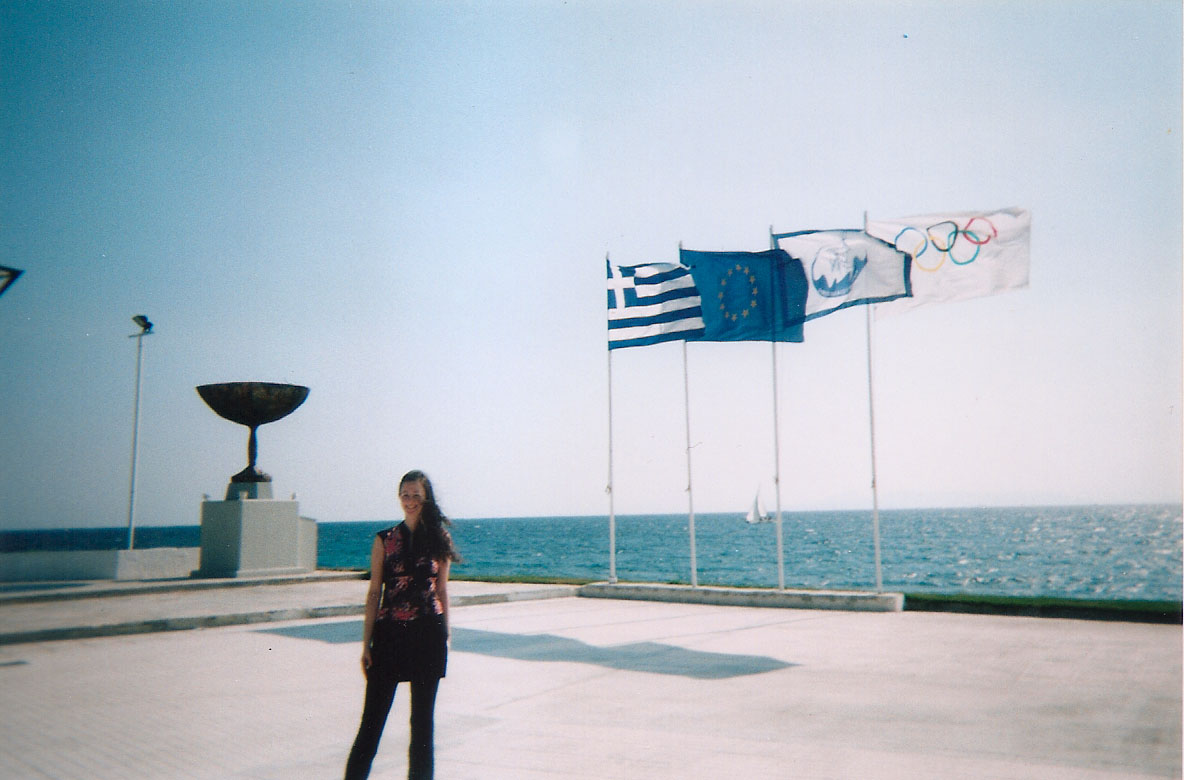
I couldn’t pass up going to the Olympics when they were held in Athens in 2004.  At last, the Olympic Games were back where they began!  The men’s and women’s shot put tournament were even held in Olympia, the original site of the Olympics.  The rest of the games were in Athens, which had been completely revamped and upgraded with insanely gorgeous stadiums.  Unfortunately, because of the slow rate of construction there was a lot of fuss in the media about whether the Greeks could get it done in time.  The condescending attitude seemed kind of ironic, considering the Greeks invented the tradition of the Olympics and preserved the ancient site.  Between that and it being the first Olympics since 9/11, there weren’t as many people there as expected.  It was too bad because the Olympic Village that they created especially for the 2004 Athens Olympics was one of the most gorgeous modern venues I’ve ever had the experience of being in.  My friend and I got great seats to our chosen event — men’s swimming 😉


Have you ever been to the Olympics?  Which sports would you most want to watch in person?


Exclusive Interview with J. Haeske, Author of Retracing Jack Kerouac

7 Aug

Jack Kerouac is the type of author who inspires pilgrimages. People don’t just read his novels. They endeavor to live his novels. And because much of Kerouac’s work is based on actual places, it’s easy for fans to track down not just his birth home and the bars he wrote in but the very places he describes in his books. J. Haeske did just that. He traveled around the country, visiting places that Kerouac visited, photographing places Kerouac described with words. He records these literary landmarks on his blog, Retracing Jack Kerouac. Each blog entry offers a photograph and some background information to situate the reader. Haeske is currently writing a book based on the material from the blog, entitled Anywhere Road.  Below is my exclusive interview with Haeske, which is interesting for those who are fans of the Beat Generation writers, those with wanderlust, and writers interested in going from blog to book.


Photo via J. Haeske


How did you first become interested in Jack Kerouac?

I believe it was a friend recommending On the Road (what else?) to me about 20 years ago. The main attraction in the beginning I suppose was the description of travel and seeing the US, its landscapes, cities and people, that made the book so fascinating to me. I come from Europe, so an US road trip is appealing as it is so different landscape- and place-wise from what we are used to over here, and of course all the films, songs and books you see, hear and read. The notion of traveling somewhat apart from the usual tourist routes and in a unsual kind of way as portrayed in the book held a special appeal to me, as I guess it held and still holds to most people that care about the book.

What made you decide to physically go on the road and retrace Kerouac’s steps?

As I said in the previous question, a road trip through the US seemed a fascinating idea for a long time, but it took me until 2009 (you know how life is) to decide to finally undertake the trip. The catalyst was actually the record One Fast Move Or I’m Gone (as part of the DVD/CD project by the same name from Kerouac Films) by Jay Farrar and Benjamin Gibbard. When I first listened to the song “California Zephyr,” describing the train journey from New York to San Francisco, it clicked. I knew that the time was ripe to do it, and I set about planning the trip I did take in October of 2010. So you could say it was 20+ years in the making. I also knew that I had to do something a bit more with the photos I would be taking then just load them up onto Flickr, so I came up with the idea of the blog and book. I also like to see both as my own small contribution to work related to Kerouac, as I haven’t had the chance to gather and add any new and first-hand information to all the information about his life that are out there already (and still appearing in books such as yours).

You began your first trip in 2010.  Where did you go, and how long were you on the road for?

I only had 3 weeks for that trip, so I had to leave out a lot of places I ideally would have liked to visit. My first stop was San Francisco and I planned on checking out places I was aware of at that point, such as North Beach, 29 Russell Street and the old Six Gallery. Fortunately I went to the City Lights bookstore on my first day and discovered Bill Morgan’s invaluable guides The Beat Generation in San Francisco and The Beat Generation in New York, so I got to know of many more locations in both cities (not to mention the fantastic time I had in that magic place; it felt overwhelming to sit upstairs in the poetry room reading for a few hours). From San Francisco I took the California Zephyr train to Denver, where I spent a few days, mostly wandering up and down Market, Larimer and Wazee streets in what is now called LoDo. From all I read and saw, I have to say that the area looks much different than what it must have looked like in the 1940s and ’50s, so I didn’t find any of the pool halls and bars Kerouac wrote about in books such as Visions of Cody. Fortunately Union Station apparently looks pretty much the same as the time Kerouac dropped off his mum there when she got on the train back east after his failed 1949 attempt to make a home for them in Denver. I then took another Zephyr train to Omaha, a city which didn’t actually play a big part in Kerouac’s life and is only mentioned a few times in his books, but I went there anyway and found it to be very much (with my limited experience) a typical Midwest city, so it was definitely worth going there. Due to time constraints I took a plane (rather then a train) from Omaha over to Boston and from there a commuter train to Jack’s hometown Lowell, where I also spent a few days. I probably should have stayed longer, and I also wasn’t aware then of quite a few houses he lived in, so another visit to Lowell in the future is due. From Lowell I took another train down to New York where I, again with Bill Morgan’s books’ help, checked out and photographed some more places, such as the area around the Columbia University campus.

Since then, how many other trips have you taken to retrace Kerouac’s travels?

I only undertook one other trip so far, to New York, in March of this year. Although that was a rather short trip, it proved to be very worthwhile, as I got to go to Northport were he spent a number of years in the late 1950s/early 1960s, as usual living with his mum. Compared to the early 1940s he was by that time home much more often and mainly went into New York for business meetings or to go on parties. I found Northport to be very charming and a lovely place, no wonder they stayed there for that long. This being Kerouac, he was of course always planning on moving to various other places, such as cabins in upstate New York or closer to his hometown Lowell, and Florida, where they moved to eventually, after another brief stay in Lowell, when he was married to Stella Sampas.

But there are still quite a few more places I will have to check out at some point: the house he lived in for 3 months in 1949 in Denver and Central City for example, all the places in Florida and North Carolina he and his family lived in, as well the area around San Francisco, such as Bixby Canyon and Marin County and a few others.

How do you think traveling cross country has changed from Kerouac’s time in the 1940s and ’50s to the present day?

Of course most people travel by plane nowadays, which is a shame in my opinion and that’s why I prefer to take trains, simply because it allows you to “read the landscape” as Kerouac loved to do himself. I do not think that it really is a good idea to sleep on the hood of your car in the middle of Mexico nowadays, as Sal, Cody and Marylou did in On the Road. I guess hitchhiking is much more cumbersome nowadays, and I’m not even sure if riding freight trains is even possible anymore nowadays with all the security measures and stuff, but Kerouac has been complaining about this as early as the 1950s.

What did you learn about travel from Kerouac?

I have to admit that my method of traveling is rather boring compared to the trips described in On the Road: no long drives from North Carolina to New York in one go with a wild gang and all that. That said, I will be trying out riding a Greyhound bus on my next US trip, just to find out what that is like, although I can’t imagine I will be enyoing that very much. I also try to be more open-minded when traveling, (I am a bit of a control-freak and tend to plan my travels rather thoroughly). And I try to speak to people I meet more nowadays, which is a something of a challenge for me, as I am rather shy and introverted – so I guess you could say the last two things I mentioned are what Kerouac has told me about travel. Perhaps most importantly though is the urge to actually want to go and see the world as much as I can. Kerouac definitely infected me with the travel bug. I also have to add that the aspect of “reading the landscape” and getting to know places I see has always been the most fascinating aspect of his works On the Road and Lonesome Traveler. I’ve never been all that much into all the drugs and “wild” times Kerouac, Cassady, Ginsberg and Huncke had, as colorful and intriguing that is to read about, it’s just a bit too destructive for me. I guess I’m too normal/boring for that.

What were some of your own memorable experiences from your time on the road?

There are so many I can think of–the whole trip has definitely been the best one I ever undertook so far in my life. The train journey from San Francisco to Denver especially was the most overwhelming travel experience yet, so this is not easy to answer. But If I have to choose one it would be the lucky break I had in Lowell. I was standing in front and taking photographs of his birthplace on Lupine Road, when this pickup drove up and these two guys got out asking me if I was a Kerouac fan. When I told them yes, they asked if I wanted to come inside and have a look around. One of them was the current owner and they were in the process of renovating the apartment before renting it out again, so I had the chance to stand in the room he was apparently born in and check out all the other rooms too – the apartment looked pretty old-fashioned so it is possible (although not very likely, so it’s probably just wishful thinking) that bits in it were there when he was born there in 1922 (maybe the chandelier in the main room, that looked very old). Unfortunately, I was too shy to ask if I could take some photographs from the inside of the apartment, which is my biggest regret about the trip.

The other outstanding experience was my visit to the Kerouac archive at the Berg Collection of the New York Public Library in March this year. Browsing through some of his old family photographs, his correspondence and the travel maps he used was fascinating. I especially loved the hand-drawn map of the US on which he marked the places and cities that were playing a part in On the Road and a short snippet of a draft of the opening paragraph on the back.

The book you’re working on will contain the photographs you’ve taken while visiting places Kerouac has been.  Will it be a photography book or are photos just a portion of your book?

It will to a very large part be comprised of photographs with only a short introduction and an index listing places and/or explaining the reasons for including the photographs I chose, just to give a bit of context. I don’t really feel comfortable enough as a writer to include more text and describing my experiences, so yes it will mainly be a photography book.

What do you think of the Beat photography—for example, work by Fred McDarrah, Robert Frank, and of course Allen Ginsberg—that exists? 

I have to admit that I so far only had the chance to get Allen Ginsberg’s Beat Memories. I am still trying to get hold  a copy of Robert Frank’s The Americans and don’t really know much of Fred McDarrah’s work, so I can’t really comment about those two in detail, especially the latter. However, I like Ginsberg’s photography work a lot. Of course it’s a whole different aesthetic to the photos I take, and he was mainly photographing people, which I don’t really do, but I like the grainy black-and-white style of those photos a great deal. But incidentally my favorite Kerouac photograph is the one taken by Allen Ginsberg on the fire escape of his partment at 206 East 7th Street in the East Village. He also took the saddest one of Kerouac in 1964 in Ginsberg’s apartment at 704 East 5th Street, in which Kerouac at 42 looks about 65 years old, slumped in a chair and marked by his alcoholism – heartbreaking.

What are the top 3 places fans of Kerouac should visit?

  • One can’t really do without Lowell. I especially enjoyed the Centralville part of the town, as I believe it is probably the area that has changed the least since then, whereas, as far as I can tell, the Pawtucketville area has been transformed quite considerably, mainly by all the UMASS buildings.
  • San Francisco, simply because it is such a great city with all that lovely architecture and gorgeous landscape around it. As much as I felt a bit freaked out wandering down Market Street and the rest of the Tenderloin, the image of the (now sadly gone) “redbrick area behind the SP (Southern Pacific) station” and the bum hanging around there is still one of the most memorable images in my mind when it comes to Kerouac’s work.
  • In and around New York: The Columbia University campus, mainly because it played such an important role in his life and brought together the Beat Generation main players. Also the houses in various parts of Queens, such as the one on Cross Bay Blvd in Ozone Park, where the family lived for a few years and in which his dad died. Also the three houses in Northport – as I mentioned before, it’s a lovely little town and the houses he lived in there look very nice and New England-ish, and as such hard for me to understand why he wanted to leave it for a place like Florida, especially considering he couldn’t stand the heat (much as I can’t). I know it was mainly for wanting to escape all the attention in and around New York he’s been getting after the publication of On the Road, but as it turned out, the move didn’t actually prevent his unfortunate and sad early decline.

For more on Retracing Jack Kerouac and Anywhere Road, visit J. Haeske’s blog.

Photographs from My Trip to the Ancient Olympics

6 Aug


Are you watching the Olympics right now?

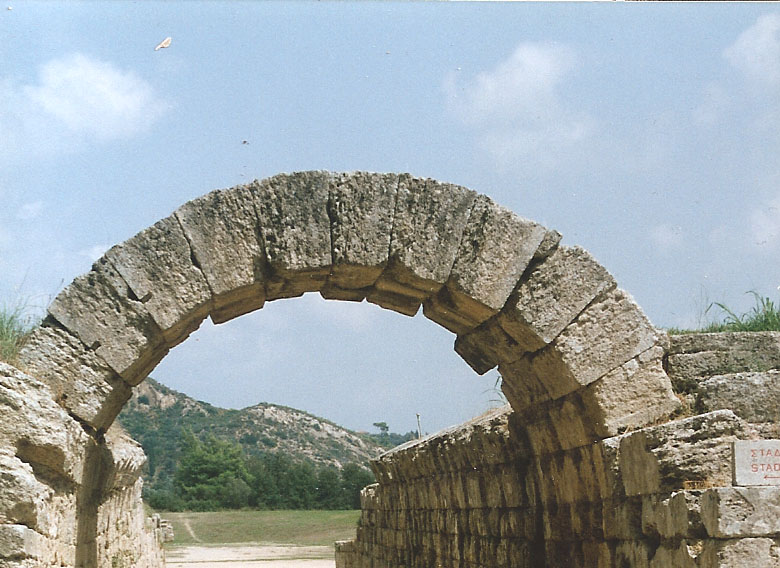
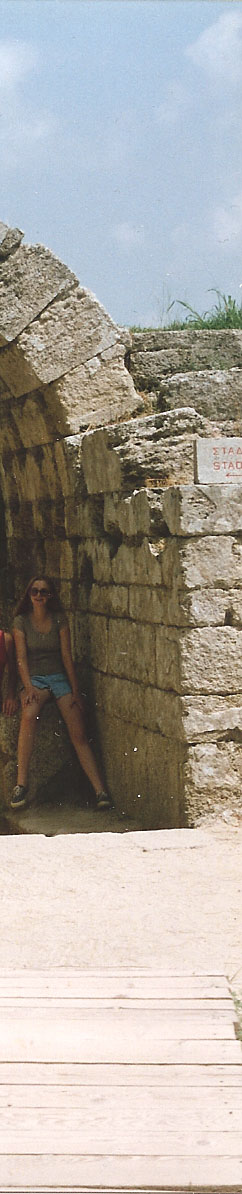
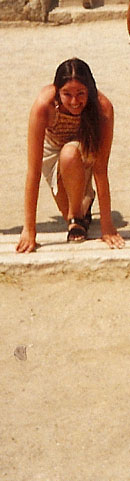
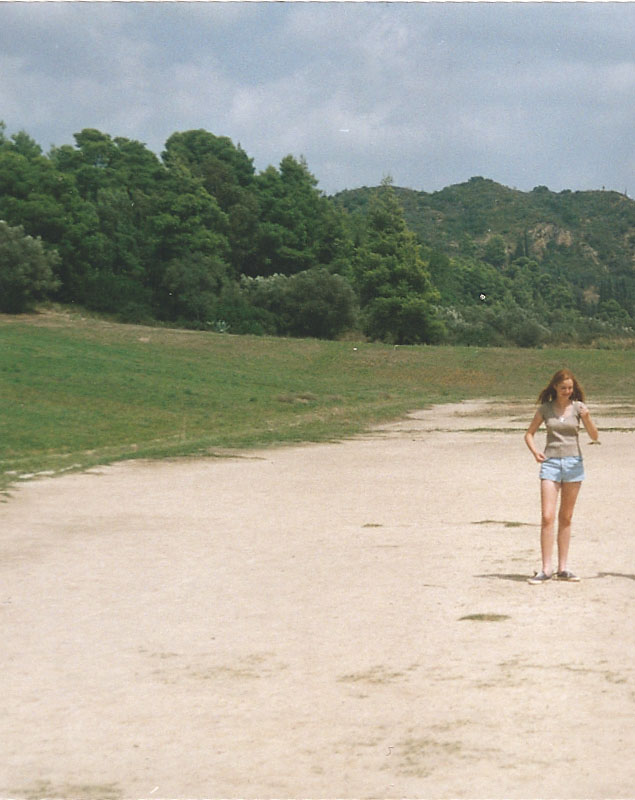
My family lives close to where the very first Olympics were held — the Olympic games began in 776 BC in Olympia, which is in the Peleponnesus in Greece — so over the years, I’ve visited Olympia more times than I could possibly count.  Even though I’m probably one of the least athletic people on the entire planet and couldn’t care less about watching any of the Olympic games, I still love going to site of where the Olympics all began.

What’s so fun about Olympia, which is now a UNESCO World Heritage Site, is that you can actually walk right up to the incredible stone columns.  You’re essentially treading the same path as the ancient Olympians.  My father always insists that we run the stadium, and since I love to ham it up for the camera, we end up with lots of silly pictures like the above.  Through this tradition, he’s been able to capture me growing up through the lens of the Ancient Olympics.

If you’re planning a trip to Olympia, Greece, you may find this site helpful.


Does your family have a tradition of taking annual photos anywhere unique?


Clip: Chapel-Turned-Brewery Hopping

2 Aug


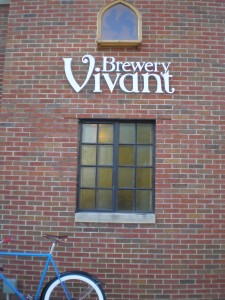
Burnside Writers Collective published my latest Church Hopping column.  In this edition of my ongoing column, I visit Brewery Vivant in Michigan. What’s now a trendy Grand Rapids beer hall used to be the Metcalf Funeral Chapel.  Writers Kim Gottschild and Larry Shallenberger join me.

You can read the full article here.


For the last time Burnside went Church Hopping during the Festival of Faith & Writing, check out: Calvin College Chapel with Fellow Burnside Writers.

For the time Burnside Writers Susan Isaacs and Donald Miller went Church Hopping in New York, check out: Calvary-St. George’s.

For another repurposed church, check out: Don Justo’s “Trash” Cathedral.

Save the Date! I’m reading at Sidewalk Cafe on August 12

1 Aug

Image via the event’s Facebook invitation

Poet RA Araya invited me to read from Burning Furiously Beautiful: The True Story of Jack Kerouac’s On the Road, the book I’m coauthoring with esteemed biographer Paul Maher Jr.  It’s going to be an AWESOME event!  I’m so honored to have been invited to read as part of R’s birthday jam.

Get a load of this line up:::

RA’s Music Poetry Jam Celebration… FREE ADMISSION Sunday August 12th 5PM-9PM

Featuring:
Cabaret singer Marissa Mulder and pianist composer Mr Bill Sefiro

… Foamola to perform

Opera gospel singer Virdell Williams

Tango singer Steve

Poets Patricia Spears Jones, Sparrow, Puma Perl, Kate Levin, Sarah Sarai, birthday-oh-boy RA “R!” Araya and the German poetry of Hillary Keel

Stephanie Nikolopoulos will read, as the f-b-p band plays, from her upcoming co-authored biography about Jack Kerouac: Burning Furiously Beautiful

RA’s Flashbackpuppy band featuring bassist singer Jon Martinez and guitarist singer composer Peter Becket

With poet Mia Hansford via telephone

MORE PERFORMERS TO BE ADDED AND YET CONFIRMED

Plus invited performers from the audience

Free Admission, one drink minimum

http://www.sidewalkny.com/

It’s my b-day celebration… With artists friends at a nice hip restaurant bar with a stage in the back room, free admission with a one drink or coffee minimum… ’tis to be a sweet four hour event, come and go and come back for more on a Sunday that’s surely be filled with fine seasoned performers… Open-mic with band backing yer poetry or and music… Don’t bring a present, bring a poem 🙂 -R!

Seriously, seriously excited about reading while Flashbackpuppy plays and hearing all the other amazing poets and performers.  This also will be my debut reading from Burning Furiously Beautiful.

Tasty Tuesday: Karpouzi! (Watermelon!)

31 Jul

Nothing says summer like fresh watermelon! I found these at a market in the Hamptons.

How about cutting up a few slices and serving it up with ouzo?

Judging On the Road by Its Covers

30 Jul

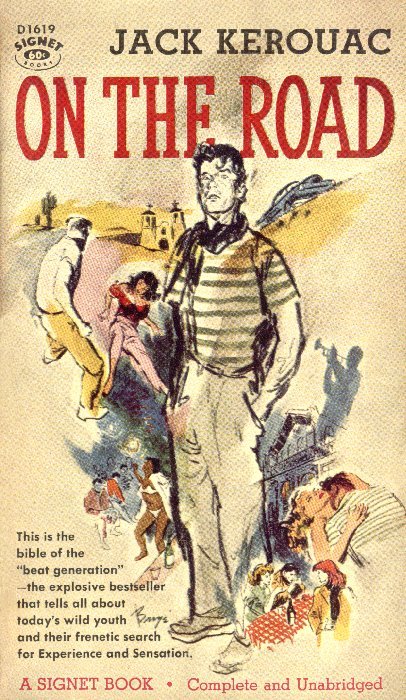
Okay, by now you’ve probably heard about the six year old who guesses what classic novels are about based on their covers, but I can’t resist rehashing her cute take on this early On the Road cover:


 “I think it’s about a car. A car that goes to Mexico, Indonesia and other places. It’s about a car that goes on all sorts of adventures. The guy on the cover is a teen, he likes to drive people places a lot. And he’s French.”

The cover she was looking at was the Signet 1958 edition.  I love that she guesses that the book is an adventure in many places and correctly guesses Mexico is one of them.

The fact that she guesses the main character is French is so perfect.  Of course, her guess is based on the drawing of a man in a Parisian-inspired striped shirt and scarf, which probably anyone would guess means the character is French.

Kerouac indeed was the son of French Canadian immigrants, but the kicker is that he’s usually thought of as either being very American or being anti-American.  In the 1960s, beatniks were depicted as wearing black turtlenecks and berets. In reality, Kerouac didn’t wear a costume of striped shirts or black turtlenecks.  If you look at most pictures of him, his clothes are nondescript.  He wore a lot of t-shirts and flannel and overcoats.

That’s why it’s so fascinating to look at the 1958 edition from a historical perspective on the evolution of Kerouac’s image.  As they’d do with any author, the publishing house tried to brand Kerouac.  In 1958, the striped shirt and scarf flung over his shoulder imparted a worldly, European air, meant to invoke a bohemian vibe.


The only other edition published before that was the Viking 1957 edition.  Of course, if you know about book publishing, you already know that Signet and Viking are both imprints of Penguin.  The difference between these two covers, though, is starting.  The cover of the first edition of On the Road, the Viking 1957 edition, was all black with a small rectangular abstract image in the center.  Bouncing text announced the title.  There was no image of a person or a car at all.  And yet the book sold so well that by the next year when the Signet edition came out, the cartoony line drawing cover featured the ringing endorsement “This is the bible of the ‘beat generation.’”

It should be noted that this Singet cover not only featured the Frenchman, but in the background there was a woman in a bikini and a couple making out.  Again, the publisher was trying to brand On the Road in a very specific way.  The third incarnation of the cover design for the US edition of On the Road came in 1965 when the extraneous people were deleted from the design and just the Frenchman was left standing on his lonesome, without even a car.  It lacked sex appeal, but someone must’ve liked it because two years later all the publisher did was switch from a cream colored background to a white background.  The following year, 1968, saw a cover design of a cartoony couple embracing in a car.  It marked a return to the sex theme.


Since then, the book has undergone many significant cover design changes, but what’s so interesting is that from the 1970s to the ‘90s the covers did not feature people at all.  They returned to the more metaphorical design of the first edition, featuring variations of the sun or a car.  It’s also worth noting that this was the time period in which Jack Kerouac fell out of popularity.

It wasn’t until Penguin released the 1991 paperback that the cover design included a people again.  And this is where it gets really interesting.  The romance angle is completely dropped and has not been seen in any US cover since the Signet 1968 edition.  Now, the focus becomes about friendship—a bromance, if you will—and cool hipsters hanging out in gritty New York.  The cover of the 1991 edition is a photograph of Jack Kerouac and Neal Cassady, the real life inspiration for the main characters of the novel.  The Penguin 1994 edition a collage of photos of Kerouac and his friends.  The US doesn’t see another woman on the cover until the Penguin 2011 amplified edition, which again embraces the photographic collage style.


Other covers published between the ‘70s and today tended to be text only, feature landscape (with or without a car), or a picture of the lone traveler.  They tend to be spectacularly uninspired and ugly.

In Germany and France, where the film version of On the Road has already been released in theatres, there are new editions with covers boasting the poster image for the film.  Will we be seeing a US edition with the actors’ faces instead of Kerouac’s on the cover?

Which cover inspires you to read On the Road?

Poetry, Picnics, and Catching up with Friends at the New York City Poetry Festival

27 Jul


Last weekend was so perfect.  The Poetry Society of New York held its annual New York City Poetry Festival, two full days of poetry, performance, creativity, and general amazingness out on Governor’s Island.

The last time I was at Governor’s Island, I was there to see She & Him — you know, the retro-tuned band with big-eyed Zooey Deschanel & M. Ward.  I’ve gotten to the (cranky) age where the annual tradition of outdoor summer music concerts leave me fishing out sunblock and wondering why we can’t all sit down like civilized adults and listen respectfully to the music.  The New York City Poetry Festival is kind of the Woodstock of poetry.  It fits my temperament quite nicely because I’m allowed to just lay out in the grass, close my eyes, and listen to words that make me think and feel.

My friends and I packed a picnic lunch of hummus and baby carrots and smoked gouda and nectarines.  We sat in wet grass in our sundresses and borrowed shirts.  And we listened.  And we considered not just the words, but the rhythm of the words.  And we soaked it all in.

It was also great to see so many poets from The New School‘s MFA program there!  I’m pretty picky when it comes to poetry, but I think so many of them are just brilliant.

I was quite impressed with the number of reading series that came out for the event.  There was The Inspired Word, Cornelia Street, Patasola’s ParlorNew York Quarterly, and, well, two full days worth of other poetry series. For the complete list, click here.

The festival was, like any event, a mixed bag.  Some poets were better than others.  Some I came specifically to see, and others I had never heard of and went home and looked them up.

The New York City Poetry Festival was good for my soul.

Road Trip Writing: On the Road and “Human Snowball”

26 Jul

Many summers ago, a couple of poets and I dragged some rickety chairs outside of the Bowery Poetry Club and sat in a circle, chatting about our writing, our day jobs, and life, as people passed by, sometimes stopping to talk to us. One of the girls in the group worked at a publishing house, like I did, and she offered to send us some of the books everyone in her office was buzzing about. About a week later, the package arrived, and I excitedly opened it. It’s been too many years to recall all that was in it, but I do remember it contained a book by Philipppa Gregory, which I in turn gave to another coworker because I have little patience for historical novels about the Tudor period—although I later saw her The Other Boleyn Girl on an airplane and enjoyed it—and Found.

Found started as a magazine that showcased notes, lists, drawings, and other miscellanea that readers found and sent in to the editors. In April 2004, they compiled the best of the best from the magazine and published the book Found: The Best Lost, Tossed, and Forgotten Items from Around the World. Having the book upped my coolness factor among the skinny hipster set I was hanging with at the time, and I began dating one of the guys. When Found’s founder, Davy Rothbart, published a short story collection called The Lone Surfer of Montana, Kansas, in 2005, I gave it to the guy I was dating.

I never read the book myself, but recently I read one of Rothbart’s short stories in the summer 2012 issue of The Paris Review, and it made me wonder if Rothbart might be my generation’s Jack Kerouac. While Rothbart lacks Kerouac’s poetry, they share an ear for dialogue, a captivating retelling of riding in buses and cars, an obsession with music, and an awkwardness with girls. In the short nonfiction story “Human Snowball,” Rothbart takes a Greyhound from Detroit to Buffalo to see a girl who isn’t quite his girlfriend yet or maybe ever and ends up in a carful of eccentric characters, including an ancient black man and a Neal Cassady-esque car thief. It may not have the sensory details that On the Road has, but “Human Snowball” captures characters with such honest and real details and dialogue that you feel like you know them. They’re beat characters. A little rough-around-the-edges, but sensitive and full of life.

In a bit of a Kerouac connection, actor Steve Buscemi, who stars in the film adaptation of On the Road, optioned the rights for Rothbart’s The Lone Surfer of Montana, Kansas. Rothbart himself is a chronic roadtripper. He’s traveled the country and toured with the punk rock band Rise Against, creating the documentary How We Survive for the dvd Generation Lost as well as the documetnary Another Station: Another Mile.