Tag Archives: On the Road

Warby Parker Glasses for Halloween

31 Oct

alvie_small-900x620via Warby Parker

Happy Halloween! Though I tortured my sleepover guests with classic horror films when i was a preteen, I’ve never been real big into the scary stuff of Halloween. I do, however, think it’s a super fun opportunity to play dress and reinvent one’s identity for a day.

Then again, I’m a bit of a chameleon when it comes to my style and personality even on an average day. You know how in The Breakfast Club there was the jock, the princess, the brain, the basket case, and the criminal? Or how when you ride the L train you can always tell who’s going to get off at Union Square versus who’s going to Bedford Avenue? I’ve never really identified with one social group or another. One day I might dress preppy in pearls and a button-down shirt with a sweater over it and the next day I might wear lots of dark eye shadow and all black. Likewise, some days I wear glasses and some days I wear contacts. It would be fun to own multiple pairs of glasses to switch out depending on my mood.

Glasses are such a defining accessory/medical need. Certain glasses styles have become synonymous with certain celebrities. Think John Lennon’s little circles. Buddy Holly’s thick frames.

Warby Parker says, “There are plenty of characters to be channeled with the right pair of glasses.” They’re featuring costume ideas like Tootsie, and Dr. Strangelove, Alvie Singer (Annie Hall) on their blog, complete with the prescription glasses they sell. Oh sure it’s a gimmick to get you to buy their merch, but — and I’m not at all affiliated with them and not getting anything for saying this — it’s a rather clever idea. Because sometimes it’s fun to channel someone else for a day!

Also, I really like Warby Parker’s business model: for every pair you buy, they donate to someone in need.

Oh, and get this: their name is a Jack Kerouac reference! Here’s the story:

We’ve always been inspired by the master wordsmith and pop culture icon, Mr. Jack Kerouac. Two of his earliest characters, recently uncovered in his personal journals, bore the names Zagg Parker and Warby Pepper. We took the best from each and made it our name.

So what I want to know then is why they don’t have a blog post for dressing like Allen Ginsberg?! You can’t help but think of his glasses when you visualize him. Plus, with all the Hollywood attention on the Beats lately — characters based on Ginsberg or Kerouac’s alias for him appear in On the Road and Kill Your Darlings — you’d think he’d be a fun person to dress up as for Halloween.

Or maybe I’m the only nerd who thinks dressing like authors and literary characters is a perfectly normal Halloween costume?

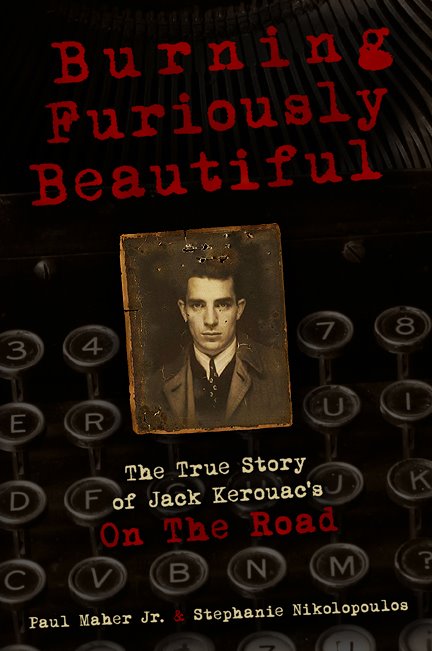
And, for a story about the time Allen Ginsberg lost his glasses, check out Burning Furiously Beautiful: The True Story of Jack Kerouac’s “On the Road.” It’s available as an ebook and paperback.


Is Hollywood Glamorizing the Beats or Just Retelling Their Stories?

29 Oct

“The flat Hollywood characterization allows viewers to live vicariously through Ginsberg, Kerouac and the gang, but it almost mythicizes them. Hollywood digs right into the drama — catering to what people want to see — and ignores the very human parts of them. But it may be a hard balance to keep. Even when depicting that soul-searching, it’s easy to fall to sentiment. The Beat Generation’s search for belief ends up being something we believe in. We’re all drawn to the image of explorers after all: modern pilgrims, earnestly due west like Lewis and Clark in Mustangs, toward the unknown destination,” writes Karen Yuan in her closing paragraph to “Notebook: Hollywood shouldn’t glamorize the Beat Generation’s self-destruction” in The Michigan Daily.

With descriptions like “wide, fruited plains,” “all vintage Cadillacs and cigarette escapism,” and “slick cool and soft anarchy,” Yuan’s turns of phrases are beautiful in this article. I commend her attention to language in this journalistic essay about writers. It’s a breath of fresh air from so many dry works of criticism. Furthermore, she brings up a valid point on the complexity of Hollywood trying to encapsulate the human experience. Whether one is a so-called Beat, a journalist, or a movie-goer our lives cannot be easily summed up in one film or three films … or even several volumes of literature, as it may be. Yuan herself makes that very point when she says “But it may be a hard balance to keep.”

Consequently, she seems to have out-argued her own thesis, “However, what [Hollywood] doesn’t realize is that the Beats are nothing to be glamorized,” by acknowledging the intricacy of life and that portraying “clouds of brooding angst” doesn’t create balance or reality anymore than depicting “carefree, YOLO-esque youth” does. Though she rightly suggests the Beats’ perpetual movement is related to their “existential search,” it is unclear what she thinks a more accurate adaptation of On the Road or Big Sur would be or how the murder of David Kammerer should have been told.

I would argue that the film adaptation of On the Road did a fine job of showing both sides. It perhaps doesn’t do the existential search justice but there are intimations of it, particularly in the scenes when Sal Paradise hallucinates among the Catholic saints, with the insertion of Proust, and when Dean Moriarty confesses that he doesn’t know why he does the things he does. The go! go! go! mentality comes to a screeching halt in the closing scene, indicating that maybe all those wild times weren’t all they were cracked up to be. Meanwhile, Yuan says Kill Your Darlings contains “tantalizing hints of murder,” when in fact the film does not hint but tells of the events leading up to a murder that landed three of the Beats in jail, with one of them doing time in a reformatory. It does not paint any one character as the villain, but again shows that the people involved and the events that unfolded were complex. Existentialism is a recurring theme of the film as seen through the New Vision. I haven’t seen Big Sur yet, but I’ve read the reviews of the film, and it seems to me that it’s far from glamorizing Kerouac’s life. More so, I’ve read the novel twice and know that it’s actually the antithesis of glamorizing the Beat Generation machine.

So here’s the question … or rather, I should say questions: Is documenting a life, an event, or a novel automatically glamorizing it? Where is the line between telling the truth and glorifying—when storytelling? Do stories have to be redemptive? If they are not redemptive, must they be cautionary tales? If they do not fall into these categories, are we better off ignoring them?

The pastor of the church I grew up in used to say, “Ignorance is not bliss.” Being downright oblivious or purposely ignoring issues doesn’t make them go away. The truth of the matter is the “intrigue and montages of reckless drug use” were a part of the life of Allen Ginsberg, Jack Kerouac, William S. Burroughs, and so forth. And I would gather that the parties and drugs and casual affairs were a lot of fun as they were happening. That’s why people do those things. To categorically demonize these things does a disservice to the truth. The truth of course is much more complex. Consequences aren’t always immediate or even a given. We can look now in hindsight at On the Road and know that Jack Kerouac died at only forty-seven years old, after abusing alcohol. However, we can cast our collective eye on Burroughs and see a man who did a lot of hard drugs who didn’t pass away until he was eighty-three years old.

Yuan says, “They wanted to rebel against this new middle-class United States and find something new to believe in….” Today’s suburban teens and Ivy League undergrads may very well still be searching for something to believe in. I think the Beats’ stories go on, not because they glamorize illicitness, but because they speak to that very basic human need to feel like more than just a cog in the machine but like we’re actually living, that our lives have meaning. I think this is part of what Yuan is advocating for, and I think it’s actually there in the films and in the literature. It’s just not whitewashed, pristine, perfect. But then again, neither is life.


* * *

Burning Furiously Beautiful: The True Story of Jack Kerouac’s “On the Road” is now available as an ebook and paperback!

Limited Time Offer: 10% Off the Paperback of Burning Furiously Beautiful

10 Oct

528764_288645227899680_240973182_n

Exciting news!

Pop the champagne! The paperback edition of Burning Furiously Beautiful: The True Story of Jack Kerouac’s “On the Road” is now on sale.

Limited-time offer

We’re giving you an extra 10% off now through the end of Lowell Celebrates Kerouac. (Unfortunately, the books won’t arrive in time for us to sell physical copies at the festival, but at least you’ll get a discount!)

What’s the book about, you ask?

Burning Furiously Beautiful: The True Story of Jack Kerouac’s “On the Road” is the most up-to-date and accurate account of the development of American writer Jack Kerouac’s groundbreaking 1957 novel, On the Road. Using archival resources as the foundation of this book, Kerouac scholars Paul Maher Jr. and Stephanie Nikolopoulos have fashioned a gripping account of the internal and external experiences of Kerouac’s literary development.
Fueled by coffee and pea soup, Jack Kerouac speed-typed On the Road in just three weeks in April 1951. He’d been traveling America for the past ten years and now, at last, the energy of his experiences flowed through his fingertips in a mad rush, pealing forth on a makeshift scroll that he laboriously taped together. The On the Road scroll became literary legend, and now Burning Furiously Beautiful sets the record straight, uncovering the true story behind one of America’s greatest novels.
Burning Furiously Beautiful explores the real lives of the key characters of the novel—Sal Paradise, Dean Moriarty, Carlo Marx, Old Bull Hubbard, Camille, Marylou, and others. Ride along on the real-life adventures through 1940s America that inspired On the Road. By tracing the evolution of Kerouac’s literary development, this book explains how it took years—not weeks—to write the seemingly sporadic 1957 novel. Through new research and exclusive interviews, this revised and expanded edition of Jack Kerouac’s American Journey (2007) takes a closer look at the rise of Jack Kerouac and the Beat Generation, giving insight into Kerouac’s family roots, his time at sea, the shocking murder that landed Kerouac in jail, his romances, and his startlingly original writing style.
Who is my coauthor?

Paul Maher Jr. is the author of the critically acclaimed biography Kerouac: His Life and Work and Empty Phantoms: Interviews and Encounters with Jack Kerouac
Check out my exclusive interview with Paul here.
You can judge our book by its cover
We’ve gotten a lot of compliments on our cover. Credit goes to Igor Satanovsky. He’s an award-winning cover designer that I’ve worked with for many years now on various publishing projects. Igor also is a poet (buy his book here!) and studied with Allen Ginsberg.

* * *

Burning Furiously Beautiful: The True Story of Jack Kerouac’s “On the Road” is now available as an ebook and paperback!

Recap from My Reading at Jason Harrod’s Album Launch

2 Oct

WP_20130913_001

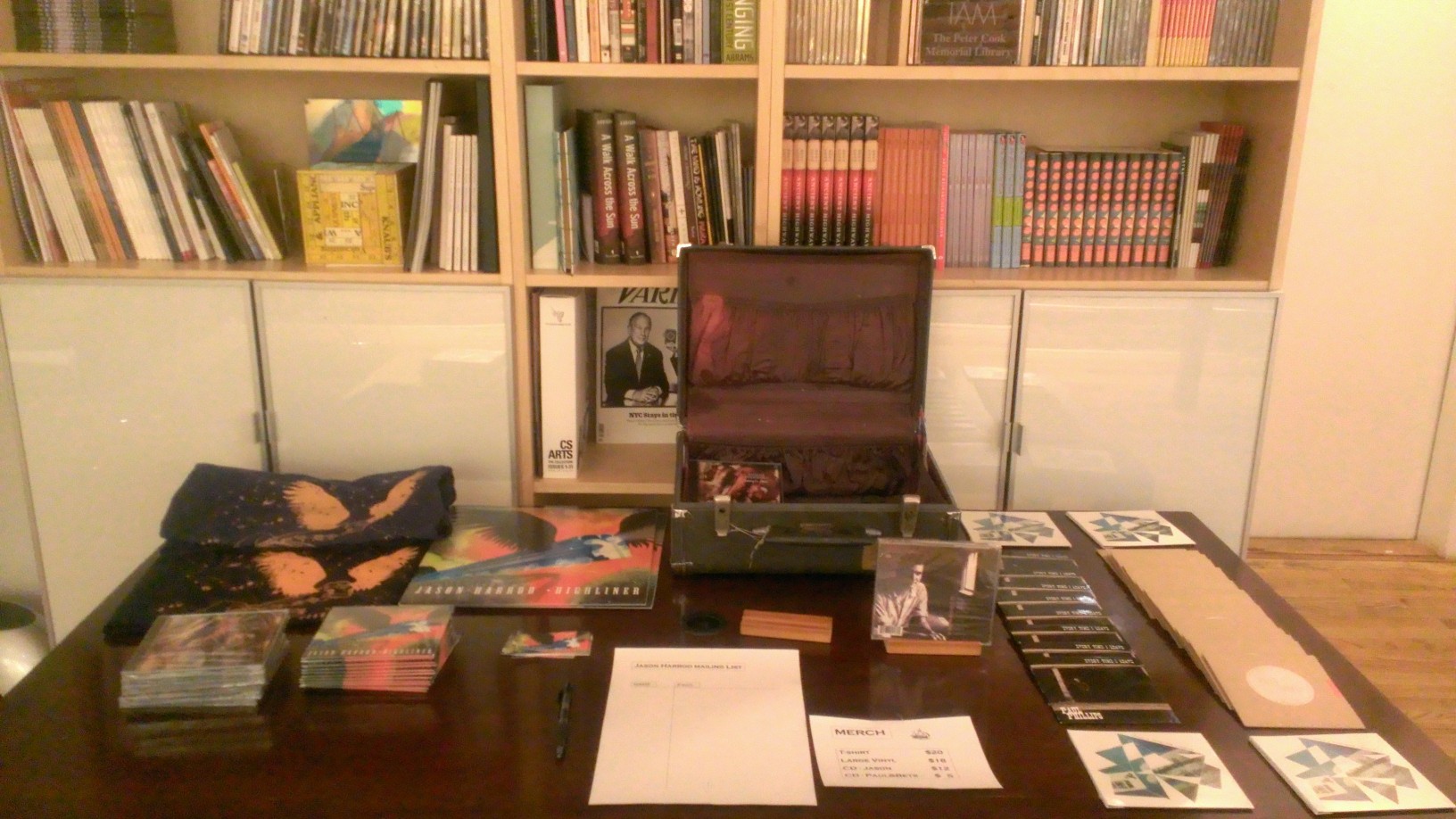
Do you mind if I tell you about my reading with Jason Harrod, even though it happened a few weeks ago? I know it’s waaaaay overdue but I still want to share it with you because it was a fun event and I was happy to see some of you there.

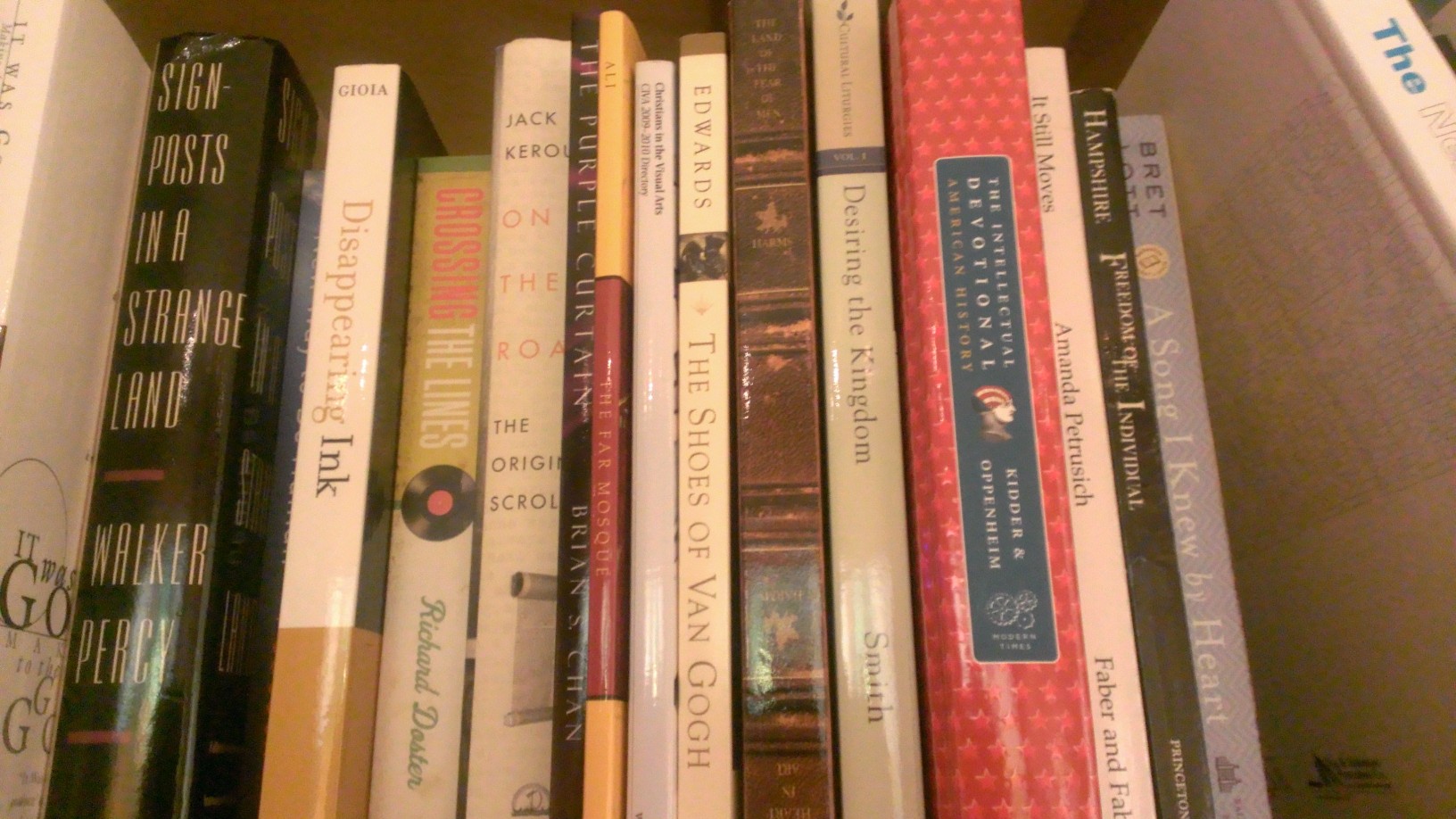
So I get to Space 38|39 a bit early and, as any bibliophile would do, I spend my time browsing the bookshelves. And look what I spy on the shelves! Do you see it? The original scroll version of Jack Kerouac’s On the Road! Providence, right?!

I actually read the same passage from the book I coauthored with Paul Maher Jr., Burning Furiously Beautiful: The True Story of Jack Kerouac’s “On the Road,” as the one I read with David Amram. Someone recorded it so I may have video in the future to show you from the reading, but in the meantime you can see me reading it with Amram here. I selected this particular passage because Jason had asked me to read something about wrestling with God, and here Paul and I tell about when Kerouac felt God wanted to have a few words with him and paid penance for watching a bullfight. It’s actually a pretty gruesome passage, so I always feel awkward reading it, but I think it’s an important passage. It speaks a lot to the way we try to reconcile our actions to God, and it demonstrates Kerouac’s softer, sensitive side.

I was invited to read a second piece and chose an old personal essay I had written. Jason joked with the audience that most of his songs were about God, girls, and the road, and it fit in perfectly with my writing. My first piece was about Kerouac’s road trip, but my second one was about my own road trip, where I met a woman who talked to me about God. The essay I read was called “Man Cannot Live on Bread Alone,” and it’s an early piece that Burnside Writers Collective published. You can read it here.

I made Jason play guitar as I read, and it was beautiful. I love collaborating with other people, and he’s a super talented musician. You can get Jason Harrod’s new album, Highliner, here.

Paul and Bets also performed, and they were so adorable. They’re this amazingly good-looking couple that look like they should be on TV, and they sang songs that transported us from the grime of New York City to the quaintness of the South. And you guys! They whistled! Oh it was too hipster cute.

Anyway, after the show this woman comes up to me, and starts saying her name and how I may not remember her but…. And I was like of course I remember you! It was a woman I used to work with and whom I actually met with on a regular basis right before the publishing division at the company shut down. She and another woman had been a  blessing on my life in dealing with work and life and the transition with the company, but whom over the course of the past few years I had lost contact with. It was such a surprise and so nice to see her. She had no idea when she came to Jason’s album release that I would even be there, so we were both surprised!

Anyway, New York City is a small world full of wonder. It was a great honor to get to read at Jason’s album release party and to have so many friends show up to support it and to run into a few I wasn’t even expecting to see!

WP_20130913_003


* * *

Burning Furiously Beautiful is now available as an ebook! You can download your copy here.

“Burning Furiously Beautiful” eBook Now Available!

30 Sep

528764_288645227899680_240973182_n


Happy Monday! I have BIG news to share today. Burning Furiously Beautiful: The True Story of Jack Kerouac’s “On the Road” is now available as an eBook! You can get it for $8.99 at Lulu.

Here’s a bit about the book from Lulu:

Burning Furiously Beautiful: The True Story of Jack Kerouac’s “On the Road” is the most up-to-date and accurate account of the development of American writer Jack Kerouac’s groundbreaking 1957 novel, On the Road. Using archival resources as the foundation of this book, Kerouac scholars Paul Maher Jr. and Stephanie Nikolopoulos have fashioned a gripping account of the internal and external experiences of Kerouac’s literary development.

And here’s our synopsis:

Fueled by coffee and pea soup, Jack Kerouac speed-typed On the Road in just three weeks in April 1951. He’d been traveling America for the past ten years and now, at last, the furious energy of his experiences flowed through his fingertips in a mad rush, pealing forth on a makeshift scroll that he laboriously taped together. The On the Road scroll has since become literary legend, and now Burning Furiously Beautiful sets the record straight, uncovering, among other things, the true story behind one of America’s greatest novels. Burning Furiously Beautiful explores the real lives of the key characters of the novel—Sal Paradise, Dean Moriarty, Carlo Marx, Old Bull Hubbard, Camille, Marylou, and others. Ride along on the real-life adventures through 1940s America that inspired On the Road. By tracing the evolution of Kerouac’s literary development and revealing his startlingly original writing style, this book explains how it took years—not weeks—to ultimately write the seemingly sporadic 1957 novel, On the Road. This revised and expanded edition of Jack Kerouac’s American Journey (2007) takes a closer look at the rise of Jack Kerouac and the Beat Generation.

The ebook can be read in the following formats: Windows, PC/PocketPC, Mac OS, Linux OS, Nook, Apple iPhone/iPod/iPad, Android, Kindle (Amazon), Sony Reader, Blackberry Devices, Palm OS PDAs, Cybook Opus, Bebook (Endless Ideas), Papyrus (Samsung) Jetbook (Ectaco), Windows Mobile OS PDAs.

A print book is forthcoming.

The Coffee Habit of Jack Kerouac

25 Sep

I’m on a coffee kick! Following up on my post about coffee and personality, I wanted to take a look at Jack Kerouac’s coffee habits.

Although people are quick to point to Jack Kerouac’s proclivity for alcohol, he downed coffee while writing On the Road. Okay, he may have also been hopped up on bennies—that’s Benzedrine—but his intake of coffee during that writing spree is notorious.

In the famous Paris Review interview between Kerouac and Ted Berrigan, Kerouac said that it wasn’t until Satori in Paris that he “wrote with drink at my side (cognac and malt liquor).”

Of writing, Book of Dreams, he explained how coffee entered into his writing process:

Bleary eyes, insaned mind bemused and mystified by sleep, details that pop out even as you write them you don’t know what they mean, till you wake up, have coffee, look at it, and see the logic of dreams in dream language itself, see?

As for how he took his coffee, Kerouac apparently drank it black.

Tonite: I’m Talking with Tim Z. Hernandez

19 Sep

New Image

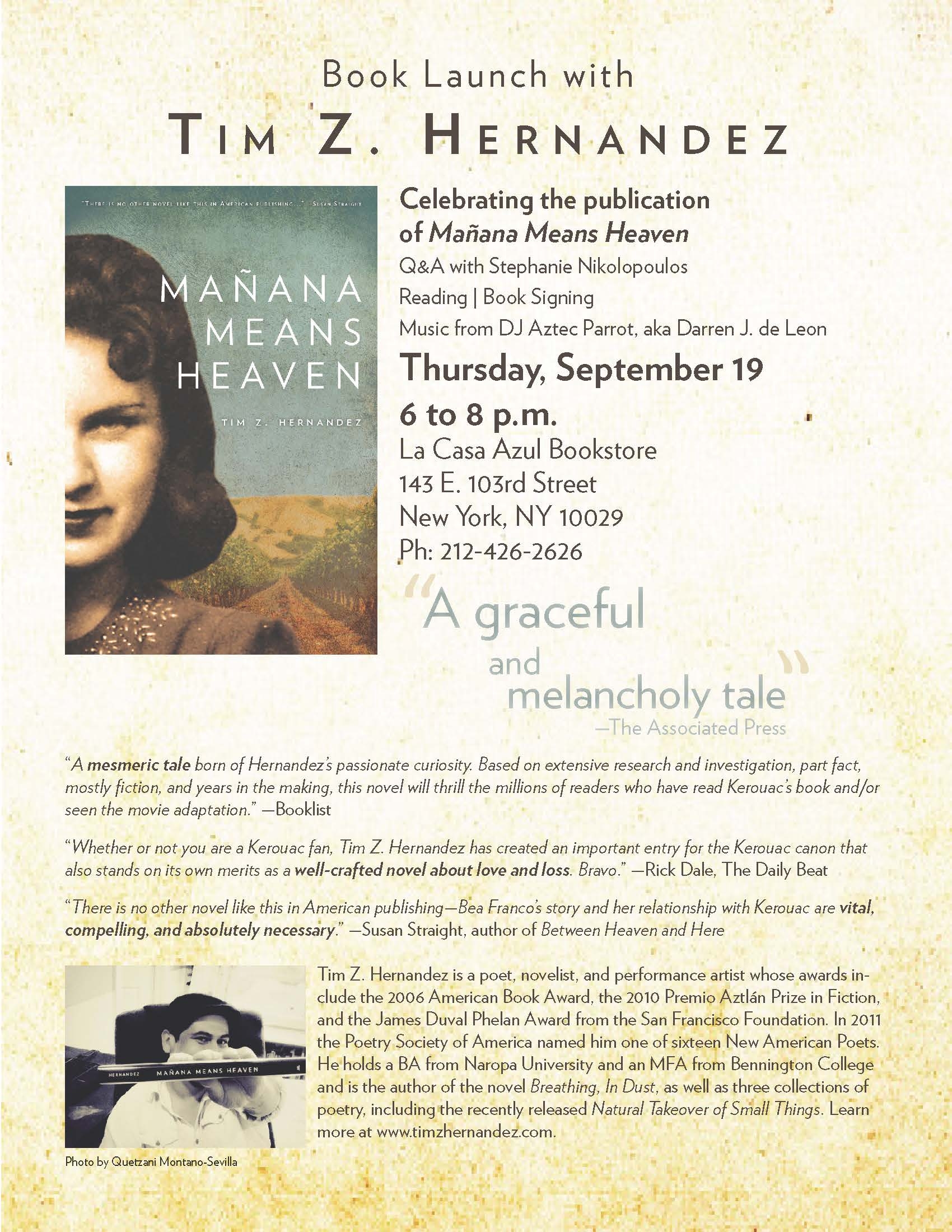
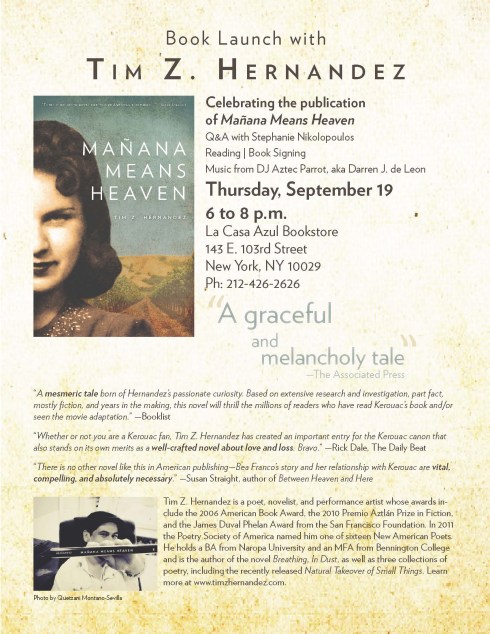
Just a quick reminder that I’ll be expanding upon my interview with award-winning poet Tim Z. Hernandez at La Casa Azul (143 E. 103rd, NYC) tonight at 6:00. We’ll be talking about his new book Manana Means Heaven, whether Jack Kerouac was a womanizer, what it’s like to write sex scenes about someone’s grandmother, the difference between fiction and creative nonfiction, and a whole lot more.

Tim will give a reading and will sign books — and DJ Aztec Parrot will be spinning music from the 1940s and ’50s.

I’m super excited! Hope to see you there!!

Mediabistro posted about the event here.

* * *

In the meantime, check out the awesome photos of Bea Franco and Tim’s guest post over on Rick Dale’s blog The Daily Beat, read an excerpt of Manana Means Heaven on La Bloga, and stop by to see Tim on The Big Idea. Then, follow along on the rest of Tim’s blog hop:

Friday, September 20 | The Dan O’Brien Project http://thedanobrienproject.blogspot.com/

Saturday, September 21 | Impressions of a Reader http://www.impressionsofareader.com/

If you happen to be in the New York area, Tim Hernandez will also be on a panel at the Brooklyn Book Festival this Sunday:

The Poet & the Poem: Natalie Diaz (When My Brother Was an Aztec), Alex Dimitrov (Begging For It), Lynn Melnick (If I Should Say I Have Hope) and Tim Hernandez (Mañana Means Heaven) will examine politics and identity in poetry, and the complex ways in which a poet’s work can become intertwined with the poets’ personal narrative. Moderated by Hafizah Geter, Cave Canem Foundation.


Adventuring with Author Larry Closs to See Jonathan Collins’ Beat-inspired Paintings

17 Sep

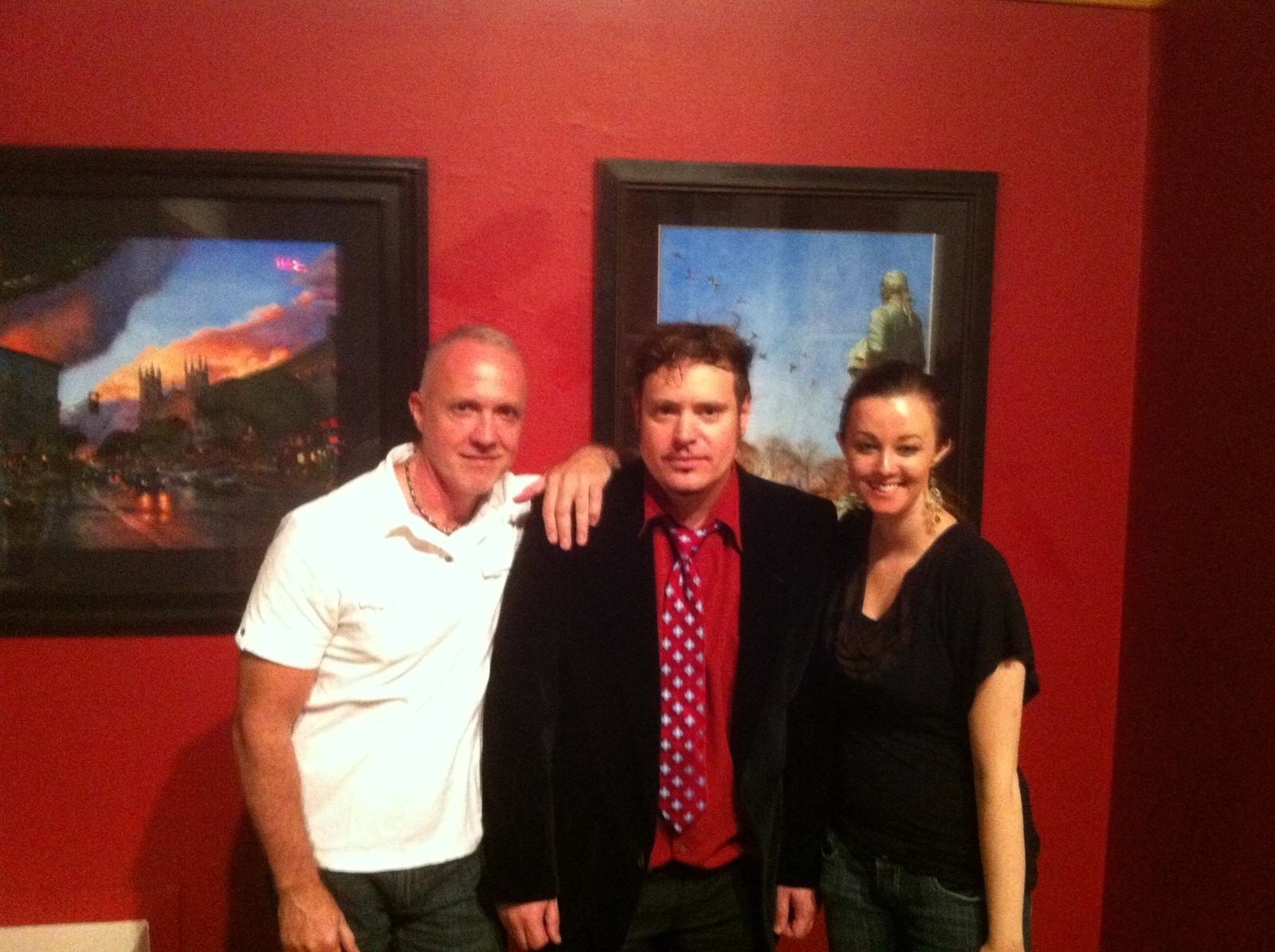
JonThat’s Larry Closs on the left, Jonathan Collins in the middle, and me on the right.

Collins2

Collins3

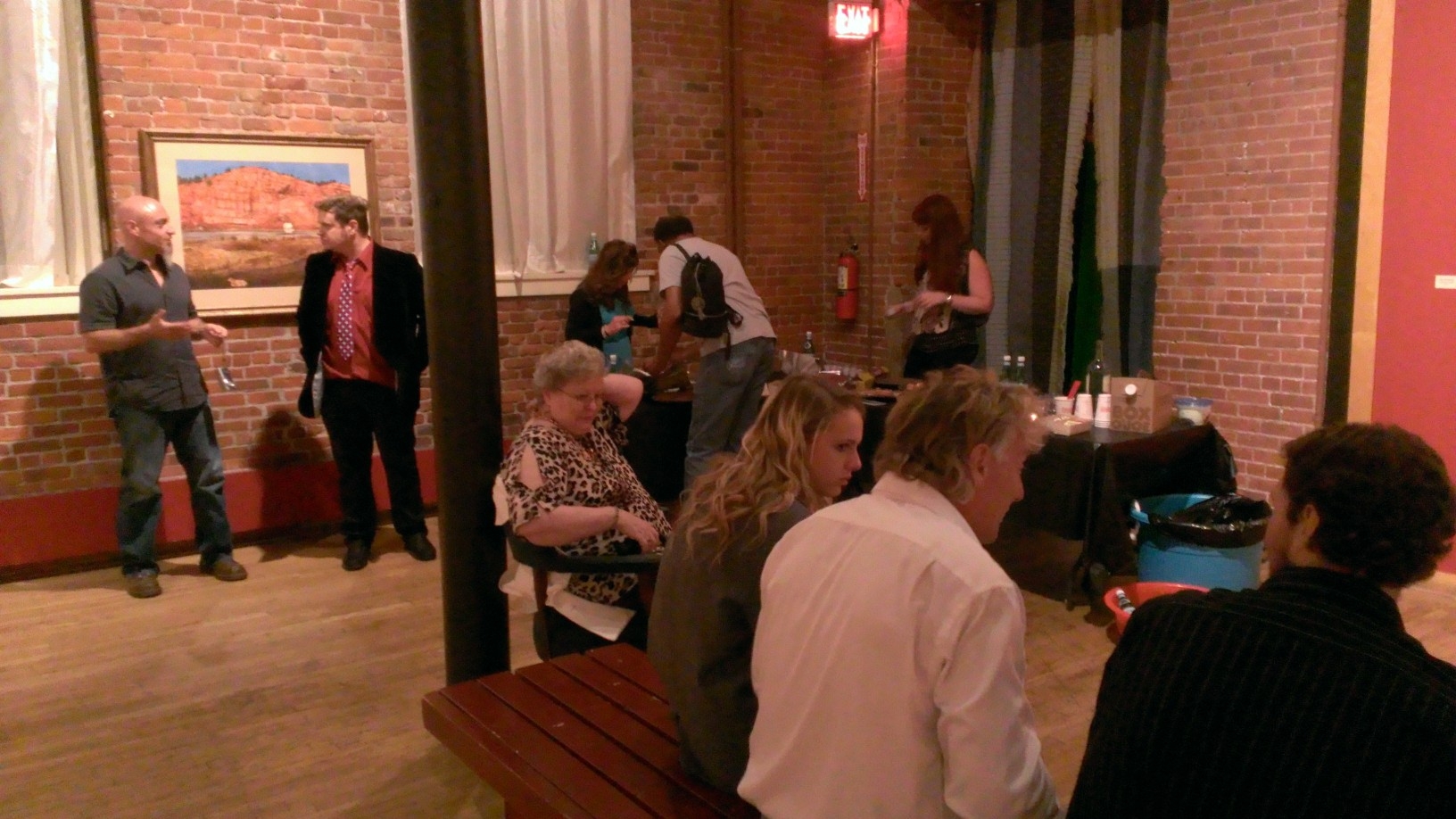
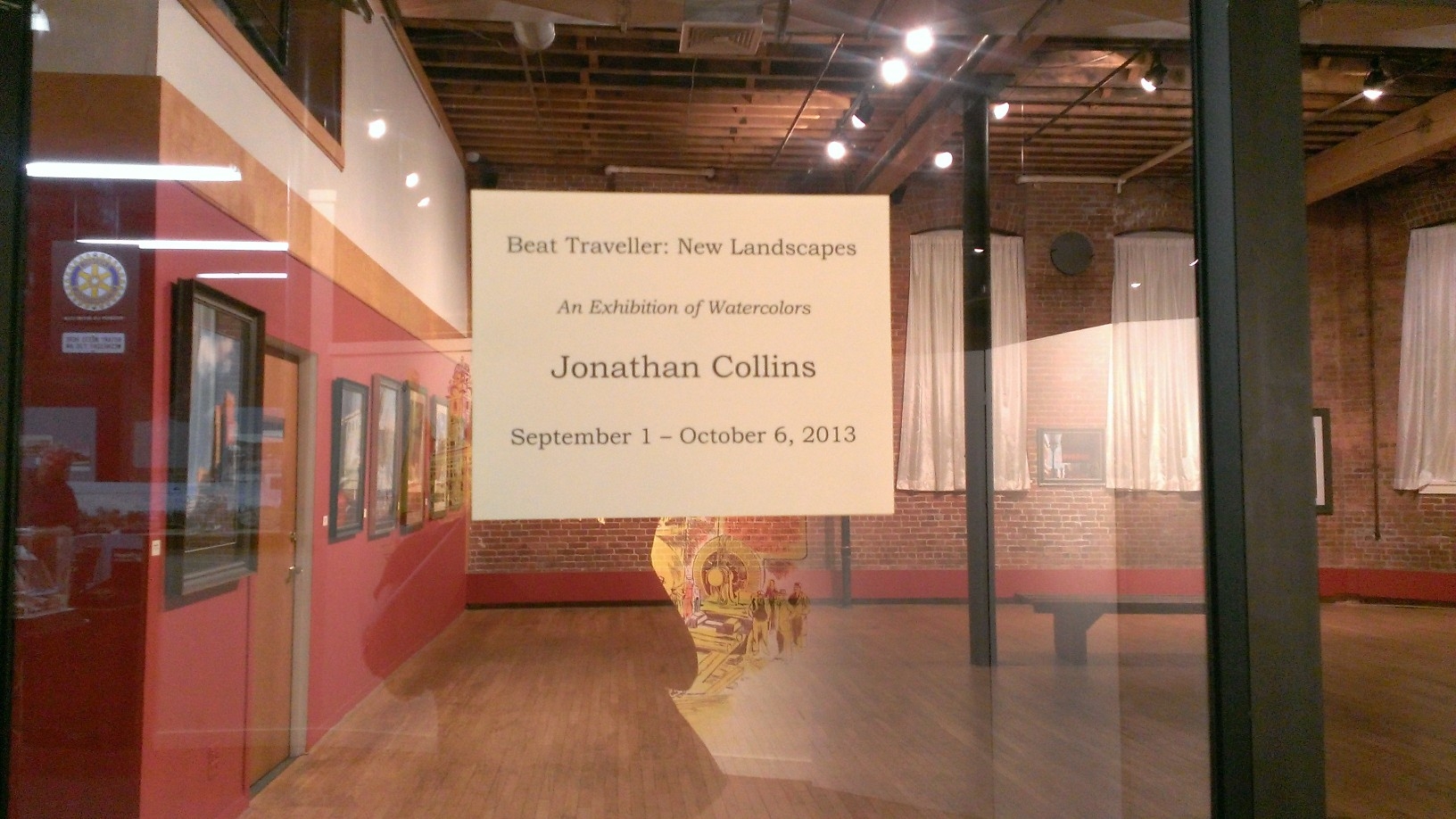
Larry Closs and I took a mini road trip to attend the opening of Jonathan Collins‘ Beat-inspired paintings at the Paterson Museum (2 Market Street, Paterson, NJ). It turned out to be quite the adventure. You may remember Larry as the author of Beatitude, a book I stayed in on a Saturday night to read because I was so captivated by the story I couldn’t put it down. Larry also happens to be a great conversationalist with fascinating stories about the writers’ life, bumping into Beat authors, and his own world travels. I got so caught up in our conversation on the way over to Jonathan’s show that I didn’t pay enough attention to the train directions, and, well, if you want to know what happened, check out Larry’s blog.

The first time I ever saw Jonathan’s paintings, when he’d brought his portfolio down to Cornelia Street Cafe when I was reading with David Amram, they were so realistic I thought they were photographs. Seeing them in person for the first time I was even more impressed by their beauty. From Kerouac’s Moody Street Bridge to neon-lit bars, Jonathan’s watercolors evoke nostalgia. Larry put it this way on his blog:

The paintings illuminate—and celebrate—the sometimes hidden beauty and “mystical qualities” often overlooked in the ordinary, the everyday and even the dreary.

The show runs at the Paterson Museum through October 6.

Collins1

I’m Talking with Tim Z. Hernandez; Join Us!

16 Sep


New Image


This Thursday I’m going to be in conversation with Tim Z. Hernandez, author of Manana Means Heaven, at the Spanish Harlem bookstore La Casa Azul. DJ Darren de Leon will be spinning music from the 1940s and ’50s. It’s going to be such a fun event. I’m really excited.

Tim’s novel Manana Means Heaven is about the real-life person who inspired Jack Kerouac to write one of the most poignant parts of Jack Kerouac’s On the Road: Bea Franco, “the Mexican Girl.” Tim tracked her down and interviewed her for the book, and she got to see it right before she passed away last month.

An award-winning poet, Tim pays close attention to words and imagery in his novel. We’ve been writing back and forth for a while now, and I have so many questions I want to ask him at the bookstore. There’s going to be a Q&A too so come with questions!

Here’s the essential info:

Thursday, September 19

6pm

La Casa Azul

143 E. 103rd Street, NYC

See you there!

*Please excuse the lack of the proper Spanish “n” with a tilde in “Manana”; I’m not tech-savvy enough to get my blog to use it.


Tim Z. Hernandez Gives a Behind-the-Scenes Look at Manana Means Heaven

16 Sep

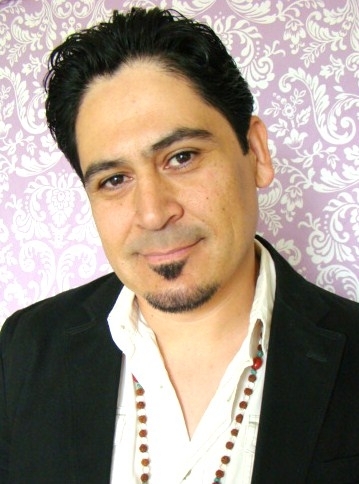
TimTim Z. Hernandez photo courtesy of the University of Arizona Press

I’ve often thought that poets make the best prose writers, and I was reminded of this once again as I read award-winning poet Tim Z. Hernandez’s novel Mañana Means Heaven. The story is about Bea Franco, the real-life woman who inspired Jack Kerouac to write one of the most poignant passages in On the Road—the story of “the Mexican girl,” Terry. Mañana Means Heaven is by no means a work of fan fiction. It is beautifully crafted and painstakingly researched, and stands on its own. Even as I got caught swept up in the story, I kept wondering how Hernandez did it—how was he able to write such a captivating story about a real person, one he’d met and interviewed, one whose children he’d met, who for so long seemed mythical herself yet was perhaps overshadowed by Beat mythmaking?

When the University of Arizona Press asked me if I’d be interested in participating in a blog hop with Tim Hernandez, I jumped on the opportunity. Special thanks to the University of Arizona Press for arranging this interview and for being great to work with. And, of course, a big thanks to Tim for so thoughtfully answering all my questions.

* * *

TimCover

How did you first come across Jack Kerouac’s On the Road and how old were you?

I first read it when I was around 17. I believe a friend of mine from Sweden, Jonas Berglund, turned me onto it. He was the poet back then, while I was mostly into painting. He was trying to get me to go backpacking with him in Europe, and he kept telling me how cool it would be. He told me I should read “On the Road,” so I did. That summer I split with him to Europe.

What did you think of it at the time and how has your perspective on the novel changed over time?

I’ve read OTR three times now. At age 17, and then in my early twenties, and then later at around 30. At age 17 I identified with the desire to break free, to adventure and take risks, to get away from the place I called home. In my early twenties I began questioning whether or not these guys, Kerouac and his crew (The Beats), were just completely insane. Also, the idea of a threshold appeared. I related more with the underlying question Sal Paradise was seeking to answer, that is, do I continue on this path of wild abandon, this path as perpetual seeker of truths, by whatever means, OR, do I fall in line with the rest of the world and live a “normal” life clocking in day to day and having a family? It was a matter of maturation. Not that I decided to let go of that desire “to seek” but just that I would go about it differently, in my own way. And then by age thirty, I was reading the book less for its subject and more for the writing itself, the technique and process, and also the idea of lineage. This is what sparked the initial seed for Mañana Means Heaven.

In the introduction to Manana Means Heaven, you say that you became interested in the story of “the Mexican girl” Terry/Bea Franco because it was the part of Kerouac’s novel that you could relate to. I understand that your parents were migrant workers near where Bea’s family worked as migrant workers. I know you also worked for the California Council for the Humanities interviewing immigrants about their lives and struggles. Were your parents immigrants? Can you talk a little about your relationship to and interest in the migrant worker experience and how it relates to your writing?

Yes, all of this was very influential to my wanting to write about Bea Franco. My work with CCH, and even the Colorado Humanities today, has been very instrumental in the research and process for the making of this book. It’s the experience of working for them that has emboldened me to walk up porches and knock on the front doors of total strangers, for the sake of stories. Not to mention, having these two entities as a resource throughout my research has been invaluable. As for the other part of your question, my parents were migrant farmworkers, but they were born in Los Angeles and Texas, so they weren’t immigrants. I’m the third generation in my family to be born here in the United States, and I think this is also why I related to Bea so much once I finally met her. My first question to her was, “What do you think about being called the Mexican Girl?” She laughed and replied, “I’m not from Mexico, I was born in L.A..” So she was very conscious of her own identity in this way too. She was not an immigrant by any means, and I believe that it’s possible this assumption about her is what kept Kerouac biographers from finding her, or even looking. In any case, having come from the same background as Bea Franco, the farmworker experience, living among the labor camps of the San Joaquin Valley, this was all part of my growing up. My parents and grandparents used to travel all over picking crops, grapes, hoeing sugar beets, so I knew the people from this place very well. When Sal Paradise entered the San Joaquin Valley in “On the Road” I felt he was now entering my world, a distinct place that is in every fiber of who I am, and I knew I could write about this with some authority.

Similar to your experience with Bea Franco, part of what continues to draw me to Kerouac is his ethnic experience and how he writes about feeling a duality within him. I was born here in New York City, but my father is an immigrant. He moved here from Greece when he was in his thirties, and he felt embarrassed because sometimes people couldn’t understand him because of his accent. Kerouac’s parents were immigrants from Quebec, and although he spoke English as a child he really didn’t feel comfortable with the language until he was a teenager. I think our immigrant experience was much different, though, because of our skin color. Kerouac is seen as a quintessential American novelist while Bea got pegged as “the Mexican girl” even though they were both born here in the States. Was Kerouac’s portrayal of the immigrant experience something you were interested in or were you mainly interested in telling Bea’s story?

Yes, all valid points here. Bea too was in that strange purgatory of “immigrant born in the U.S.,” and she too was very light skinned with green eyes, and because of it was sort of an insider-outsider, similar to Kerouac’s and your own situation. In some of our conversations she talked about how she was treated differently, sometimes cruelly, while growing up because of her complexion. In many ways, hers was a real “Chicana” experience, before the term was popular. She was balancing between two cultures at once, was educated in Los Angeles public schools, spoke fluent English and Spanish. She loved both the Mexican classic songs, and the big bands of her time. In 2010 she still had stacks of records by Tommy Dorsey and Glenn Miller, folks like that. When I first met her she had a portrait of Ronald Reagan in her dining room. It took my aback for a moment, until I asked her about it. I was afraid she’d say something like, “He was our greatest President.” But instead, she said, “He was a great actor and I loved his movies,” and then she chuckled. Bea loved being American, and even though her father was from Mexico she clearly identified with aspects from both sides of the border. In regards to the last part of your question, yes, I was mostly after Bea’s story, about who she was/ is. As a fan of Kerouac’s writing, in the beginning it was tough for me to distance the two, but it was necessary to do so. If I was to write about Bea’s life, to fill in that “missing link” about who “The Mexican Girl” was, I had to start from scratch. That is, I had to, in some ways, reject what other biographers had written about her, and even reject what Kerouac himself had written about her, and go straight to the source—Bea and her family—and start there. So then the question of what she remembered of her time with Jack was no longer significant. Instead I would ask her, Tell me who you are? Where were you born? Who did you love? Approaching it this way would allow readers to enter the book on her terms, not based on anything else written about her previously. This is what I was after.

The Beats have often been criticized for the way they treated and portrayed women. In fact, I have been criticized in the media for being a woman who likes Beat writing. You’ve given voice to one of the most influential women connected to the Beats. The story of “The Mexican Girl” was the first part of On the Road Kerouac got published in a lit magazine. Some might argue that Kerouac used her for her body or for gaining experience for his book. Your depiction of their relationship was quite tender and sympathetic toward both of them. It reads like a beautiful love story. What was your thought process in writing about Bea striving to make a change in her life and cheating on her husband, and Jack leaving and never reconnecting with her?

Yes, my initial idea, as I started to envision the book, was that I’d somehow have the opportunity to “even the score.” That I would make Jack out to be this womanizer only after his own “kicks” or “experiences.” Of course, this was still before I had ever met Bea. Too, I think in order to write a good story, an honest or authentic story, at least in this case, one has to suspend those kind of judgments about their own characters. This occurred to me after I had met Bea and began speaking with her. She never viewed herself as the “damsel in distress,” and in fact, was a woman who took responsibility for her own decisions, in her early years and even now, yet was also very much a romantic. After speaking with her I quickly saw that she was not the naive “Mexican Girl” that Kerouac made “Terry” out to be in “On the Road.” Nothing in our conversations told me that for Bea, at least in her own mind and heart, ever doubted their relationship was a real possibility. Of course, she was aware that this could also mean a new start for her and her children. And this is the sense I get too from reading her love letters to him. In the end, the relationship had to feel like a very real possibility, for her mostly, but for Kerouac too. Because if he didn’t believe in it, then going by what I know about her, she would not have wasted her time.

You tracked down the real Bea Franco and got to know her. How did she feel about being a character in Kerouac’s novel and how open was she when answering questions for your book?

When I located her in September 2010, she nor her children had any clue about the legacy of “The Mexican Girl.” She was just about to turn 90 years old, and when I did tell her, I said something to the effect of, “Did you know you are a famous character in a famous American novel?” Her children, Albert and Patricia, laughed out loud. Bea just sort of nodded and said, “Oh really. I didn’t do nothing so special.” The next thing I did was take out a list of over 20 Kerouac biographies that mention her name. She just shrugged, like it was no big deal. Her son though, Albert Franco, who Kerouac dubbed “Little Johnny” in On the Road, he opened up his laptop and started typing stuff into the search engine. There he was now at age 70, blown away by it all. I can’t describe the feeling of it, but the word “surreal” comes to mind. I just sort of sat there praying they wouldn’t kick me out of the house. A couple of visits later, while interviewing Bea, Albert asked me, “After all these years…how can so many people mention my mother’s name in their books and never tell us about it?” I didn’t have an answer for them. But I knew right then that I had already done a couple of interviews and still had not formally asked their permission. I felt, symbolically at least, that this was necessary. So I asked her point blank, “Bea, can I write the book about your life?” She said, “Sure.” I replied to her, “What would you like the world to know about you?” She answered, “Oh, I guess that I tried hard to be a good person.” Albert was sitting with us too. At the time he looked reluctant with the idea of yet another book. I told him, “People will continue to learn about your mother from all these books, or I can write the only book with her input, her own words, from her perspective, and after that everyone will no longer guess at who she is.” I think it was after he did his research on me and saw that I was a kid from Fresno whose parents were also migrant farmworkers, did he finally begin to trust me. Of course, Albert and I are now great friends.

How did her children react? You uncovered Bea’s affair and described her and Jack’s relationship in pretty sensual terms. Did you feel any awkwardness writing about any of this or any responsibility toward her and her family for how you portrayed the events?

Patricia and Albert are both very proud of the book. As are the rest of their family and friends, many of who are the children or grandchildren of some of the background characters in my book. As for the “sensual” aspect, this is probably where I had the toughest time writing the book. Which seems weird coming from me, since both of my first two books have been called “raw,” “graphic,” “sexual,” in past reviews. But here I was dealing with someone else’s life, not purely my own imagination. My first attempts with the love-making scenes were horrible. A good friend who was a first reader told me, “You’re writing as if Bea herself is standing over your shoulder.” And this was true. I was worried about losing the trust of her and her children. I didn’t want it to come across as distasteful. But still, in order for anyone to be convinced of this romance, an affair where two adults holed up in a hotel room for several days, then the range of intimacy had to be present—everything from long talks in the wee hours of the night, to the ebb and flow of emotions, sex, regret, risk, liberation, all at once. I’ve long considered myself to be the kind of writer who doesn’t shy away from “the real,” and in fact, this is what I returned to as the book was being written.

Manana Means Heaven is categorized as a work of fiction. How much of it is true? In literature, where do you think the lines are drawn between fiction and creative nonfiction?

This is the kind of question that would require many pages to even scratch the surface, so I’ll try and give you the brief version. “Fiction” and “Creative Non-Fiction” are genres, and I treat them as such. Neither are qualified substitutes for “the actual.” Isn’t this part of what Kerouac’s own legacy is built on? The idea of writing it as he lived it? If I had to put it into a percentage I would say about 75% of Manana Means Heaven is “true” from Bea’s perspective. The other 25% is authored by me, but also rooted in truth, about the life of farmworkers in the 1940’s, about the history of that part of California and the people who worked the land. Like I told Bea herself, even though it’s called “fiction” it’s still closer to the truth about who you are than anything else out there. Which is odd when considering that most of what is out there can be found in the “Non-fiction” books shelves. Reason being is that biographers have only counted on Kerouac’s version of events. One of the first biographers I contacted when my research began was Paul Maher Jr. This was because his book, “Jack Kerouac’s American Journey” had the most unique pieces of information about Bea than any other book out there at the time. I wondered how he knew certain things, so I asked him. Turns out he had read Bea’s letters to Kerouac, which were housed in Kerouac’s archives at the New York Public Library. So Maher had dug a little deeper than most in regards to Bea. And now only recently, Joyce Johnson’s new book “The Voice is All” has echoed some of what Maher had discovered. I imagine now that my book is out we’ll start to see more accurate information about Bea Franco, which is also a big part of why I wrote this book.

You’re also an award-winning poet. I think poets often make the best writers. Can you talk a bit about how you approached this novel as a poet or how the writing process differed?

Yes, ultimately, I feel at home with poetry. For me, prose is like going to work, slinging a hammer from 6am–5pm. Poetry is like the ice cold beer you crack open when the day is done. Poetry was my focus throughout my undergrad and graduate degrees. But I do love telling stories too. Why can’t both happen? In writing I don’t begin by saying “I’m going to write a poem today.” Or, “I’m going to make this a story.” I write and allow the muse to tell me what it is. Even then I’m skeptical, or open about it. I keep writing until I get to a point where I go, okay, now I have to make a decision here. In the end, my main goal is tell a damn good story. It so happens that for me a good story is one that works on multiple levels. Not merely subject, but on the line level. For me a good story also has language that sings, that isn’t afraid to dig deep in the crates, use fresh turns of phrase, make rhythm, use imagery that evokes emotion.

Can you talk a little about the literary device you used in opening and closing the book in the same way?

Yes, there are two ends to the book, Bea’s story, and then my search for Bea. The idea of starting the book at the second ending emerged somewhat organically. I had to figure out how to let the reader know that this book is rooted in my interviews with Bea, and I had to address the one thing that I knew would be on the minds of Kerouac fans, that is, what did she remember of her time with Kerouac. And then there was one big wrench in the machine that I also had to figure out how to get around. By starting from the very end of what is considered the “non-fiction” portion I was able to set these three things up so that when the reader finally enters the “fictional” portion of Bea’s story, they have suspended their idea of “fiction.” The book went through something like twelve drafts before I could figure this part out. There was a lot of shuffling chapters around and reconfiguring the whole thing…in fact, there were times when I thought to myself, who am I kidding? It’ll never work. But I finally found a combination that did work.

* * *

Tim and I will be continuing this conversation this Thursday night at La Casa Azul.
New Image

* * *

Meanwhile, join Tim Z. Hernandez on the rest of his blog-hop!

Tim Z. Hernandez Blog Tour:

Tuesday, September 17 | The Daily Beat http://thedailybeatblog.blogspot.com/

Wednesday, September 18 | La Bloga http://labloga.blogspot.com/

Thursday, September 19 | The Big Idea http://www.jasonfmcdaniel.com/

Friday, September 20 | The Dan O’Brien Project http://thedanobrienproject.blogspot.com/

Saturday, September 21 | Impressions of a Reader http://www.impressionsofareader.com/