Tag Archives: poetry

Happy 83rd Birthday, Gregory Corso!

26 Mar

bday

One of my very favorite poets was born on this day in 1930. That’s right: Gregory Corso. He was quite a few years younger than his friends—William S. Burroughs was born in 1914, Jack Kerouac in 1922, Allen Ginsberg in 1926—but was one of the first published. Kerouac had published The Town and the City in 1950, but the novel that would put him on the map—On the Road—wasn’t published for another seven years. Ginsberg’s Howl was published in 1956. Corso published his first poetry book, The Vestal Lady on Brattle, in 1955. He was only twenty-five years old. Speaking of which, Corso wrote a lovely poem called “I Am 25.” I remember back when I was in college, reading it and thinking how far off that seemed. Twenty five. What a magical age. I wrote a little poem emulating his about how old I was then, and instead of saying “I HATE OLD POETMEN!” like the line in his poem, I wrote “I LOVE OLD POETMEN!” And I do. Gregory Corso is brilliant. Both a classicist and a rule breaker.

If anyone could be called “beat,” it was Corso. Most of the people who came to be associated with the Beat Generation were middle-class suburbanites, or something close to that. Corso was born to a sixteen-year-old Italian immigrant in New York City, who later abandoned him to the Catholic Church Charities. He was sent to live with foster parents and ended up homeless on the streets of New York, eventually doing time in prison at thirteen years old for petty larceny. The story goes that while in The Tombs, the Mafia encouraged him to read, and he fell in love with poetry.

Review: Ferlinghetti: A Rebirth of Wonder

14 Mar

ferlinghetti_splash

I caught the documentary Ferlinghetti: A Rebirth of Wonder (2009) at Anthology Film Archives this past weekend. Lawrence Ferlinghetti is one of my favorite poets, for his use of language and whimsy. I’ve long appreciate his commitment to freedom of speech, and this documentary made me more aware of how he used his position as a poet and bookseller for activist purposes. Quirky fact: he uses the windows of his office at City Lights as a “blog,” writing his political thoughts for all who pass by to see.

Ferlinghetti: A Rebirth of Wonder is star-studded, including informative interviews and clips with everyone from Amiri Baraka, David Amram, Jack Hirschman, Michael McClure, Anne Waldman, and George Whitman to Giada Diano, Bill Morgan, Dave Eggers, and Lorenzo Ferlinghetti. It impresses upon the viewer just how important Ferlinghetti is by indicating his support of Bob Dylan, his place in American poetry, awards given to him, and the naming of a street after him.

The biographical background information is fascinating, particularly when we hear about Ferlinghetti’s rearing in France, how his mother’s ineptitude at caring for him led to his being raised by the daughter of the founder of Sarah Lawrence College, and his service in World War II (spoiler alert: he saw Nagasaki right after the bomb dropped). There’s even a scene in which Ferlinghetti searches for his roots in Italy, where he was arrested for trespassing when he tried to get a sneak peek at where his father grew up! This of course is all balanced with his founding of City Lights, the Howl trial, and the Human Be-In.

All of it is wonderful, but its broad scope and pacing left the film falling flat in terms of its aesthetics. As a biographer, I understand how director/producer Christopher Felver must have struggled with the editing process. How could he cut anything out when it’s all so important? No one wants to see significant and appealing research fall on the cutting room floor. As a viewer, though, I would have preferred a more limited scope or narrative approach. It would have been a stronger film if Felver, who worked on the documentary for ten years, ruthlessly edited his work to give it a story arc. This film is best suited for those interested in learning more about the free speech movement, poetry in America, the Beat Generation (though Ferlinghetti adamantly declares in one scene “Don’t call me a Beat! I never was a Beat!”), San Francisco, and the 1950s and ‘60s. I’d recommend Ferlinghetti: A Rebirth of Wonder for high-school English classes as well as for writers in general, as it motivates one to consider poetry as subversive action.

Modern Love

14 Feb
by William Hilton

by William Hilton

When I was still just a teenager, I fell for John Keats. He was a Romantic, prone to fits of passion and depression, the highs and lows most teenagers can relate to. He had studied and gotten his apothecary license, but who wants to be a doctor when they could be a poet? Both fix the heart, do they not? He sat under a plum tree and wrote an ode to a nightingale. Swoon. He wasn’t stuffy. He infused humor into his poetry and broke traditional rules, using false rhymes. He went on “road trips,” walking tours of the Lake District, Ireland, and Scotland. There’s a beautiful scene in the film Bright Star, about Keats’ romance with Fanny, in which a million butterflies flutter though a bedroom. And isn’t that just like love? Whimsical. Animated. Delicate. Fleeting. Memorable.

Gregory Corso, the poet associated with the Beat Generation, was a fan of John Keats’ poetry. It’s easy to see their resemblance to each other—the way they both referenced their hero poets in their poetry, the cheeky humor, their admiration for the Classics, the way they strayed from conformity, their struggling to make ends meet.

In honor of Valentine’s Day, here’s Keats’ thoughts on modern love.


Fragment: Modern Love

And what is love? It is a doll dress’d up

For idleness to cosset, nurse, and dandle;

A thing of soft misnomers, so divine

That silly youth doth think to make itself

Divine by loving, and so goes on

Yawning and doting a whole summer long,

Till Miss’s comb is made a pearl tiara,

And common Wellingtons turn Romeo boots;

Then Cleopatra lives at number seven,

And Antony resides in Brunswick Square.

Fools! if some passions high have warm’d the world,

If Queens and Soldiers have play’d deep for hearts,

It is no reason why such agonies

Should be more common than the growth of weeds.

Fools! make me whole again that weighty pearl

The Queen of Egypt melted, and I’ll say

That ye may love in spite of beaver hats.


Lou Reed, Anne Waldman, Hettie Jones, and Others Celebrate Allen Ginsberg’s FIRST BLUES

16 Jan

ORG_BKS_FirstBlues_01

Image via Housing Works

If you’ve never heard Allen Ginsberg read “Howl,” you can’t grasp its full intensity. Ginsberg has one of those voices you can’t shake out of your head, a voice you could hear once and then ten years later still recognize. It’s even but possessive, sucking you into the inner crevices of the poet’s mind and locking you in.

This evening at 7, Housing Works is hosting a musical soiree for the reissue of Ginsberg’s First Blues: Rags, Ballads, Harmonium Songs, Chanteys & Come-All-Ye’s. Ginsberg was a connector, a person who liked to introduce people and make things happen for them. As such, he had many friends and collaborators. Among those who will be celebrating this night of poetry and song include:

Here’s a bit about First Blues from Housing Works:

The work was originally released as a double LP back in 1983, and as a CD in 2006.  Produced by legend John Hammond Sr., this record of songs is a collection of studio sessions from 1971, 1976, and 1981 and included the likes of Bob Dylan, Arthur Russell, David Mansfield, Happy Traum, David Amram, Steven Taylor and Peter Orlovksy. To commemorate this reissue, a limited run of 500 seven track vinyl that mimics the original style down to the newspaper insert will be available that night and online.

Housing Works puts on nerdilcious events.  There was, for instance, the epic reading of Moby-Dick.
They’re also advocates for those living with HIV/AIDS. They’re located at 126 Crosby Street  in Manhattan.

The event is also hosted by Ginsberg Recordings (a collaboration of Ginsberg’s Estate and Esther Creative Group), VitaCoco, and Warby Parker (after all, it’s hard to picture Ginsberg without picturing glasses). 

The Light Holds Harvey Shapiro

8 Jan

9780819560964_p0_v1_s260x420

I have just learned that Harvey Shapiro passed away yesterday.

Shapiro, whose first language was the endangered language of Yiddish, is the person who suggested Martin Luther King, Jr., compose a letter while he was in jail. The result was “Letters From Birmingham Jail,” which Shapiro wasn’t able to get published at The Times Magazine, where he was editor, but which was published by The Christian Century, among others.

Shapiro was a poet in his own right, crafting poems both witty and profound and oftentimes reflecting on life in New York City. Born in 1924 and obtaining his master’s degree in American literature from Columbia University in 1948, he was a contemporary of the Beats. He served in World War II and edited the volume Poets of World War II.

I had the good fortunate of hearing him speak at McNally Jackson Books two years ago. One of the big takeaways I had was that one must persevere in writing. Here was someone who even in his eighties was still engaged in the literary community and encouraging writers.

Beat Poetry Competition at the Nuyorican

17 Dec

OLYMPUS DIGITAL CAMERA OLYMPUS DIGITAL CAMERA OLYMPUS DIGITAL CAMERA OLYMPUS DIGITAL CAMERA OLYMPUS DIGITAL CAMERA OLYMPUS DIGITAL CAMERA OLYMPUS DIGITAL CAMERA OLYMPUS DIGITAL CAMERA

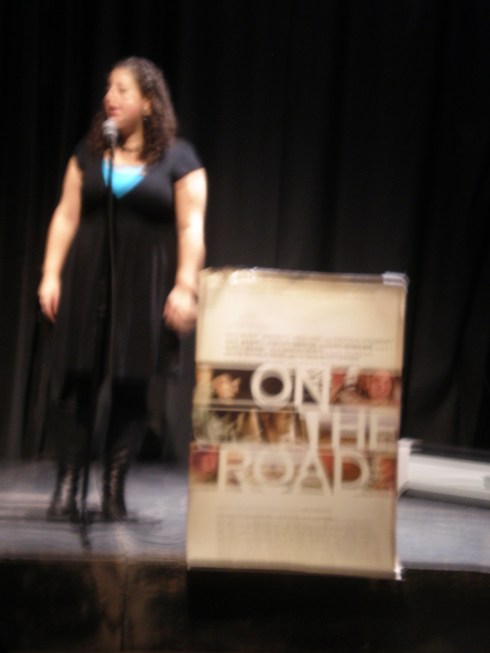
Checked out the Beat poetry slam at The Nuyorican Poets Cafe over on the Lower East Side during Beat Week. “We’re excited to be here in a proper poet’s cafe, celebrating a proper poet,” said host Mahogany Browne. The Nuyorican was cofounded by Miguel Algarin, who knew Jack Kerouac back in the day. Browne encouraged the audience to snap as she read a quote from On the Road “like the Beat poets” did “because they were too high to clap.” Of Kerouac’s famous novel, she said, “It’s a dude book. [The characters] get to travel all over the world and fall in love. I’d be too scared [to go on the road].” Hm… sounds familiar.

Browne, a poet in her own right, said the contestants would be “burning some poems on this motherf*cking mic.” She explained that slam is “the Olympics of poetry.” The poets were competing for a chance to win $50 and the soundtrack to the film adaptation of On the Road. The judges were told to rank each poet from 1 to 10, with decimals and exclamation points encouraged. The poets each had a unique style. Some poets appeared to be seasoned professionals, who had memorized their words, and others seemed like brave young artists. Even the quieter, dreamier poems were powerful. I love the way the photographs I took show the energy of the poetry.

There was also a Jack Kerouac trivia contest. I abstained from reading at the event and wasn’t planning on competing in the trivia contest, but when everyone was stumped, I couldn’t help but blurt out the answer. A teenaged girl in the audience wanted to win so desperately that she practically fell out of her chair trying to ask me for trivia answers. Instead of helping her cheat, I just gave her the winning copy of the On the Road novel. I’ve never seen anyone want to read a book that badly, and it was my little way of encouraging people to read Kerouac.

Afterwards I talked to one of the poets, a guy who’d been on the road himself. He was a truck driver and had also spent time studying painting in Syria. I liked how each poet had their own story to tell.


James Franco Reveals How He Was Introduced to the Beats

11 Dec

I was just thinking the other day that it had been a long time since I’d heard about James Franco. I’m serious! It seemed like a year or two ago James Franco was omnipresent. There’s James Franco sleeping in class at Columbia! There’s James Franco explaining it wasn’t technically class! There’s James Franco playing with a cat! There’s James Franco’s book! There’s James Franco teaching at NYU! There’s–well, you get the idea.

And then nothing.

I don’t know why, but I suddenly missed hearing about James Franco. Maybe it had something to do with the fact that we were both getting our MFAs. Or maybe it had to do with the fact that I thought his portrayal of Allen Ginsberg in Howl was authentic.

Well, wouldn’t you know it: today I stumbled upon The Los Angeles Review of Books‘ recent interview with James Franco. In the article, Franco discusses poetry, writing, and filmmaking. He talks about William Carlos Williams, Hart Crane, Allen Ginsberg, Frank Bidart, and his writer mother. He also says that even though he portrayed Allen Ginsberg in Howl it was another author who inspired his foray into Beat literature:

Kerouac came first. On the Road was my introduction to the Beats, but “Howl” was my introduction to poetry. I studied Williams in school, but I didn’t really study him as a craftsman until later, when I went to the writing program at Warren Wilson College in North Carolina.

He also reveals that he’s studying Beat literature with Amy Hungerford, who has written about Ginsberg’s supernatural language, in his PhD program at Yale.

Reading Recap: I Got Upstaged

12 Nov

I was completely upstaged at my last reading.

The last time I read at a Storytellers event at The Penny Farthing, I read a portion from my memoir about growing up Greek American.  I decided to mix it up a bit this last time.  Since I’ve been working really hard these days on Burning Furiously Beautiful: The True Story of Jack Kerouac’s On the Road, I selected a snippet from one of its chapters.  The reading itself went well.  A friend I hadn’t seen in forever surprised me by showing up, so that was super encouraging.  And one of the other performers shared their own travel experiences before it was my turn, so that was a nice little connection.  All of the performers — poets, musicians, monologists — were incredible.  Everyone was so talented and their artistry felt so effortless.

But we were all upstaged when the last poet takes to the mic.  The entire evening the MC had been playing the role of standup comic with eye-roll-inducing pick up lines.  When she announced the last poet, he started reciting a love poem to his girlfriend.  Then he stepped away from the microphone and opened a little box.  The room went wild!  His girlfriend went wild!  He had proposed!  It was like something out of a movie.  So sweet, so beautiful.

He stole the show.

Recap — with Photos! — of David Amram Reading

10 Sep


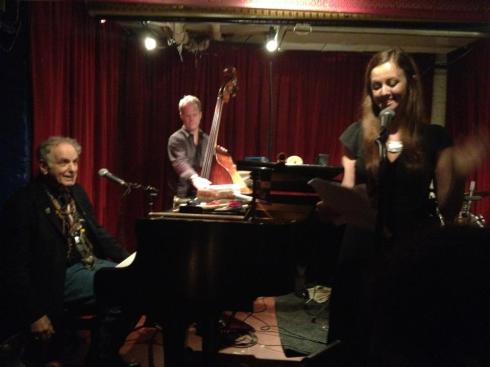
When musician David Amram introduced me before I read with him at Cornelia Street Cafe on September 3, 2012, he very generously said people should pay attention because one day they’d see me on television.  To me, though, reading with David Amram was a much bigger deal than being on television.  There are countless television shows, but there is only one David Amram.  While there are many fantastic musicians and writers out there whom I’d be honored to read with, there are few who hold such a special place in forming my creative identity as Amram does.

I first became acquainted with Amram through studying Jack Kerouac when I was just a teenager.  I was enamored with his improvised performance as Mezz McGillicuddy in the 1957 Robert Frank and Alfred Leslie film Pull My Daisy.  In fact, this photograph, featuring Larry Rivers, Jack Kerouac, David Amram, Allen Ginsberg, and Gregory Corso, who all collaborated on the film, is probably my all-time favorite photograph of the poets, writers, and artists associated with the Beat Generation.  It seems to so purely capture their friendship: just a couple of people hanging out at a cafe, maybe talking about the arts, or maybe just drinking coffee late into the night and enjoying each other’s company.

Although it was literature that introduced me to Amram, his music fascinated me.  Here was a musician who was more than just skillful.  Amram is an innovator.  He’s someone who experiments, improvises, blends genres, captivates.  He is, quite simply, mesmerizing to watch and listen to.

Through reading biographies on Kerouac and also reading Amram’s own biographies, I came to discover the jazz-poetry readings Amram and Kerouac began doing in the Village in 1957.  These were improvised sets, requiring each to masterfully foresee and adapt to changing tempos and moods in each other’s works.  These jazz-poetry collaborations captured my imagination, challenging my view of art and the way in which it’s created, the musicality of words, and the role of collaboration, improvisation, and performance in literature.  As I read about the collaborations in musty library books, forty-some-odd years after they’d taken place, I envisioned what it must’ve been like to be in the crowd at a painter’s loft or at the Circle in the Square.  Did the people there realize they were part of history?

In 2001, I had the opportunity to ask Amram just that when I interviewed him for some research I was doing at the time.  I sat enthralled, clinging to his every word, as he told me about all the places he used to hang out at in New York, about collaborating with Kerouac, and about how the term “Beat Generation” is just a marketing term that people later attached to the individual artists who each create unique works.  As he talked, answering all of my questions and never rushing me, and later as I read another biography of  his, I realized that Amram is the real deal — a creative genius and also a beatific individual, an artist who inspires and encourages.

Amram has been someone whom I’ve long admired, both on an artistic and a personal level.  Reading about those 1957 jazz-poetry readings he did with Jack Kerouac, I never imagined that one day I would have the opportunity to read the book I’m writing on Jack Kerouac with him.  When my former editor suggested we attend Amram’s show at Cornelia Street Cafe in the Village, I excitedly said yes.  A few days later, I had to email him back to say Amram had invited me to read with him.  It was completely surreal.

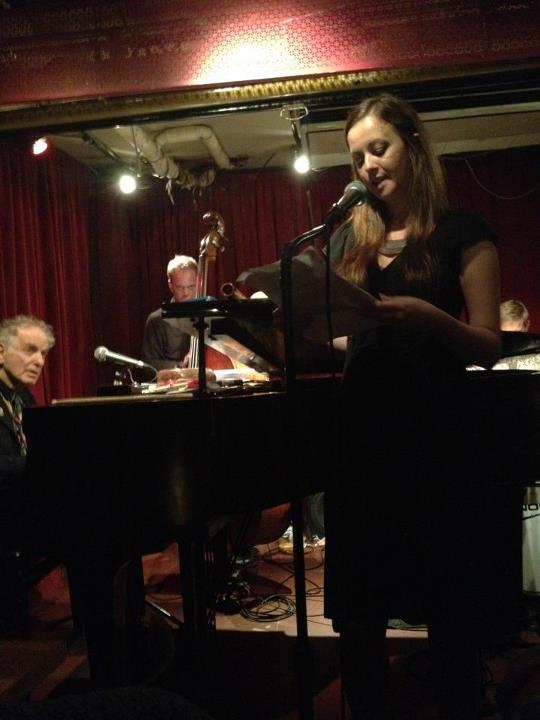
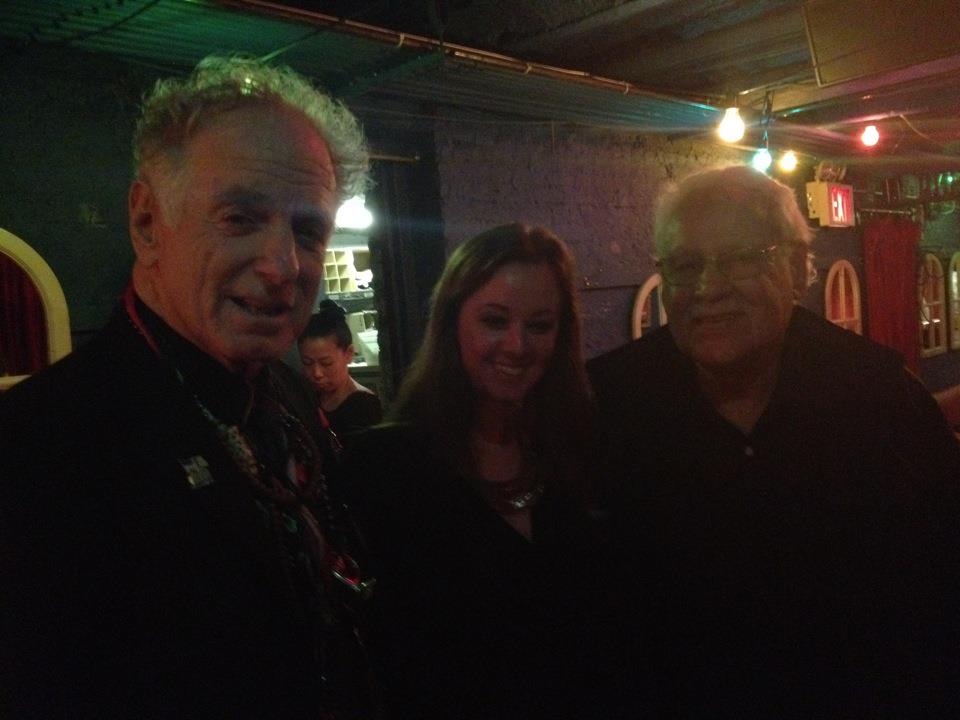
The September 3, 2012, show was completely sold out.  I had some friends who were turned away at the door.  Special thanks to Cornelia Street Cafe’s Robin Hirsch and the staff for hosting the reading and for doing such an excellent job in organizing the event.  I read a short selection about Kerouac’s time in Mexico from Burning Furiously Beautiful: The True Story of Jack Kerouac’s On the Road, the book I’m co-authoring with Paul Maher, Jr.  It was really exciting because author Larry Closs and painter Jonathan Collins, both of whom I met through the Burning Furiously Beautiful Facebook page, were in the audience.  Poet and producer RA Araya, who has been hugely supportive of my work and whose birthday bash was the premiere reading from Burning Furiously Beautiful, was also there, and graciously provided the photography you see here.  I had some other family and friends there as well and am so appreciative of their support.  It means more to me than most people realize.

As soon as my videographer, Liz Koenig, sends the video, I’ll post it so you can hear me reading with David Amram and his band.  The band, consisting of Amram, Kevin Twigg, and John de Witt played so beautifully — even more of a feat, considering Twigg had hurt his hand before the show.  The music was haunting and fit the piece that I read so perfectly.  I wanted to remain present in the moment, to really hear what they were playing, and savor the moment.  It was one of those times in life that I wanted to tuck into my heart and cherish.


David Amram, Stephanie Nikolopoulos, Joe Pacheco
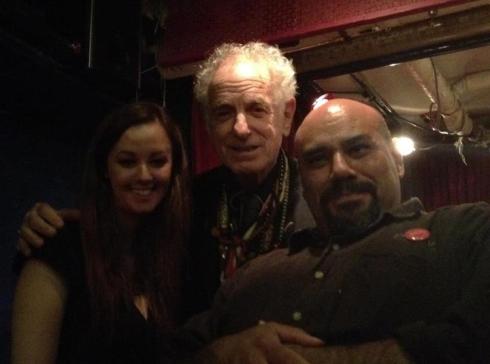
Stephanie Nikolopoulos, David Amram, RA Araya

Character Growth in “On the Road”

27 Aug

A friend of mine told me he was reading On the Road and couldn’t figure out what the point of the novel was.  He was only partway through and wanted to know if the characters ever grow.

I thought it was such a fascinating question!

As I’ve posted before, I do believe that the narrator, Sal Paradise, grows.  He is exceedingly complicated.  He’s zigzagging across America, refusing to conform to society.  And yet he keeps stating that’s what he so desperately wants.  He wants the house and the wife.  Likewise, he’s Sal Paradise—oh what a name!—is out cavorting with a car thief, and yet he’s constantly thinking about God and heaven and the holy.

I guess I can kind of relate to Sal Paradise a bit, and maybe that’s why I feel like the whole notion of whether his character grows is a complicated one.  I so often feel torn between two things that don’t seem to fit together.

I don’t know if it’s an American thing or a contemporary reader thing, or both, but it seems like we have this notion that characters have to change, grow, evolve.  We want them to become people by the end of the story.  …I guess that’s because we want that for our own lives.  We like inspirational stories—be they self-help books or Hollywood movies.  We think if this lowly character can overcome this-or-that, maybe we can too.

But how often does life play out like an inspirational book or movie?  Isn’t it more often the case that life is pretty mundane?  That we continually struggle with the same issues over and over again?  Aren’t we always searching for meaning?  Significance?  Trying to understand ourselves better?

I suppose if I’m honest, I do want to like the characters I read about, and I do want them to grow.  But I don’t think they have to.  I think part of what I love about On the Road has more to do with the language.  I’m not a huge fan of Kerouac’s poetry—though I do enjoy a few of his haikus—but I love the poetry imbued in On the Road.  I love reading his novel because of how sensual, visual it is.  I feel like I’m looking out the car window with him.  I don’t really care whether he’s in California or Mexico, whether he’s picking cotton or hitchhiking.  It’s all just so beautiful.