Tag Archives: social media

The Next Big Thing Blog Hop

21 Nov

I am so excited to have been tagged by Maria Karamitsos for the The Next Big Thing Blog Hop.  Even though I’m not a mother, I love reading Maria’s blog From the Mommy Files, which is full of humor and light.  She has the gift of storytelling.  Her blog entries read like snippets of a novel-like memoir, with dialogue, reflection, and a strong voice, despite the fact that much of her writing is focused on what could be a very technical topic: molar pregnancy.  Take for instance, her post “The Influence of the Lost Child,” in which she talks to her two adorable little girls—”BooBoo BeDoux” and “Bebs LaRoux”—about the baby she miscarried.  It’s a difficult and heartbreaking subject, yet she injects humor in it through the personalities of her daughters (“it’s tough to be 3, after all!”) as well as tenderness and faith.  I’m really excited about the book she’s writing called Positive About Negative: Adventures in Molar Pregnancy.  Maria also tagged some other Greek authors for the Blog Hop, and it’s great discovering all these writers.

I’m tempted therefore to write about my memoir about being Greek American, but since my book on Jack Kerouac is coming out first my answers to the Blog Hop questions are about that book.

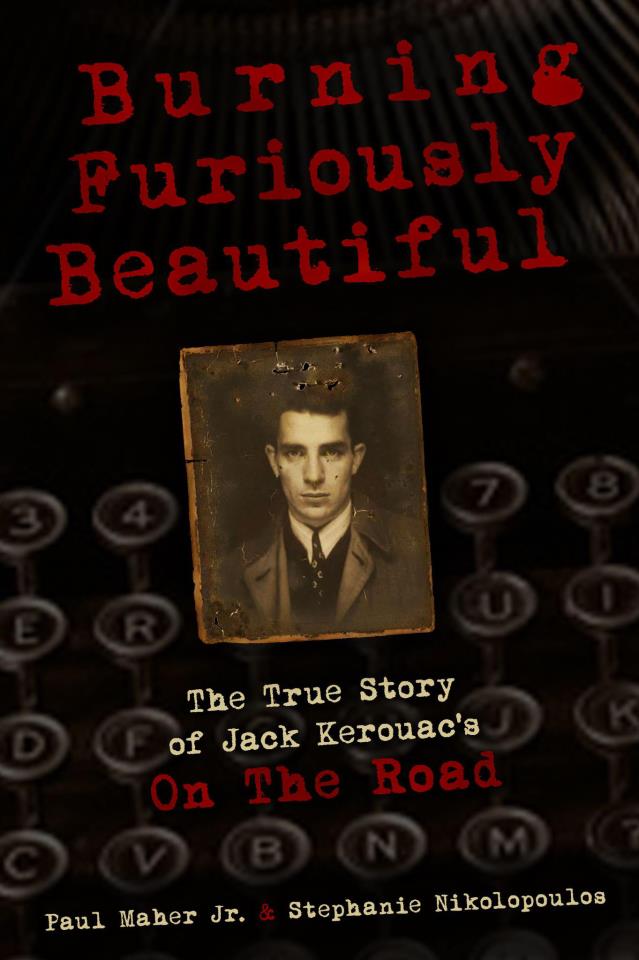
What is the working title of your book?  Burning Furiously Beautiful: The True Story of Jack Kerouac’s On the Road

Where did the idea come from for the book?  Paul Maher Jr. had written a book entitled Jack Kerouac’s American Journey: The Real-Life Odyssey of “On the Road” for the fiftieth anniversary of the publication of Kerouac’s seminal work.  I had read this book one summer and some months later began reading Paul’s blog.  We began talking and decided to revise and expand his book because we knew that a film adaptation of On the Road was coming out and we wanted to provide a resource for those interested in finding out more about this famous novel.  It was important to us that the book had a strong narrative, contextual information, and new research because we wanted both the teenager turned on from the film and the literary scholar who’s read every book by Kerouac to enjoy it and find value in it.

What genre does your book fall under?  It’s literary criticism and biography.

Which actors would you choose to play your characters in a movie rendition?  Isn’t that the million dollar question?  There’s been a lot of talk over the years about who should play Sal Paradise and Dean Moriarty in the film adaptation of On the Road.  Johnny Depp, Brad Pitt, Colin Farrell, Marlon Brando, you name it, they’ve been associated with it.  I almost never go to the movies and don’t really know the young actors of today well enough to say who would be age appropriate to cast.  Joseph Gordon-Levitt?  Zac Efron?  These actors are too old to play the roles now but if I were casting the film back when I first read On the Road as a teenager, this is who I’d pick:

  • Sal Paradise — Johnny Depp and Ethan Hawke would be excellent choices for Sal Paradise, particularly because they both have a deep appreciation for literature.  Depp is a known Kerouac fan and just started his own publishing imprint, and Hawke is a published author.
  • Dean Moriarty — Woody Harrelson would make a great Dean Moriarty.  He can play both earnest and wild so well!  Matthew McConaughey would be great as Dean too.
  • Carlo Marx — I loved James Franco’s portrayal of Allen Ginsberg in Howl, but if I had to select someone else I might go with Adam Goldberg.
  • Old Bull Lee — The choice of Viggo Mortensen as Old Bull Lee for the Walter Salles film is brilliant, but again if I had to choose someone else maybe I’d with Ewan McGregor.
  • Marylou — Drew Barrymore would be so much fun to watch as Marylou.  Do you remember her in Mad Love and Boys on the SideAlmost Famous hadn’t been made yet when I was a teenager but Kate Hudson (think Penny Lane) would be my runner-up pick.


What is the one-sentence synopsis of your book?  Burning Furiously Beautiful tells the true story of  Jack Kerouac travels on the road and how it took him years, not weeks, to write On the Road.

Will your book be self-published or represented by an agency?  We decided to self-publish Burning Furiously Beautiful.

How long did it take you to write the first draft of your manuscript?  The first draft, so to speak, had already been written and published as Jack Kerouac’s American Journey.

What other books would you compare this story to within your genre?  There have been so many biographies of Kerouac written over the years, and each offers its own perspective.  Burning Furiously Beautiful uses Kerouac’s journals and letters, as well as archival material from other people who knew Kerouac during the time he was on the road and writing On the Road, to tell a the specific story of the making of a novel that continues to generate interest today.

Who or What inspired you to write this book?  Obviously, Paul Maher Jr. inspired Burning Furiously Beautiful as it was his original idea.  I, however, had been researching and writing about Kerouac since I was an undergrad many years prior to this and brought my own knowledge and skills to the project.  I was very much inspired by the fact that the film adaptation is soon to be released here in the States.  There’s a whole new generation coming to Kerouac’s literature, which is immensely exciting to me.  Reading Kerouac when I was in high school opened up so many possibilities for me as a reader and writer.  I hope that the film will pique people’s interest so that they’ll go back and read Kerouac’s books for themselves—not just On the Road  but his other great works as well—and that they’ll watch Pull My Daisy, the film that Kerouac himself spontaneously narrated.  Burning Furiously Beautiful is important because it contextualizes On the Road and provides a fascinating look at Kerouac’s life and writing process.  This is critical because there’s so much myth surrounding Kerouac and the 1950s.  I became engrossed in odd little details like the fact that the Kerouac’s didn’t have a phone and took their calls at the store below their apartment in Queens.  It’s so different than today when it seems like every middle schooler has a cell phone.  If Cassady could’ve just called Kerouac up on his iphone, he might not have written the infamous Joan Anderson letter that spurred on Kerouac’s writing style.

What else about your book might pique the reader’s interest?  Burning Furiously Beautiful is a great book for an aspiring writer, regardless of whether or not you like Kerouac’s writing style.  It’s a portrait of a young writer and details how his writing voice developed (his first book has a much different style), what his writing routine was, the editing process (yes, there was one!), what his relationship with other writers and editors was like (imagine lots of parties), and the many false starts he had in writing his book.  We even talk about book signings, contracts, and press interviews.  Sometimes I’ve felt frustrated with various writing projects of mine, but realizing that Kerouac, who purported to have written On the Road in only three weeks, went through some of the same struggles and took years to find success makes me realize that it’s all part of the writing process.

I tag:

Emily Timbol

Nana Ekua Brew-Hammond

Larry Shallenberger 

Michael D. Bobo

Check them out!  They’re each really different from each other.

Writing Wednesday: Why I’m Tweeting and Posting on Facebook

26 Sep

I have a nifty little free newsletter that you can sign up for over there on the right-hand column of this blog à.  All you have to do is type in your email address, and you’ll automatically receive notification whenever I post a new blog entry. Those who are signed up for my free newsletter find out about my blog articles first.  The second an article gets posted, subscribers get notification.

A lot of you come to my website through Facebook and Twitter, though.  I generally post on Facebook that I have a new entry up about three hours after the entry posts.  I should probably sync my Facebook and Twitter accounts through HootSuite so it posts to Twitter at the same, but I haven’t done that yet.  I don’t have any particular reason why.  I just tend to use my Twitter account a little differently and less frequently.  My Facebook account tends to be more personal.  On Twitter, I post more publishing and Beat news.

Since a lot of people prefer not to sign up for the newsletters, social media is a great way for me to keep people up to date on what I’m writing about.  But it does more than just drive traffic to individual articles I post.

According to AllTwitter, social media is “strongly correlated to Google search engine rankings.”  Check out this incredible fact:

Facebook is the highest correlated factor when it comes to search engine rankings – even higher than on-page optimization like domain name keywords and traditional off-page optimization like backlinks.

Before returning to book publishing, I used to do SEO (search engine optimization) for a company.  It’s incredible to think that social media may have even more influence on page rank than SEO.

It also says that sharing posts is one of the biggest ranking improvers.  So feel free to share my blog entries with your friends on Facebook and Twitter!

That’s my story, but it should be yours too.  I’ve spoken to many of you one-on-one about the importance of blogging and social media.  If you’re an aspiring writer, you need to build a platform, an audience of readers.  Being a good storyteller just isn’t enough these days, unfortunately.  Publishers want to know you have a built-in readership.  If you have a blog, it’s super easy to post it on Facebook, Twitter, and Google+ whenever it gets updated.  And sites like Hootsuite, make it even easier to do it quickly and efficiently.  Why aren’t you using social media to build your writing career?

Writing Wednesday: Building Your Book Before You Even Begin Writing It

5 Sep

David Krell’s article “From Book to . . . Blog? Inspiration for the Aspiring Nonfiction Author,” published in Publishing Perspectives is jam-packed with great advice for nonfiction writers.  To sum it up succinctly: start garnering interest in your nonfiction book before you even publish it.

Krell offers five tips on how to build your author platform before you’ve even published books.  He advises that you can score interviews and forewords for your book as well as lectures at conferences before you’ve even finished writing your book.  This, in turn, will improve your chances of writing a well-informed book, obtaining a reputable agent, and selling your book successfully because you’ll have taken the time to build up your reputation as an authority on the subject and gotten other authorities on the subject to contribute to your book.  You should read his tips on Publishing Perspectives for more insight on how to begin building your platform and become a successful author now, even before you’ve written a book.

In relation to Krell’s advice, here are a few questions I think a nonfiction writer should start thinking about as early as possible:

Who is your target audience?

What are the sub-themes of your book?  What are the various angles you can use to market your book?  (Krell’s book is about the Brooklyn Dodgers, but his friend suggests it’s also about urban history.  One of my books is a memoir about growing up Greek American in New Jersey.  It touches on family dynamics, coming-of-age stories, New Jersey, Greece, identity, and the immigrant experience.  Another of the books I’m working on is about Jack Kerouac.  Looking at it through a broader lens, it could appeal to anyone interested in the Beat Generation, the 1940s and 1950s, travelogues, and American history.)

Who would you like to interview?  (Approach them now.)

Who would you like to write your foreword?  (Approach them now.)

Who would you like to blurb your book?  (A blurb is the endorsement on the back of a book.  Approach people now.)

What associations are there for your subject?  (Sign up for the mailing list, get to know its leaders, volunteer to help with an event or to write a guest blog entry.)

What conferences are held on your subject—or on your sub-theme?  (Begin attending, meeting people, speaking.)

What websites are about your subject or sub-theme?  (Sign up for their newsletter, leave comments on their posts, offer to guest blog.)

What books are similar to yours?  (Read them to get ideas.  Also, read the acknowledgements to find out who their agent is.  Begin following the agent’s work to see if you’re interested in signing with them.)

Are there any other questions you would add to the list?

By thinking about these questions now, you’ll have a clearer vision of where you’re headed.  You’ll also be more motivated to continue writing because you’ll have people who are already invested in your success.

Happy writing!

3 Takeaways on Blogging Advice from A Cup of Jo

22 Aug

It’s been a while since I’ve posted anything about social media, but when I ran across this article, “Blogging As a Career,” with A Cup of Jo’s Joanna Goddard, I knew I had to share it with you.

You’ll want to read the whole article because there’s a tenderness to it, touching on heartbreak and personality types, but here are my three takeaways:::

Follow your dreams. – As cliché as this may sound, you can’t force yourself to enjoy a career that isn’t the right fit for you (in Joanna’s case, law).  You’ll be more successful when you discover what you want and really go after it.  Following your dreams is not easy.  It requires sacrifice.  You may end up not even being able to afford to add a sliced tomato to your bagel with cream cheese.  You may have to work on your honeymoon.  But it’s worth it.

Don’t be afraid to fail. – Sometimes the things in life that feel like the most excruciating at the time, end up propelling you forward.  There is risk involved in work and love and life.

Stay true to yourself. – There are so many blogs out there.  Don’t try to copy other blogs.  Blog in your own voice.  As Joanna says, “When you write a post, imagine your mom or best friend reading it.”  To earn a living as a blogger, you need to secure advertisement; choose companies you love.

Joanna also gives advice on work-life balance, how to start a magazine career, and other insight, so check out her complete interview on her blog.

Parallel Generations

19 Jul

Why is Hollywood taking an interest in the Lost Generation and the Beat Generation?  Are there parallels between the generations of the past and today’s generations?  Is history cyclical?

From a historic standpoint, it makes sense that today’s generations are looking back at the Lost Generation and the Beat Generation.  Like the Lost Generation, the current generation has experienced war.  Although the Lost Generation predates the Great Depression by a few years, novels such as The Great Gatsby have much to say about the disparity of wealth, a topic that this generation has dealt with during the Great Recession.  Part of the seedy wealth distribution of the ‘20s had to do with bootlegging.  Prohibition may not be something today’s candidates have on the table, but there’s a definite right-wing conservatism bent influencing culture today.

The Beat Generation writers were those who were born around the time of the Great Depression and came of age during World War II.  Kerouac and John Clellon Holmes actually were thinking of the Lost Generation when they came up with the idea that they were the Beat Generation.  The obvious parallels between the two generations being the world wars.  While the Lost Generation was going into the Great Depression, the Beat Generation was coming out of it, and so while the Lost Generation was more about decadence the Beat Generation was more about simplicity.  Perhaps, then, today’s older generation is looking toward the Lost Generation and the younger generation looking towards the Beat Generation for confirmation on the way we live our lives.

After all, generations have followed suit in this pattern of economy and war since these generations.  The Baby Boomers were all about the money, and then Generation X was the slacker generation.

Since then we’ve seen Generation Y, also known as the Millennials or Generation Next, who are often thought of as privileged Trophy Kids.  These are the eighties babies (give or take) that are now in their twenties, a few even in their thirties.

Generations X and Y heard Reality Bites, My So-Called Life, and Fight Club tell us our great war was within ourselves.  –And then the terrorist attacks took place on 9/11.  It was around that time that Generation Y turned to indie music, the locavore movement, and reviving arts and crafts.

After that came Generation Z, or Generation I, the kids born in the ‘90s, for whom the Internet, the War on Terror, and the Great Recession are a way of life.  Generations Y and Z are the i-generation, each having their own personal computers, finding fame on blogs and in social media, the generation that is connected and disconnected.  They began looking back at Generation X, wearing flannel.  Miley Cyrus was photographed wearing a Nirvana t-shirt.

The Pew Research Center has a fascinating report that charts the different Generations’ attitudes toward politics, religion, immigration, marriage, and more.

Technology is developing at a faster and faster rate, and with it, generations are shortening and multiplying.  When you think about it, iphones models are even called by their generation, as in the second generation iphone, acknowledging how much generations are defined by technology, as well as money and politics.  Therefore, it’s easy to see how certain generations blend together, which may also be a result, as the Pew Research Center data seems to suggest, of the delayed adulthood.

What generation do you identify with?

Social Media Lessons from SXSW 2012

11 Jul

Calvin Reid makes insightful remarks about the role e-technology and social media are playing in publishing in “SXSW 2012: New Publishing Models and the Rise of the Referral Economy.”  If you’re new to publishing and looking to make your mark on the industry and find readers, I’d highly encourage you to read the entire article.  To his point on “curating,” here’s some remarks of his that you might find especially helpful:

  • “Altounian said he’s targeting a demographic under the age of 40 that wants to read on an array of devices anytime they want and they don’t want to pay much, if anything, for the content they read on them. … Altounian was making the point that, at least for emerging artists, getting their content in front of readers through traditional publishers is an uphill battle that doesn’t work for everyone; that his goal is to build a list of self-branded artists (using social media tools) and by offering some free content now, and some for-pay content later when the freebie-oriented audiences for these artists reaches critical mass and wants more of their stuff.”
  • “Certainly one of the most intellectually vivid panels was Curators or the Curated, a panel examining the phenomenon of content sharing—essentially the practice of any and everyone linking to content and sending it out to followers and friends around the web—and what that means to publishers, creators and the curators themselves. … In theory curators bring attention to content and drive traffic to the original site; in practice some curators are having more impact than the publications they curate from. And its generated a debate about the practice and what it means—and of course how to monetize it.”
  • “He also rejected some of the anti-advertising curatorial comments, noting that business platforms were important and that he had worked for a Minn.-based newspaper that did away with escort ads and the loss of revenue killed the newspaper.”

What I take away from this is the following:

Writers need to start building a platform NOW—as in, even before we’ve written our book, we need to start curating content on our subject matter.  This means tweeting, forwarding, and “liking,” other writers’ posts related to our subject and also blogging, tweeting, and writing our own status updates on our subject.

Generate content and don’t be afraid to give it away for free.  It’s better to give our writing away for free in the beginning so that we can establish ourselves as authorities on that topic and/or as interesting storytellers.  Eventually, people will love you and want to buy your writing—but it might take a lot of giving your work away for free first.  Michael Hyatt is a big proponent of giving away free content.  Not only does he give away valuable information on his blog, but he also created an ebook that he gives to anyone who subscribes to his blog.  Both the blog subscription and the ebook are free.

Don’t be all holier than thou about advertising.  Solicit advertising for your blog.  I personally would suggest keeping your advertising in line with your brand—and your brand should probably be consistent with how you’d want to be thought of by your friends and parents as well.  What I mean is, I personally would rather go hungry than earn money from escort ads.  The best ads are going to be ones that relate to your subject matter.  So if I’m writing about Greek identity, ads about learning how to play the harmonica aren’t going to be controversial but they won’t be as relevant as ads about learning how to speak Greek.

Humbly consider the rights to your content.  Bloggers may quote rather heavily from anything you post—and by heavily, I mean they might use your work entirely and just give you credit via a link.  This might be a breach of your copyright, but before you get your knickers in a bunch consider if their promotion of your work might be helping you out with some free advertising.  Maybe it’s bringing new readers to your work.  …But then again, maybe it’s not.  Therefore, always be careful with what sort of content you put on your blog.  Sure, someone could pirate your whole book, but it’s more likely someone will repost a blog entry than your entire book.  With that in mind, be prepared that what you publish on your blog might end up elsewhere.

Pay attention to your e-rights.  Landing a book contract is about more than just the print rights these days.  Make sure your contract expressly states an agreement about electronic and print-on-demand editions.

It feels like writers—and artists of any sort—get a raw deal.  We have to give a lot of free content away.  Professionals in other industries don’t seem to have to do this to the same extent.  Lawyers may work an occasional pro bono case, but they’re not expected to work for free before making it big.  Doctors may do Doctors Without Borders to give back and help people, but this is a personal choice they make.  I suppose in some ways artists giving away their work—and having it stolen from them in the case of extreme curating—is an internship of sorts, but the difference is that artists are expected to intern their entire lives or at least until they hit it big.

Therefore, I’d encourage all artists to be savvy.

Yes, you might feel pressured to build your platform and give away content for free, but make sure you’re getting something in return for your investment.

Don’t let your platform overtake your writing.  Your platform is a means to an end—your book project.

Use the system.  There’s nothing wrong with giving away content for free.  There’s nothing wrong with soliciting ads.  There’s nothing wrong with social media.  Don’t let anyone or any platform rule over you.  Keep your goals in perspective and use the system to your advantage.  Find your target audience, make connections, earn money, promote your projects.

You can find me not only here on this blog, but also on Twitter, Pinterest, and Google+.

Hipsters Hate Driving

3 Jul

I knew I was getting old the day I saw a car commercial where the driver was clearly younger than I am.

So here’s an interesting bit of news: Generation Y doesn’t like to drive. According to Reuter’s “America’s Generation Y not driven to drive,” the Millennials think driving is more of a hassle than it’s worth.  A California think tank analyst, Tony Dudzik says instead of a driver’s license, a cell phone is the new rite of passage for young adults.

The article points to a few different reasons why Generation Y may be less interested in driving:

  • Smart phones make it easier to know public transportation schedules
  • More Gen-Yers are riding bikes
  • People are more concerned about saving the planet
  • Car-sharing services are making it easier not to have to own a car

From a cultural perspective, this makes total sense.  Gen Y is the hipster culture.  The kids in Williamsburg who listen to low-fi indie music on their hi-tech iphone, knit water-bottle cozies that they sell on etsy, ride their bicycles to work, buy their clothes from Buffalo Exchange, spend their weekends at the food coop, brew their own craft beer, and vlog on YouTube. If they drive, they drive hybrids. Because they’re all about the i-this and the i-that, they seek out community more intentionally. Who needs a car, if your friend or parents (they also happen to be the Peter Pan Generation, living at home after college) have one?

I personally fall somewhere between Gen X and Gen Y, making me part of Generation Flux.  Generation X refers to people born between the early 1960s and 1980s, while Generation Y refers those born between the late 1970s and the 2000s.  I know when I was growing up, there were a lot of cultural arts programs in the school about saving the rainforest and saving the whales, we studied acid rain and the ozone layer, and we joined KAP: Kids Against Pollution.  In drivers ed, they pretty much terrified you with statistics, photos, and videos that suggested it was likely you were going to die if you got behind the wheel. The shows that were popular when I was a teen were Mad About You, Seinfeld, Friends, Will & Grace, and Sex and the City, all of which were set in New York City.  Other popular shows like Ally McBeal, Frasier, and ER were also set in cities. Our stars didn’t drive.  They took cabs and rode the subway. Is it any surprise that we moved into the city and followed suit?

So will a generation who grew up watching Paris Hilton, Lindsey Lohan, and Snooki getting arrested for driving under the influence and/or crashing their cars, a generation coming of age during the Great Recession, a generation who doesn’t care about driving, embrace the 1950s road trip adventure of On the Road when the movie comes out and the novel by Jack Kerouac it is based on?  Well, here’s another interesting twist: Jack Kerouac didn’t like driving either. If you read his novel, you’ll see that most of the time, the character based on him in the novel is on the bus or in the passenger seat.

How do you feel like the era you grew up in influenced you?

Now you can “like” Burning Furiously Beautiful on Facebook!

Mixtape: Music and Poetry for On the Road

28 Jun

photo via Aunt13’s 8tracks mix

Aunt13 over on 8tracks made a mix called Music and Poetry for On the RoadIt’s inspired by Jack Kerouac’s On the Road and in the blurb she mentions Burning Furiously Beautiful!  How cool is that?!

I have the coolest friends!  I am going to be listening to this while I write, for sure, and daydreaming of hitting the road.  Aunt13 has over 300 mixes, so be sure to show her some love.

You may recall I posted a while back the soundtrack for the On the Road film.  It was just announced yesterday that the film will be making its US debut in late fall.

J. Haeske also made a mix for the soundtrack he’d envision for the film.  Teaser!  I have an interview with him about his new book on Kerouac lined up for you, so stay tuned.

What songs would you put on a mix for On the Road?

Also, I took my own advice about social media, and created a Facebook page for Burning Furiously Beautiful: The True Story of Jack Kerouac’s On the Road, the book I’m co-authoring with Paul Maher Jr.  Be sure to “like” the book on Facebook!  We’ll be posting news about the book, information from Across the Underwood, updates on the film, and so much more!

I Heart Social Media

27 Jun

Image by Dallas Shaw

One of my favorite aspects of working in book publishing is my involvement in social media.  I absolutely love crafting Tweets!  It’s so much fun coming up with fun and unique ways to promote the books I’ve loved working on and want the world to know about.

Social media is also important to me as a writer.  Even before an author publishes a book, she must have a “platform”—she must be cultivating readers interested in her expertise and enthusiasm on a given subject.  I’m on this blog, Twitter, Facebook, and Pinterest so I can share with you my latest obsessions and ideas, give you a little sneak peek into my so-called literary life, and hopefully inspire other writers and readers to do the same.  The world’s a lot cozier when we know we’re not alone in our endeavors.

That’s why I’m also addicted to following other social media gurus.  One of my favorite is DKNY PR GIRL.

I love reading her #PR101 tips and her blog in general.  If you’re just starting out in social media, check out the social media tips she gave to Teen Vogue.

Dear readers, what social media platforms do you use?  Will you do me a favor and post them in the comments section?  I’d love to subscribe/follow/friend you! xoxo

Goodreads Page for Burning Furiously Beautiful

7 Jun

We’re on Goodreads!  Now you can add Burning Furiously Beautiful as a to-read on Goodreads.