Novelist Breena Clarke — whose book River, Cross My Heart was an Oprah book club pick! — recently interviewed me for the Hobart Festival of Women Writers blog.
She asks:
Clarke: I’m of the generation that kind of took our counter-culture marching orders from the Beats. You’re a couple of thousand years younger than me. How did you fall under the spell of Jack Kerouac and the Beats?
You can read my answer that question and her others here.
I’m super excited to be participating in the Festival of Women Writers again this year!
Even though many successful — and I mean New York Times best-selling authors — authors have turned to self-publishing, self-publishing today still carries a certain stigma to it. Many readers think that if an author self-publishes, it means he or she failed at landing an agent or a publisher. That may be true for some authors.
However, there’s another truth.
There are some authors who self-publish and then get picked up by major publishers. There are other authors who never bother trying to place their work with so-called traditional publishers at all. Further, some authors have found critical and monetary success in traditional book publishing, and then have turned to self-publishing.
I am an editor at a book publishing house, so I’ll say that I have firsthand experience as to the many benefits of signing with a traditional publisher. That said, there are also benefits to self-publishing. I don’t think it’s an either/or situation. I think it’s a matter of knowing your strengths and knowing what works best for you and for your book.
There is no shame in making the decision to self-publish. It gives you complete creative control over your words. This includes selecting the title for your book. Many first-time authors don’t realize that, though they submit their book with a title idea, the editors, marketers, and publishers at traditional publishing houses have the final say and may completely alter your title. Same goes for cover. Most authors have little, if any say, as to their cover design. As a self-publisher, you make all the decisions. You also generally have a higher profit margin, though you personally will incur the cost of hiring an editor, hiring a cover designer, hiring someone to layout your interior pages, printing the book, marketing the book, shipping the book to retailers, and so forth. There’s an incredible amount of dedication and work that goes into self-publishing. It’s not the easier route.
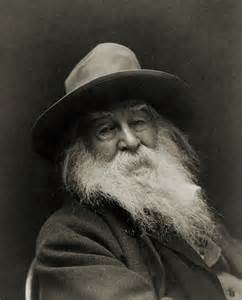
And if someone still shames you for self-publishing, just tell them Walt Whitman did it.
Walt Whitman self-published the seminal poetry collection Leaves of Grass in Brooklyn in 1855. Bridges and schools have been named after him. His birth home is a pilgrimage for poets.
For the 150th anniversary of the self-published book, literary critic Harold Bloom said:
If you are American, then Walt Whitman is your imaginative father and mother, even if, like myself, you have never composed a line of verse. You can nominate a fair number of literary works as candidates for the secular Scripture of the United States. They might include Melville’s Moby-Dick, Twain’s Adventures of Huckleberry Finn, and Emerson’s two series of Essays and The Conduct of Life. None of those, not even Emerson’s, are as central as the first edition of Leaves of Grass.
I don’t mind being in the company of Walt Whitman. Do you?
One of the best decisions I ever made was attending Scripps College. I accepted their offer of enrollment sight unseen. I had never even been in California before arriving a few days before orientation!
I made so many great friends — and I’m STILL making new friends because of Scripps.
A few years after graduating, I began attending the New York chapter of the Scripps alumnae book club. At the time, I didn’t know a single person who attended the book club. None of them were from my graduating year. In fact, it was only after I’d been attending for over a year that someone I’d actually known when I was attending Scripps as an undergrad began attending book club and we reconnected. What’s great about the alumnae book club is that I’ve met so many new smart women, some around my age, some much older, and some much younger.
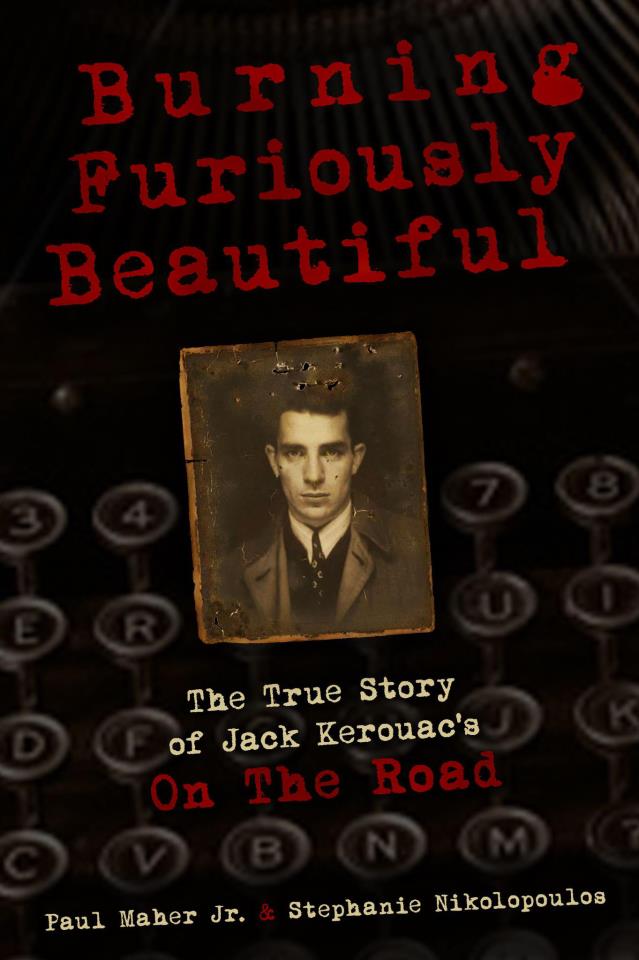
These women from my book club have been so supportive of me. As I posted a while back, they selected the book I coauthored with Paul Maher Jr., Burning Furiously Beautiful: The True Story of Jack Kerouac’s “On the Road,” for their January 2014 read and invited me to speak about the book.
I haven’t been supported just online, though. In the Winter 2014 issue, Scripps Magazine featured me (see page 40) in their regular column “ManuScripps” about Scripps authors.
It’s not just Scripps, though. The New School, where I received my MFA, has also supported me. Every week during the academic year, the Creative Writing program emails a newsletter of students’ and alumni’s publications. It’s sent through email to those who attend or have attended the graduate program so I don’t have links to share with you (though the New School Writing is on Twitter!), but they have generously announced my publications.
Does it sound like I’m bragging? Well, I am. I went to a GREAT undergraduate college and a GREAT MFA. I feel so supported by the community I had while I was attending and also by the new community I’ve made back here on the East Coast.
But I’m not any more special than you. YOUR college would love to hear from you. Colleges love to brag about the success of their former students because it makes them look great too.
They’re also always looking for stories to fill the pages of their newsletters. Don’t expect them to keep tabs on you and know about your every publication, though. Many people who work on these publications are interns, work-study students, or volunteers who don’t have time to track you down and see what you’ve been up to. You have to tell them! They want to brag about you, but they have to know how first.
What to send to your alumni network:
Do the hard work for them by sending your alumni publication full details of your latest story any time you get something new published. That means: your full name (perhaps maiden name if you got married), your graduating year, the title of the piece, what type of piece it was, who published it, when it was published, and a link to the story (if applicable).
It’s not just about you
Be sure to give back, though. Class participation counts when it comes to fundraising campaigns, so even if you can’t give a lot, just by giving you’re contributing to the college’s efforts. If you’re a starving artist, there are other ways to give back too, such as submitting free articles for the alumni magazine, meeting with prospective students in your town, fostering a sense of community amongst alumni by congratulating individuals on their achievements, participating in regional alumni events, informing your alma mater about internships and job openings at your place of business, and mentoring recent grads. Cheesy as it may sound, it’s actually a real ego boost to be able to help others. Real success is being good enough at what you do to help others become better at what they want to do.
I’m not one to blog politics, but I will talk copywriting: these two headlines grabbed my attention and made me actually laugh out loud. It sounded like an Onion article! I kind of love the fact that they’re so outlandish and made me think about politics and the media.
Are some Republicans seriously against writers getting to use a seat that would’ve otherwise gone empty on a train? Of allthethingsgoingonintheworld, is Amtrak’s residency really worth the political hubbub? Did the “liberal media” exaggerate and twist what Republican senators actually said? Are the senators’ concerns that the taxpaying public has subsidized Amtrak services with $1.5 billion and yet are giving away free tickets legitimate? Should the government help fund writers and those in the arts as a means toward furthering our cultural heritage?
When the Amtrak Writers Residency was announced a few weeks ago, friends came out of the wood works to urge me to apply. After all, writing and being on the road is my literary jam.
No matter what your politics are and your stance on copyright, Amtrak’s certainly made headlines. Someone in their marketing department is doing something right!
You, yes YOU, have the power to select the winners of the 2013 GABBY Awards. What’s that? You’ve never heard of the GABBYs? Where have you been, my friend? The GABBY Awards celebrates Greek America’s best and brightest:
The Gabby Awards were created to celebrate those Greek North Americans who strive to be the very best at what they do. Whether in business, philanthropy, the arts, education or other areas of interest that our awards cover, we celebrate the pursuit excellence as a core Greek ideal and are inspired by people who pursue excellence.
The name “Gabby” comes from the acronym “Greek America’s Best and Brightest Stars” and the Gabby has quickly become the top achievement awards for Greek North Americans. The awards are based on a purely meritocratic system that involves a 100-member Academy that determines the nominees, followed by a popular vote via the internet.
I attended the 2011 GABBY Awards on Ellis Island, which were AMAZING. Here are my recaps.
This year, the star-studded festivities will take place in Hollywood.
And the nominees are….
…Drum roll, please!
Business & Entrepreneurism
Sophia Amoruso, Founder and Owner, Nasty Gal (fashion)
George Kalogridis, President, Walt Disney Resort
Arianna Huffington, Journalist and Founder of the Huffington Post
Politics & Public Service
Andromache Karakastanis, Justice of the Supreme Court of Canada
Reince R. Priebus, Attorney, Chairman of the Republican National Committee
John Sarbanes, Maryland Congressman
Philanthropy
John Paul DeJoria, Co-founder of Paul Mitchell Systems, Patron Spirits, and JP Selects
Michael Lazaridis, Founder of Blackberry, Philanthropist
John Pappajohn, Entrepreneur, Philanthropist
Athletics
George Kontos, Professional Baseball Player
Christina Loukas, Olympian, Diver
Nick Markakis, Professional Baseball Player
Education
Nicholas Economides, Professor of Economics
C. L. Max Nikias, President, University of Southern California
Nicholas Zeppos, Chancellor, Vanderbilt University
Arts & Culture
Alexander Payne, Screenwriter and Director
George Pelecanos, Novelist, Writer and Producer
Greg Yaitanes, Director and Innovator
Performing Arts
Chris Diamantopoulos, Actor
Tina Fey, Actress
Zachary Galifianakis, Actor and Comedian
Science & Medicine
Paul Alivisatos, Ph.D., Professor of Chemistry and Materials Science
Dr. Peter Diamandis, Founder, Chairman & CEO of the X Prize Foundation
Constantine Stratakis, M.D. D.Sc., Medical Investigator
You can officially vote here. Let me know in the comments section, though, who you’re voting for. Also, is there anyone that didn’t make the cut that you think should have been nominated?
I was just thinking the other day that it had been a long time since I’d heard about James Franco. I’m serious! It seemed like a year or two ago James Franco was omnipresent. There’s James Franco sleeping in class at Columbia! There’s James Franco explaining it wasn’t technically class! There’s James Franco playing with a cat! There’s James Franco’s book! There’s James Franco teaching at NYU! There’s–well, you get the idea.
And then nothing.
I don’t know why, but I suddenly missed hearing about James Franco. Maybe it had something to do with the fact that we were both getting our MFAs. Or maybe it had to do with the fact that I thought his portrayal of Allen Ginsberg in Howl was authentic.
Well, wouldn’t you know it: today I stumbled upon The Los Angeles Review of Books‘ recent interview with James Franco. In the article, Franco discusses poetry, writing, and filmmaking. He talks about William Carlos Williams, Hart Crane, Allen Ginsberg, Frank Bidart, and his writer mother. He also says that even though he portrayed Allen Ginsberg in Howl it was another author who inspired his foray into Beat literature:
Kerouac came first. On the Road was my introduction to the Beats, but “Howl” was my introduction to poetry. I studied Williams in school, but I didn’t really study him as a craftsman until later, when I went to the writing program at Warren Wilson College in North Carolina.
I am so excited to have been tagged by Maria Karamitsos for the The Next Big Thing Blog Hop. Even though I’m not a mother, I love reading Maria’s blog From the Mommy Files, which is full of humor and light. She has the gift of storytelling. Her blog entries read like snippets of a novel-like memoir, with dialogue, reflection, and a strong voice, despite the fact that much of her writing is focused on what could be a very technical topic: molar pregnancy. Take for instance, her post “The Influence of the Lost Child,” in which she talks to her two adorable little girls—”BooBoo BeDoux” and “Bebs LaRoux”—about the baby she miscarried. It’s a difficult and heartbreaking subject, yet she injects humor in it through the personalities of her daughters (“it’s tough to be 3, after all!”) as well as tenderness and faith. I’m really excited about the book she’s writing called Positive About Negative: Adventures in Molar Pregnancy. Maria also tagged some other Greek authors for the Blog Hop, and it’s great discovering all these writers.
I’m tempted therefore to write about my memoir about being Greek American, but since my book on Jack Kerouac is coming out first my answers to the Blog Hop questions are about that book.
What is the working title of your book? Burning Furiously Beautiful: The True Story of Jack Kerouac’s On the Road
Where did the idea come from for the book? Paul Maher Jr. had written a book entitled Jack Kerouac’s American Journey: The Real-Life Odyssey of “On the Road” for the fiftieth anniversary of the publication of Kerouac’s seminal work. I had read this book one summer and some months later began reading Paul’s blog. We began talking and decided to revise and expand his book because we knew that a film adaptation of On the Road was coming out and we wanted to provide a resource for those interested in finding out more about this famous novel. It was important to us that the book had a strong narrative, contextual information, and new research because we wanted both the teenager turned on from the film and the literary scholar who’s read every book by Kerouac to enjoy it and find value in it.
What genre does your book fall under? It’s literary criticism and biography.
Which actors would you choose to play your characters in a movie rendition? Isn’t that the million dollar question? There’s been a lot of talk over the years about who should play Sal Paradise and Dean Moriarty in the film adaptation of On the Road. Johnny Depp, Brad Pitt, Colin Farrell, Marlon Brando, you name it, they’ve been associated with it. I almost never go to the movies and don’t really know the young actors of today well enough to say who would be age appropriate to cast. Joseph Gordon-Levitt? Zac Efron? These actors are too old to play the roles now but if I were casting the film back when I first read On the Road as a teenager, this is who I’d pick:
Sal Paradise — Johnny Depp and Ethan Hawke would be excellent choices for Sal Paradise, particularly because they both have a deep appreciation for literature. Depp is a known Kerouac fan and just started his own publishing imprint, and Hawke is a published author.
Dean Moriarty — Woody Harrelson would make a great Dean Moriarty. He can play both earnest and wild so well! Matthew McConaughey would be great as Dean too.
Carlo Marx — I loved James Franco’s portrayal of Allen Ginsberg in Howl, but if I had to select someone else I might go with AdamGoldberg.
Old Bull Lee — The choice of Viggo Mortensen as Old Bull Lee for the Walter Salles film is brilliant, but again if I had to choose someone else maybe I’d with Ewan McGregor.
Marylou — Drew Barrymore would be so much fun to watch as Marylou. Do you remember her in Mad Loveand Boys on the Side? Almost Famous hadn’t been made yet when I was a teenager but Kate Hudson (think Penny Lane) would be my runner-up pick.
What is the one-sentence synopsis of your book? Burning Furiously Beautiful tells the true story of Jack Kerouac travels on the road and how it took him years, not weeks, to write On the Road.
Will your book be self-published or represented by an agency? We decided to self-publish Burning Furiously Beautiful.
How long did it take you to write the first draft of your manuscript? The first draft, so to speak, had already been written and published as Jack Kerouac’s American Journey.
What other books would you compare this story to within your genre? There have been so many biographies of Kerouac written over the years, and each offers its own perspective. Burning Furiously Beautiful uses Kerouac’s journals and letters, as well as archival material from other people who knew Kerouac during the time he was on the road and writing On the Road, to tell a the specific story of the making of a novel that continues to generate interest today.
Who or What inspired you to write this book? Obviously, Paul Maher Jr. inspired Burning Furiously Beautiful as it was his original idea. I, however, had been researching and writing about Kerouac since I was an undergrad many years prior to this and brought my own knowledge and skills to the project. I was very much inspired by the fact that the film adaptation is soon to be released here in the States. There’s a whole new generation coming to Kerouac’s literature, which is immensely exciting to me. Reading Kerouac when I was in high school opened up so many possibilities for me as a reader and writer. I hope that the film will pique people’s interest so that they’ll go back and read Kerouac’s books for themselves—not just On the Road but his other great works as well—and that they’ll watch Pull My Daisy, the film that Kerouac himself spontaneously narrated. Burning Furiously Beautiful is important because it contextualizes On the Road and provides a fascinating look at Kerouac’s life and writing process. This is critical because there’s so much myth surrounding Kerouac and the 1950s. I became engrossed in odd little details like the fact that the Kerouac’s didn’t have a phone and took their calls at the store below their apartment in Queens. It’s so different than today when it seems like every middle schooler has a cell phone. If Cassady could’ve just called Kerouac up on his iphone, he might not have written the infamous Joan Anderson letter that spurred on Kerouac’s writing style.
What else about your book might pique the reader’s interest?Burning Furiously Beautiful is a great book for an aspiring writer, regardless of whether or not you like Kerouac’s writing style. It’s a portrait of a young writer and details how his writing voice developed (his first book has a much different style), what his writing routine was, the editing process (yes, there was one!), what his relationship with other writers and editors was like (imagine lots of parties), and the many false starts he had in writing his book. We even talk about book signings, contracts, and press interviews. Sometimes I’ve felt frustrated with various writing projects of mine, but realizing that Kerouac, who purported to have written On the Road in only three weeks, went through some of the same struggles and took years to find success makes me realize that it’s all part of the writing process.
I’ve never been intimidated by a blank page or a brand new diary. When I was younger and in elementary school, I relished in-class writing assignments. Inspiration and ideas came easily to me, and I wrote fast and furious. Perhaps this is because I was a quiet student, who probably went days without speaking in class, so writing assignments gave me a chance to let loose all the thoughts that had been bottled up inside my head.
Most of the time when I sit down to write, I have little idea what will come out. I almost never work off of an outline, and even when I have a thesis or a direction I want to take my work, the writing seems to have a mind of its own. I feel that my job as a writer is to just let the words flow and the story will find itself. If I try to wrestle my words down to keep to some preconceived notion of what I am expected to say, I run the risk of missing something purer and truer.
Much more intimidating to me than the blank page is a work in progress. Are my words rebelling against my story and leading me astray? Has everything I’ve said been gibberish?
Below are famous literary quotes about persevering and finding form and structure:
The work never matches the dream of perfection the artist has to start with. ~William Faulkner
There is no method except to be very intelligent. ~T. S. Eliot
One must be drenched in words, literally soaked in them, to have the right ones form themselves into the proper pattern at the right moment. ~Hart Crane
Something that you feel will find its own form. ~Jack Kerouac
The task of a writer consists in being able to make something out of an idea. ~Thomas Mann
If the artist does not fling himself, without reflecting, into his work, as Curtis flung himself into the yawning gulf, as the soldier flings himself into the enemy’s trenches, and if, once in this crater, he does not work like a miner on whom the walls of his gallery have fallen in; if he contemplates difficulties instead of overcoming them one by one…he is simply looking on at the suicide of his own talent. ~Honore de Balzac
Any man who keeps working is not a failure. He may not be a great writer, but if he applies the old-fashioned virtues of hard, constant labor, he’ll eventually make some kind of career for himself as writer. ~Ray Bradbury
It is perfectly okay to write garbage–as long as you edit brilliantly. ~C. J. Cherryh
Books aren’t written, they’re rewritten. Including your own. It is one of the hardest things to accept, especially after the seventh rewrite hasn’t quite done it… ~Michael Crichton
Get it down. Take chances. It may be bad, but it’s the only way you can do anything really good. ~William Faulkner
Do you plot out your entire work before you begin writing?
Part of the way Kerouac wrote his novels was to sit down at a typewriter and write, write, write til the story was told. There’s something to be said about this. The intensity of writing a whole novel in a short time span drives the work. It’s so easy as an author to get distracted, to start something and never complete it, to get so caught up in getting syntax correct that the story never moves forward. The “backspace” button on the computer keyboard is all too familiar to most authors, struggling as self-editors. We want to get it right. Sometimes this happens at the expense of getting it done at all.
While many would disagree, some authors believe that the key to writing is to push out a first draft. Once the backbone of the story is there on the page, the author can always go back and edit it. Most times, the editing process is the longest and most arduous. Whole sections are moved or deleted. Characters are killed off if they’re not important. Diction is tightened.
I decided to participate in NaNoWriMo — National Novel Writing Month — this year to gain a better sense of what Kerouac went through when he wrote his books. Call it “method writing” to understand the subject of my book better.
Today is the start of NaNoWriMo — National Novel Writing Month!
NaNoWriMo is touted as “thirty days and nights of literary abandon!” The premise is simple. On November 1, anyone interested in writing a novel begins a novel with the goal of completing the first draft by the end of the month. More specifically:
National Novel Writing Month is a fun, seat-of-your-pants approach to novel writing. Participants begin writing on November 1. The goal is to write a 50,000-word (approximately 175-page) novel by 11:59:59 PM on November 30.
Here’s how it works. The novel has to be completely new, though you are allowed to write an outline before the official start of the month.
In addition to the writing goal itself, participants receive encouragement from the staff and from famous authors and can join in in a variety of meetups, virtual and in person.
I’ve signed up for NaNoWriMo for a few years now without writing a single word toward a novel. I’m interested in actually participating this year for a number of reasons.






 Stephanie Nikolopoulos