Tag Archives: On the Road

Character Growth in “On the Road”

27 Aug

A friend of mine told me he was reading On the Road and couldn’t figure out what the point of the novel was.  He was only partway through and wanted to know if the characters ever grow.

I thought it was such a fascinating question!

As I’ve posted before, I do believe that the narrator, Sal Paradise, grows.  He is exceedingly complicated.  He’s zigzagging across America, refusing to conform to society.  And yet he keeps stating that’s what he so desperately wants.  He wants the house and the wife.  Likewise, he’s Sal Paradise—oh what a name!—is out cavorting with a car thief, and yet he’s constantly thinking about God and heaven and the holy.

I guess I can kind of relate to Sal Paradise a bit, and maybe that’s why I feel like the whole notion of whether his character grows is a complicated one.  I so often feel torn between two things that don’t seem to fit together.

I don’t know if it’s an American thing or a contemporary reader thing, or both, but it seems like we have this notion that characters have to change, grow, evolve.  We want them to become people by the end of the story.  …I guess that’s because we want that for our own lives.  We like inspirational stories—be they self-help books or Hollywood movies.  We think if this lowly character can overcome this-or-that, maybe we can too.

But how often does life play out like an inspirational book or movie?  Isn’t it more often the case that life is pretty mundane?  That we continually struggle with the same issues over and over again?  Aren’t we always searching for meaning?  Significance?  Trying to understand ourselves better?

I suppose if I’m honest, I do want to like the characters I read about, and I do want them to grow.  But I don’t think they have to.  I think part of what I love about On the Road has more to do with the language.  I’m not a huge fan of Kerouac’s poetry—though I do enjoy a few of his haikus—but I love the poetry imbued in On the Road.  I love reading his novel because of how sensual, visual it is.  I feel like I’m looking out the car window with him.  I don’t really care whether he’s in California or Mexico, whether he’s picking cotton or hitchhiking.  It’s all just so beautiful.

Evening of David Amram’s Chamber Music and Readings from Jack Kerouac’s On the Road

21 Aug
This promises to be an unforgettable evening:
An Evening of David Amram’s Chamber Music
and Readings From Jack Kerouac’s On The Road with music
Friday, September 7, 8:00 pm


Symphony Space, Peter Jay Sharp Theatre
2537 Broadway @ 95th


A tribute concert to celebrate the chamber music of composer David Amram
as a part of the New York Chamber Music Festival

On Friday September 7 at 8 pm, the acclaimed New York Piano Quartet, internationally renowned flutist Carol Wincenc, violinist and former MET Orchestra concert master Elmira Darvarova, eminent cellist Wendy Sutter, New York Philharmonichornist Howard Wall, Metropolitan Opera principal percussionist Greg Zuber, actor John Ventimiglia (of the The Sopranos), famed pianists Tomoko Kanamaru and Hsin-Chiao Liao, talented young musicians from the award-winning ensemble Face the Music with artistic director Jenny Undercofler, the much talked about David Amram Quartet and multi-instrumentalist David Amram himself, will gather at the Peter Jay Sharp Theater at Symphony Space to celebrate the chamber music of one of the most significant American composers of all times — the indefatigable David Amram, as part of the 2012 New York Chamber Music Festival.

This celebration of David Amram’s chamber music includes a wide variety of the composer’s works which represent his prolific career spanning many decades. Works include the 1960 Violin Sonata, the 1979 piano quartet Portraits, the 1977 Native American Portraits, the 1982 Blues and Variations for Monk, the 1993 Theme and Variations on Red River Valley, the Andante movement from the Concerto for Flute Giants of the Night (commissioned and premiered in 2002 by Sir James Galway), its chamber music version presented at this concert by flutist Carol Wincenc in its New York premiere, and the very recently written 2012 Cancion de Verano (Summer Song), also performed in its New York premiere, by the acclaimed young musicians ensemble Face The Music.  Several of these works are inspired by David Amram’s legendary collaboration with Jack Kerouac, whose iconic work On the Road has its own presence at the September 7 concert, with 5 readings, performed by actor John Ventimiglia (of The Sopranos) and David Amram’s daughter Adira Amram.
Program
Violin Sonata (1960)
Elmira Darvarova (violin) and Tomoko Kanamaru (piano)
Theme and Variations on Red River Valley (1993)
Carol Wincenc (flute) with the members of the Face the Music ensemble
Andante from Giants of the Night* (2002)
Carol Wincenc, flute and Hsin-Chiao Liao (piano)
*New York premiere of the chamber version
Portraits (1979)
Members of the New York Piano Quartet with Wendy Sutter (guest cellist)
Intermission
Cancion de Verano (Summer Song)* (2012)
Members of the Face the Music ensemble
*New York premiere
Blues and Variations for Monk (1982)
Howard Wall (horn)
5 Readings from “On the Road’ by Jack Kerouac (2011)
John Ventimiglia and Adira Amram with the David Amram Quartet
Native American Portraits (1977)
Elmira Darvarova (violin), Greg Zuber (percussion), David Amram (percussion), Tomoko Kanamaru (piano)
*
Tickets: $20 in advance (Symphony Space Members, Students, Seniors $15; Day of Performance $25) at symphonyspace.org or call their Box Office at 212-864-5400


David Amram has conducted more than seventy-five of the world’s great orchestras, composed more than 100 orchestral and chamber works, written two operas and, early in his career, wrote and conducted many scores for theater and films, including Splendor in the Grass and The  Manchurian Candidate. Since being appointed by Leonard Bernstein as the first composer in residence with the New York Philharmonic in 1966, he has become one of the most acclaimed composers of his generation, listed by BMI as one of the 20 Most Performed Composers of Concert Music in the United States since 1974. The Boston Globe has hailed him, “The Renaissance Man of American Music.”
For twenty-nine seasons, Amram was the Music Director, Conductor and Narrator of Young People’s, Family and Free Summer Parks concerts for the Brooklyn Philharmonic at the Brooklyn Academy of Music; and for seventeen seasons, Amram was the Musical Director and Conductor of the International Jewish Arts Festival, conducting members of the Metropolitan Opera Orchestra.  In addition to conducting, he has also performed with symphony orchestras as a soloist on instruments from all over the world, combining jazz, Latin American, Middle Eastern, Native American and folk music alongside the European classics.
Today, Amram continues to perform as a guest conductor and soloist while continuing a remarkable pace of composing. Recently acclaimed new works include Symphonic Variations on a Song by Woody Guthrie; Three Songs: A Concerto for Piano and Orchestra; and Giants of the Night, a flute concerto commissioned and premiered by Sir James Galway.  A Little Rebellion: Thomas Jefferson, a piece for narrator and orchestra, was premiered at the Kennedy Center with Amram conducting;  and Kokopeli, A Symphony in Three Movements, had its world premiere with the Nashville Symphony Orchestra, also with Amram conducting.
A pioneer player of jazz French horn, he is also a virtuoso on piano, numerous flutes and whistles, percussion, and dozens of folkloric instruments from 25 countries, as well as an inventive, funny improvisational lyricist.  He has collaborated with Leonard Bernstein, Dizzy Gillespie, Jack Kerouac, Leopold Stokowski, Langston Hughes, Dustin Hoffman, Willie Nelson, Thelonious Monk, Odetta, Elia Kazan, Eugene Ormandy, Arthur Miller, Bob Dylan, Alan Ginsberg, Charles Mingus, Lionel Hampton, Paddy Chayevsky,  Johnny Depp, Archibald MacLeish, Pete Seeger, Tito Puente and Joseph Papp.
A documentary feature film, David Amram: The First 80 Years, is currently being shown at major music and film festivals throughout the United States and internationally. Directed by Lawrence Kraman, the film includes the New York premier of his Symphonic Variations on a Song by Woody Guthrie and highlights of his comic opera 12th Night.  Amram is also featured in Andrew Zuckerman’s book and new feature film documentary Wisdom: The Greatest Gift One Generation Can Give To Another, as one of the world’s 50 Elder Thinkers and Doers;  and his instructional video, Origins of Symphonic Instruments, released by Educational Video, is shown in over 6,000 schools throughout the United States and Canada.
On Sept 7th, 2012, the 4th Annual New York Chamber Music Festival presents an entire evening of Amram’s chamber music compositions at Symphony Space in Manhattan; and on September 21st and 22nd, Amram conducts the Colorado Symphony in Denver for a program which will include a live recording of his Symphonic Variations on a Song by Woody Guthrie.
For further information of Amram’s activities, access his webpage.
If you haven’t visited the appearances section in a while, you may have missed this news:
September 3, 2012.  8:30pm.  Cornelia Street Cafe (29 Cornelia St.).  New York, NY.  Stephanie will be reading from Burning Furiously Beautiful: The True Story of Jack Kerouac’s On the Road as David Amram plays, just like the first jazz-poetry readings Amram and Kerouac did in 1957. Amram & Co. includes David Amram, Kevin Twigg, John de Witt, and Adam Amram.  $10 cover, plus $10 minimum.
See you there!

Ramblin’ Jack: Just Because You Don’t Like a Book, Doesn’t Mean It Isn’t Well Written

20 Aug

Over the years, many readers have criticized Jack Kerouac’s work for its rambling prose and sounding too colloquial.  Everyone is certainly welcome to his or her own opinions.  The world would be a pretty boring place if we all liked exactly the same thing.  The literary arts are, to a certain degree, subjective.  One doesn’t have to like or enjoy a work, though, to see its importance and value.  Even if it doesn’t change the likeability of a work, it’s important to consider its artistry before completely dismissing it.

Take Of Mice and Men.  This book did nothing for me when I read it in high school.  I didn’t like the story.  The writing style was just fine, but not particularly innovative.  Still, it was a classic!  John Steinbeck!  I should like it, right?  I didn’t.  I moved on to The Red Pony.  Hated it even more.  But I was determined to like John Steinbeck.  Finally, I read Travels with Charley, which became one of my favorite books.  Same thing with Kurt Vonnegut.  As a teenager, I didn’t feel cool because I thought Breakfast of Champions was simultaneously silly and trying too hard.  Afterward, I read Cat’s Cradle, and even though the nature of the subject matter wasn’t of interest to me, I loved the book.

Sometimes it just takes finding that right book by an author.  Just because it’s a classic doesn’t mean we’re going to all like the same book.  And that’s okay, but it doesn’t mean we should dismiss it—it’s a classic for a reason—or give up on the author.  If we do, we face missing out on some really great literature.

I don’t enjoy all of Jack Kerouac’s books.  And perhaps my favorite of his works is one that many people don’t read: Visions of Gerard.  For the people who don’t like Kerouac because of his subject matter, I’d encourage them to check out some of his other books.

However, even for the books we don’t like, we can still learn from them and sometimes even appreciate them.  When I was getting my Master of Fine Arts—I spell this out to emphasize the artistic nature of literature—in creative writing at The New School, instructors always stressed that we didn’t have to like everything we read but we had to keep an open mind and give each work a fair shot.  One of my first instructors always asked whether we liked the book, sometimes taking a poll.  Of course the interesting part came when we debated why or why not.

I’ll be honest: I read a lot of books I did not enjoy.  Many I ended up giving away to anyone who would take them.  But I kept some of the books I did not like—because even though I didn’t find reading them a pleasurable reading experience, either because they weren’t the style I enjoy or the subject matter bored me, I recognized their brilliance.  Sometimes the books I hated reading the most ended up being the very ones that had the most profound influence on my understanding of literature and the craft of my own writing.

One of these books was Alain Robbe-Grillet’s Jealousy.  The antithesis of a beach read, this book requires the reader to concentrate and piece together and analyze.  It’s not so much that the language or concepts were difficult—in fact, quite the contrary.  It was the author’s style, the limited view he gave the reader, that made the book both frustrating and genius.  It challenged my view of what literature was, how literature was supposed to work, and why we read—in a good way!

Now, as far as Kerouac’s prose stylings, there are a few things worth considering:

  • Kerouac’s first language was not English.  He was born in Massachusetts to immigrant parents who spoke to him in the French-Canadian dialect joual.  When he went off to school, half the day was taught in French Canadian and the other half in English.  It wasn’t until he reached high school that he began to feel comfortable speaking in English.
  • While many people critique the American colloquialisms Kerouac uses, it’s worth noting that people praise Mark Twain for doing the same thing.  Kerouac was working to capture a unique American sound, the language of his times.  He used to tape record conversations with his friends and refer to letters they wrote him, just to capture authentic speech patterns and diction.
  • The so-called rambling prose wasn’t just echoing true-to-life conversations and speech patterns; it was also referring to the stream-of-consciousness narrative of modernist novels.  One of the books he read that influenced his writing style was James Joyce’s Ulysses, an experimental novel that employed stream of consciousness.  In fact, you know that famous quote from On the Road about the roman candles?  The one that goes:

… but burn, burn, burn like fabulous yellow roman candles exploding like spiders across the stars and in the middle you see the blue centerlight pop and everybody goes “Awww!”

Well, compare it to this line from Ulysses:

…O! then the Roman candle burst and it was like a sigh of O! and everyone cried O! O! in raptures and it gushed out of it a stream of rain gold hair threads and they shed and ah! they were all greeny dewy stars falling with golden, O so lovely, O, soft, sweet, soft!

  • Kerouac read voraciously.  He read the Greek Classics, comic books, the Russian masters, westerns, the bible, and history books.  In his journals, he refers to these works, evidence of his thoughtful contemplation of what he read.  These works influenced both the content and prose style of his own writing.
  • In addition to books, Kerouac’s writing was deeply influence by music.  If you read his work aloud or dissect his sentence structure, you can hear the bebop rhythm of his prose.  He and his musician friend David Amram used to improvise jazz-poetry readings together, creating it spontaneously, on the spot.  This is a lot harder than it sounds.  You have to really have a firm grasp on chord progression, rhythm, rhyme, and language—all while taking cues from someone else who is also improvising.

Sometimes works that seem effortless are the hardest ones of all to create.


Burning Furiously Beautiful: The True Story of Jack Kerouac’s On the Road discusses in more detail Kerouac’s literary development.

Judging On the Road by Its Covers

30 Jul

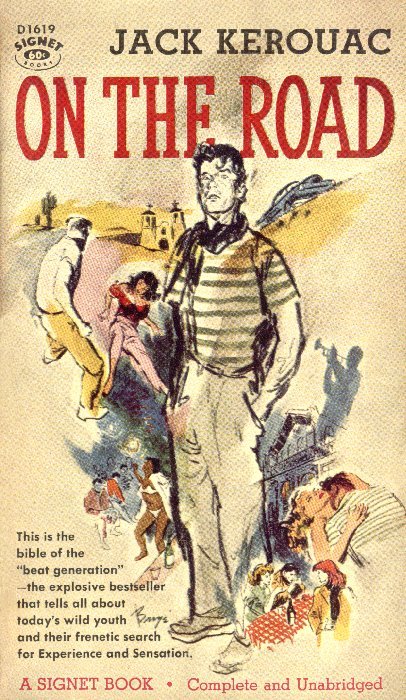
Okay, by now you’ve probably heard about the six year old who guesses what classic novels are about based on their covers, but I can’t resist rehashing her cute take on this early On the Road cover:


 “I think it’s about a car. A car that goes to Mexico, Indonesia and other places. It’s about a car that goes on all sorts of adventures. The guy on the cover is a teen, he likes to drive people places a lot. And he’s French.”

The cover she was looking at was the Signet 1958 edition.  I love that she guesses that the book is an adventure in many places and correctly guesses Mexico is one of them.

The fact that she guesses the main character is French is so perfect.  Of course, her guess is based on the drawing of a man in a Parisian-inspired striped shirt and scarf, which probably anyone would guess means the character is French.

Kerouac indeed was the son of French Canadian immigrants, but the kicker is that he’s usually thought of as either being very American or being anti-American.  In the 1960s, beatniks were depicted as wearing black turtlenecks and berets. In reality, Kerouac didn’t wear a costume of striped shirts or black turtlenecks.  If you look at most pictures of him, his clothes are nondescript.  He wore a lot of t-shirts and flannel and overcoats.

That’s why it’s so fascinating to look at the 1958 edition from a historical perspective on the evolution of Kerouac’s image.  As they’d do with any author, the publishing house tried to brand Kerouac.  In 1958, the striped shirt and scarf flung over his shoulder imparted a worldly, European air, meant to invoke a bohemian vibe.


The only other edition published before that was the Viking 1957 edition.  Of course, if you know about book publishing, you already know that Signet and Viking are both imprints of Penguin.  The difference between these two covers, though, is starting.  The cover of the first edition of On the Road, the Viking 1957 edition, was all black with a small rectangular abstract image in the center.  Bouncing text announced the title.  There was no image of a person or a car at all.  And yet the book sold so well that by the next year when the Signet edition came out, the cartoony line drawing cover featured the ringing endorsement “This is the bible of the ‘beat generation.’”

It should be noted that this Singet cover not only featured the Frenchman, but in the background there was a woman in a bikini and a couple making out.  Again, the publisher was trying to brand On the Road in a very specific way.  The third incarnation of the cover design for the US edition of On the Road came in 1965 when the extraneous people were deleted from the design and just the Frenchman was left standing on his lonesome, without even a car.  It lacked sex appeal, but someone must’ve liked it because two years later all the publisher did was switch from a cream colored background to a white background.  The following year, 1968, saw a cover design of a cartoony couple embracing in a car.  It marked a return to the sex theme.


Since then, the book has undergone many significant cover design changes, but what’s so interesting is that from the 1970s to the ‘90s the covers did not feature people at all.  They returned to the more metaphorical design of the first edition, featuring variations of the sun or a car.  It’s also worth noting that this was the time period in which Jack Kerouac fell out of popularity.

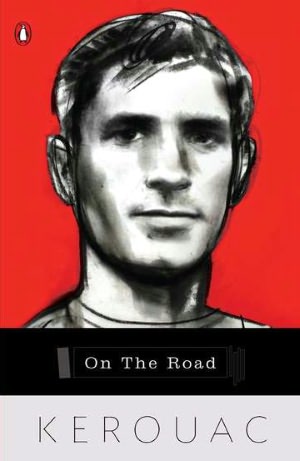
It wasn’t until Penguin released the 1991 paperback that the cover design included a people again.  And this is where it gets really interesting.  The romance angle is completely dropped and has not been seen in any US cover since the Signet 1968 edition.  Now, the focus becomes about friendship—a bromance, if you will—and cool hipsters hanging out in gritty New York.  The cover of the 1991 edition is a photograph of Jack Kerouac and Neal Cassady, the real life inspiration for the main characters of the novel.  The Penguin 1994 edition a collage of photos of Kerouac and his friends.  The US doesn’t see another woman on the cover until the Penguin 2011 amplified edition, which again embraces the photographic collage style.


Other covers published between the ‘70s and today tended to be text only, feature landscape (with or without a car), or a picture of the lone traveler.  They tend to be spectacularly uninspired and ugly.

In Germany and France, where the film version of On the Road has already been released in theatres, there are new editions with covers boasting the poster image for the film.  Will we be seeing a US edition with the actors’ faces instead of Kerouac’s on the cover?

Which cover inspires you to read On the Road?

Road Trip Writing: On the Road and “Human Snowball”

26 Jul

Many summers ago, a couple of poets and I dragged some rickety chairs outside of the Bowery Poetry Club and sat in a circle, chatting about our writing, our day jobs, and life, as people passed by, sometimes stopping to talk to us. One of the girls in the group worked at a publishing house, like I did, and she offered to send us some of the books everyone in her office was buzzing about. About a week later, the package arrived, and I excitedly opened it. It’s been too many years to recall all that was in it, but I do remember it contained a book by Philipppa Gregory, which I in turn gave to another coworker because I have little patience for historical novels about the Tudor period—although I later saw her The Other Boleyn Girl on an airplane and enjoyed it—and Found.

Found started as a magazine that showcased notes, lists, drawings, and other miscellanea that readers found and sent in to the editors. In April 2004, they compiled the best of the best from the magazine and published the book Found: The Best Lost, Tossed, and Forgotten Items from Around the World. Having the book upped my coolness factor among the skinny hipster set I was hanging with at the time, and I began dating one of the guys. When Found’s founder, Davy Rothbart, published a short story collection called The Lone Surfer of Montana, Kansas, in 2005, I gave it to the guy I was dating.

I never read the book myself, but recently I read one of Rothbart’s short stories in the summer 2012 issue of The Paris Review, and it made me wonder if Rothbart might be my generation’s Jack Kerouac. While Rothbart lacks Kerouac’s poetry, they share an ear for dialogue, a captivating retelling of riding in buses and cars, an obsession with music, and an awkwardness with girls. In the short nonfiction story “Human Snowball,” Rothbart takes a Greyhound from Detroit to Buffalo to see a girl who isn’t quite his girlfriend yet or maybe ever and ends up in a carful of eccentric characters, including an ancient black man and a Neal Cassady-esque car thief. It may not have the sensory details that On the Road has, but “Human Snowball” captures characters with such honest and real details and dialogue that you feel like you know them. They’re beat characters. A little rough-around-the-edges, but sensitive and full of life.

In a bit of a Kerouac connection, actor Steve Buscemi, who stars in the film adaptation of On the Road, optioned the rights for Rothbart’s The Lone Surfer of Montana, Kansas. Rothbart himself is a chronic roadtripper. He’s traveled the country and toured with the punk rock band Rise Against, creating the documentary How We Survive for the dvd Generation Lost as well as the documetnary Another Station: Another Mile.

should i read on the road

13 Jul

Someone found my blog by typing in

“should i read on the road”

I hope they found the correct answer.

From the Lost Generation to the Beat Generation: Hollywood’s Obsession

12 Jul


With Hemingway and Gellhorn currently on HBO and a remake of The Great Gatsby heading to theatres this Christmas, The Observer’s Daniel D’Addario ponders if we’re experiencing a “Lost Generation Boom.”

The Lost Generation refers to the writers during the World War I era, many of whom became expatriates.  The Lost Generation writers include F. Scott Fitzgerald, T. S. Eliot, Gertrude Stein, Ernest Hemingway, and John Dos Passos, among others.  Hemingway popularized the term in A Moveable Feast, in which he quoted Stein as telling him a story about a man who said, “That’s what you all are … all of you young people who served in the war. You are a lost generation.”

D’Addario also references last summer’s Midnight in Paris, but in some regard, we’ve been experiencing the “boom” for quite some time now … at least in the cocktail scene.  A few years ago, speakeasy-type bars became all the rage here in New York.  Dimly lit lounges served up spiked punches in tea cups.  There are also Jazz Age parties on Governor’s Island, where everyone gets all dolled up in fantastic flapper dresses and Sacque suits.  And the Oak Room—which in the ‘20s was Algonquin’s Pergola Room—just reopened.

However, Hollywood isn’t only obsessed with the Lost Generation.  The Beat Generation, which wasn’t popular for a long time, is beginning to see a revival.  On the Road, based on Beat writer Jack Kerouac’s novel, just premiered at Cannes Film Festival in May and will be released Stateside sometime later this year.  Next year, Kill Your Darlings, about a murder involving Kerouac, William S. Burroughs, and others associated with the Beat Generation, will be released.  In 2010, Howl, based on Allen Ginsberg’s poem and the trial that followed its publication, came out.  These aren’t small movies by any means.  Howl starred it-boy James Franco, Kill Your Darlings will star Daniel Radcliffe, and much has been made of On the Road starring Kristen Stewart.

Perhaps we’re trying to figure out our own generation by looking at those in the past.

Road Trip: Club Ed

6 Jul

Throw your rucksack into the trunk of your beat-up ’49 Hudson.  Rev the engine.  Peel out of LA.  An hour into the California desert, and you’ve rolled into Lancaster.  You’ve traveled back in time and hit Club Ed.

One-time film set for Eye of the Storm, Club Ed embodies the nostalgia of On the Road, though IMDB does not report Lancaster as one of the locations the Hollywood version of Jack Kerouac’s novel was filmed.

Club Ed is pure roadside bliss for the wanderlust traveler who wishes to step back into an era, where pie was still made on the premises of greasyspoons and served up by surly waitresses, who kept your mug full of stale coffee.  The menu is written in paint on the window.  You look out and all you see for miles on end is the scorched shrubs dotting the valley.  Mountains loom in the distance.  There’s an old gas station, where you should fill your tank.  You may not see another one soon.

On the Road will inevitably inspire people to hit the road.  Route 66 isn’t what it used to be, though.  Drive through Missouri or Texas, and you’ll likely seen the same chain stores from the highway that you’d seen in Arizona and California.  Club Ed isn’t the real deal, and yet it looks more authentic than a Denny’s.

Eloping on the Road

5 Jul

I have so many friends right now who either just got married or are in the process of planning their weddings. There’s so much to consider: venues, wedding cake ganache, narrowing down the guest list, who sits next to whom, DIYing centerpieces, the dress.

Eloping sounds better and better….  And what better way than eloping on the road?!

Green Wedding Shoes featured a couple who got married on the road. Their wedding photos feature retro suitcases, maps, and the classic hand-out-the-window shot.

Did you know that when Jack Kerouac, the author of On the Road, got married he was quite the opposite of being on the road? He’d been arrested as a material witness of a murder. His dad was so upset he refused to post bail. But his girlfriend, Edie Parker, came from a wealthy family. She said she’d post bail—on one condition: that Kerouac agreed to marry her. You can read the whole story in Burning Furiously Beautiful.

Hipsters Hate Driving

3 Jul

I knew I was getting old the day I saw a car commercial where the driver was clearly younger than I am.

So here’s an interesting bit of news: Generation Y doesn’t like to drive. According to Reuter’s “America’s Generation Y not driven to drive,” the Millennials think driving is more of a hassle than it’s worth.  A California think tank analyst, Tony Dudzik says instead of a driver’s license, a cell phone is the new rite of passage for young adults.

The article points to a few different reasons why Generation Y may be less interested in driving:

  • Smart phones make it easier to know public transportation schedules
  • More Gen-Yers are riding bikes
  • People are more concerned about saving the planet
  • Car-sharing services are making it easier not to have to own a car

From a cultural perspective, this makes total sense.  Gen Y is the hipster culture.  The kids in Williamsburg who listen to low-fi indie music on their hi-tech iphone, knit water-bottle cozies that they sell on etsy, ride their bicycles to work, buy their clothes from Buffalo Exchange, spend their weekends at the food coop, brew their own craft beer, and vlog on YouTube. If they drive, they drive hybrids. Because they’re all about the i-this and the i-that, they seek out community more intentionally. Who needs a car, if your friend or parents (they also happen to be the Peter Pan Generation, living at home after college) have one?

I personally fall somewhere between Gen X and Gen Y, making me part of Generation Flux.  Generation X refers to people born between the early 1960s and 1980s, while Generation Y refers those born between the late 1970s and the 2000s.  I know when I was growing up, there were a lot of cultural arts programs in the school about saving the rainforest and saving the whales, we studied acid rain and the ozone layer, and we joined KAP: Kids Against Pollution.  In drivers ed, they pretty much terrified you with statistics, photos, and videos that suggested it was likely you were going to die if you got behind the wheel. The shows that were popular when I was a teen were Mad About You, Seinfeld, Friends, Will & Grace, and Sex and the City, all of which were set in New York City.  Other popular shows like Ally McBeal, Frasier, and ER were also set in cities. Our stars didn’t drive.  They took cabs and rode the subway. Is it any surprise that we moved into the city and followed suit?

So will a generation who grew up watching Paris Hilton, Lindsey Lohan, and Snooki getting arrested for driving under the influence and/or crashing their cars, a generation coming of age during the Great Recession, a generation who doesn’t care about driving, embrace the 1950s road trip adventure of On the Road when the movie comes out and the novel by Jack Kerouac it is based on?  Well, here’s another interesting twist: Jack Kerouac didn’t like driving either. If you read his novel, you’ll see that most of the time, the character based on him in the novel is on the bus or in the passenger seat.

How do you feel like the era you grew up in influenced you?

Now you can “like” Burning Furiously Beautiful on Facebook!